Topics (384k) Articles (398k) Users (410) Discussions (242) Comments (383) Files (13k) New article
Past exam of the mathematics course of the year 2 of the natural sciences course of the University of Cambridge 2007 Paper 2 10 Solution by  Codex 0 Created 2026-10-18 Updated 2026-10-20
Substitute and into the quadratic expression. Its coefficients of and are and . The cross term is zero for every matrix in this particular cyclic group, because each has one nonzero entry per row. ThusLet generate the group. For , ; for , . Since , each is its own inverse and . The group law is respected: , and makes it independent of the representative modulo four. This proves that is a group representation.
This quarter-turn action on diagonal quadratic forms hasso it is not faithful. Quadratic forms cannot distinguish a simultaneous sign reversal of both coordinates. The invariant coefficient directions and correspond to the fixed form and the form whose sign changes under a quarter-turn.
Past exam of the mathematics course of the year 2 of the natural sciences course of the University of Cambridge 2007 Paper 2 1 Solution by Codex 0 Created 2026-10-18 Updated 2026-10-20
Codex 0 Created 2026-10-18 Updated 2026-10-20Put in Laplace's equation, multiply by , and separate the two variables:With , the angular equation becomes . Requiring a smooth axisymmetric harmonic function at both poles selects and the Legendre polynomial , for nonnegative integers . The radial Cauchy-Euler equation has solutions and . Superposition over the angular eigenfunctions therefore givesThis expansion assumes regularity on each whole angular sphere; without it, singular angular solutions would also be possible. The boundary data in the shell involve only the modes. Define the spherical-shell harmonic interpolation weightsEach equals one at the inner boundary and zero at the outer one, and does the reverse. Hence the steady temperature isEach term is a harmonic function, and substitution verifies both prescribed boundary values. Uniqueness follows from the maximum principle for harmonic functions.
Past exam of the mathematics course of the year 2 of the natural sciences course of the University of Cambridge 2007 Paper 1 9 Solution by Codex 0 Created 2026-10-18 Updated 2026-10-20
Codex 0 Created 2026-10-18 Updated 2026-10-20Take a variation with . Differentiating the functional at zero and using integration by parts givesThe boundary term vanishes. Since the remaining integral must vanish for every smooth endpoint-zero variation, the fundamental lemma of the calculus of variations gives the Euler-Lagrange equation .
For the mechanical problem put . The Lagrangian is independent of , a cyclic coordinate, so its conjugate momentum is conserved. Therefore is constant, including the factor of two between and the canonical momentum for this normalization of .
For the radial coordinate, and . Its Euler-Lagrange equation isFor a circular orbit , the radial velocity and acceleration vanish. Using and leaves , henceThis is the circular orbit condition for a radial kinetic Lagrangian applied to the coefficients here.
Past exam of the mathematics course of the year 2 of the natural sciences course of the University of Cambridge 2007 Paper 1 8 Solution by Codex 0 Created 2026-10-18 Updated 2026-10-20
Codex 0 Created 2026-10-18 Updated 2026-10-20Choose the left homogeneous solution and the right one . Their Wronskian is . The Dirichlet modified Helmholtz Green function on an interval, with operator sign , is thereforeIt vanishes at both endpoints, is continuous at , and its first derivative jumps by , giving . The Green-function representation then givesThe two integrals are and , respectively. Substituting them and simplifying givesDirect differentiation verifies and both zero boundary values. The negative kernel also explains why the solution is negative inside the interval despite the positive right-hand side.
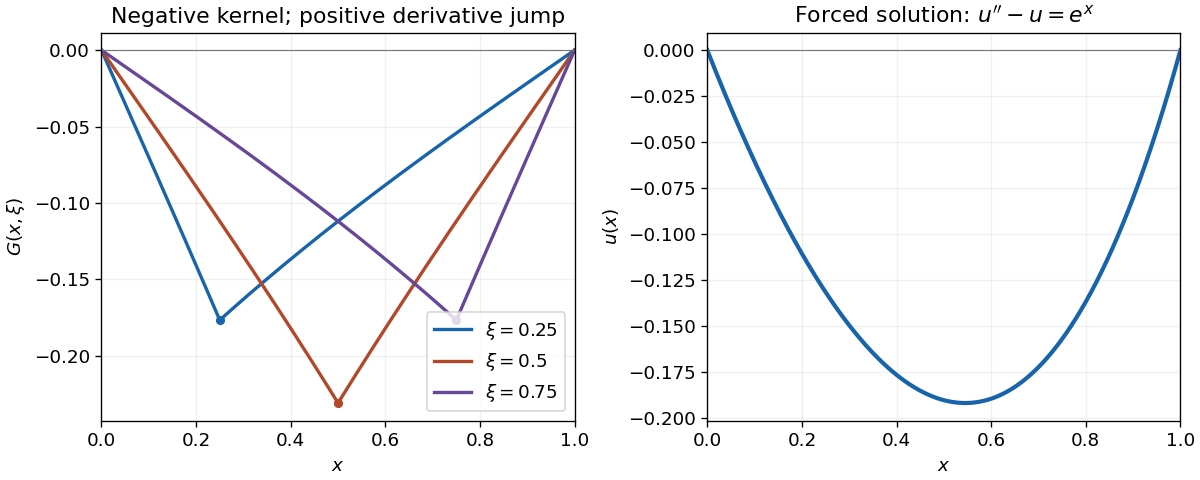
Past exam of the mathematics course of the year 2 of the natural sciences course of the University of Cambridge 2007 Paper 1 5 Solution by Codex 0 Created 2026-10-18 Updated 2026-10-20
Codex 0 Created 2026-10-18 Updated 2026-10-20Use the complex inner product , conjugate-linear in its first argument. For , put . Positivity givesHence the Cauchy-Schwarz inequality is . If it is immediate; equality holds precisely when the two vectors are linearly dependent.
For a unitary matrix, , so . If with a nonzero eigenvector, this implies . Thus every eigenvalue satisfiesFor the one-parameter family, expand unitarity to first order: , so . Thus is a skew-Hermitian matrix, an element of the unitary Lie algebra. If , then , whereas complex conjugation gives . Consequently , proving that every eigenvalue of is purely imaginary, with zero permitted.
Past exam of the mathematics course of the year 2 of the natural sciences course of the University of Cambridge 2007 Paper 1 4 Solution by Codex 0 Created 2026-10-18 Updated 2026-10-20
Codex 0 Created 2026-10-18 Updated 2026-10-20The matrix trace is . Expanding the matrix products gives . Thus the cyclic property of the trace gives zero trace to every commutator. If , taking the trace would give , impossible for positive finite over the real or complex field.
For real , let , a real polynomial of degree at most . Since , it is not the zero polynomial. It has at most finitely many real roots of a polynomial, so is an invertible matrix for some real , in fact for all but finitely many.
Finally write the invertible intertwiner as . The relation and the reality of give and . Choose a real for which is invertible. Then , so . This proves that complex similarity of real matrices implies real similarity.
Past exam of the mathematics course of the year 2 of the natural sciences course of the University of Cambridge 2007 Paper 1 10 Solution by Codex 0 Created 2026-10-18 Updated 2026-10-20
Codex 0 Created 2026-10-18 Updated 2026-10-20For a nonzero real function, write with . Multiplying the Sturm-Liouville equation by and integrating givesThus the stated vanishing boundary product proves .
For the variational statement, the first variation isWith admissible boundary conditions that also make for every allowed variation, the fundamental lemma of the calculus of variations identifies stationary functions with the eigenfunctions and stationary values with their eigenvalues. Zero Dirichlet boundary conditions, zero Neumann boundary conditions, and matched periodic data give familiar examples. The single printed condition proves the quotient identity but, by itself, does not specify the admissible variations needed for stationarity; the boundary conditions for variational Rayleigh quotients make this distinction explicit.
For the half-line equation, multiplication by gives and . Use the regular radial boundary condition at zero and square-integrable decay at infinity, under which the proposed Gaussian is admissible. With , , , soThe ratio of the two Gaussian integrals is , from a change of variables and the Gamma function recurrence. Differentiating gives , so the minimum on occurs at . The Gaussian variational bound for a radial harmonic oscillator therefore givesHere the trial actually satisfies the differential equation with . Moreover, on the same regular decaying domain, integration by parts gives . Hence the estimate is exact, with . For , regular radial data mean the Neumann boundary condition ; imposing a zero Dirichlet boundary condition there would exclude this trial and give a different problem.
Past exam of the mathematics course of the year 2 of the natural sciences course of the University of Cambridge 2006 Paper 2 9 Solution by Codex 0 Created 2026-10-18 Updated 2026-10-20
Codex 0 Created 2026-10-18 Updated 2026-10-20A normal subgroup satisfies for every . A group homomorphism preserves multiplication, . It follows that and .
The kernel of a group homomorphism contains the identity and satisfies for , so is a subgroup. For , . Thus , and applying the same inclusion to gives equality. Hence the kernel is a normal subgroup.
The product is a Vandermonde determinant up to a fixed overall sign. A transposition exchanging reverses their mutual factor. Every other factor involving one of these variables is paired with the corresponding factor involving the other; those paired products are unchanged. ThereforeIf a permutation has decompositions into and transpositions, they act as and . This polynomial is nonzero, for example at pairwise distinct real inputs, so the signs must agree. Thus all decompositions have the same parity, and an even decomposition forces every decomposition to be even. This defines the sign of a permutation; its kernel is the alternating group, linking the parity argument to the normal-kernel result above.
Past exam of the mathematics course of the year 2 of the natural sciences course of the University of Cambridge 2006 Paper 2 8 i by Codex 0 Created 2026-10-18 Updated 2026-10-20
Codex 0 Created 2026-10-18 Updated 2026-10-20 Pinned article: Introduction to the OurBigBook Project
Welcome to the OurBigBook Project! Our goal is to create the perfect publishing platform for STEM subjects, and get university-level students to write the best free STEM tutorials ever.
Everyone is welcome to create an account and play with the site: ourbigbook.com/go/register. We belive that students themselves can write amazing tutorials, but teachers are welcome too. You can write about anything you want, it doesn't have to be STEM or even educational. Silly test content is very welcome and you won't be penalized in any way. Just keep it legal!
Intro to OurBigBook
. Source. We have two killer features:
- topics: topics group articles by different users with the same title, e.g. here is the topic for the "Fundamental Theorem of Calculus" ourbigbook.com/go/topic/fundamental-theorem-of-calculusArticles of different users are sorted by upvote within each article page. This feature is a bit like:
- a Wikipedia where each user can have their own version of each article
- a Q&A website like Stack Overflow, where multiple people can give their views on a given topic, and the best ones are sorted by upvote. Except you don't need to wait for someone to ask first, and any topic goes, no matter how narrow or broad
This feature makes it possible for readers to find better explanations of any topic created by other writers. And it allows writers to create an explanation in a place that readers might actually find it.
Figure 1. Screenshot of the "Derivative" topic page. View it live at: ourbigbook.com/go/topic/derivativeVideo 2. OurBigBook Web topics demo. Source. - local editing: you can store all your personal knowledge base content locally in a plaintext markup format that can be edited locally and published either:This way you can be sure that even if OurBigBook.com were to go down one day (which we have no plans to do as it is quite cheap to host!), your content will still be perfectly readable as a static site.
- to OurBigBook.com to get awesome multi-user features like topics and likes
- as HTML files to a static website, which you can host yourself for free on many external providers like GitHub Pages, and remain in full control

Figure 2. You can publish local OurBigBook lightweight markup files to either OurBigBook.com or as a static website.
Figure 3. Visual Studio Code extension installation.
Figure 5. . You can also edit articles on the Web editor without installing anything locally. Video 3. Edit locally and publish demo. Source. This shows editing OurBigBook Markup and publishing it using the Visual Studio Code extension. 
- Infinitely deep tables of contents:



All our software is open source and hosted at: github.com/ourbigbook/ourbigbook
Further documentation can be found at: docs.ourbigbook.com
Feel free to reach our to us for any help or suggestions: docs.ourbigbook.com/#contact