Topics (384k) Articles (398k) Users (410) Discussions (242) Comments (383) Files (13k) New article
An antilepton is the antiparticle of a lepton, with opposite additive quantum numbers. A Positron is the charged antilepton corresponding to an electron.
The angular frequency of free Larmor precession in a uniform magnetic field of magnitude , with gyromagnetic ratio . Interactions can shift a collective resonance away from this free-spin scale.
In the upper half-plane outside a circle of radius centered at , with , set . The displayed harmonic function is zero on the real axis and equals on the circle. Indeed, the Apollonius circle with ratio has center and radius ; hence . The logarithmic singularity at is inside the excluded circle, and the one at is below the real axis. The real part of a local holomorphic logarithm is harmonic even if its imaginary part is multivalued. The potential tends to zero at infinity. Finite boundary values alone do not impose a growth condition at infinity; uniqueness in the unbounded domain needs such an additional condition, for example boundedness with the prescribed limit.
For , this Poisson kernel for the unit disk has the uniformly convergent Fourier seriesThe identity follows by taking the real part of the geometric series . For integrable -periodic boundary data , its Poisson extension iswhere are the usual Fourier coefficients. Each term is a harmonic function in the open disk. For continuous boundary data, the extension solves the Dirichlet problem with those boundary values.
For a particle of mass with linear drag , the velocity relaxation time is the exponential relaxation time . Under a constant applied force and zero-mean random forcing, the averaged Langevin equation is . Solving givesThus the initial mean-velocity deviation decays by a factor after time . Since the force-per-velocity coefficient has units , has units of time. If the damping parameter is instead defined as a rate , the same time is . For a sphere obeying Stokes's law, . The fluctuation-dissipation relation for a Langevin particle gives the same decay time for its equilibrium velocity covariance.
For a three-dimensional isotropic unpolarized spin-one-half Fermi liquid, define and . Dimensionless Landau parameters use the spin-summed density of states per volume: is a Legendre polynomial; label spin symmetry. No extra multiplies this expansion.[ref]
Renormalization Group Approach to Interacting Fermions by Ramamurti Shankar. Section VIII, angular interaction function; normalization stated explicitly here
The superscript on is unrelated to the dimensionless wave speed below.A diffuse-interface free energy balances the bulk preference for coexisting compositions against a positive penalty for sharp composition gradients. For dimensionless composition , is a bulk energy density and has units of energy per length. Subtract the bulk coexistence common tangent to define , with equal zero minima at the two compositions. A planar equilibrium profile obeys and . Its surface tension is . As a thermodynamic critical point is approached, the composition contrast and bulk curvature vanish, the correlation length grows, and the intrinsic interface broadens. A scalar quartic domain wall gives the mean-field hyperbolic-tangent profile. Thermally excited capillary waves can broaden a measured profile further.
A roton is an excitation near a local minimum of a superfluid's dispersion relation at nonzero momentum . The displayed local approximation defines a positive energy gap and positive curvature effective mass ; it is not a free helium atom or a macroscopic quantum vortex.[ref]
On the Theory of Superfluidity of Helium II by Lev Davidovich Landau. Landau, On the Theory of Superfluidity of Helium II (1947), p.91, Fig.1
In the stipulated plot, these correspond to , and . The plot illustrates how a low energy at appreciable momentum can lower the Landau criterion below the speed of sound, without assigning any measured parameter to real helium.For with , put and . The Floquet discriminant of the delta-comb Kronig-Penney model is . Extended Bloch states require . Since , there is a positive lower band edge; a repulsive potential does not support negative-energy states in this energy convention.
The th positive-energy band ends at . Its lower edge lies in and solves . A finite periodic ring selects only the discrete allowed values of crystal momentum within these bands. Nonzero band gaps do not by themselves imply an insulator: the band filling must also place the Fermi energy in a gap.
Real bounded Fourier modes of the Klein-Gordon equation by  Codex 0 Created 2026-10-18 Updated 2026-10-20
With inverse-time convention , the half-line Klein-Gordon equation has spatial normal modes , where above threshold and below it. For the branch even in , reality above threshold requires . Below threshold boundedness eliminates , and reality requires . At threshold the spatial differential equation instead has the basis ; boundedness retains only the constant mode. A spectral integral with ordinary integrable functions as amplitudes ignores the isolated threshold points, while distribution amplitudes can represent the surviving monochromatic constant-spatial modes.
Let the Klein four-group have generators and , with and . For every real , the matricesdefine a group representation. Indeed, , and commutes with every matrix, so the group relations hold.
Set . A direct change of basis givesConsequently all these representations are isomorphic representations, with character values on . Each is a direct sum of the two one-dimensional representations whose values on are and whose values on are and . A group representation need not be orthogonal; nonzero changes the basis rather than the represented group.
Group generated by sign reversal and reciprocation by Codex 0 Created 2026-10-18 Updated 2026-11-05
Codex 0 Created 2026-10-18 Updated 2026-11-05On the nonzero real numbers, sign reversal and reciprocation are commuting involutions. Their function composition generates exactly , , and . The relations and identify the group with , the Klein four-group. Its subgroups are the trivial group, its three order-two cyclic subgroups and itself. Excluding zero from the domain is necessary for all four transformations to be defined and invertible.
A flat circular contact of radius carrying total normal force has uniform pressure . In steady relative rotation, a ring of radius and thickness experiences tangential kinetic friction . Its resisting torque is . Integration from zero to gives . A different pressure distribution changes the result; for an axisymmetric distribution use .
A cylindrical plug of radius , length and density is pushed outward by gauge pressure . If its remaining contact length is and its constant radial contact pressure is , the resisting kinetic friction is . At the marginal initial condition , the net outward force becomes . With mass ,Thus the exit speed at tends to as . Exactly leaves the marginal configuration stationary, and the exit time diverges in that limit. An attached extra mass changes the acceleration but not the pressure-minus-friction work, if the contact geometry is unchanged.
Water Cherenkov neutrino reconstruction infers a vertex, time and charged particle direction from photomultiplier pulses. The 1987 analysis recorded charge and timing, calibrated with decaying muons and source-produced gamma rays, and rejected outer-detector activity and events following muons.[ref]
Observation of a Neutrino Burst from the Supernova SN1987A by K. Hirata and others. pp. 1490–1491; Fig. 1 and event-selection criteria
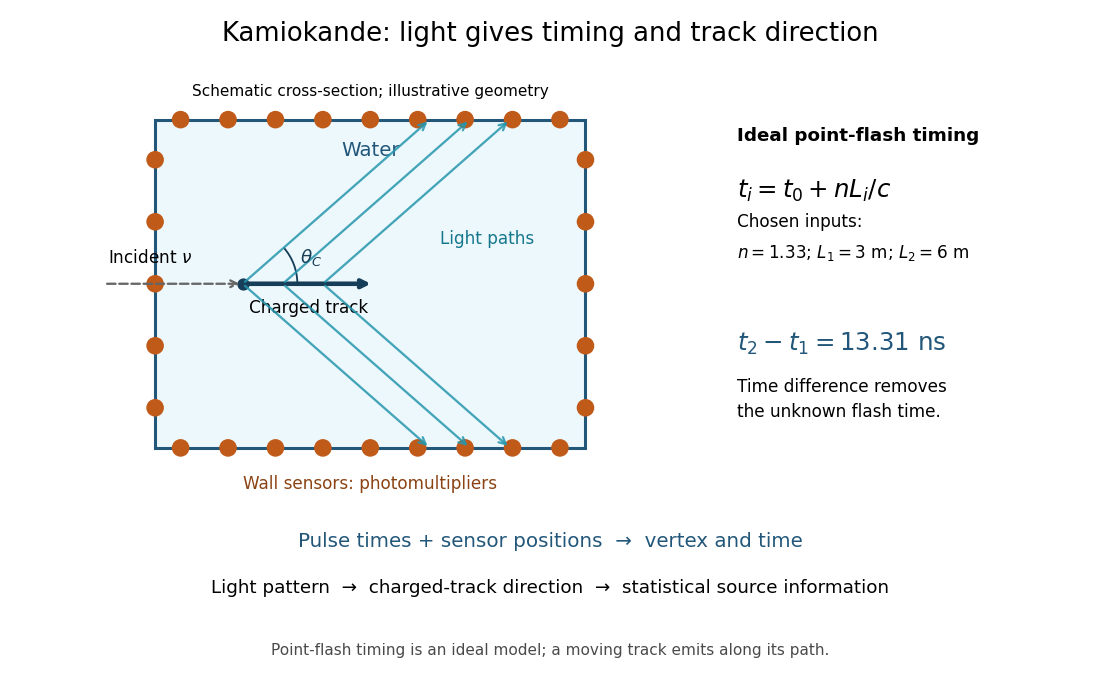
In an ideal point-flash approximation, a light source at and time gives the displayed travel-time relation at sensor in a medium of refractive index . Subtracting two times eliminates . With a chosen constant and path lengths and , the arrival-time difference is . These are synthetic inputs, not detector measurements. Several sensors constrain the vertex; an extended moving track requires the light-emission position and time along that track as well.
For a charged particle moving at , the Cherenkov cone angle satisfies when . With and the illustrative , . The geometrical cone carries track-direction information; electron deflections and the spread of emission positions broaden the observed pattern. The neutrino itself does not draw the light cone.
A Cherenkov radiation threshold and an analysis threshold are different constraints. For a fixed , an electron must exceed . With and the chosen , this gives about . Recording and selecting a useful event requires much more light: the 1987 detector's trigger accepted electrons with 50% efficiency.[ref]
Observation of a Neutrino Burst from the Supernova SN1987A by K. Hirata and others. p. 1491: trigger acceptance
For , with independent of , an affine parameter makes and the tangent norm constant. The four-dimensional interval satisfiesConsequently the formula assumes the additional normalization ; affine parametrization alone does not set this value. With base metric signature and , the projected curve is timelike only for . The normalized case gives . The positive fibre term and the base together have two positive directions; the same sign convention must be retained when interpreting the reduction.
Take with constant. The Euler-Lagrange equation for isThus, with ,Reversing the explicit derivative order while retaining this metric and the same definition of changes the equation rather than merely changing a field-tensor naming convention. More generally, a fibre term , , gives ; its conserved canonical fibre momentum is .
In the normalized positive-fibre case with , four-dimensional proper time gives . This has the Lorentz force form. The scale relating the geometrical to a physical electromagnetic four-potential fixes the conversion to an SI charge-to-mass ratio.
A mass unit based on Jupiter, conventionally written ; numerical calculations must state the adopted value or gravitational parameter.
Pinned article: Introduction to the OurBigBook Project
Welcome to the OurBigBook Project! Our goal is to create the perfect publishing platform for STEM subjects, and get university-level students to write the best free STEM tutorials ever.
Everyone is welcome to create an account and play with the site: ourbigbook.com/go/register. We belive that students themselves can write amazing tutorials, but teachers are welcome too. You can write about anything you want, it doesn't have to be STEM or even educational. Silly test content is very welcome and you won't be penalized in any way. Just keep it legal!
Intro to OurBigBook
. Source. We have two killer features:
- topics: topics group articles by different users with the same title, e.g. here is the topic for the "Fundamental Theorem of Calculus" ourbigbook.com/go/topic/fundamental-theorem-of-calculusArticles of different users are sorted by upvote within each article page. This feature is a bit like:
- a Wikipedia where each user can have their own version of each article
- a Q&A website like Stack Overflow, where multiple people can give their views on a given topic, and the best ones are sorted by upvote. Except you don't need to wait for someone to ask first, and any topic goes, no matter how narrow or broad
This feature makes it possible for readers to find better explanations of any topic created by other writers. And it allows writers to create an explanation in a place that readers might actually find it.
Figure 1. Screenshot of the "Derivative" topic page. View it live at: ourbigbook.com/go/topic/derivativeVideo 2. OurBigBook Web topics demo. Source. - local editing: you can store all your personal knowledge base content locally in a plaintext markup format that can be edited locally and published either:This way you can be sure that even if OurBigBook.com were to go down one day (which we have no plans to do as it is quite cheap to host!), your content will still be perfectly readable as a static site.
- to OurBigBook.com to get awesome multi-user features like topics and likes
- as HTML files to a static website, which you can host yourself for free on many external providers like GitHub Pages, and remain in full control

Figure 2. You can publish local OurBigBook lightweight markup files to either OurBigBook.com or as a static website.
Figure 3. Visual Studio Code extension installation.
Figure 5. . You can also edit articles on the Web editor without installing anything locally. Video 3. Edit locally and publish demo. Source. This shows editing OurBigBook Markup and publishing it using the Visual Studio Code extension. 
- Infinitely deep tables of contents:



All our software is open source and hosted at: github.com/ourbigbook/ourbigbook
Further documentation can be found at: docs.ourbigbook.com
Feel free to reach our to us for any help or suggestions: docs.ourbigbook.com/#contact