Topics (384k) Articles (398k) Users (410) Discussions (242) Comments (383) Files (13k) New article
The displayed implicit ordinary differential equation has a singular initial point at the origin. On a nonconstant regular branch, treating as a function of gives . The integrating factor yields the first integral of an ordinary differential equationOne can verify this identity without dividing by : its derivative along a solution is .
The initial point forces , so . Near the origin this gives the two differentiable solutions and , with initial slopes zero and one. A division by would lose the first solution. A piecewise switch between the two at zero would fail differentiability because their one-sided slopes differ.
There is no conflict with the Picard-Lindelöf theorem: solving explicitly for requires division by , which vanishes at the initial point. A regular implicit equation or a local uniqueness theorem must be checked before claiming a unique solution through a singular point.
Linearize the Euler equation in a uniformly rotating frame about rest and impose incompressible flow, . Taking the curl eliminates the reduced pressure. For constant , , giving the displayed vorticity equation. Taking another curl and time derivative yields . These equations describe the restoring influence of background rotation on small disturbances without buoyancy or viscosity.
Insert a transverse plane wave into the inertial-wave vorticity equation, with . It gives . Applying again and using transversality gives the title dispersion relation. If is the angle to the rotation axis, . At fixed direction the angular frequency does not depend on wavelength. Parallel wavevectors give the maximum ; perpendicular ones have zero frequency and belong to the nonoscillating balanced limit.
For a uniform planar lamina with and , put , . The Jacobian determinant is one, the mass is , and symmetry puts the centre of mass at zero. Uniform rectangular moments give , , . Substitution into yields the displayed inertia tensor. The in-plane principal moments of inertia are ; the perpendicular moment is their sum. This separates the geometric shear from the elementary rectangular integrals.
Positive second-moment matrix test for an inertia tensor by  Codex 0 Created 2026-10-18 Updated 2026-10-20
For a nonnegative mass distribution relative to an origin, the second-moment matrix is and the inertia tensor is . Taking the trace gives the displayed inverse formula, which must be positive semidefinite. Conversely, any such can be realized by pairs of point masses along its orthogonal principal directions. Thus this is also a realizability test when total mass and dimensions are unrestricted. In principal coordinates it is equivalent to the moment-of-inertia triangle inequalities: , with cyclic counterparts. A symmetric positive definite matrix alone need not be a physical inertia tensor.
For constant scalar response and a body small compared with the applied field's spatial variation scale, the gradient of the induced magnetic dipole energy gives . Along an axis this is . For an ellipsoidal body, put to obtain . Positive effective magnetic susceptibility attracts the body towards stronger field; a negative response repels it. Reversing the source current leaves the force unchanged because both the induced moment and the field gradient reverse. Shape and orientation enter through the demagnetizing factor, not merely through volume.
A grounded hemispherical boss of radius on the grounded plane in an otherwise uniform downward electric field has the displayed exterior electric potential, with . It vanishes both on the hemisphere and on the surrounding plane, and tends to at large distance. The outward normal field gives surface charge on the hemisphere and on the plane at cylindrical radius . The apex field is , so a field-limited breakdown voltage is reduced by a factor three. For a capacitor with finite spacing , this is a leading local approximation; it is not an exact solution on the distant second plate.
For a uniform on-axis plane wave reference, choose its constant wave phase to be zero, so . The reconstructed cross terms are then proportional to and its complex conjugate . This pair creates the twin image in holography. An outgoing curved wavefront and its conjugate have opposite curvature: under forward propagation, one can appear to diverge from a virtual image while the other converges to a real image. In in-line holography their depths differ, but a defocused member still overlaps the other. This is the same conjugation of spatial wave phase used in phase conjugation, although a transmission hologram here launches both components forward rather than automatically creating a returning phase-conjugate mirror.
A lossless intermediate section of positive real characteristic impedance matches unequal real exterior characteristic impedances when and its propagation wave phase is an odd multiple of . The length is an odd quarter of the internal wavelength. This principle also applies to the characteristic impedance of a stretched string.
For a uniform intermediate string of length , put . Continuity of displacement and transverse force gives the displacement reflection coefficientAt real positive mechanical impedances, the denominator never vanishes. Its numerator vanishes only if and . Thus unequal exterior strings require the quarter-wave condition. Equal exterior strings with a different middle string instead transmit perfectly at integer half-wavelengths; if all three mechanical impedances agree, every frequency is matched.
A Thévenin equivalent voltage source with positive source resistance supplies load power to a real resistive load. Differentiating gives its maximum at . With reactive impedances and fixed source impedance, conjugate matching maximizes the average delivered power. Maximum delivered power is distinct from maximum efficiency; at a real resistive match half of the source's internally generated power is dissipated in .
An identity element for addition: . In a vector space, it is the zero vector; among matrices of fixed dimensions, it is the zero matrix.
For , let and place the foci of a conic at . On the right branch write , . Direct expansion givesSince , both square roots are positive and . On the reflected left branch the signed difference reverses, while its absolute value stays . This proves the constant-difference characterization of a hyperbola and keeps track of which branch a hyperbolic function parametrization covers.
For an ideal gas with constant composition, set , where is the mean particle mass. Constant downward gravitational acceleration and give by hydrostatic equilibrium. Integration gives , and the ideal gas law gives the displayed mass density ratio. The isothermal limit is .
Hold fixed and move only the sixth observation . For , the sample mean is , the sample median is , and the Huber location estimator with fixed stays at . Once , its Huber score is already ; moving it farther changes the Huber loss but leaves the root unchanged.
For a closer view of the transition, the exact Huber location estimator over isTo verify the first branch, when the score of is saturated and the other five scores sum with it to . When , the score of is saturated instead, giving the same expression. At , the moving observation saturates too, and the equation becomes . The piecewise formula is continuous at the transition.
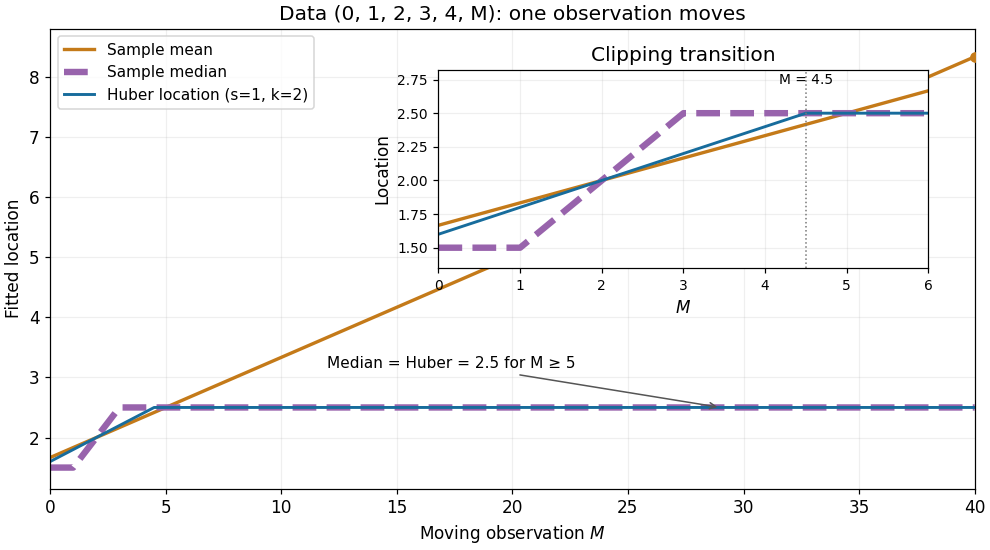
The rising sample mean comes from an unbounded linear score, the flat distant-outlier response from a bounded Huber score. This is a finite-data response curve with a specified scale and threshold, rather than a population influence function or a general claim about arbitrary numbers of outliers.
An ideal spring with stiffness and zero natural length has extension equal to the distance between its endpoints. Its elastic potential energy is exactly , and its force on endpoint 2 is . Thus its Cartesian stiffness is isotropic and constant. Coupled systems of such springs have exactly linear displacement equations after a constant force, such as gravity, is absorbed into the equilibrium position. This special model differs from an ordinary finite-natural-length spring, whose transverse small-motion stiffness depends on its tension and equilibrium length.
Slope parameter for a homogeneous first-order equation by Codex 0 Created 2026-10-18 Updated 2026-10-20
Codex 0 Created 2026-10-18 Updated 2026-10-20An implicit homogeneous first-order differential equation , where , can be reduced by treating the slope as an auxiliary variable. Differentiating givesWhere the divisions are valid, this is a separable differential equation. Constant slopes lost when dividing by must be checked in the original equation.
For , the reduced equation is and its nonconstant solutions obey . Substitution recovers the parabolas , together with the constant solution . Real graph branches must have , and the original restrictions , still apply. The constant slopes solve the reduced equation but are excluded from the original equation.
Otto Hölder's 1889 paper begins with a weighted-mean inequality for a function with increasing derivative. In current terminology, its opening statement is a weighted form of Jensen's inequality: applying a convex function after taking a weighted mean gives a lower bound for the weighted mean of its values. This connects product estimates to the geometry of convex functions, rather than treating them as isolated formulas.[ref]
Ueber einen Mittelwerthssatz by Otto Hölder. Otto Hölder, Ueber einen Mittelwerthssatz (1889), §§1–2, printed pp. 38–39: weighted means and increasing derivative
On a probability space, the same inequality readsIf the displayed moments are finite, the product is an integrable random variable. The random variables can be dependent: the estimate controls their possible overlap without assuming a factorization of the expected value. This is useful when a calculation needs the product to be integrable but the joint probability distribution is complicated.
For and nonzero factors in their respective Lp spaces, equality in the product-integral bound holds precisely whenIn other words, the normalized powers match. Zero factors give the trivial equality separately. For real vectors, equality for the signed finite sum also needs the nonzero coordinate products to have a common sign; otherwise the preceding triangle inequality loses information.
For and on , with , ,Changing only to gives , and both sides become . The factors need not be equal: their conjugate powers are what must agree after normalization.
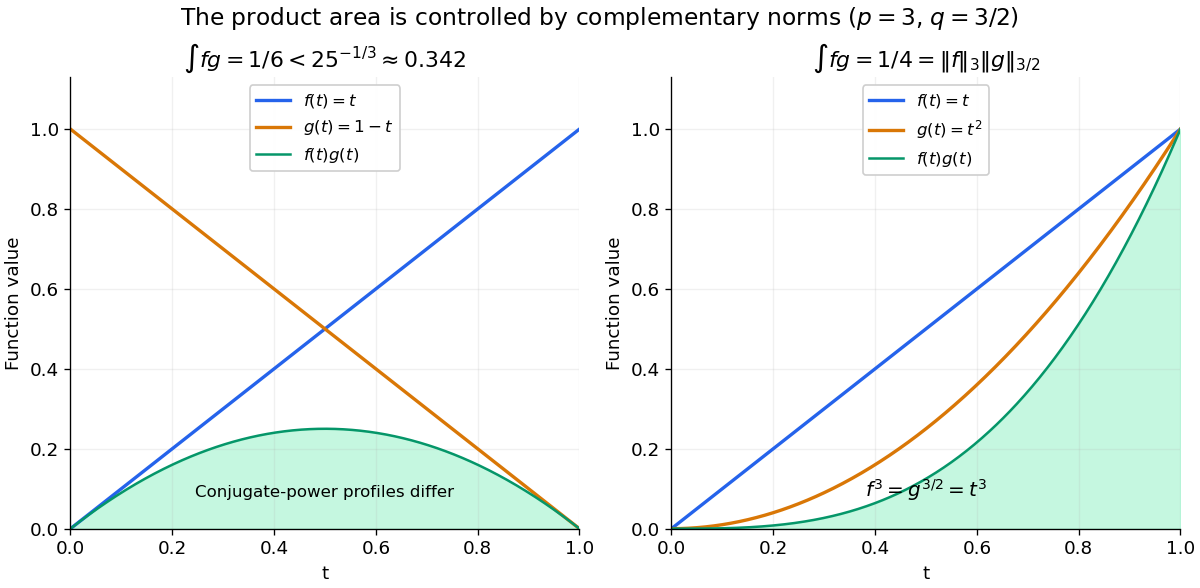
The proof outline makes the equality condition natural. Normalize and . The Young inequality gives ; integration yields . Equality requires almost everywhere. The endpoint proof uses the essential supremum directly, so it does not need division by at .
Take , , and vectors and . Their coordinate products are , soTheir Lp norms give the larger boundThus cancellation explains , and Hölder's inequality explains the remaining gap between and the norm product. Small signed sums need not imply small individual coordinate products.
Now keep and choose . The coordinate products are , with no cancellation, andThe matching powers are , namely .
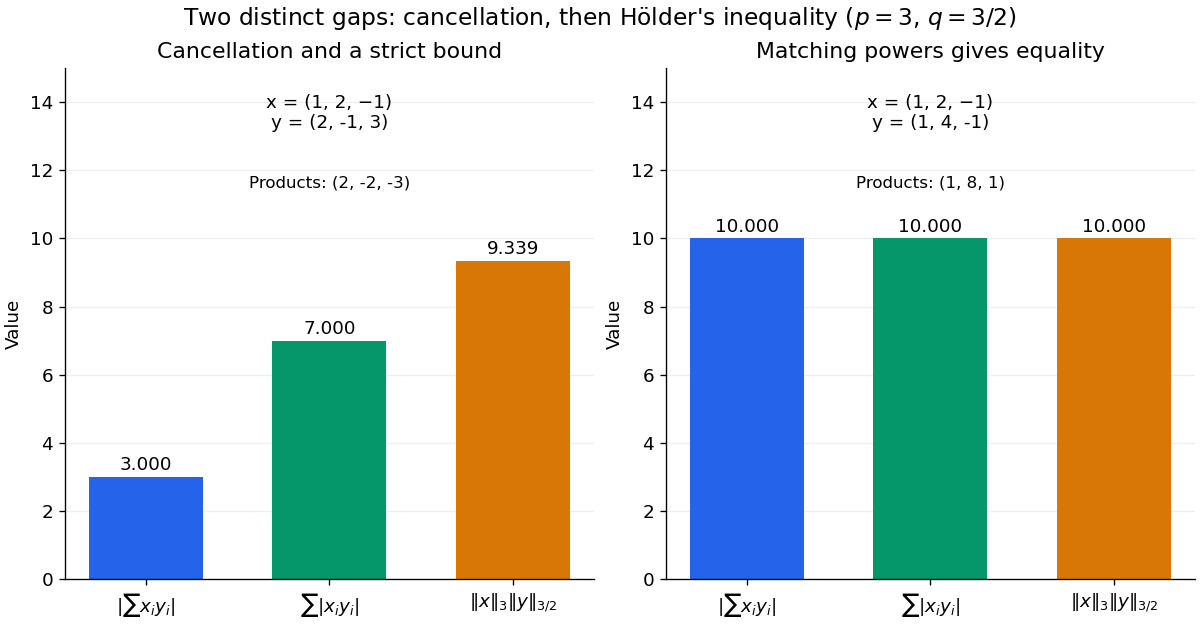
Cancellation and Hölder's inequality account for two different gaps
. Two original finite-vector calculations with , . The first pair has signed sum , absolute-product sum and norm-product bound approximately . The second pair attains equality at . The diagrams show calculated values, with no simulated data. Details. Pinned article: Introduction to the OurBigBook Project
Welcome to the OurBigBook Project! Our goal is to create the perfect publishing platform for STEM subjects, and get university-level students to write the best free STEM tutorials ever.
Everyone is welcome to create an account and play with the site: ourbigbook.com/go/register. We belive that students themselves can write amazing tutorials, but teachers are welcome too. You can write about anything you want, it doesn't have to be STEM or even educational. Silly test content is very welcome and you won't be penalized in any way. Just keep it legal!
Intro to OurBigBook
. Source. We have two killer features:
- topics: topics group articles by different users with the same title, e.g. here is the topic for the "Fundamental Theorem of Calculus" ourbigbook.com/go/topic/fundamental-theorem-of-calculusArticles of different users are sorted by upvote within each article page. This feature is a bit like:
- a Wikipedia where each user can have their own version of each article
- a Q&A website like Stack Overflow, where multiple people can give their views on a given topic, and the best ones are sorted by upvote. Except you don't need to wait for someone to ask first, and any topic goes, no matter how narrow or broad
This feature makes it possible for readers to find better explanations of any topic created by other writers. And it allows writers to create an explanation in a place that readers might actually find it.
Figure 1. Screenshot of the "Derivative" topic page. View it live at: ourbigbook.com/go/topic/derivativeVideo 2. OurBigBook Web topics demo. Source. - local editing: you can store all your personal knowledge base content locally in a plaintext markup format that can be edited locally and published either:This way you can be sure that even if OurBigBook.com were to go down one day (which we have no plans to do as it is quite cheap to host!), your content will still be perfectly readable as a static site.
- to OurBigBook.com to get awesome multi-user features like topics and likes
- as HTML files to a static website, which you can host yourself for free on many external providers like GitHub Pages, and remain in full control

Figure 2. You can publish local OurBigBook lightweight markup files to either OurBigBook.com or as a static website.
Figure 3. Visual Studio Code extension installation.
Figure 5. . You can also edit articles on the Web editor without installing anything locally. Video 3. Edit locally and publish demo. Source. This shows editing OurBigBook Markup and publishing it using the Visual Studio Code extension. 
- Infinitely deep tables of contents:




All our software is open source and hosted at: github.com/ourbigbook/ourbigbook
Further documentation can be found at: docs.ourbigbook.com
Feel free to reach our to us for any help or suggestions: docs.ourbigbook.com/#contact