Topics (376k) Articles (389k) Users (410) Discussions (242) Comments (383) Files (13k) New article

Every Adjoint representation operator raises the lower central series of a Lie algebra filtration. In a basis adapted to that finite filtration, all adjoint operators are strictly triangular. Their products have zero trace, so the Killing form vanishes. Consequently its radical of the Killing form is the whole algebra. For strictly upper triangular matrices the filtration can be seen directly by the gap between the column and row indices.
// Target: algebra.bigb
For a vector field with linear part , and cubic terms , write with homogeneous cubic . The transformed cubic field is , where . Taking the coefficients of to be and those of to be eliminates every cubic term in and the terms in . The remaining normal form is , through cubic order. The invariant damping coefficient contains the contribution from differentiating the first equation.
A newform is a normalized Hecke eigenform in the new subspace of cusp forms. Its weight, level and Dirichlet character are part of its specification. For a newform, its Fourier coefficients equal its eigenvalues of Hecke operators.
For a unit nematic director, the bulk elastic density is . The three positive moduli penalize nematic splay, nematic twist, and nematic bend. Boundary elastic terms, chirality, or varying nematic order require additional contributions.
For independent one-stop negative multinomial distribution observations, the natural estimates are and . Their sum is with strictly concave , so Jensen's inequality makes its expectation strictly below . Conditional category proportions split this bias between both estimates. With zero observed counts of a category, that estimate lies at zero; in a parameter space requiring strict positivity the likelihood supremum is not attained.
If an effective divisor is linearly equivalent to a negative curve , then . Otherwise forces to be a component of , since distinct irreducible curves have nonnegative intersection multiplicities. Write with effective and linearly equivalent to zero. An ample divisor intersects positively unless , while linear equivalence forces that intersection to vanish.
Distinct negative curves cannot have the same integral cohomology class: their mutual intersection would equal a negative self-intersection, contradicting nonnegative intersection multiplicities for distinct curves. A smooth complex projective surface has finitely generated integral cohomology groups, so its negative curves form an at most countable set. Zero-self-intersection curves need not obey this restriction: one ruling of gives an uncountable family.
Complete the square as . Translation of the Gaussian functional integral gives the displayed identity for nonzero , with the appropriate oscillatory contour prescription. At , the Nakanishi-Lautrup field is a Lagrange multiplier imposing the gauge-condition delta functional. This field has no kinetic term and no independent propagating degree of freedom.
For the unit-width symmetric box kernel for density estimation, suppose the design density is positive and differentiable at , the regression function is twice differentiable there, and the conditional variance and design density are bounded near . Write . Symmetry cancels its linear Taylor term, giving ; independence gives . The absolute error bound for a ratio estimator with a controlled denominator gives the displayed rate if the small-denominator contribution is negligible. The balance gives . Interior design positivity matters: support boundaries can prevent the linear cancellation.
A Graeco-Latin square is the superposition of two orthogonal Latin squares of the same order. Each symbol of either square occurs once per row and column, and every cross-square pair occurs once. It permits four mutually orthogonal additive factor spaces: rows, columns, and the two symbol factors.
For a negative muon with rest-frame spin vector , the leading massless-electron distribution is , where . Its final-spin sum is . The spin vector is axial whereas the electron direction is polar, so their scalar product reverses under parity. Its occurrence demonstrates parity violation by the left-chiral weak charged current.
If is differentiable at the point of a differentiable parametric curve, the multivariable chain rule givesThe gradient supplies the local spatial rates; the velocity vector supplies the direction and rate of movement. Their dot product is the change in the sampled scalar field per unit parameter. If the parameter is time, this is a rate per unit time; a directional derivative per unit distance instead uses a unit vector.
Take and the unit circle path . Along the path,At , the gradient is , the velocity vector is , and their dot product is . The sampled value is and increases at rate one, even though one coordinate is decreasing. This is why a moving observation must combine every coordinate's contribution.
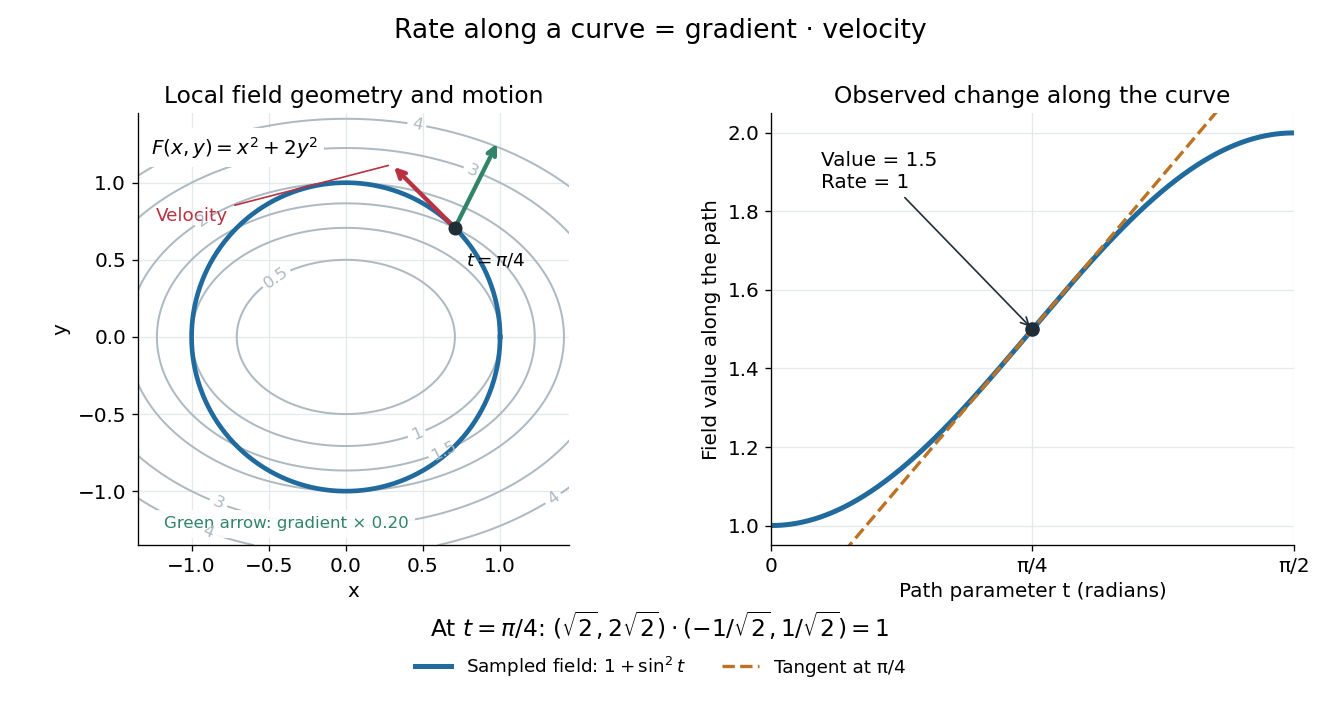
For a level curve, is constant, so the derivative along a curve is zero and its velocity vector is orthogonal to the gradient. Along other paths, the same formula combines a field's geometry with the observer's motion. [ref].
A root of a polynomial is double when its multiplicity of a root is exactly two. Equivalently, with . A generic small perturbation splits it according to square-root splitting of a double polynomial root.
For independent multinomial distributions with fixed stratum totals and baseline logits , the sufficient statistics are the displayed response-specific design-weighted counts, . Expanding the log-likelihood gives , plus a data-only term. The Fisher-Neyman factorization theorem therefore proves sufficiency; with an unrestricted identifiable canonical parameter, a likelihood-ratio argument proves minimal sufficiency. Factor indicators give the corresponding response/covariate margins.
For ordered response categories, model each displayed conditional probability by a grouped-binomial logistic regression. The multinomial likelihood factors exactly into successive conditional binomial likelihoods, using the remaining category total as each stage's denominator. This is a different regression parameterization from baseline-category logits or cumulative odds. Separate cumulative binary indicators from the same person are dependent and cannot be treated as independent likelihood contributions.
For a symmetric zero-diagonal dissimilarity matrix , square each entry to obtain and put . Take the eigenvectors of corresponding to its largest positive eigenvalues. Multiplying them by square roots of these eigenvalues gives coordinates. If contains Euclidean distances, is a centered Gram matrix, so retaining all positive eigenvalues reconstructs those distances exactly. Retaining fewer approximates the Gram matrix, not generally the sum of squared errors in raw distances. Negative eigenvalues signal failure of an exact Euclidean representation. Coordinates are unchanged in meaning by orthogonal transformations.
The quantum Hamiltonian with kinetic energy and Morse potential has bound energies of the displayed form, where , and . Adjacent energy differences are , distinct and positive over the physical bound-level range. A finite truncation with nonzero adjacent dipole couplings therefore satisfies connected nondegenerate transition chain generates special unitary control. Controllability of such a truncation does not by itself prove controllability on the full space including dissociation states.
Pinned article: Introduction to the OurBigBook Project
Welcome to the OurBigBook Project! Our goal is to create the perfect publishing platform for STEM subjects, and get university-level students to write the best free STEM tutorials ever.
Everyone is welcome to create an account and play with the site: ourbigbook.com/go/register. We belive that students themselves can write amazing tutorials, but teachers are welcome too. You can write about anything you want, it doesn't have to be STEM or even educational. Silly test content is very welcome and you won't be penalized in any way. Just keep it legal!
Intro to OurBigBook
. Source. We have two killer features:
- topics: topics group articles by different users with the same title, e.g. here is the topic for the "Fundamental Theorem of Calculus" ourbigbook.com/go/topic/fundamental-theorem-of-calculusArticles of different users are sorted by upvote within each article page. This feature is a bit like:
- a Wikipedia where each user can have their own version of each article
- a Q&A website like Stack Overflow, where multiple people can give their views on a given topic, and the best ones are sorted by upvote. Except you don't need to wait for someone to ask first, and any topic goes, no matter how narrow or broad
This feature makes it possible for readers to find better explanations of any topic created by other writers. And it allows writers to create an explanation in a place that readers might actually find it.
Figure 1. Screenshot of the "Derivative" topic page. View it live at: ourbigbook.com/go/topic/derivativeVideo 2. OurBigBook Web topics demo. Source. - local editing: you can store all your personal knowledge base content locally in a plaintext markup format that can be edited locally and published either:This way you can be sure that even if OurBigBook.com were to go down one day (which we have no plans to do as it is quite cheap to host!), your content will still be perfectly readable as a static site.
- to OurBigBook.com to get awesome multi-user features like topics and likes
- as HTML files to a static website, which you can host yourself for free on many external providers like GitHub Pages, and remain in full control

Figure 2. You can publish local OurBigBook lightweight markup files to either OurBigBook.com or as a static website.
Figure 3. Visual Studio Code extension installation.
Figure 5. . You can also edit articles on the Web editor without installing anything locally. Video 3. Edit locally and publish demo. Source. This shows editing OurBigBook Markup and publishing it using the Visual Studio Code extension. 
- Infinitely deep tables of contents:



All our software is open source and hosted at: github.com/ourbigbook/ourbigbook
Further documentation can be found at: docs.ourbigbook.com
Feel free to reach our to us for any help or suggestions: docs.ourbigbook.com/#contact