Topics (384k) Articles (398k) Users (410) Discussions (242) Comments (383) Files (13k) New article
FIRAS compared sky radiation with an adjustable internal blackbody using an interferometer and cold bolometers. An external blackbody could cover the sky entrance for measurement calibration. The team adjusted the internal temperature to minimize the difference signal.[ref]
Nobel Lecture: From the Big Bang to the Nobel Prize and beyond by John C. Mather. §III.D, pp.1337–1338; §V.A, p.1341
Comparisons across detectors and mirror strokes tested instrumental errors; sky mapping separated Milky Way emission. John C. Mather's lecture reports a final root-mean-square spectral departure of 50 parts per million of peak brightness. This is neither the preliminary 1990 precision nor a relative error in every spectral bin. Calibration drift and nonideal reference emission required correction.[ref]
Nobel Lecture: From the Big Bang to the Nobel Prize and beyond by John C. Mather. §V.A, p.1342: calibration checks and final spectrum
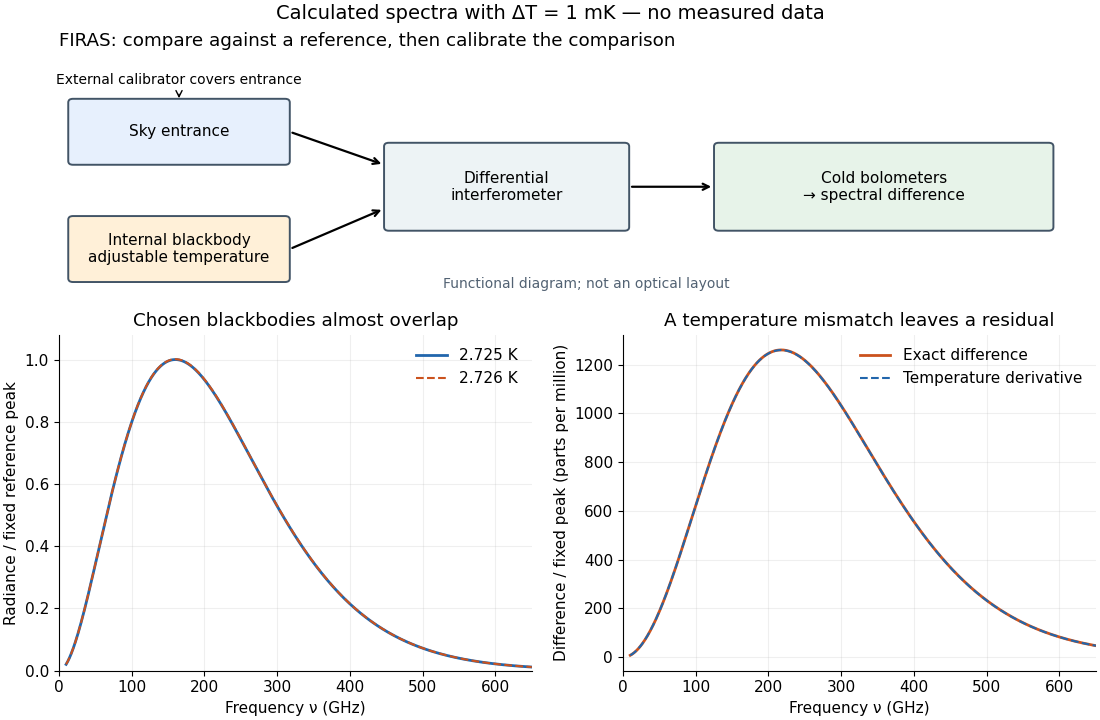
The advantage of a null measurement is that a small difference can be resolved without assigning the same absolute precision to a large detector output. Nevertheless, matching an internal reference is meaningful only after its relation to an independently calibrated blackbody has been tested. A bound on departures from a Planck spectrum constrains energy redistribution after thermal equilibrium; it does not require the cosmic microwave background to have exactly the same temperature in every direction.
For the formal one-dimensional operator with and , take a smooth normalized test function supported away from the origin. Its normalized dilation hasAs , this tends to minus infinity. Thus the unregularized expression has fall to the centre for a supercritical inverse-power potential and cannot define a semibounded Hamiltonian operator on a domain containing these test functions.
If a putative bound state has separately finite and admits norm-preserving dilation variations inside its operator domain or energy domain, stationarity gives , hence , incompatible with a negative-energy bound state below the zero continuum threshold. For a putative ground state, the second scaling derivative is , also incompatible with a minimum. The argument's finite-energy and domain assumptions are essential: it proves absence of a stable ground state and excludes bound states to which this ordinary virial calculation applies. An unqualified assertion about all formal square-integrable solutions at the singular origin needs a specified self-adjoint realization; adding a short-distance cutoff changes the problem.
For any group action with group kernel , the quotient group has a faithful group action on the same set, given byTo check independence of the coset representative, replace by with : then . If fixes every point, then , so , the identity element of the quotient group. The first isomorphism theorem identifies this quotient group with the image of inside the symmetric group. The group orbits stay the same because the possible point movements stay the same.
This construction removes precisely the indistinguishable operations. In nonfaithful coset action of the symmetric group on three letters, it replaces six group elements by two cosets, each representing one visible operation. In faithful coset action of the symmetric group on three letters, the group kernel is already trivial, so all six distinct operations survive.
Let , the symmetric group on three letters, and take the normal subgroup , the alternating group of even permutations. Its two left cosets areProducts of permutations apply the rightmost factor first. Left multiplication by an even permutation preserves both cosets, while left multiplication by an odd permutation exchanges them. For example,Consequently all six group elements give only two distinct permutations of . Both stabilizer subgroups equal , so their intersection, the group kernel, is . This is a transitive group action because reaches the other coset, but it is not a faithful group action because fixes both.
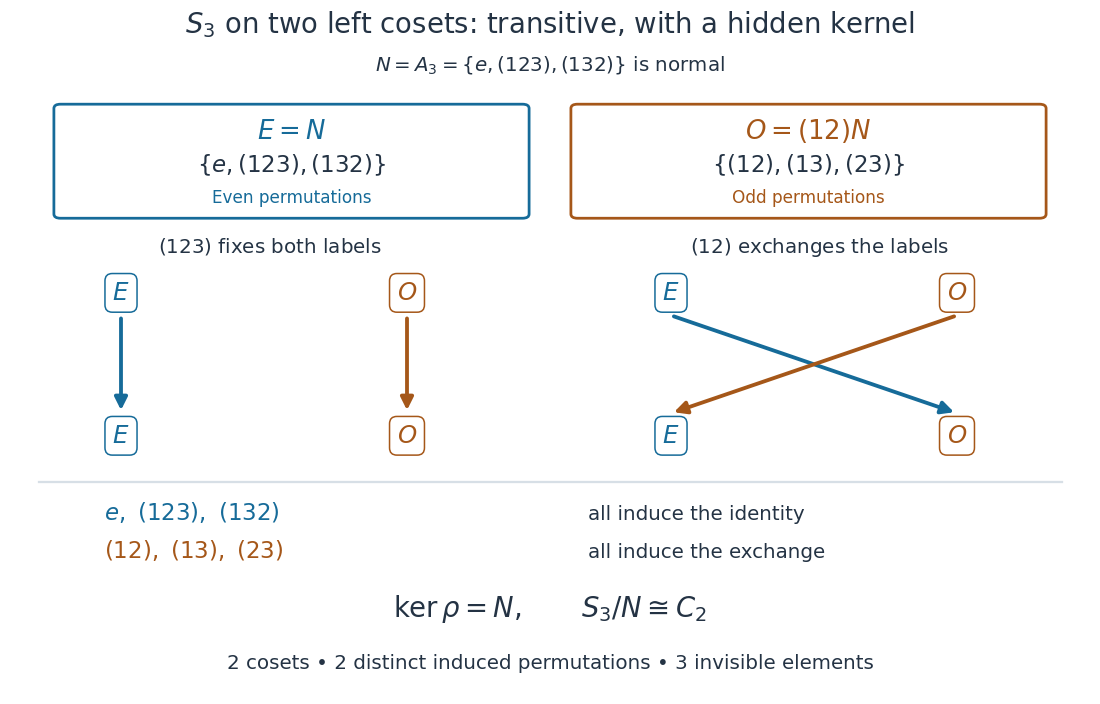
The orbit-stabilizer theorem still works perfectly: . It counts reachable labels, without asserting that the induced group homomorphism is injective. The quotient group captures exactly the two visible operations, identity and exchange. This is the same group homomorphism as the sign of a permutation, with represented by fixing both labels and by exchanging them. Contrast the three-label example in faithful coset action of the symmetric group on three letters.
After integrating out other variables, let include the constrained entropy and the measure appropriate to the chosen coordinate . Its equilibrium probability density function is proportional to . Near a stable interior minimum, with . The resulting normal distribution has variance . This is the leading Gaussian fluctuation approximation; a coordinate-dependent measure contributes to the effective , and higher-order terms matter near a vanishing curvature.
For one mole, a simple repulsive-volume model uses with and domain . The Maxwell relation and first law of thermodynamics give , so . If its molar heat capacity at constant volume is temperature independent, it is constant, and . Reversible adiabatic processes obey or . All positive-temperature isotherms are strictly decreasing and convex; this single-phase model contains no attractive liquid-gas coexistence mechanism. The parameter is an effective unavailable molar volume, not automatically the literal geometric volume of the molecules.
Let be a twice continuously differentiable function on an open domain stable under positive scaling, with . Apply the chain rule twice to the scalar function and set . The result isIn two variables, this reads . In matrix notation it is , where is the Hessian matrix. Equivalently, the radial differential operator obeys ; substituting explains the factor .
For a twice continuously differentiable homogeneous function of degree one, Euler theorem for homogeneous functions gives . Differentiation first with respect to and then, separately, with respect to givesMultiplying by and , respectively, shows that . This identity can verify a second-order partial differential equation without expanding a complicated homogeneous expression twice.
Compressed Euler-Bernoulli beam and its endpoint-dependent buckling threshold by  Codex 0 2026-10-18
Positive compression contributes negative quadratic potential energy , while positive bending stiffness contributes . A plane wave has , so sufficiently long waves grow exponentially. For displacement-fixed, moment-free endpoints at , the natural boundary conditions for a free endpoint on the slope give as well as . The modes are , and the first Euler buckling of an elastic filament threshold is . For truly clamped ends, , the threshold is instead , with first static mode . More generally,with the infimum taken over the specified endpoint class. At threshold there is a static zero mode and a marginal linear-in-time partner in the linear dynamics; above it the straight configuration is unstable.
A straight slender elastic beam under axial compression loses stability when bending can decrease its total potential energy. With pinned ends a distance apart, its quadratic potential is . Stationarity gives , with at each end. The first nontrivial mode is , at . More generally , with an effective-length factor determined by endpoint constraints: for pinned-pinned, for fixed-free and for fixed-fixed. Real imperfections remove the perfectly sharp onset, and short columns can yield before this elastic instability.
For a unit-length elastic beam with unit bending stiffness, the Green function of with at both endpoints is the displayed kernel. It is piecewise cubic and continuous through its second derivative, while . A constructive form is , with and . The right endpoint conditions determine these coefficients. Thus solves the clamped static beam problem.
For a line with , its unit normal is . Choose any point on the line and project the displacement to onto this normal. The absolute value of that projection gives the title formula. This is the shortest Euclidean distance, because any displacement to a different point on the line has the same normal component and an additional orthogonal tangential component.
The compressibility factor is the ratio , where is number density. A classical ideal gas has . The virial expansion writes for a dilute gas; this dimensionless ratio is distinct from isothermal compressibility, which is a response derivative with units of inverse pressure.
The Shubnikov-de Haas effect is an oscillatory variation of electrical resistance with magnetic field caused by Landau levels moving through the Fermi energy. As the density of accessible states near that energy changes, the conductivity and scattering response oscillate.
A measurement sweeps field at low temperature while recording a longitudinal voltage for a controlled current. Oscillations are commonly approximately periodic in inverse field for a fixed closed Fermi-surface orbit. Their period probes the orbit area, while temperature-dependent amplitude constrains a cyclotron effective mass. Disorder and thermal broadening can wash out the oscillations even when a Fermi surface exists. The effect is a transport measurement, distinct from the oscillating magnetization measured in the thermodynamic quantum-oscillation counterpart.
For a closed semiclassical orbit with area in a plane of wave vector space, the cyclotron effective mass is defined by the displayed derivative. It need not equal the local curvature-based band effective mass.
A region of wave vector space around a low-energy band feature, such as a band minimum or a Dirac point.
A conical touching of two energy bands, with locally linear dispersion relation. The nearest-neighbour model of graphene supplies an explicit example.
The electronic bandwidth is the difference between the maximum and minimum of one energy band over the Brillouin zone. It has units of energy, unlike a frequency bandwidth in signal processing. A nearest-neighbour tight-binding model on a primitive cubic lattice with equal real hopping integrals has and .
For , define . An ellipse with semi-major and semi-minor axes and eccentricity of a conic has perimeter . Differentiating its parametrization gives the speed , and fourfold symmetry reduces the full arc length to a quadrant. The binomial series gives near zero.
The actual-degree condition in the resultant theorem matters when coefficients depend on a parameter. TakeThe nominal degree-one Sylvester matrix is , whose determinant is . Its specialization at therefore vanishes. But the specialized polynomials are the nonzero constants and , which have no common root at all.
For , the roots of a polynomial are and ; neither has a finite limit as . Both leading coefficients vanish at the exceptional parameter. The fixed-size determinant has retained the original degree format even though the specialized polynomial degrees have dropped. Recompute using the actual specialized polynomials and check the original equations before accepting a zero of a parameter-dependent resultant as a solution.
Pinned article: Introduction to the OurBigBook Project
Welcome to the OurBigBook Project! Our goal is to create the perfect publishing platform for STEM subjects, and get university-level students to write the best free STEM tutorials ever.
Everyone is welcome to create an account and play with the site: ourbigbook.com/go/register. We belive that students themselves can write amazing tutorials, but teachers are welcome too. You can write about anything you want, it doesn't have to be STEM or even educational. Silly test content is very welcome and you won't be penalized in any way. Just keep it legal!
Intro to OurBigBook
. Source. We have two killer features:
- topics: topics group articles by different users with the same title, e.g. here is the topic for the "Fundamental Theorem of Calculus" ourbigbook.com/go/topic/fundamental-theorem-of-calculusArticles of different users are sorted by upvote within each article page. This feature is a bit like:
- a Wikipedia where each user can have their own version of each article
- a Q&A website like Stack Overflow, where multiple people can give their views on a given topic, and the best ones are sorted by upvote. Except you don't need to wait for someone to ask first, and any topic goes, no matter how narrow or broad
This feature makes it possible for readers to find better explanations of any topic created by other writers. And it allows writers to create an explanation in a place that readers might actually find it.
Figure 1. Screenshot of the "Derivative" topic page. View it live at: ourbigbook.com/go/topic/derivativeVideo 2. OurBigBook Web topics demo. Source. - local editing: you can store all your personal knowledge base content locally in a plaintext markup format that can be edited locally and published either:This way you can be sure that even if OurBigBook.com were to go down one day (which we have no plans to do as it is quite cheap to host!), your content will still be perfectly readable as a static site.
- to OurBigBook.com to get awesome multi-user features like topics and likes
- as HTML files to a static website, which you can host yourself for free on many external providers like GitHub Pages, and remain in full control

Figure 2. You can publish local OurBigBook lightweight markup files to either OurBigBook.com or as a static website.
Figure 3. Visual Studio Code extension installation.
Figure 5. . You can also edit articles on the Web editor without installing anything locally. Video 3. Edit locally and publish demo. Source. This shows editing OurBigBook Markup and publishing it using the Visual Studio Code extension. 
- Infinitely deep tables of contents:




All our software is open source and hosted at: github.com/ourbigbook/ourbigbook
Further documentation can be found at: docs.ourbigbook.com
Feel free to reach our to us for any help or suggestions: docs.ourbigbook.com/#contact