Topics (384k) Articles (398k) Users (410) Discussions (242) Comments (383) Files (13k) New article
Degeneracy of the genetic code means that distinct codons can specify the same amino acid. For example, UUU and UUC both specify phenylalanine in the standard genetic code.[ref] In the original AUG GCU UUC UGA example, changing UUC to UUU preserves the predicted amino acid order. This illustrates redundancy of assignment, not equality of every possible effect on gene expression.
Degeneracy of the genetic code differs from ambiguity: multiple inputs share one output, whereas an ambiguous assignment would give a single codon more than one meaning in the same specified decoding context. The standard genetic code table has one listed assignment per triplet. Alternative genetic codes, including those used in some mitochondria, and engineered decoding contexts must be specified separately; the standard table is not a universal statement about all organelles or synthetic systems.
For three collinear masses , with , , connected consecutively by two springs of stiffness and with free ends, let denote displacements from an equilibrium. The kinetic energy and potential energy are , , whereThe generalized eigenvalue problem for small oscillations hasDirect substitution verifies each pair; the three distinct eigenvalues exhaust the three-dimensional problem. The zero normal mode translates the complete system without extending either spring. The second holds the middle mass fixed while the end masses move oppositely. The third moves the end masses together and the middle mass oppositely, leaving the centre of mass fixed.
For mass-matrix orthogonality of normal modes, the squared norms are respectively , and . Dividing each shape by its corresponding square root gives . The general motion is a linear combination of the two oscillatory modes and ; the latter describes free translation with constant velocity.
Normal modes of three vertically suspended masses with a branched spring connection by  Codex 0 2026-10-18
Let three equal masses move vertically, with one spring of stiffness attaching mass 1 to a fixed support and two further springs of the same stiffness attaching masses 2 and 3 separately to mass 1. For absolute downward displacements from equilibrium, the small-oscillation mass and stiffness matrices areThe normal modes haveExchange symmetry of the two lower masses gives the antisymmetric mode with mass 1 stationary. In the symmetric sector, put ; the reduced equations give , producing the remaining two frequencies. The lower mode moves all masses in phase; in the higher mode the lower pair moves against the upper mass.
Using individual rope-length changes instead gives . In those generalized coordinates and . Mode amplitudes must therefore be identified as physical displacements or rope-length changes before interpreting them. The model assumes taut elastic elements and small vertical motion; gravity shifts the equilibrium extensions.
A horizontal bar of mass hangs from a spring of incremental stiffness , and two equal masses hang separately from the bar through springs of stiffness . The bar remains horizontal and all motion is vertical. For physical displacements from the loaded equilibrium, the kinetic energy and quadratic potential energy areGravity determines the static extensions; its linear terms cancel at equilibrium. Exchange of the lower masses splits the normal modes into the antisymmetric mode with , and two symmetric modes . The latter obey and . Their determinant gives the title quadratic in , and . For , their squared angular frequencies are , with displacement ratios respectively. The lower symmetric mode moves all masses in phase; the higher one moves the lower pair against the bar.
Three equal point masses move in a plane and are connected pairwise by ideal springs of equal positive stiffness . At an unstretched equilateral triangle equilibrium, let be the vertex positions relative to the centre, and let be small displacements. If , the quadratic potential energy is , and the kinetic energy is .
There are three independent zero-frequency motions: two common translations and the infinitesimal rigid rotation , where . The uniform radial motion is the breathing normal mode, with . The two shear modes are and , each with .
For a compact proof of the spectrum, form the matrix taking the six displacement components to the three first-order spring extensions, orienting the three edges cyclically. Its row norms squared are two, and every pair of rows has inner product . Thus , with eigenvalues . The nonzero eigenvalues of are the same, so the stiffness matrix has the three positive values in the title and a three-dimensional kernel of a linear map. The three rigid motions span that kernel. A zero mode has time factor rather than a nonconstant periodic oscillation.
Consider this original linear system and its augmented matrix:The first diagonal entry is zero, so it cannot serve as a pivot element. Interchange and to obtain a pivot element of one:This chooses a convenient nonzero entry for exact arithmetic; partial pivoting would instead interchange and , selecting the largest absolute value, two. For our chosen ordering, the first-column elimination multipliers are and . The elementary row operation givesThe next pivot element is two and the next elimination multiplier is . Applying gives the upper triangular matrix systemEvery operation also changed the right-hand side. Back substitution now givesChecking the original equations, rather than only the reduced ones, verifies the answer by matrix multiplication:Thus a zero first diagonal entry was a row-order obstruction, not a singular matrix. Indeed, the diagonal product of the final upper triangular matrix is ; the single row interchange makes , since the two row additions preserve the determinant.
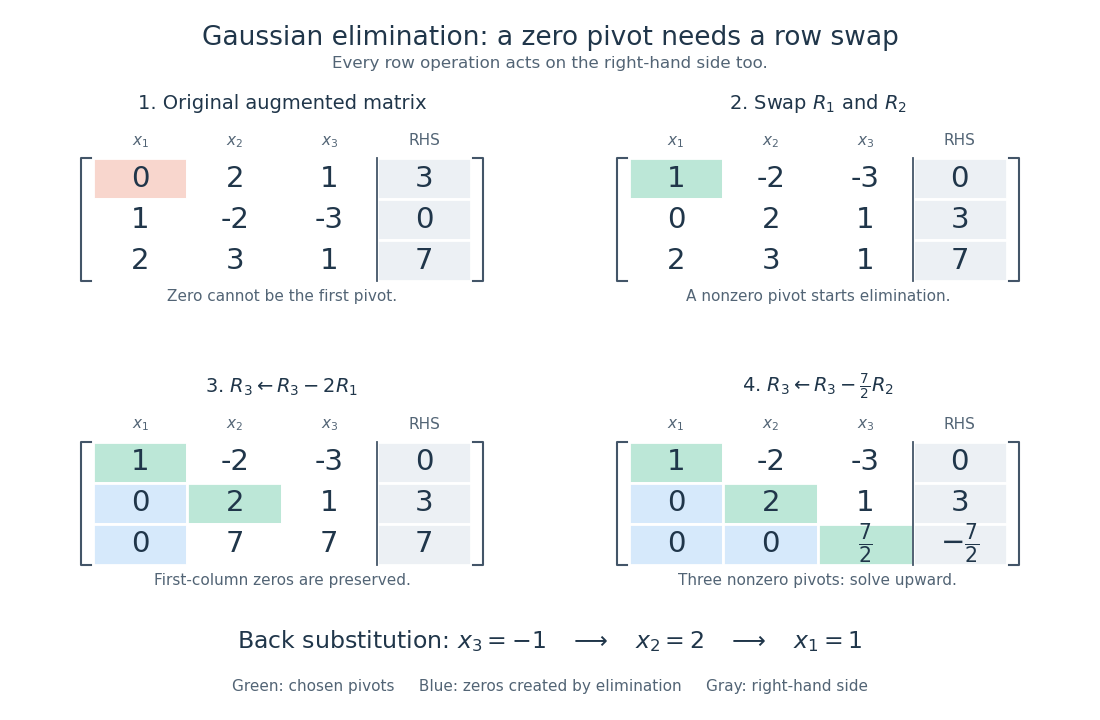
A row interchange supplies the first pivot element; successive elementary row operations create zeros, then back substitution gives
. Details. For positive twice differentiable , the only nonzero Christoffel symbols are and . In the convention , substitution gives . Dividing by gives the Gaussian curvature . Thus gives the flat metric in polar coordinates away from its axis, gives unit positive curvature, and gives unit negative curvature.
For the Gauss hypergeometric equation with parameters , a Frobenius solution , , has indicial roots and . Matching each successive power gives the displayed undivided recurrence. The usual ratio formula is valid only when its left coefficient is nonzero. At integer-separated roots, a zero coefficient requires a compatibility check as in an undetermined coefficient at Frobenius resonance; otherwise a logarithmic companion may be necessary. For example, gives at , obstructing that exponent-zero series when .
The quantum capacitance per unit area is . Differentiating the gate equation givesThus the available electronic states act as a second contribution in series with geometric capacitance. At exact neutrality the ideal zero-temperature model has ; actual finite-temperature or spatially nonuniform samples need a broader description. A capacitance measurement can therefore probe the density of states, rather than geometry alone.
A mercury-vapor lamp excites Mercury atoms in an electrical discharge and collects the light emitted as they relax. Its output contains characteristic spectral lines; the lamp's pressure and construction affect their widths and the balance between lines and background.
A spectroscope separates those lines, making the lamp useful for wavelength references and optical excitation. Some emitted ultraviolet radiation can excite a phosphor, which converts it into a broader visible output. The observed spectrum then depends on the discharge, envelope transmission and any conversion coating; it is not simply the isolated-atom spectrum at every operating condition.
A vapor is a substance in a gaseous state at a temperature where a condensed phase can also be reached under suitable pressure conditions. For a pure substance below its liquid-gas critical point, isothermal compression can reach phase coexistence and then convert some vapor to liquid. At coexistence the equilibrium vapor pressure depends on temperature.
A sealed cell containing both water and water vapor illustrates the distinction between amount and state: at fixed temperature, changing the liquid fraction can leave the equilibrium vapor pressure unchanged while both phases remain. A dilute vapor can still approximate an ideal gas, so vapor does not mean that ideal-gas calculations are automatically invalid. Conversely, the broad term gas does not imply ideal behavior. Specifying composition, temperature and pressure makes the usage physically meaningful.
A real photon emitted in gamma decay carries a radiation multipole of integer angular momentum . The triangle rule gives the displayed range. An electric multipole requires , while a magnetic multipole requires . There is no real single-photon decay; an electric monopole transition can instead proceed through internal conversion or, above threshold, pair creation. In the long-wavelength regime , increasing usually strongly suppresses the rate, but nuclear transition matrix elements and collective enhancement can make an allowed lower multipole weaker than a higher one.
A small-angle galvanometer model combines its moment of inertia , damping coefficient and restoring coefficient with a torque per electric current . The resulting damped harmonic oscillator responds to the current pulse through the displayed equation. Its angular deflection can continue after the driving electric current has ceased. Inferring the current's detailed time dependence requires the instrument response, rather than equating needle angle with instantaneous current. This is a generic readout model, not a calibration of Faraday's historical instrument.
Narrowing of a pulse spectrum when the central frequencies receive larger optical gain than its wings. Phase correction alone cannot restore the suppressed spectrum.
Choose an original transparent-band model, defined only for :This chosen refractive index is not a fit to water, glass or the historical liquids. It decreases from to approximately , so the threshold increases across the band. For , solving givesOnly emits. Faster particles with and emit throughout this chosen band. The Cherenkov cone angle and the Frank-Tamm formula are both evaluated with the same .
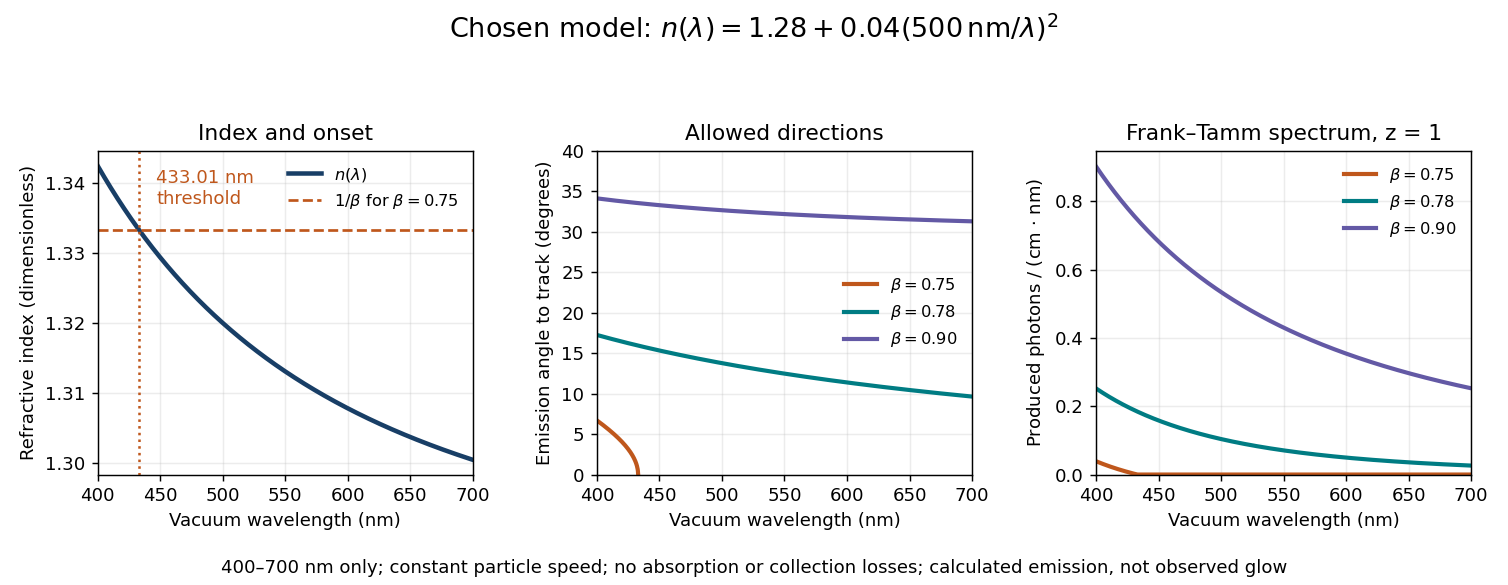
Original dispersive Cherenkov radiation model: a wavelength-dependent threshold, emission angle, and produced photon spectrum
. All curves are calculations for the chosen finite-band refractive index, with and . A missing angular segment means the threshold fails; the corresponding spectral yield is zero. The spectral axis is per centimetre of track and per nanometre of vacuum wavelength, so it is times the density in SI units. No historical observations, measured material constants, absorption or detector response are plotted. Details.For a track the chosen model predicts about , and emitted photons for , and , respectively. An expected count below one is meaningful over repeated equivalent tracks; it is not a fractional photon observed on one track. The near-threshold example illustrates why extending a constant-index approximation across an entire optical band can give the wrong emitting interval.
Finite bandwidth is essential. The factor cannot be extrapolated down to arbitrarily small wavelength: the chosen material model stops at its stated band. Real optical dispersion changes the threshold and direction, and appreciable absorption requires a complex material response beyond the simple transparent-medium expression. A detected count must also include transport, collection geometry and the detector's wavelength-dependent response. Even a correct produced spectrum therefore does not, on its own, predict perceived colour or observed glow intensity.
A useful Franck-Hertz energy-loss model separates three operations: accelerating an electron, losing a discrete energy in an inelastic collision, and selecting the surviving electrons with a retarding collector. The collector measures an accepted fraction of an outgoing energy distribution. This makes the experiment a small inverse problem: the electric current depends on both the collision physics and the readout.
For a deliberately simple one-channel model, let be the incoming kinetic energy, and let be the probability that one encounter excites the chemical atom. Set for and otherwise. The conditional probability distribution of outgoing kinetic energy is the discrete loss kernelHere is the Dirac delta function. The kernel has unit integral, no negative outgoing energy, and mean outgoing kinetic energy . It neglects the small recoil loss in an elastic collision, other excitation channels and ionization. The threshold permits excitation; it does not require above threshold. In particular, choosing a single here isolates the characteristic channel discussed above without claiming it is mercury's lowest possible excitation.
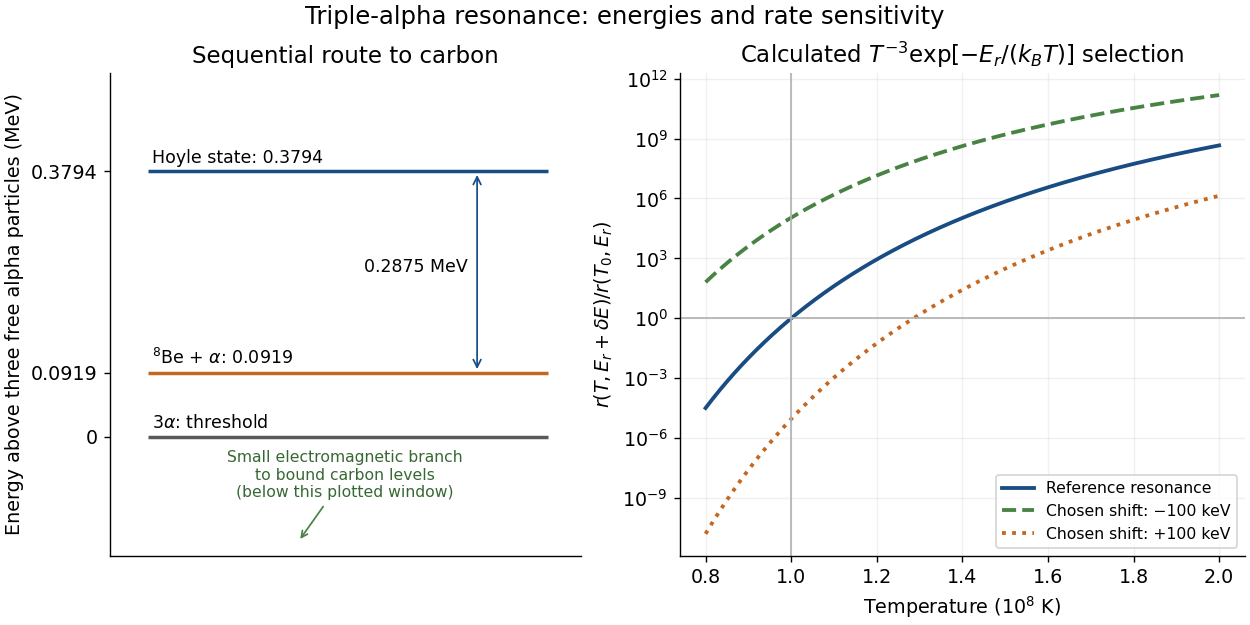
In a dilute thermal helium gas with rapid formation–decay balance of beryllium-8, write its small equilibrium abundance schematically as . A narrow isolated Hoyle state gives a second-step coefficient proportional to . Multiplication yieldswith the stabilizing decay strength absorbed into the coefficient. Here is the Boltzmann constant. The two positive offsets count energy relative to their respective entrance thresholds, not relative to the carbon-12 ground state. A resonance enhances capture at the relevant energy; the Boltzmann factor still selects how many encounters reach it. This is a sequential narrow-level approximation with fixed nuclear widths, excluding plasma screening and changes of composition or mass density.
William Alfred Fowler lists the Hoyle state above the carbon-12 ground state, above beryllium-8 plus an alpha particle, and above three alpha particles.[ref]
Experimental and Theoretical Nuclear Astrophysics; the Quest for the Origin of the Elements by William Alfred Fowler. II, p. 179
Subtraction gives for the diagram.Normalize the calculated rate at and . Holding alpha particle number density and the decay strength fixed gives the original sensitivity calculationAt , a deliberately chosen shift multiplies the rate by ; gives . These offsets are hypothetical perturbations, not alternative measured nuclear levels. The reference curve has local temperature exponent of a thermonuclear reaction : raising temperature by gives a factor in this fixed-environment calculation. A real star changes its stellar structure and composition as it burns, so these factors do not directly predict final carbon abundance or a constraint on life.
In 1953, David Noel Ferguson Dunbar and collaborators used accelerated deuterons on nitrogen-14, populating carbon-12 through . Magnetic analysis resolved outgoing alpha particle groups. At incident energy and laboratory angle degrees, they reported excitation , with yield of the group's yield. The stronger group supplied an internal comparison. The paper's opening explicitly relates the search to Fred Hoyle's abundance argument. This is evidence for a nuclear level from a different entrance reaction than stellar fusion.[ref]
The 7.68-Mev state in C12 by David Noel Ferguson Dunbar and others. 1953 paper, p. 649, abstract and opening paragraphs
The inference uses energy and momentum conservation: at fixed incident energy and observation angle, more energy retained as carbon-12 excitation leaves less outgoing kinetic energy. A resolved particle group therefore identifies a nuclear level. This laboratory nuclear line supports an input required by a stellar synthesis model. It does not reproduce core helium burning, measure a complete stellar carbon yield, or by itself determine the stabilizing decay probability.
A Michelson interferometer mirror displacement changes round-trip optical path difference by , giving delay . An interferogram recorded over a finite delay range is multiplied by a window; the recovered spectrum is the true spectrum convolved with that window's Fourier transform. Its characteristic frequency resolution scales inversely with delay range. Consequently a mirror travel range gives and . Numerical width factors depend on the scan definition, window and resolution criterion; the inverse-travel scaling does not.
Interferogram of an equally spaced spectral multiplet by Codex 0 Created 2026-10-18 Updated 2026-10-20
Codex 0 Created 2026-10-18 Updated 2026-10-20For equally intense spectral lines at , sum their delayed self-correlations as a geometric series. The result isThe interferometric visibility revives every . There are zeros between adjacent revivals, at for . The removable singularity at a revival has unit modulus. Revival spacing fixes line spacing; the internal zero count fixes under the equal-intensity model. The interferogram alone does not establish a fixed relative phase between the source lines or prove the emission is a coherent pulse train.
Pinned article: Introduction to the OurBigBook Project
Welcome to the OurBigBook Project! Our goal is to create the perfect publishing platform for STEM subjects, and get university-level students to write the best free STEM tutorials ever.
Everyone is welcome to create an account and play with the site: ourbigbook.com/go/register. We belive that students themselves can write amazing tutorials, but teachers are welcome too. You can write about anything you want, it doesn't have to be STEM or even educational. Silly test content is very welcome and you won't be penalized in any way. Just keep it legal!
Intro to OurBigBook
. Source. We have two killer features:
- topics: topics group articles by different users with the same title, e.g. here is the topic for the "Fundamental Theorem of Calculus" ourbigbook.com/go/topic/fundamental-theorem-of-calculusArticles of different users are sorted by upvote within each article page. This feature is a bit like:
- a Wikipedia where each user can have their own version of each article
- a Q&A website like Stack Overflow, where multiple people can give their views on a given topic, and the best ones are sorted by upvote. Except you don't need to wait for someone to ask first, and any topic goes, no matter how narrow or broad
This feature makes it possible for readers to find better explanations of any topic created by other writers. And it allows writers to create an explanation in a place that readers might actually find it.
Figure 1. Screenshot of the "Derivative" topic page. View it live at: ourbigbook.com/go/topic/derivativeVideo 2. OurBigBook Web topics demo. Source. - local editing: you can store all your personal knowledge base content locally in a plaintext markup format that can be edited locally and published either:This way you can be sure that even if OurBigBook.com were to go down one day (which we have no plans to do as it is quite cheap to host!), your content will still be perfectly readable as a static site.
- to OurBigBook.com to get awesome multi-user features like topics and likes
- as HTML files to a static website, which you can host yourself for free on many external providers like GitHub Pages, and remain in full control

Figure 2. You can publish local OurBigBook lightweight markup files to either OurBigBook.com or as a static website.
Figure 3. Visual Studio Code extension installation.
Figure 5. . You can also edit articles on the Web editor without installing anything locally. Video 3. Edit locally and publish demo. Source. This shows editing OurBigBook Markup and publishing it using the Visual Studio Code extension. 
- Infinitely deep tables of contents:




All our software is open source and hosted at: github.com/ourbigbook/ourbigbook
Further documentation can be found at: docs.ourbigbook.com
Feel free to reach our to us for any help or suggestions: docs.ourbigbook.com/#contact