Topics (384k) Articles (398k) Users (410) Discussions (242) Comments (383) Files (13k) New article
The Edwards-Anderson order parameter measures squared local spin magnetization within a selected equilibrium state . Squaring prevents opposite local orientations from cancelling. The state selection and limits matter: the full finite, zero-field canonical ensemble has by spin inversion symmetry, so substituting that average would miss broken-state order.[ref]
50 years of spin glass theory by David Sherrington and Scott Kirkpatrick. p. 1, replica and squared-local-moment order parameter; finite-system state selection is distinguished explicitly here
A common Ising version of the Edwards-Anderson model places Ising spins on a spin lattice with short-range, fixed random interactions . The displayed sum counts each interacting pair once; positive favors equal spins, negative favors opposite spins. Different samples retain different couplings. Quenched disorder describes this fixed-sample averaging.[ref]
Take three Ising spins , with an antiferromagnetic interaction of energy scale on each edge of a triangle. An individually satisfied bond has . But multiplying all three bond products gives , whereas three satisfied bonds would give . At least one bond must therefore remain unsatisfied. This is an exactly finite example of geometrical frustration.
There are six ground states with one unsatisfied bond and ground-state energy . The two all-aligned microstates have energy . No interaction is switched off in a ground state: the system minimizes their sum by accepting one local disappointment. Allowing continuous three-component spins instead of Ising spins changes this optimization problem and permits the -degree arrangement described under geometrical frustration.
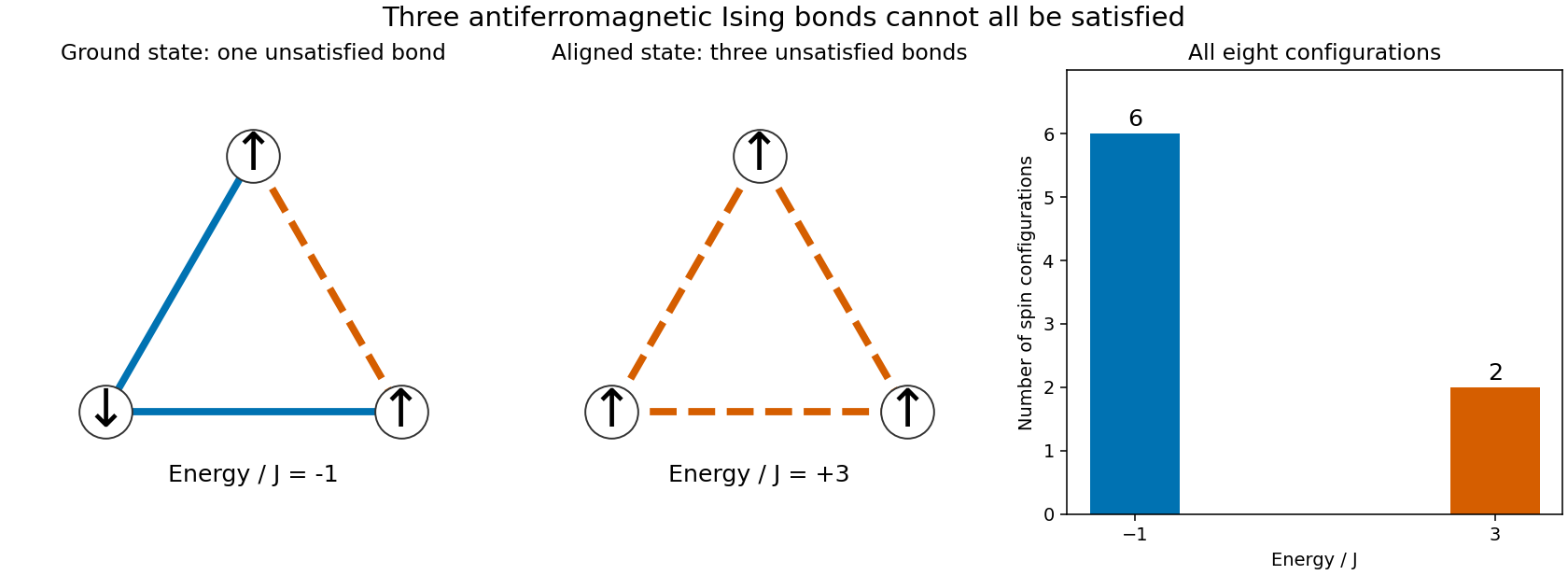
Writing for inverse temperature, the exact partition function and mean internal energy areAt these expressions are smooth: a finite triangle has no thermodynamic phase transition. In zero magnetic field, spin inversion symmetry also gives at every site, even as the Boltzmann distribution concentrates on the six frustrated ground states.
For transverse coupling with equal mode amplitudes , Fermi's golden rule and the oscillator creation operator and annihilation operator givewhere the first index is the final spin and is the density of states per unit angular frequency. Decay creates a quantum and carries the factor ; excitation annihilates one and carries . For nonuniform resonant occupations, is their density-weighted mean.
With a thermal Bose-Einstein distribution, . The two-state master equation therefore has the Boltzmann distribution as its unique stationary populations when . The population deviation relaxes at rate . If there is no resonant coupling, both rates vanish and stationarity does not determine the populations.
Spin relaxation is the approach of nonequilibrium spin populations and coherences toward their equilibrium values through coupling to other degrees of freedom or environmental fluctuations. A spin polarized away from equilibrium can lose its net polarization even when the total angular momentum of the larger closed system is conserved.
For a simple ensemble in a fixed magnetic field, longitudinal relaxation with time restores the population difference along the field, while transverse relaxation with time damps the rotating transverse spin polarization. Static field inhomogeneity can produce an additional reversible spread of precession phases, so an observed free-induction decay time need not equal the intrinsic . Spin-flip scattering changes populations; phase-randomizing processes can also suppress transverse coherence without individual flips. A Hanle spin-precession measurement probes the competition of precession, transport and relaxation.
The spin-rotation coupling contribution to a rotating-frame Hamiltonian couples angular velocity to angular momentum. When discussing spin alone, identify which part of the total angular momentum enters the effective model.
For a spin-one-half ensemble, spin polarization measures unequal occupation or coherent alignment of spin states. A spin-dependent energy splitting does not alone determine the ensemble's response: occupation, temperature and spin relaxation matter. A spin polarization is distinct from a net change of charge density and from the optical polarization of waves.
A spin-spin interaction couples two spin angular momenta. In an isotropic model it is proportional to their dot product, whose expectation in a total-pair-spin state follows from . Magnetic interactions generate examples in atoms and effective colour-magnetic interactions in hadron models.
A spin eigenstate along a specified axis is a simultaneous eigenstate of the squared spin operator and its component . Its eigenvalues are and , where . The axis must be specified because components along different axes generally do not commute. For spin one-half, the two field-axis eigenstates have projections and form the branches of a Stern-Gerlach experiment.
The two-site quantum version of an XY model couples the transverse components of two spin one-half degrees of freedom. In the ordered basis , its only off-diagonal entries are . The parallel states have energies and ; the symmetric and antisymmetric opposite-spin combinations have energies and respectively. The latter is the singlet state. The formulas remain valid at accidental degeneracies.
Bound-state thresholds of a spherical square well by  Codex 0 Created 2026-10-18 Updated 2026-10-20
For a spherical square well of radius , depth and reduced mass , the regular zero-orbital angular momentum solution has reduced radial wavefunction inside and outside. Wavefunction matching at a finite potential step gives , where and . The th radial branch first reaches at , for . A normalizable negative-energy state on that branch requires . Thus exactly one such state exists for ; the new zero-energy -wave solution at the upper equality is not normalizable.
For the first branch, the zero-energy exterior solution has . The regular interior solution is , where is a Spherical Bessel function. Matching logarithmic derivatives gives , or , with . Its first threshold is , so . Higher values of orbital angular momentum increase the positive centrifugal potential, so none can bind below this first -wave threshold. Spin-dependent nuclear forces are absent from this central-well model.
For a solid spherical cap of height cut from a sphere of radius ,Centre the sphere at the origin with the cap on the side . Its cross-section at height is a circle of squared radius . A volume integral in cylindrical coordinates givesThe formula includes caps larger than a hemisphere, when , and the whole solid sphere, when . For the retained region with , set to obtain . Multiplying by uniform mass density gives its mass.
For with integer , the Frobenius method gives or . The general coefficient equation is , taking negative-index coefficients as zero. The regular branch has and . The singular branch has except at . That resonant equation is compatible because its earlier odd coefficient vanishes; the newly free coefficient adds a multiple of the regular solution. Setting it to zero gives a pure even series times , independent of the regular branch, with no logarithmic term. For the resonance occurs already at .
The normalization on the regular branch gives the Spherical Bessel functionIn particular , with removable value one at zero.
A scalar field solving the Helmholtz equation inside a sphere of radius and Laplace's equation outside has a regular interior mode and a decaying exterior mode . Continuity of the field and its radial derivative gives, for ,The Spherical Bessel function recurrence turns this into , not . This elimination does not require division by a possibly vanishing boundary value.
For , and , so the first positive root is . For , the matching condition is , whose first positive root is . The distinction matters when a scalar model permits the monopole sector but a physical multipole model excludes it.
To compare angular sectors, put . Its equation and boundary conditions are , and . Its Rayleigh quotient isBoth added terms are nonnegative and increase with . Thus the lowest scalar eigenvalue is in the sector; if only is admitted, the lowest is in the sector. Zeros at caused by the vanishing normalization of are not additional eigenvalues.
Two spheres with centres and positive radii intersect in a nondegenerate circle exactly under the displayed strict triangle inequalities. Put . Subtracting and gives its plane,The circle centre is , where , and its squared radius is . This is positive exactly under the strict inequalities. Equality gives internal or external tangency; coincident equal spheres have an entire sphere in common rather than a unique intersection circle.
A spherical wedge is the portion of a solid sphere between two meridional half-planes meeting at a dihedral angle , with . Put the common axis along and its azimuthal bisector along . For radius , use spherical coordinates , , . Its volume is .
For constant mass density, reflection symmetries put the centre of mass on the bisector. The first moment isDividing by volume gives . It decreases from the limiting value for an infinitesimal wedge to zero for a full sphere.
The curved boundary is a spherical lune. Its outward vector area is . Indeed, its component has the same angular integrals as the first moment, multiplied by ; the other components cancel by symmetry. Its scalar surface area is , which is generally different from the magnitude of its vector area.
A spectrometer that selects charged particles using the bending of their trajectories in a magnetic field. For a uniform magnetic field of magnitude , the perpendicular momentum component is , where is the electric charge and is the curvature radius of the projected trajectory.
An electron energy analyzer selects electrons by kinetic energy, allowing their count rate to be recorded as an energy scan.
An electron spectrometer measures an electron energy distribution. A time of flight design infers kinetic energy from calibrated travel times.
Near the axis of a solenoid, the magnetic vector potential givesThe radial fringe component enforces the solenoidal magnetic-field constraint. A sharp axial step in must retain this fringe as a distributional field; a purely axial field that jumps to zero violates Gauss's law for magnetism. The hard-edge model is a convenient limit for near-axis trajectories, not a literal monopole sheet.
Pinned article: Introduction to the OurBigBook Project
Welcome to the OurBigBook Project! Our goal is to create the perfect publishing platform for STEM subjects, and get university-level students to write the best free STEM tutorials ever.
Everyone is welcome to create an account and play with the site: ourbigbook.com/go/register. We belive that students themselves can write amazing tutorials, but teachers are welcome too. You can write about anything you want, it doesn't have to be STEM or even educational. Silly test content is very welcome and you won't be penalized in any way. Just keep it legal!
Intro to OurBigBook
. Source. We have two killer features:
- topics: topics group articles by different users with the same title, e.g. here is the topic for the "Fundamental Theorem of Calculus" ourbigbook.com/go/topic/fundamental-theorem-of-calculusArticles of different users are sorted by upvote within each article page. This feature is a bit like:
- a Wikipedia where each user can have their own version of each article
- a Q&A website like Stack Overflow, where multiple people can give their views on a given topic, and the best ones are sorted by upvote. Except you don't need to wait for someone to ask first, and any topic goes, no matter how narrow or broad
This feature makes it possible for readers to find better explanations of any topic created by other writers. And it allows writers to create an explanation in a place that readers might actually find it.
Figure 1. Screenshot of the "Derivative" topic page. View it live at: ourbigbook.com/go/topic/derivativeVideo 2. OurBigBook Web topics demo. Source. - local editing: you can store all your personal knowledge base content locally in a plaintext markup format that can be edited locally and published either:This way you can be sure that even if OurBigBook.com were to go down one day (which we have no plans to do as it is quite cheap to host!), your content will still be perfectly readable as a static site.
- to OurBigBook.com to get awesome multi-user features like topics and likes
- as HTML files to a static website, which you can host yourself for free on many external providers like GitHub Pages, and remain in full control

Figure 2. You can publish local OurBigBook lightweight markup files to either OurBigBook.com or as a static website.
Figure 3. Visual Studio Code extension installation.
Figure 5. . You can also edit articles on the Web editor without installing anything locally. Video 3. Edit locally and publish demo. Source. This shows editing OurBigBook Markup and publishing it using the Visual Studio Code extension. 
- Infinitely deep tables of contents:



All our software is open source and hosted at: github.com/ourbigbook/ourbigbook
Further documentation can be found at: docs.ourbigbook.com
Feel free to reach our to us for any help or suggestions: docs.ourbigbook.com/#contact