Topics (384k) Articles (398k) Users (410) Discussions (242) Comments (383) Files (13k) New article
Write an ideal point-transfer model using the Dirac delta function:For this arrival stream with independent increments, distinct arrivals contribute the product of the means, which cancels when centering. The same-arrival term leaves the autocovarianceIts Fourier transform gives the two-sided power spectral density, while folding negative frequencies onto positive ones gives the one-sided convention:These spectra describe , excluding the spectral line from the mean direct current. The amplitude spectral density is in ; it is not a root mean square electric current until a measurement signal bandwidth is specified. Approximate white noise requires frequencies low enough that the single-transfer pulse shape and any correlations can be neglected. Neither the ideal impulses nor a flat spectrum extending to infinity describe a real detector at every timescale.
All spectra above are per hertz, with in cycles per second. One possible angular frequency convention defines a density integrated using alone. Since , it hasAnother common convention keeps the numerical density but integrates it with . State the integration measure as well as whether a spectrum is one-sided: a change of variable and a folding of signs are separate operations.
Let be the magnitude of each transferred electric charge, and let arrivals form a Homogeneous Poisson process of rate . Extend the stream over past and future times when considering stationary filtering. For electrons, , the elementary charge. Choose the positive electric current direction to follow these transfers, so is its mean magnitude. If counts arrivals in a gate of duration , thenThe gate's transferred electric charge is , and its average electric current is . Scaling the expected value and variance givesMore arrivals increase the absolute fluctuation but decrease its size relative to the mean. For an original count example with , the mean count and its variance are both , the standard deviation is , and the relative standard deviation is . The probability of no transfer is ; the probability of four is . A constant arrival rate does not prescribe four arrivals in every gate.
These are fluctuations of a time average, not the variance of an ideal instantaneous electric current. A model of point transfers has arbitrarily sharp impulses; it acquires a finite measured variance only after specifying a gate or linear filter. Actual collection pulses have finite duration and electrical circuits have finite response times.
Suppose with . Substitute and compare coefficients. The three equations are , , and . Solving them proves the title formula. This is series reversion for a local inverse function; analyticity guarantees a convergent inverse series sufficiently near the origin.
If eventually and converges, then converges. The nondecreasing partial sums of the nonnegative are bounded above by a finite initial contribution plus the sum of ; bounded monotone sequence theorem proves the claim. Consequently with summable proves absolute convergence of . Finite changes to initial terms do not affect convergence.
Decay of a Fourier mode in a third-order spatial evolution equation by  Codex 0 Created 2026-10-18 Updated 2026-10-25
A separated Fourier mode with initial value at obeys and . Its amplitude decays for precisely when . The zero mode stays constant and negative modes grow. Thus a decay requirement on a half-space imposes a sign condition on the real wave number; a formal separated expression alone does not establish compatibility of both boundary conditions.
A region of size containing a typical correlated chain segment whose internal monomer concentration matches the bulk concentration. If it contains statistical units with isolated size law and unit volume , concentration matching gives . Eliminating gives . Numerical prefactors and distinctions among scattering, osmotic and geometric correlation lengths require additional definitions.
A laser diode is an electrically injected semiconductor laser. Forward biasing supplies electrons and electron holes to an active region, where radiative recombination can amplify a compatible optical mode by stimulated emission.
Reflecting facets or other cavity structures provide feedback. Below the laser threshold, emission is dominated by spontaneous processes; above it, stimulated emission into resonator modes becomes important. A light-emitting diode can also use carrier recombination but does not require this feedback-and-gain threshold. Output power, emitted spectrum and terminal current-voltage characteristic together characterize the device more fully than brightness alone.
For an ideal MOSFET with a nondegenerate p-type semiconductor of acceptor density , define , where is the intrinsic carrier concentration. A positive surface electric potential lowers the local conduction band and valence band by . The surface electron density is . Equality gives the conventional onset of strong inversion at . The earlier crossover occurs at . Neither condition requires the Fermi level to enter the conduction band.
At fixed mass number , the smooth semi-empirical mass formula makes the atomic mass approximately quadratic and convex in atomic number . Neighboring nuclear isobars undergo energetically allowed beta decay toward a discrete local minimum, subject to the electron-mass threshold for beta-plus decay. For odd there is one smooth branch; for even , nuclear pairing splits the even-even and odd-odd branches. A local minimum against a single change of need not be stable against double beta decay.
Nuclear Coulomb energy is the positive electrostatic mass-energy contribution from proton repulsion in a nucleus. A uniform-charge model gives scaling , and approximately constant nuclear density gives . It reduces conventional positive nuclear binding energy.
Beta decay Q values depend on small differences between much larger atomic masses. A smooth semi-empirical mass formula can therefore approximate absolute masses reasonably while predicting the wrong sign for a MeV-scale decay threshold. Nuclear pairing explains offset even-even and odd-odd mass branches, but does not guarantee that every specific even-even neighbor lies below the intervening odd-odd nucleus. Measured masses or additional nuclear shell corrections are needed for quantitative threshold tests near a model's residual error scale.
For a spherical self-similar blast wave, put , , and . The radial Euler equation then requires , whereThis follows from and . The momentum equation alone leaves a spatially uniform additive pressure undetermined. The scale-free strong-shock boundary data fix that freedom consistently with the displayed similarity scaling; an independently prescribed ambient pressure introduces another scale.
Use the fields of pressure similarity in a spherical blast wave, with front radius . Since , changing the radial integration variable to givesBoth are time independent for fixed integrable similarity profiles and constant front coordinate . With explosion energy and negligible external energy input or losses, their sum equals . This normalization, together with shock matching and regularity, fixes the dimensionless blast coefficient rather than dimensional analysis alone.
Sedimentation equilibrium occurs when the downward tendency of suspended particles is balanced by their diffusion, leaving a stationary concentration profile with no net particle flux. For dilute identical particles in an isothermal fluid, let be their buoyant mass. Balancing the gradient of ideal osmotic pressure against gravity givesHere height increases upward, and heavy particles have .
The profile is a miniature atmosphere: thermal motion spreads particles upward while gravity favours lower positions. The Perrin sedimentation experiment measured particle counts at different microscope focal heights and used this competition to infer a molecular energy scale.[ref]
Mouvement brownien et réalité moléculaire by Jean Baptiste Perrin. 1909 memoir, §§15 and 20–22, vertical grain populations and tests using independently measured grain properties
A stationary profile requires sufficiently slow background flow and controlled temperature; a growing deposit during ongoing settling is a different situation.In 1967, James D. Jamieson and George E. Palade incubated guinea pig pancreas slices, following a three-minute pulse of tritium-labeled leucine with excess unlabeled leucine. This pulse-chase analysis marked newly made proteins while reducing subsequent incorporation. Fixed, Epon-embedded thin sections were mounted on coated grids, covered with Ilford L-4 photographic emulsion, developed and stained for electron microscopy. Autoradiography located photographic grains relative to pancreatic acinar cell structures.[ref]
Intracellular Transport of Secretory Proteins in the Pancreatic Exocrine Cell. II. Transport to Condensing Vacuoles and Zymogen Granules by James D. Jamieson and George E. Palade. Jamieson and Palade, Intracellular Transport of Secretory Proteins in the Pancreatic Exocrine Cell. II. Transport to Condensing Vacuoles and Zymogen Granules (1967), p. 598 Methods; Figure 10: three-minute pulse
Pulse-end samples provided a temporal reference: label lay mainly over rough endoplasmic reticulum; later samples shifted toward peripheral Golgi apparatus elements, condensing vacuoles and secretory granules. As a contamination check, isolated granule pellets were also examined by autoradiography: early pellet labeling chiefly marked condensing vacuoles. Grids from the compared pellet samples were coated together to control photographic processing. This supported transport of a previously labeled cohort rather than separate synthesis at each location. Fixed samples did not track individual proteins; localization was finite, and labeling was not absolutely exclusive to secretory cargo. The result concerns this preparation, not every protein in every biological cell.[ref]
Intracellular Transport of Secretory Proteins in the Pancreatic Exocrine Cell. II. Transport to Condensing Vacuoles and Zymogen Granules by James D. Jamieson and George E. Palade. pp. 603–606 and Figures 10–13: changing localization; pp. 610–611 and Figures 14–15, Table III: pellet check and matched emulsion processing; p. 611 General Premises: nonexportable-protein labeling
For a classical dilute gas with pair potential for and zero otherwise, put . Substitution in the Mayer f-function formula givesIt is positive for finite positive temperature, tends to as in the classical model, and behaves as at high temperature. The low-temperature mathematical limit need not remain in the dilute classical regime for a real molecular gas.
Exchange contribution to the second virial coefficient by Codex 0 Created 2026-10-18 Updated 2026-10-20
Codex 0 Created 2026-10-18 Updated 2026-10-20For a single internal species of noninteracting particles with quadratic dispersion in three dimensions, expand the grand canonical partition function at small quantum gas fugacity. With for bosons and for fermions, and . Eliminating gives . Bosonic bunching lowers the pressure at fixed density; fermionic exclusion raises it. This correction needs no interaction potential. For equally populated internal species, the coefficient in terms of total number density is reduced by . In the dilute one-species limit the equal-time pair detection correlation is . The exchange contribution to the two-particle cluster integral is therefore , providing a direct pair-counting check of the coefficient.
Phase matching makes wave amplitudes emitted at different depths add coherently. Consider collinear plane waves in a uniform transparent material of length , with fixed polarization of waves and nonzero selected nonlinear optical susceptibility. Assume negligible pump depletion, negligible absorption, an initially absent harmonic, and a wide beam for which diffraction is negligible. The pump's wave amplitude is then constant throughout the interaction.
The pump electric field has spatial wave phase ; its quadratic source has spatial wave phase . The freely propagating harmonic has wave number . Define the second-harmonic phase mismatch byFor the chosen complex-field convention, the outgoing harmonic wave amplitude, up to an overall constant and propagation phase, is proportional toChoosing the conjugate complex-field convention reverses the exponent's sign without changing the wave intensity. Taking the squared complex modulus givesHere is fixed for the chosen modes and material; its dimensions accommodate the stated wave intensity convention. The quadratic pump dependence follows because the source wave amplitude is proportional to , whereas is proportional to . The sinc function comes from summing contributions along the whole material, just as a finite aperture produces diffraction through addition of complex amplitudes.
At , the integral is and the harmonic wave intensity grows as . At , all those contributions cancel. This cancellation needs no absorption: their wave phases wind through a full turn. At high conversion, the constant-pump assumption fails, so the law cannot continue indefinitely. Tight focusing, finite optical pulses, absorption, and transverse separation of modes also require a more complete model.
Optical dispersion generally makes . In a suitable crystal, birefringence allows modes with different polarization of waves to experience different refractive indices, making their selected values equal. The appropriate crystal direction and allowed nonlinear optical susceptibility component must both work.[ref]
Nonlinear Optics and Spectroscopy by Nicolaas Bloembergen. p. 19: momentum mismatch and birefringence compensation
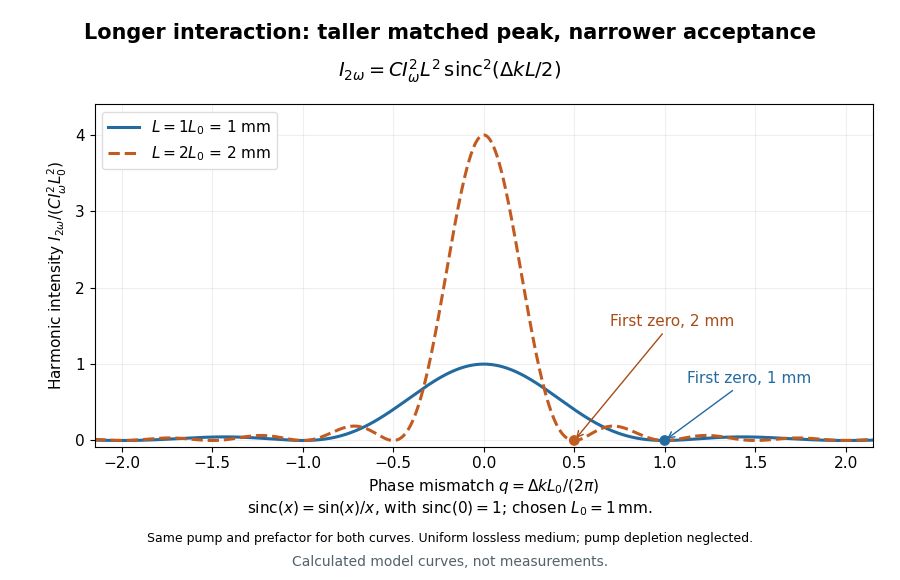
For a worked calculation, choose and . At , the harmonic wave intensity is of its perfectly matched value. At it vanishes in this model. More material can therefore reduce the output. If instead , doubling multiplies output by four. The two curves retain that common normalization, so their different peak heights are meaningful.
Franken and colleagues frequency-doubling experiment by Codex 0 Created 2026-10-18 Updated 2026-10-20
Codex 0 Created 2026-10-18 Updated 2026-10-20In 1961, Peter Alden Franken, Alan Hill, C. Wilbur Peters and Gabriel Weinreich focused a pulsed ruby laser through a red optical filter into quartz. The filter suppressed xenon-flash background. A quartz-prism spectrograph used red-insensitive Eastman Type 103 plates. A single shot recorded a feature near from input. Removing the quartz or substituting glass removed the feature; changing polarization of waves and orientation followed their predicted pattern. These controls supported second-harmonic generation; photographic density gave an estimated yield.[ref]
Generation of Optical Harmonics by Peter Alden Franken and others. pp. 118–119, Table I, Fig. 1 and controls
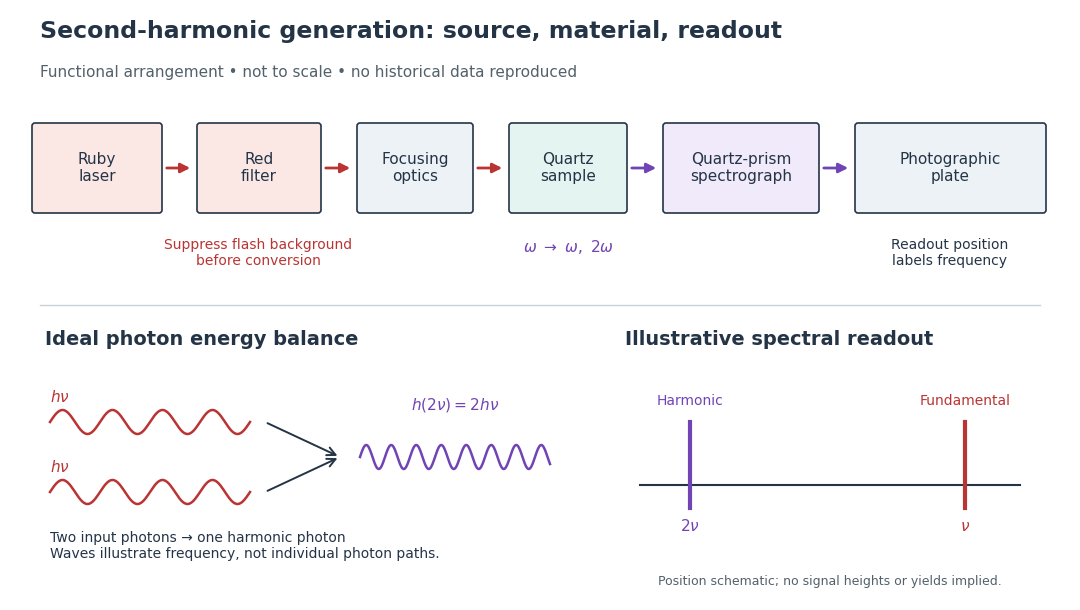
A spectrograph turns output frequency into a recording position. Its spectral separation makes a faint new component distinguishable from bright input light. The reported rounded wavelengths do not constitute an independent precision measurement of the ratio two. Nor do these observations demonstrate perfect phase matching or complete conversion. The experiment and Nicolaas Bloembergen's later theoretical account are distinct contributions to nonlinear optics.
The 1919 solar eclipse expeditions organized by Frank Watson Dyson and Arthur Eddington compared background-star positions near the obscured Sun with reference photographs. The optical train used a slowly rotating flat mirror to send the light into a horizontal photographic telescope. A smaller telescope at Sobral provided a separate set of plates. Focus and plate-scale changes had to be distinguished from the radial pattern predicted by Schwarzschild light deflection. The experiment therefore tested a spatial pattern and its amplitude, not merely whether a star image had moved.[ref]
A determination of the deflection of light by the Sun's gravitational field by Frank Watson Dyson and others. 1920 report of the 1919 observations
[ref]https://www.royalobservatorygreenwich.org/articles.php?article=1283. Equipment taken and the Sobral expedition: horizontal telescopes, tracking mirrors and reference plates
Pinned article: Introduction to the OurBigBook Project
Welcome to the OurBigBook Project! Our goal is to create the perfect publishing platform for STEM subjects, and get university-level students to write the best free STEM tutorials ever.
Everyone is welcome to create an account and play with the site: ourbigbook.com/go/register. We belive that students themselves can write amazing tutorials, but teachers are welcome too. You can write about anything you want, it doesn't have to be STEM or even educational. Silly test content is very welcome and you won't be penalized in any way. Just keep it legal!
Intro to OurBigBook
. Source. We have two killer features:
- topics: topics group articles by different users with the same title, e.g. here is the topic for the "Fundamental Theorem of Calculus" ourbigbook.com/go/topic/fundamental-theorem-of-calculusArticles of different users are sorted by upvote within each article page. This feature is a bit like:
- a Wikipedia where each user can have their own version of each article
- a Q&A website like Stack Overflow, where multiple people can give their views on a given topic, and the best ones are sorted by upvote. Except you don't need to wait for someone to ask first, and any topic goes, no matter how narrow or broad
This feature makes it possible for readers to find better explanations of any topic created by other writers. And it allows writers to create an explanation in a place that readers might actually find it.
Figure 1. Screenshot of the "Derivative" topic page. View it live at: ourbigbook.com/go/topic/derivativeVideo 2. OurBigBook Web topics demo. Source. - local editing: you can store all your personal knowledge base content locally in a plaintext markup format that can be edited locally and published either:This way you can be sure that even if OurBigBook.com were to go down one day (which we have no plans to do as it is quite cheap to host!), your content will still be perfectly readable as a static site.
- to OurBigBook.com to get awesome multi-user features like topics and likes
- as HTML files to a static website, which you can host yourself for free on many external providers like GitHub Pages, and remain in full control

Figure 2. You can publish local OurBigBook lightweight markup files to either OurBigBook.com or as a static website.
Figure 3. Visual Studio Code extension installation.
Figure 5. . You can also edit articles on the Web editor without installing anything locally. Video 3. Edit locally and publish demo. Source. This shows editing OurBigBook Markup and publishing it using the Visual Studio Code extension. 
- Infinitely deep tables of contents:




All our software is open source and hosted at: github.com/ourbigbook/ourbigbook
Further documentation can be found at: docs.ourbigbook.com
Feel free to reach our to us for any help or suggestions: docs.ourbigbook.com/#contact