Topics (384k) Articles (398k) Users (410) Discussions (242) Comments (383) Files (13k) New article

An unusually extreme noisy observation tends to be followed by a less extreme observation even without intervention. Selecting locations for an intervention because they had high prior event counts can therefore bias a simple before-and-after comparison toward an apparent reduction. The effect follows from conditioning on an extreme value with a transient random component, rather than from a causal treatment effect.
An outlier is an observation unusually far from the behavior expected under a statistical model. A large regression residual can identify a candidate, but data validation, regression leverage, and the possibility of model misspecification should be examined before excluding it. An outlier need not be an influential observation.
Nonlinear regression fits a conditional mean whose dependence on its parameters is nonlinear. In a normal distribution observation model, the likelihood is based on residuals . Nonlinearity can create parameter trade-offs, asymmetric uncertainty and several posterior regions, so prior predictive checks and Markov chain Monte Carlo convergence diagnostics can be especially useful.
Mark and recapture estimates the cardinality of a finite set of individuals when counting everybody is impractical. The useful information is the overlap between observations: with fixed sample sizes, finding many of the same individuals again suggests a smaller population, while finding few suggests a larger one. More elaborate capture-recapture models also estimate survival and changing probabilities of detection.
In a closed-population capture-recapture model, let be the unknown population cardinality. Capture distinct individuals, mark them, release them all, and allow them to mix with the rest. Next take a second sample of distinct individuals using sampling without replacement, and count the individuals carrying a mark. The observed marked fraction estimates the population's marked fraction , giving the Lincoln-Petersen estimatorRelease happens between the two samples; sampling without replacement means that an individual is counted at most once within the second sample. See Richard J. Barker, Open Population Mark-Recapture Models, §1.1.1.
For a constructed teaching example, mark individuals and later capture , including marked individuals. One fifth of the second sample is marked, suggesting that the twenty marked individuals are one fifth of the population:Let and be the sets of individuals in the first and second samples. Their intersection has cardinality five. By the inclusion-exclusion principle, the set union containsThus is an observed lower bound, whereas is the output of an estimator based on the capture-recapture model. These are toy counts, not measurements from a medical or ecological study.
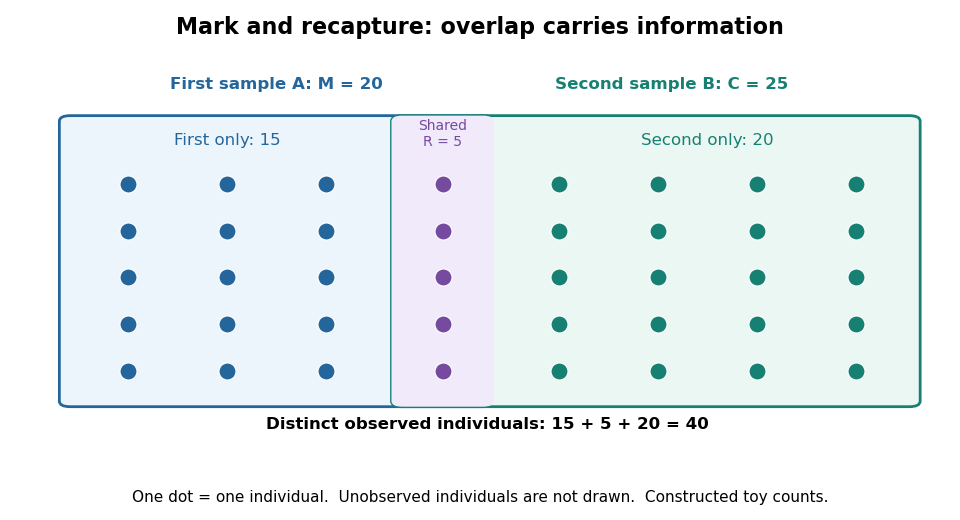
Forty distinct observed individuals: fifteen in the first sample only, five shared, and twenty in the second sample only
. Details. The diagram shows only observed individuals. It does not draw an assumed population of one hundred. The capture-recapture model uses the overlap to infer how many individuals may have escaped both samples; its likelihood function shows why one estimator output cannot describe all that uncertainty.
Regression analysis studies how a response variable depends on explanatory variables through a regression model. It estimates that dependence and assesses uncertainty in fitted regression coefficients, predictions and model comparisons. Linear regression is one important case.
Statistical reflection symmetry means that the joint distributions of a random field are unchanged by a simultaneous spatial reflection, with each field component transformed according to its vector or pseudovector character. For an isotropic magnetic field, it excludes a parity-odd magnetic helicity contribution to the two-point spectral tensor.
A functional statistic evaluates a statistical functional at the empirical distribution . The map acts on distributions, whereas is a statistic. If has an asymptotic linear representation, thenA square-integrable influence function with mean zero consequently gives asymptotic variance by the central limit theorem.
A ratio estimator divides one statistic by another, for example an estimated joint moment by an estimated marginal probability. Its definition must specify what happens when the denominator is zero. A denominator bounded away from zero permits direct error bounds through .
A measurable choice of an action from observed data, with a randomized rule allowing a conditional distribution of actions. Its performance under a loss function is the risk function . Admissibility compares risks pointwise, Bayes optimality integrates risk under a prior, and minimax optimality minimizes the worst-case risk.
A prior on a parameter, a conditional observation distribution, an action space and a loss specify a Bayesian decision problem. The normal form minimizes prior expected loss over decision rules; the extensive form minimizes posterior expected loss after each observation. Conditional expectation gives the same Bayes risk for these formulations, provided measurable optimal or approximate choices can be made.
Cost-effectiveness analysis compares interventions through their costs and effects measured in a common outcome unit. Let and denote mean differences relative to a specified comparator. A positive effect increment with nonpositive cost increment gives dominance; the reverse signs give a dominated intervention. A tradeoff in the positive-positive quadrant requires a willingness-to-pay threshold per outcome unit. Randomized controlled trials can estimate these differences, but their joint sampling distribution is needed to express uncertainty. Outcome units, time horizon and costing perspective must be specified; a survival-day increment is not automatically a quality-adjusted outcome.
If sample transformations preserve the model and both hypotheses, the invariance principle restricts attention to tests whose decisions are unchanged by those transformations. Such tests are functions of a maximal invariant. In estimation, the analogous requirement is equivariance, accompanied by an invariant loss function so that risks transform compatibly. The principle respects symmetries; it does not by itself prove optimality among all unrestricted procedures.
A statistic is complete for a parameter family if the displayed implication holds for every measurable integrable under all parameter values. This property does not itself assert sufficiency; a complete sufficient statistic has both properties. A nonconstant unbiased estimator of a known constant provides a direct obstruction to completeness.
A timelike Killing vector with hypersurface orthogonality admits local coordinates with and . The only connection coefficients with time indices that can be nonzero are and . Substitution into the Ricci tensor gives . Thus has only its time component and is proportional to . Equivalently . This local statement does not require the Vacuum Einstein equations and is independent of the overall curvature-sign convention.
In units , a smooth Wick rotation of the four-dimensional static patch of de Sitter spacetime has Euclidean time period . Its compact geometry is a round four-sphere of radius . The Einstein field equations give , and direct integration gives volume , hence gravitational Euclidean action . With zero assigned internal energy, gives Bekenstein-Hawking entropy .
In a linear Gaussian state-space model, let the predicted state mean and covariance be . The observation innovation process has conditional mean zero and covariance , with innovation . The conditional multivariate normal distribution gives the predictive observation density. Multiplying these conditional densities by the chain rule gives the displayed likelihood function; equivalently the innovations are independent Gaussian vectors. The Kalman filter supplies recursively, so one evaluates the exact observed-data likelihood function without integrating all latent states jointly.
The latent state follows a random walk, while observations add independent measurement noise. If the two noises have variances , the differences have autocovariances at lag zero, at lag one, and zero at larger lags. For , write and . The differenced process is an invertible moving-average model with coefficient and innovation variance . Its level has a unit root.
For an autoregressive moving-average model of order , this state has observation row and transition matrixThe state noise is . Its first transition row reconstructs and its third row shifts the previous white noise value.
A gas is a fluid that expands to occupy its available container and is readily compressed compared with an ordinary liquid. Its pressure reflects microscopic momentum transfer to boundaries. In a sufficiently dilute classical gas, molecular separation is large enough that the ideal gas law can approximate its equilibrium response.
A real gas can depart from that law because intermolecular interactions and finite molecular size become significant. Compressing a gas or changing its temperature therefore tests an equation of state, rather than a universally exact proportionality. A vapor is the gaseous form of a substance under conditions where a condensed phase can be reached by suitable compression or cooling. The same substance can pass continuously between liquid-like and gas-like states around its liquid-gas critical point, so a complete phase description requires a phase diagram as well as the broad word gas.
A liquid flows under a sustained shear stress while usually resisting a change of volume much more strongly than a gas. It adopts the shape of a container but, when it coexists with a gas and gravity permits, can form a free surface rather than expanding to fill all available space. These are mechanical observations, not a requirement that every liquid be exactly incompressible.
At rest in a uniform gravitational field, a liquid develops the hydrostatic pressure variation needed to support its weight. During flow, viscosity relates rate of deformation to viscous stress for a Newtonian fluid. Releasing a small surface disturbance probes its dynamical response through gravity waves and surface tension. Thus its static pressure, resistance to rapid compression and resistance to shear rate are distinct measurable properties. Liquid and gas can also connect continuously around a liquid-gas critical point, so the broad labels do not imply a first-order boundary along every thermodynamic path.
Pinned article: Introduction to the OurBigBook Project
Welcome to the OurBigBook Project! Our goal is to create the perfect publishing platform for STEM subjects, and get university-level students to write the best free STEM tutorials ever.
Everyone is welcome to create an account and play with the site: ourbigbook.com/go/register. We belive that students themselves can write amazing tutorials, but teachers are welcome too. You can write about anything you want, it doesn't have to be STEM or even educational. Silly test content is very welcome and you won't be penalized in any way. Just keep it legal!
Intro to OurBigBook
. Source. We have two killer features:
- topics: topics group articles by different users with the same title, e.g. here is the topic for the "Fundamental Theorem of Calculus" ourbigbook.com/go/topic/fundamental-theorem-of-calculusArticles of different users are sorted by upvote within each article page. This feature is a bit like:
- a Wikipedia where each user can have their own version of each article
- a Q&A website like Stack Overflow, where multiple people can give their views on a given topic, and the best ones are sorted by upvote. Except you don't need to wait for someone to ask first, and any topic goes, no matter how narrow or broad
This feature makes it possible for readers to find better explanations of any topic created by other writers. And it allows writers to create an explanation in a place that readers might actually find it.
Figure 1. Screenshot of the "Derivative" topic page. View it live at: ourbigbook.com/go/topic/derivativeVideo 2. OurBigBook Web topics demo. Source. - local editing: you can store all your personal knowledge base content locally in a plaintext markup format that can be edited locally and published either:This way you can be sure that even if OurBigBook.com were to go down one day (which we have no plans to do as it is quite cheap to host!), your content will still be perfectly readable as a static site.
- to OurBigBook.com to get awesome multi-user features like topics and likes
- as HTML files to a static website, which you can host yourself for free on many external providers like GitHub Pages, and remain in full control

Figure 2. You can publish local OurBigBook lightweight markup files to either OurBigBook.com or as a static website.
Figure 3. Visual Studio Code extension installation.
Figure 5. . You can also edit articles on the Web editor without installing anything locally. Video 3. Edit locally and publish demo. Source. This shows editing OurBigBook Markup and publishing it using the Visual Studio Code extension. 
- Infinitely deep tables of contents:



All our software is open source and hosted at: github.com/ourbigbook/ourbigbook
Further documentation can be found at: docs.ourbigbook.com
Feel free to reach our to us for any help or suggestions: docs.ourbigbook.com/#contact