Topics (384k) Articles (398k) Users (410) Discussions (242) Comments (383) Files (13k) New article
For the constant-coefficient model with and , the zero equilibrium point is asymptotically stable if and only if . For positive , perturbations are measured by the supremum norm of the initial history of delayed feedback; in the stable regime, every continuous history produces a solution tending to zero. At equality, nondecaying sinusoids prevent asymptotic stability. For , growing oscillatory solutions exist. These statements concern this ideal linear time-invariant system, rather than an arbitrary controlled plant. The corresponding linear equation and its threshold are developed in Cain and Reynolds, section 6.4, pages 174–177.
Substitute the exponential function , allowing a complex number . The characteristic equation isFor positive feedback delay this is not a characteristic polynomial: it has infinitely many roots. A root's real part determines growth or decay of its exponential mode, and its imaginary part determines the angular frequency. To find the first boundary, set with and use Euler's formula:The smallest positive crossing is and . Thus at the complex conjugate roots are . In fact, with the matching initial history of delayed feedback,solves the delay differential equation exactly: a quarter-cycle feedback delay turns the past displacement into precisely the current derivative. Its cycle lasts . The amplitude is arbitrary; this linear model does not select a finite-amplitude oscillation.
The roots cross toward growth as feedback delay increases. Differentiating the characteristic equation at fixed givesThis calculation identifies the direction of the first destabilization. The full threshold also requires ruling out earlier unstable roots: if with and , the characteristic equation implies and , hence . A real nonnegative root is impossible because there. This supplies the geometric reason the threshold is a quarter-cycle rather than an arbitrary fitting constant.
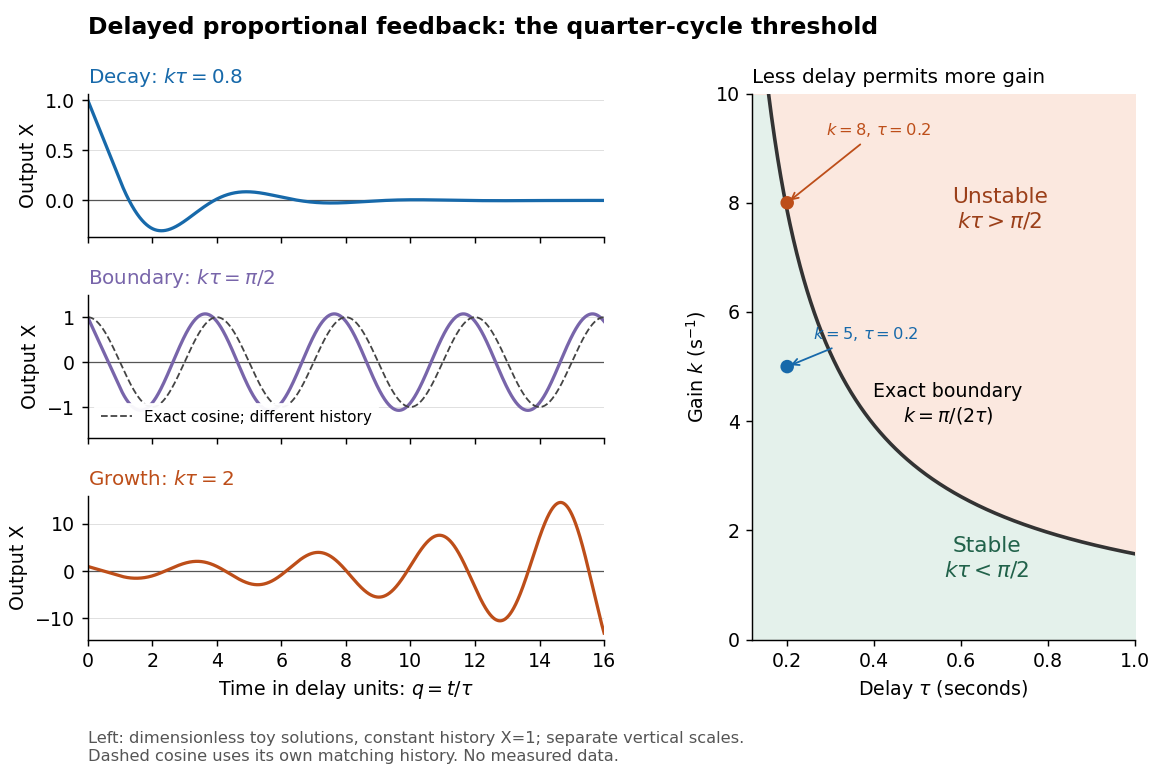
Feedback delay separates decay, persistent oscillation, and growth
. Left: numerical solutions with the same constant initial history of delayed feedback on , plotted against for , , and . The middle trajectory includes a transient because this history is not a pure sinusoid; the dashed curve is a separate exact solution with history . Each row has its own vertical scale. Right: the exact boundary for positive feedback gain and feedback delay. Toy responses are not measured data. The generator uses the classical fourth-order Runge-Kutta method with linear interpolation of delayed values and , checked against a separately evaluated exact finite sum and two coarser steps. Details.The tradeoff is concrete. Without feedback delay, increasing shortens the exponential decay time constant . With known , the same proportional control must satisfy . For , the threshold is : is stable and is unstable. A design close to the boundary leaves little room for additional feedback delay; reducing or reducing measurement latency increases that room. The zero-delay time constant is only a comparison scale, not the decay time of the delayed response. Frank discusses the gain–delay compromise in Control Theory Tutorial, section 13.4 and figure 13.3.
For positive feedback delay , an initial condition at a single instant is insufficient. Prescribe a continuous function throughout : for , the derivative depends on . A right derivative at is understood; the earlier history need not itself obey the subsequent control law. Once this first interval is computed, it supplies the delayed values for the next interval. This successive integration is the method of steps for a delay differential equation. [ref]
https://math1um.github.io/Teaching/cain-reynolds-odes.pdf#page=174. John W. Cain and Angela M. Reynolds, Ordinary and Partial Differential Equations, sections 6.1 and 6.2: history and the method of steps
For the constant initial history of delayed feedback , direct integration givesFor , , the plant output crosses zero at , while its measured output remains positive until . At , the delayed command therefore increases the magnitude of the actual deviation. This short exact calculation explains the first diagram without relying on a numerical approximation.
A Fatou component is a connected component of the Fatou set of a rational map. It is open. A rational map sends each Fatou component onto another one: complete invariance of the Fatou set puts it inside the inverse image of the target component; its maximal connectedness makes it one full inverse-image component. Restricting the globally proper sphere map to such a component is proper, since the inverse image of a compact subset intersected with the component is closed in a compact set. Its image is both open and closed in the connected target component, hence the whole target. A component is periodic if some iterate returns it to itself.
Under random mating and Hardy-Weinberg equilibrium, label each parental allele by whether it is transmitted. Let and be the transmitted/untransmitted pairs of two parents. Before ascertainment all four draws are independent with population frequencies . If offspring disease weights the transmitted pair by , thenThe transmitted pair is an affected-case genotype and the untransmitted pair a population family pseudo-control genotype under this homogeneous model. For unordered genotypes, compatible labelled transmissions must be summed. Conditioning on parental genotypes instead removes nuisance population frequencies and gives the usual transmission disequilibrium test.
// Target: statistical-modelling.bigb
A falling free surface does not instantaneously dry previously wetted rigid walls. Thin films remain above the bulk liquid and drain under the component of gravitational acceleration parallel to the walls. For a film of thickness over a wetted distance , falling film flow gives a speed of order , hence at late times for an order-one wall angle. These films can be visible in a cross-section while holding asymptotically negligible volume. In a V-shaped channel gravity current, local bulk depth falls only as ; at a fixed nonzero station with a finite previous maximum wetted height, film volume decays as while bulk-sectional volume decays as . Thus the film does not change the leading spreading law.
Two-layer falling film of equal-density viscous fluids by  Codex 0 Created 2026-10-14 Updated 2026-10-18
Let the lower fluid have thickness and viscosity , and the upper fluid thickness and viscosity , with common density . For steady flow down a plane inclined at angle , set , . The common hydrostatic pressure is . No slip at the wall, continuous velocity and shear stress at , and zero upper surface shear give and . These follow by integrating in each layer. The stress applied to the lower fluid equals the downslope weight of the upper layer, independent of its viscosity; the upper viscosity affects its shear rate but not that transmitted stress.
Relative to an ordered factor base , a positive integer has exponent vector . Multiplication of such integers adds their exponent vectors. Reducing every coordinate modulo two gives the parity vector used to find congruences of squares. The ordering and any sign coordinate must be used consistently across all rows.
The supergravity F-term potential on the inflationary branch has the displayed exact form. Its expansion is , so the inflaton quadratic mass cancels at tree level for this canonical model. For its derivative is ; the branch is therefore a transverse valley, not a stationary supersymmetry-breaking vacuum.
In the small-field global approximation, the waterfall fluctuations on have the displayed masses. One becomes negative when , driving the fields towards the supersymmetric vacuum branch. In the canonical supergravity model, the exact masses follow from expanding the exponential and Kähler-covariant derivatives; their Planck-suppressed corrections should not be discarded unless the corresponding field and symmetry-breaking scales are small.
For nonzero and , these field values give and all Kähler covariant derivatives of a superpotential zero, hence zero supergravity auxiliary fields and zero vacuum energy. With only the supplied chiral fields, the product condition gives a complex vacuum manifold rather than one isolated point. A specified gauged opposite-charge symmetry can add a D-flatness condition and a gauge quotient, but no such gauge sector should be invented from the field labels alone.
Let be an integer and let be independent and identically distributed random variables with an exponential distribution of rate . Their sample maximum is nonnegative. Substituting the exponential distribution's cumulative distribution function into the distribution functions of independent minima and maxima gives the exact lawFor example, at each observation is below the threshold with probability , but all observations are below it with probability . Thus an individual observation's median becomes an increasingly unlikely upper bound for the whole batch. The general order statistic density in Siegrist's treatment, with , also gives this law on integration. [ref]
https://www.randomservices.org/random/sample/OrderStatistics.html. Siegrist, Random Services: exponential order statistics
.Solving gives the exact quantile function, for ,In a toy model with , the median maximum is seconds for , seconds for , and seconds for . All three use the exact distribution function; the increase comes from taking a maximum over more observations. The case connects to the existing maximum of two exponentials as a scaled sum.
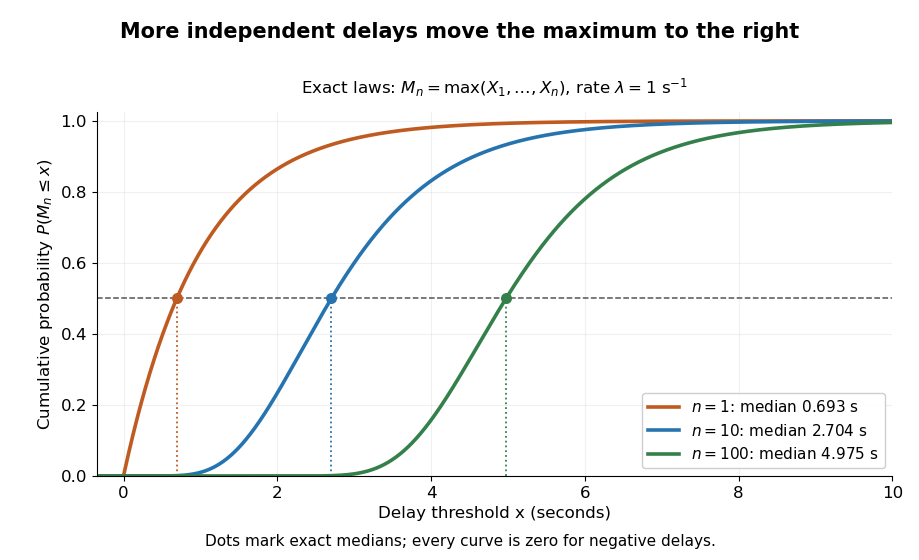
Exact cumulative distribution functions of exponential sample maxima, with rate one per second and median markers
. Details. The Gumbel distribution explains the logarithmic shift visible here: after subtracting and measuring deviations in units of , the distribution functions approach one fixed shape. The next derivation makes that convergence in distribution explicit.
For the real l-infinity sequence space, every coordinate of an extreme point must be an endpoint of ; any slack coordinate permits opposite perturbations. For the real absolutely summable sequence space, a unit vector with two nonzero coordinates permits a transfer of mass between them, so only signed coordinate vectors are extreme. For the real l2 sequence space, the parallelogram law makes every unit vector extreme. In all three cases interior points of the unit ball are nonextreme.
How many edges can we retain while excluding a prescribed clique? For integers and , every simple graph on vertices containing no complete subgraph satisfiesEquality holds exactly for the Turán graph , up to graph isomorphism. Thus the extremal number is .[ref]
For example, has independent sets of sizes and edges, as counted in Turán graph. It contains triangles in a graph, but no four-vertex clique. Consequently any simple graph on eight vertices with edges contains , while edges alone do not force one. Excluding larger cliques permits denser graphs; Mantel theorem is precisely the first nontrivial case.
A short proof outline uses Zykov symmetrization. If an extremizer is not a complete multipartite graph, it has vertices with absent and present. If either or has larger vertex degree than , clone that vertex in place of . Otherwise replace both by nonadjacent clones of , gaining edges. Both contradict extremality; balancing the resulting at most parts gives .[ref]
The vertex cloning in a graph step preserves clique exclusion because any clique using a clone can substitute its original vertex; nonadjacent clones cannot occur together in a clique. At most parts can be nonempty, since selecting one vertex from each gives a clique. If fewer than parts are nonempty and one has at least two vertices, splitting it creates more edges, so it cannot be extremal. For the bound is zero. For , the Turán graph is , and the bound is the total possible edges.
At a degenerate static horizon the Euclidean proper radial distance diverges logarithmically, so the horizon is an infinite end rather than a finite polar origin. Its time circle is not contracted at a conical tip, and local cone regularity imposes no finite period. The vanishing limiting surface gravity determines zero Hawking temperature; the simple-horizon periodicity argument must not be applied unchanged at the degenerate root.
A closed differential form satisfies ; an exact differential form has . The identity makes every exact form closed. Global failure of the converse is measured by de Rham cohomology; the Poincaré lemma gives the local converse in positive degrees.
At a double-zero eigenvalue with centre equations , to linear order, stable filters and have the displayed quadratic centre manifold graphs. Solving gives . Under the weighted scaling , , the graph term affects an coupling only at order .
// Target: dynamical-systems.bigb
The square of a number is the product . For a real number, it is nonnegative. The sum of squares of real coordinates is the squared Euclidean norm of the corresponding vector.
An exponent specifies the power in exponentiation: in , is the base and is the exponent. For a positive integer exponent, . For a positive real number base, a real exponent is defined by using the exponential function and natural logarithm. The Lp norm uses its exponent to determine how strongly large absolute values affect the result.
For in the finite field , put . The multiplicative group of a finite field is cyclic, and character orthogonality expresses the number of th roots of as . The trivial character contributes , cancelling the term. Each of the remaining Gauss sums of Dirichlet characters has modulus , by the prime-field character Gauss sum identity. Consequently .
Pinned article: Introduction to the OurBigBook Project
Welcome to the OurBigBook Project! Our goal is to create the perfect publishing platform for STEM subjects, and get university-level students to write the best free STEM tutorials ever.
Everyone is welcome to create an account and play with the site: ourbigbook.com/go/register. We belive that students themselves can write amazing tutorials, but teachers are welcome too. You can write about anything you want, it doesn't have to be STEM or even educational. Silly test content is very welcome and you won't be penalized in any way. Just keep it legal!
Intro to OurBigBook
. Source. We have two killer features:
- topics: topics group articles by different users with the same title, e.g. here is the topic for the "Fundamental Theorem of Calculus" ourbigbook.com/go/topic/fundamental-theorem-of-calculusArticles of different users are sorted by upvote within each article page. This feature is a bit like:
- a Wikipedia where each user can have their own version of each article
- a Q&A website like Stack Overflow, where multiple people can give their views on a given topic, and the best ones are sorted by upvote. Except you don't need to wait for someone to ask first, and any topic goes, no matter how narrow or broad
This feature makes it possible for readers to find better explanations of any topic created by other writers. And it allows writers to create an explanation in a place that readers might actually find it.
Figure 1. Screenshot of the "Derivative" topic page. View it live at: ourbigbook.com/go/topic/derivativeVideo 2. OurBigBook Web topics demo. Source. - local editing: you can store all your personal knowledge base content locally in a plaintext markup format that can be edited locally and published either:This way you can be sure that even if OurBigBook.com were to go down one day (which we have no plans to do as it is quite cheap to host!), your content will still be perfectly readable as a static site.
- to OurBigBook.com to get awesome multi-user features like topics and likes
- as HTML files to a static website, which you can host yourself for free on many external providers like GitHub Pages, and remain in full control

Figure 2. You can publish local OurBigBook lightweight markup files to either OurBigBook.com or as a static website.
Figure 3. Visual Studio Code extension installation.
Figure 5. . You can also edit articles on the Web editor without installing anything locally. Video 3. Edit locally and publish demo. Source. This shows editing OurBigBook Markup and publishing it using the Visual Studio Code extension. 
- Infinitely deep tables of contents:




All our software is open source and hosted at: github.com/ourbigbook/ourbigbook
Further documentation can be found at: docs.ourbigbook.com
Feel free to reach our to us for any help or suggestions: docs.ourbigbook.com/#contact