Topics (384k) Articles (398k) Users (410) Discussions (242) Comments (383) Files (13k) New article
In the small-amplitude slender-body theory approximation, an undulating swimmer accelerates an added mass of fluid per unit length . With and transverse displacement , the lateral force on the body is . Its reaction on the fluid has the opposite sign. For a periodic stroke and the usual negligible leading-edge added-mass contribution, the mean trailing-edge thrust is . This is a reactive inertial model, distinct from viscous resistive-force theory.
Gyrotaxis is the orientation response of swimming cells to the competition between gravity-induced torque and fluid rotation. A bottom-heavy spherical cell tends to point upward in still fluid, while ambient vorticity rotates it. The response changes the mean swimming direction and can focus cells or contribute to bioconvection.
If is the cell number density, the fluid velocity, the mean swimming velocity, and an isotropic translational diffusion coefficient, conservation is . Impermeable boundaries have zero normal total cell flux. For constant cell volume , the volume fraction is and obeys the same equation, but its buoyancy coefficient has no additional factor .
Bioconvection is buoyancy-driven fluid motion generated by a nonuniform concentration of swimming microorganisms. Upward swimming can create a dense upper layer, while a disturbance redistributes the cells and drives overturning. A cell conservation equation coupled to incompressible Newtonian fluid dynamics describes its linear stability under an appropriate dilute-suspension approximation.
Phototaxis is directed organism motion in response to light. An ideal spherical swimmer subject to light torque and rotational resistance aligns towards the light while ambient vorticity rotates it. Its deterministic orientation satisfies . The right-hand side is perpendicular to and preserves its unit length.
A volume conductor is a conducting three-dimensional medium through which electric currents flow. In the quasistatic bioelectric model, the total current density is , comprising an impressed source current and its Ohmic return current. Electric charge conservation gives . An insulating boundary has zero normal total current.
For an integer and any integer , Pascal's rule holds with the convention outside . The boundary values are , including . Initialize row zero separately: the recurrence relation does not require binomial coefficients with top index .[ref]
Discrete Mathematics: An Open Introduction (3rd edition) by Oscar Levin. §1.2, Recurrence relation for binomial coefficients and Pascal's Triangle: edge values and the two-parent rule
Proof by a marked element. Count the -element subsets of , marking the element as special. Those omitting are exactly the -element subsets of . From those containing , delete to obtain the -element subsets of that same smaller set; adjoining reverses this operation. The rule of sum adds these two disjoint counts. The proof includes and because the impossible class contributes zero.
For an original worked instance, choose three labels from and mark . Omitting it gives selections. Including it leaves two labels to choose from the other six, giving . Therefore . Under the bijection with north-east lattice paths to , membership of position seven says whether the final step is north: the marked-element split becomes the last-step split.
This makes Pascal's rule useful beyond an algebraic identity. A counting problem may have an obvious yes-or-no decision even when its factorial formula is obscure; splitting at that decision exposes a recurrence relation. When the smaller counts are shared between many cases, dynamic programming reuses them. The beauty of Pascal's triangle is that one local addition rule simultaneously organizes subsets, binary strings, north-east lattice paths, and the binomial theorem.
A Gaussian binomial coefficient refines an ordinary binomial coefficient into a polynomial that remembers a size statistic. For nonnegative integers and , writeThe product represents a polynomial; it is not an instruction to divide by zero when or a denominator vanishes. The Gaussian binomial coefficient recurrence gives a way to compute it with only addition and multiplication. The empty product for is one, and as well. Setting after obtaining the polynomial recovers .
For example,At this gives six objects, but its coefficients reveal how those six objects are distributed across sizes : there are two of size two and one of each other size. The lattice-path interpretation of Gaussian binomial coefficients makes that information visible. Take unit steps north or east from to . A north step at horizontal coordinate contributes shaded cells to its left. The six step words have total shaded areas .
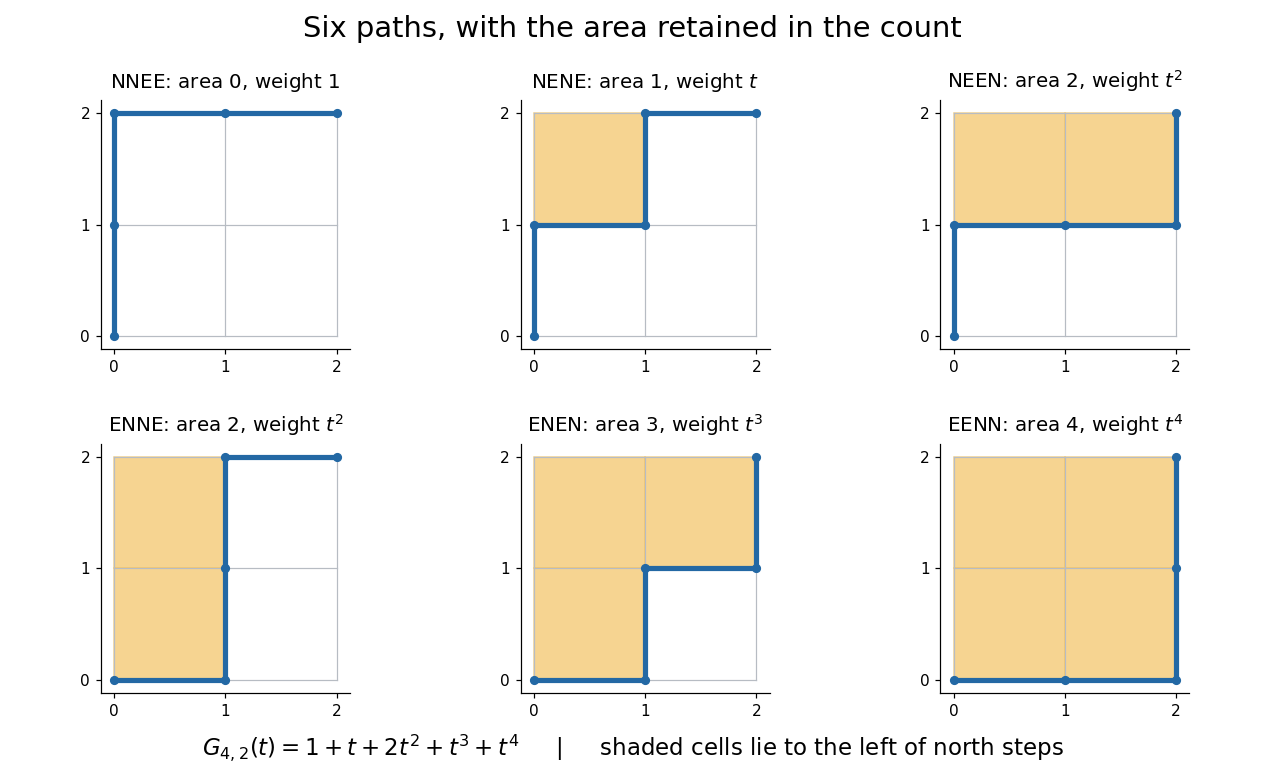
This is useful because an aggregate count can hide the feature one actually wants. A generating function retains the distribution of a statistic, so coefficient extraction answers questions such as “how many allowed diagrams contain exactly two cells?” The partition interpretation of Gaussian binomial coefficients makes every coefficient a nonnegative integer without relying on cancellation in the product formula.
An unexpected second use comes from linear algebra. If is a prime power, the value counts the -dimensional vector subspaces of . Thus the same expression that counts six paths at counts 35 two-dimensional subspaces of at . The Gaussian binomial coefficient counts finite-field subspaces article explains why selecting a vector subspace differs from selecting a subset of coordinates. [ref]
This relationship illustrates a q-analogue: the parameter can encode a statistic in one interpretation and the size of a finite field in another. Here denotes the formal variable, while denotes a finite field's cardinality when we evaluate the polynomial. The interpretation using a finite field requires to be a prime power; evaluating the polynomial at an arbitrary number does not construct a field of that size.
For a prime number , the identity has right side divisible by , while is coprime to . Cancellation in modular arithmetic proves the divisibility.
// Target: combinatorics.bigb
For , count pairs of subsets with , and . Choosing before gives the left product of binomial coefficients. Choosing and then the additional elements of gives the right product. This double counting proof explains the identity without division by factorials.
Choose a -element subset of a disjoint union of sets of sizes and . Partition the choices by the number of selected elements from the first set. The resulting count is the displayed convolution of binomial coefficients, where coefficients outside their admissible ranges are zero. This also proves the formula when .
A binary string with zeroes and ones is determined by its one-positions, giving possibilities. Sum for and apply the hockey-stick identity. Equivalently, distribute at most ones among the gaps around the zeroes and add a slack count; stars and bars counts nonnegative counts summing to .
For partial maps , retain exactly entries for which both maps define the same value at . Merely sharing a key is insufficient. Traverse one binary search tree, look up each key in the other, and insert only equal-value matches into the result.
// Destination: computer-science.bigb
Let be an integral ideal of an imaginary quadratic number field and an integral basis of . Its normalized norm is a positive definite binary quadratic form. An unramified rational prime is represented by this form exactly when there is an integral prime ideal of norm with . Indeed, a representation gives an element with , so is integral of norm . Conversely, with produces a representation by expressing in the basis. Artin reciprocity then detects this ideal class by Frobenius in the Hilbert class field.
Primes represented by x squared plus three y squared by  Codex 0 Created 2026-10-13 Updated 2026-11-05
A prime number has an integer representation exactly when or . The case three is , and two is impossible.
For necessity when , reducing the equation modulo three gives . The value cannot be zero, so it is one.
Conversely, for , the quadratic character of minus three shows that is a quadratic residue modulo . Thus the discriminant criterion for prime representation by a binary quadratic form produces a positive definite form of discriminant representing . It is primitive because .
Enumeration of reduced binary quadratic forms gives only and at discriminant : the bound is , and the integrality and boundary conditions leave those two. The second is imprimitive, so proper equivalence carries the representing form to . This proves sufficiency. Examples are and .
To repair a key in a minimum-oriented binary heap, choose the smaller-priority present entry among its children in a rooted tree. Exchange if that entry is smaller than the moving key, and continue at the new index. Stop when there are no children in a rooted tree or the heap order holds. The smaller rooted trees below the starting entry must already obey the heap order; choosing the larger child could leave a violation with the smaller one.
After inserting or lowering a key in a minimum-oriented binary heap, compare it with its parent in a rooted tree. Exchange them while the moving key is smaller, then continue at its new index. Stop at the root of a tree or when the heap order is satisfied. This repair assumes the rest of the binary heap was valid before the insertion or key decrease.
The minimum convention for heap order requires every parent in a rooted tree to have priority no greater than each of its children in a rooted tree. The displayed formula uses the array representation of a binary heap. It permits equal priorities and does not require a sorted array; the maximum convention reverses the inequality.
Primordial abundances require extrapolation to material minimally processed by stars. Helium is inferred from hydrogen and helium emission in low-metallicity ionized regions, with ionization and temperature corrections. Deuterium is inferred from isotope-shifted absorption in low-metallicity quasar systems. Lithium is measured in old metal-poor stellar atmospheres and requires a correction, or a bound, for stellar depletion. These observables probe different astrophysical environments and systematic errors.
At the cosmological baryon density favored by deuterium and the cosmic microwave background, standard Big Bang nucleosynthesis predicts more lithium-7 than is directly inferred from the Spite plateau, typically by a factor of a few. Stellar depletion, atmosphere systematics and possible new microscopic physics must be distinguished before interpreting this discrepancy as a failure of the cosmological framework.
Pinned article: Introduction to the OurBigBook Project
Welcome to the OurBigBook Project! Our goal is to create the perfect publishing platform for STEM subjects, and get university-level students to write the best free STEM tutorials ever.
Everyone is welcome to create an account and play with the site: ourbigbook.com/go/register. We belive that students themselves can write amazing tutorials, but teachers are welcome too. You can write about anything you want, it doesn't have to be STEM or even educational. Silly test content is very welcome and you won't be penalized in any way. Just keep it legal!
Intro to OurBigBook
. Source. We have two killer features:
- topics: topics group articles by different users with the same title, e.g. here is the topic for the "Fundamental Theorem of Calculus" ourbigbook.com/go/topic/fundamental-theorem-of-calculusArticles of different users are sorted by upvote within each article page. This feature is a bit like:
- a Wikipedia where each user can have their own version of each article
- a Q&A website like Stack Overflow, where multiple people can give their views on a given topic, and the best ones are sorted by upvote. Except you don't need to wait for someone to ask first, and any topic goes, no matter how narrow or broad
This feature makes it possible for readers to find better explanations of any topic created by other writers. And it allows writers to create an explanation in a place that readers might actually find it.
Figure 1. Screenshot of the "Derivative" topic page. View it live at: ourbigbook.com/go/topic/derivativeVideo 2. OurBigBook Web topics demo. Source. - local editing: you can store all your personal knowledge base content locally in a plaintext markup format that can be edited locally and published either:This way you can be sure that even if OurBigBook.com were to go down one day (which we have no plans to do as it is quite cheap to host!), your content will still be perfectly readable as a static site.
- to OurBigBook.com to get awesome multi-user features like topics and likes
- as HTML files to a static website, which you can host yourself for free on many external providers like GitHub Pages, and remain in full control

Figure 2. You can publish local OurBigBook lightweight markup files to either OurBigBook.com or as a static website.
Figure 3. Visual Studio Code extension installation.
Figure 5. . You can also edit articles on the Web editor without installing anything locally. Video 3. Edit locally and publish demo. Source. This shows editing OurBigBook Markup and publishing it using the Visual Studio Code extension. 
- Infinitely deep tables of contents:



All our software is open source and hosted at: github.com/ourbigbook/ourbigbook
Further documentation can be found at: docs.ourbigbook.com
Feel free to reach our to us for any help or suggestions: docs.ourbigbook.com/#contact