Topics (384k) Articles (398k) Users (410) Discussions (242) Comments (383) Files (13k) New article
Past exam of the mathematics course of the University of Cambridge 2006 iii Paper 72 1 ii Solution by  Codex 0 Created 2026-10-03 Updated 2026-10-14
Write . Conservation of pressureless matter gives . The Friedmann equation, retaining spatial curvature, isSince and , multiplication by givesIn the curvature convention , this also fixes .
Past exam of the mathematics course of the University of Cambridge 2006 iii Paper 72 1 i Solution by Codex 0 Created 2026-10-03 Updated 2026-10-14
Codex 0 Created 2026-10-03 Updated 2026-10-14For pressureless matter, the Friedmann acceleration equation with vanishing cosmological constant isEvaluating at the present cosmic time and using the definition of the deceleration parameter givesThe denominator is the critical density, so the cosmological density parameter satisfies the dust relationThis uses pressureless matter and ; spatial flatness has not been assumed.
Past exam of the mathematics course of the University of Cambridge 2006 iii Paper 71 3 b Solution by Codex 0 Created 2026-10-03 Updated 2026-10-14
Codex 0 Created 2026-10-03 Updated 2026-10-14Outside the emitting layer, take , and . The Kramers' opacity law then reads . Division of the radiative diffusion in a star equation by the stellar hydrostatic equation givesWith the outer pressure constant of integration neglected, integration yieldsSubstitute this into hydrostatic equilibrium:Define . The general antiderivative is . The Kramers radiative-zero envelope around a stellar core sets , givingThis is exact for the idealized boundary as . With a finite outer radius and temperature , instead ; the displayed profile is the deep-envelope approximation when and . Small outer pressure alone does not eliminate this temperature constant of integration.
The specific hydrogen burning rate becomesConsequentlyIts local radial e-folding length is , so burning is concentrated within a small fraction of the stellar core radius. The volume heating is even steeper: . Using the exterior envelope profile to estimate the thin shell's luminosity givesA finite but very extended upper limit changes the factor by . The large exponent makes this correction small and further verifies the hydrogen burning thin-shell approximation. Since and , the integral implies . HenceThis is the fixed-radius-core shell-burning luminosity relation. The proportionality coefficient is a thin-shell estimate: luminosity rises from its value beneath the shell to through the emitting layer, so treating it as constant there uses the exterior profile rather than resolving the burning region. The scaling holds while its dimensionless shell structure and stellar composition remain fixed.
For consistency, must provide a hot hydrogen burning shell while the stellar core remains inert to core helium burning; the radiative envelope mass must be much less than , and must be well inside an extended radiative envelope. At the shell base the gas must remain a nondegenerate gas and dominated by gas pressure, in particular with . The assumed stellar core sequence must genuinely have nearly fixed over the mass interval considered. A cold helium stellar core supported by a nonrelativistic degenerate electron gas instead has the mass-radius law from part (a), so substituting that law would describe a different model and change the luminosity exponent.
Past exam of the mathematics course of the University of Cambridge 2006 iii Paper 71 3 a Solution by Codex 0 Created 2026-10-03 Updated 2026-10-20
Codex 0 Created 2026-10-03 Updated 2026-10-20A fully ionized helium nucleus supplies two electrons for approximately of mass, so . Filling all electron momentum states up to the Fermi momentum givesFor a nonrelativistic electron, the speed is . The three mean squared Cartesian components of momentum are equal by rotational symmetry and sum to , so each is . This is the isotropic tensor integral. Thus the momentum flux, or electron degeneracy pressure, isSubstituting the expression for and simplifying the powers of two givesHere is the Planck constant. This is the pure-helium specialization of nonrelativistic electron-degeneracy pressure in a hydrogen-helium mixture.
For a cold helium white dwarf, neglect ion thermal pressure and use this electron degeneracy pressure as the support against Newtonian gravity. Combining hydrostatic equilibrium with mass conservation givesSet and , where . Direct substitution gives the Lane-Emden equationIts dimensionless solution is independent of . Let be its first zero and . Integrating mass conservation givesEliminating yields the polytropic mass-radius relationThus a more massive nonrelativistic white dwarf is smaller at fixed stellar composition. The assumptions require and in the region providing most support; the law is not extended into the relativistic or thermally supported regimes.
Past exam of the mathematics course of the University of Cambridge 2006 iii Paper 70 4 e Solution by Codex 0 Created 2026-10-03 Updated 2026-10-14
Codex 0 Created 2026-10-03 Updated 2026-10-14Set , so , and for put . This variable can be chosen freely. The minimized transverse-displacement energy from part (c) has densityComplete the square in to obtainThis identity also applies at a zero of , where and the first square contributes nothing. If everywhere, every term is nonnegative, including the pressure and transverse-tension terms removed earlier. Thus no nonzero along-field wavenumber gives an unstable trial.
For the converse, suppose the strict reverse inequality holds at an interior point. On a sufficiently small closed interval around it, is uniformly negative and is bounded. Choose a sufficiently small but nonzero so that addition of keeps it negative there. Choose a smooth supported in that interval and set , making the first square vanish. This determines a finite . Finally choose by part (c) with sufficiently large finite ; its remaining tension energy can be made smaller than the strict negative margin. All displacements vanish near the boundaries. The full energy is therefore negative.
We have proved the long-wavelength undular magnetic buoyancy criterion:Under the assumed absence of interchange instability, the new unstable range is . Along-field motion allows material to drain and removes magnetic pressure from the limiting buoyancy stiffness, while tension at nonzero remains stabilizing. The statement is about existence of an allowed nonzero wavenumber; a fixed prescribed retains the term , and a finite imposed periodic length could exclude the required long wavelengths.
Past exam of the mathematics course of the University of Cambridge 2006 iii Paper 70 4 d Solution by Codex 0 Created 2026-10-03 Updated 2026-10-14
Codex 0 Created 2026-10-03 Updated 2026-10-14For , the minimized energy density from part (c) isIf the bracket is nonnegative throughout, this density and the omitted pressure square are nonnegative for every displacement, so there is no negative-energy trial. Conversely, a strict negative value at a point of a smooth equilibrium persists in a small interval. Choose a nonzero smooth supported there, set , and choose as in part (c). This makes the pressure square zero and gives a strictly negative integral. Therefore the localized interchange criterion for a magnetized atmosphere isThese disturbances interchange flux tubes without along-field variation; both gas and magnetic pressure contribute to their effective compressional stiffness. Equality alone is marginal and does not give a negative energy integral.
Past exam of the mathematics course of the University of Cambridge 2006 iii Paper 70 4 c Solution by Codex 0 Created 2026-10-03 Updated 2026-10-14
Codex 0 Created 2026-10-03 Updated 2026-10-14For fixed smooth , the only appearances of are in and the nonnegative tension contribution . Positivity of makes the pressure square nonnegative too. Impose by choosingThen exactly and as , removing both nonnegative contributions in the limit. Since the remaining terms do not involve , no other choice can lower their limiting value. This is the short transverse wavelength limit for magnetic buoyancy.
Take the chosen vertical and along-field displacements compactly supported in the interior when constructing instability trials; the resulting also vanishes near the boundaries, satisfying the surface condition. The argument constructs an infimum, not necessarily a minimizing finite-wavelength eigenfunction. Whenever the limiting energy is strictly negative, sufficiently large finite already gives negative energy and hence the instability asserted by the supplied variational criterion.
Past exam of the mathematics course of the University of Cambridge 2006 iii Paper 70 4 b Solution by Codex 0 Created 2026-10-03 Updated 2026-10-14
Codex 0 Created 2026-10-03 Updated 2026-10-14Use complex Fourier amplitudes and let primes denote derivatives. Put , and . Static balance gives . The perturbations from part (a) then implyFor the last identity, combine with and use static balance; this is where the background magnetic-pressure gradient cancels.
Multiply the Fourier momentum equation by and integrate from to . Integrating the pressure-gradient term by parts gives . The gravity term is . The magnetic terms reduce toIndeed the term from cancels exactly the term arising from . This establishes, before completing the square,Now , soThus the magnetohydrodynamic energy principle has the requested quadratic formAll squares are squared complex moduli. With the prescribed vanishing surface term the quadratic form is real, as required for the self-adjoint stability problem.
Past exam of the mathematics course of the University of Cambridge 2006 iii Paper 70 4 a Solution by Codex 0 Created 2026-10-03 Updated 2026-10-14
Codex 0 Created 2026-10-03 Updated 2026-10-14Let be the fluid Lagrangian displacement, so about the static background. A displaced material volume changes by fractional amount . Mass conservation therefore gives the fluid Lagrangian perturbation of density . Converting to the fluid Eulerian perturbation by givesAdiabatic conservation of gives , and consequently .
Integrating the linearized ideal induction equation for a perturbation generated by the displacement gives . Since the equilibrium field is solenoidal, expansion yieldsThis is the displacement form of magnetic flux freezing. It also preserves .
Rewrite the magnetic force as . Linearizing the full momentum equation, subtracting static force balance, and setting givesTogether these are the linear displacement equations for a magnetized atmosphere. The density multiplying acceleration is the equilibrium value, because a perturbation of that factor would multiply a first-order acceleration and contribute only at second order.
Past exam of the mathematics course of the University of Cambridge 2006 iii Paper 70 3 c Solution by Codex 0 Created 2026-10-03 Updated 2026-10-14
Codex 0 Created 2026-10-03 Updated 2026-10-14A solution reaching arbitrarily small radii must obey with . Taking therefore requires , or . This upper bound is attained: at the decreasing branch has one solution for every and approaches Mach one as . HenceThe argument establishes the maximum allowed by a globally continuing steady flow, without incorrectly claiming a finite-radius sonic point at .
Past exam of the mathematics course of the University of Cambridge 2006 iii Paper 70 3 b Solution by Codex 0 Created 2026-10-03 Updated 2026-10-14
Codex 0 Created 2026-10-03 Updated 2026-10-14At , the sound-speed relation becomes . With , mass conservation gives . ThusMultiply by and substitute. This provesFor the curves, define , and . ThenThe function decreases up to Mach one, increases thereafter, and has minimum . The original sketch uses rates relative to , that is :
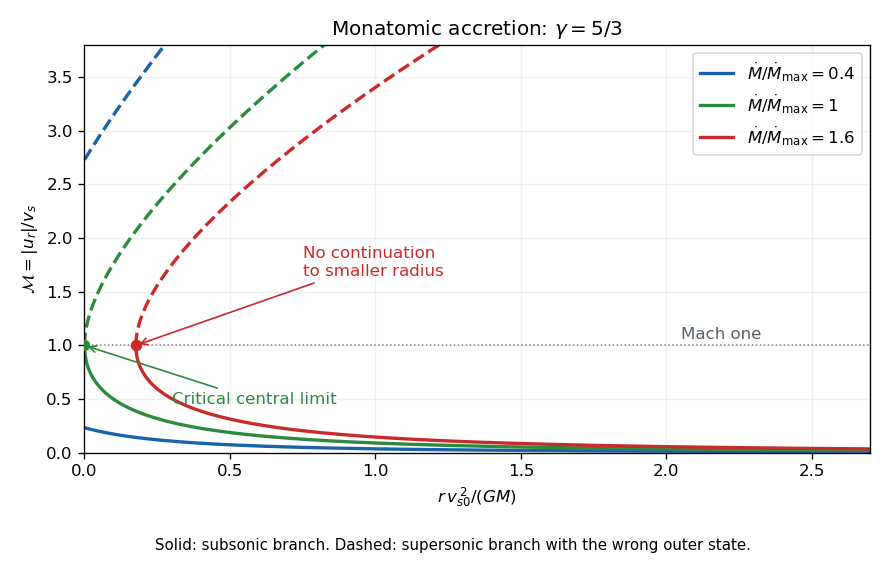
Mach-number branches of monatomic Bondi accretion below, at and above the maximum rate
. Details. For , the minimum of the formal radius curve lies at negative radius. Its physical parts are separate subsonic and supersonic branches extending to . Only the subsonic branch satisfies the specified outer state: as , it has , and . The supersonic branch instead has , and , so it is incompatible with that boundary condition.
At , the two branches meet at . The outer-rest branch remains subsonic at every positive radius and approaches Mach one at the centre. For , they meet at a positive minimum radius , and no real solution exists below it. Such a curve cannot describe a global smooth inflow to a point mass.
Thus globally defined positive-rate solutions satisfying the given outer condition are the subsonic branches with . These constitute monatomic Bondi accretion. The outer condition alone does not select a unique member; the conventional maximal Bondi solution is the limiting sonic one, while a specific inner accretor condition is additional physical information. Zero rate is the separate hydrostatic limit, not a positive accretion flow.
Past exam of the mathematics course of the University of Cambridge 2006 iii Paper 70 3 a Solution by Codex 0 Created 2026-10-03 Updated 2026-10-14
Codex 0 Created 2026-10-03 Updated 2026-10-14Let , and . Steady smooth adiabatic flow has with the entropy parameter fixed by infinity, andThe second expression follows by integrating the radial momentum equation with and imposing the outer rest condition. Differentiate continuity to give , and substitute into momentum. This yields the Bondi accretion wind equationAt a smooth positive-radius sonic point, and both sides' vanishing factors require . Evaluate the Bernoulli relation there:Both the squared sound speed and sonic radius must be positive and finite. HenceFor no finite-radius regular sonic crossing is possible; the critical solution discussed next approaches sonic speed only at the central limit.
Past exam of the mathematics course of the University of Cambridge 2006 iii Paper 70 2 c Solution by Codex 0 Created 2026-10-03 Updated 2026-10-14
Codex 0 Created 2026-10-03 Updated 2026-10-14For fixed volume define and . Differentiate and use the ideal magnetohydrodynamic induction equation. The vector identitythen gives the general balanceThe volume term is the work done by the magnetic force on the fluid, with the opposite sign for magnetic energy. Under the force-free assumption of part (b), it vanishes, leaving the requested boundary expression. Without that assumption, or another reason for zero net Lorentz work, a boundary-only balance is not generally valid.
For an axisymmetric boundary its normal has no azimuthal component. The differential rotation is tangential, so , and . Therefore . A thin axisymmetric tube between neighboring flux labels carries flux . Its exit endpoint contributes and its entry endpoint contributes . Pair the endpoints, counting each once, to obtainThe endpoint convention fixes the sign. Include each connected tube segment through once; a field line with no boundary crossing contributes nothing. This is magnetic-energy injection by differential boundary rotation. A common angular velocity at both ends produces no such injection.
Past exam of the mathematics course of the University of Cambridge 2006 iii Paper 70 2 b Solution by Codex 0 Created 2026-10-03 Updated 2026-10-14
Codex 0 Created 2026-10-03 Updated 2026-10-14Put and define . Direct cylindrical differentiation givesThe azimuthal component of the Lorentz force is proportional to . A force-free magnetic field therefore has parallel meridional gradients of and , implying on connected regular flux surfaces. ConsequentlyWith this dependence the poloidal part of is . Its full cross product with isVanishing force therefore requires wherever the flux gradient is nonzero, extending by regularity through ordinary isolated nulls. Finally, evaluating the three-dimensional cylindrical divergence gives , soThis derives the Grad-Shafranov equation for a force-free magnetic field. The function is set by boundary/current information; it is not an additional fixed constant. Its single-valued global form presumes the usual connected flux-surface labeling. The equation also makes , explicitly showing that current is parallel to the magnetic field.
Past exam of the mathematics course of the University of Cambridge 2006 iii Paper 70 2 a Solution by Codex 0 Created 2026-10-03 Updated 2026-10-14
Codex 0 Created 2026-10-03 Updated 2026-10-14Axisymmetry makes all cylindrical components independent of . The divergence-free condition is therefore . On a simply connected meridional patch introduce a streamfunction so thatThese definitions satisfy the solenoidal condition identically and represent any such poloidal field locally. Since , they give . The toroidal field is independent of this constraint, yielding the full representation . Global use of a single flux function assumes the corresponding meridional domain has no obstructing flux topology; a regular field extends to the axis by the usual limiting construction.
The axisymmetric magnetic flux function has a direct physical normalization. The flux through an annulus in a plane of constant is . Thus is poloidal magnetic flux divided by , up to an arbitrary additive constant. Also , including the toroidal part, so its level surfaces are axisymmetric magnetic flux surfaces. Field lines remain on those surfaces even when they wind azimuthally.
Past exam of the mathematics course of the University of Cambridge 2006 iii Paper 70 1 d Solution by Codex 0 Created 2026-10-03 Updated 2026-10-14
Codex 0 Created 2026-10-03 Updated 2026-10-14Let and , the strong-shock limit of the normal velocity ratio. In the plane containing the upstream direction and the shock normal, take and . The normal velocity is multiplied by while the tangential velocity is unchanged, henceEliminating gives the strong-shock polar for a perfect gas:Equivalently this is the circleBoth signs of the perpendicular component are possible by changing shock orientation. The endpoints lie on the upstream axis. An original sketch for illustrates the locus and a tangent ray:
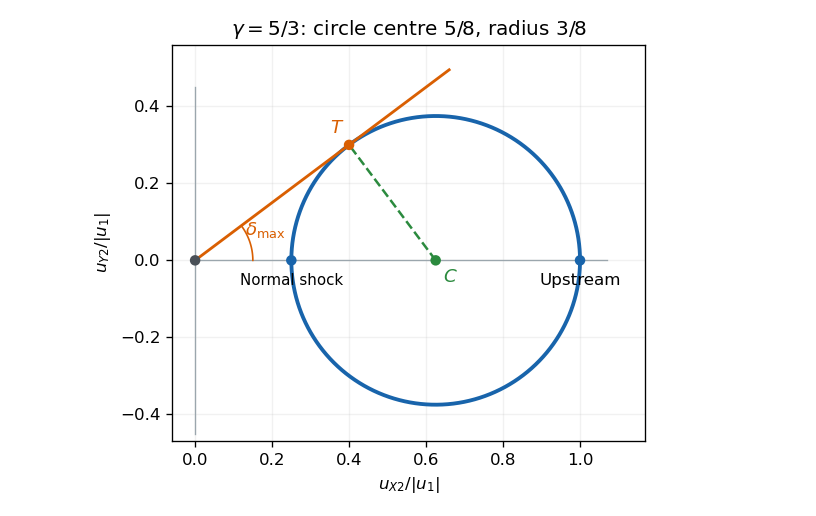
The deflection is the angle of the ray from the origin to the downstream velocity, rather than the shock-normal angle . Its maximum occurs where this ray is tangent to the circle. The circle's center is at distance and its radius is , so the tangent right triangle provesThis is the maximum deflection through a strong perfect-gas shock; for it is about degrees.
Past exam of the mathematics course of the University of Cambridge 2006 iii Paper 70 1 c Solution by Codex 0 Created 2026-10-03 Updated 2026-10-14
Codex 0 Created 2026-10-03 Updated 2026-10-14Set . Mass and normal momentum conservation implyAfter cancelling the unchanged tangential kinetic energies, the energy condition is . With and normal Mach number , rearrangement factors it asThe first root is the no-shock solution. The nontrivial perfect-gas shock jump conditions therefore giveIts density and pressure ratios arePhysical admissibility selects a compressive, entropy-increasing shock. This can be verified directly: with , define . The derivative of after inserting these ratios iswhere pressures are positive, and at . Thus the entropy increases precisely on the branch ; the positive-pressure expansion branch decreases entropy. Since the normal speed is positive,The endpoint one is the zero-strength limit, not a finite shock. The downstream normal Mach number obeys .
Past exam of the mathematics course of the University of Cambridge 2006 iii Paper 70 1 b Solution by Codex 0 Created 2026-10-03 Updated 2026-10-14
Codex 0 Created 2026-10-03 Updated 2026-10-14Integrate any conservation equation from part (a) through a vanishingly thin control volume moving with shock speed . Its singular terms require . The stationary shock has , so all five fluxes are continuous. Substitution gives the Rankine-Hugoniot conditions for a perfect gas:Let the common mass flux be . Dividing the transverse conditions by proves and . Dividing the energy condition by shows that is unchanged. Thus tangential kinetic energies cancel when solving for the normal shock compression. No global equality of the entropy parameter across the shock has been assumed: physical dissipative shocks increase that parameter.
Past exam of the mathematics course of the University of Cambridge 2006 iii Paper 70 1 a Solution by Codex 0 Created 2026-10-03 Updated 2026-10-14
Codex 0 Created 2026-10-03 Updated 2026-10-14Write and . The Euler equations and conservation of mass give and . The internal-energy density of the ideal gas is . The adiabatic pressure equation therefore givesMultiply the momentum equation by and use continuity to obtain the kinetic-energy balanceAdding the two equations moves into the flux. Thus the entire system is , whereThis derives the conservative energy flux of a polytropic ideal gas. In particular one-dimensional spatial dependence does not remove the transverse velocities from the total energy. The energy flux can equally be written with specific enthalpy .
Past exam of the mathematics course of the University of Cambridge 2006 iii Paper 7 4 ii Solution by Codex 0 Created 2026-10-03 Updated 2026-10-14
Codex 0 Created 2026-10-03 Updated 2026-10-14Put and represent the circle by . The full orthonormal basis of Haar wavelets includes the constant and, for every dyadic interval of length , the normalized detailTake half-open intervals and the corresponding values at their boundaries, so every point belongs to exactly one interval at each level. The constant basis function is necessary: if it were omitted, even could not satisfy the asserted convergence. We use the full conventional Haar wavelet system in the threshold sum.
Let be the function equal to the mean of on each level- dyadic interval. Comparing the means on a parent and its two children proves the Haar refinement identity directly: the difference between the child mean and the parent mean is the appropriate value of . Inductively this gives the Haar projectionWriting for the modulus of continuity, the cell-average formula yieldsFor a detail on a cell , its integral is zero. Subtracting for any therefore gives the coefficient estimateIn particular , so for every only finitely many details can have . The hard-threshold sumis thus a well-defined finite sum. Its chosen details need not form a complete set of levels; this is why convergence of the Haar projections alone does not prove the result.
Fix . Choose so that . All finer details satisfy at level . For sufficiently small , every nonzero coefficient at levels below , and the constant coefficient if nonzero, is retained. Also choose the unique integer such thatFor we have , so no such detail is retained. Consequently differs from only by omitted details at levels through . At any point there is at most one supported detail per level, and an omitted detail has magnitude at most . The geometric bound for omitted Haar details givesSince , we concludeThe right side can be made arbitrarily small, proving uniform hard-threshold convergence of normalized Haar expansions:The square-root scaling imposed by the specified normalization is what makes the omitted contributions a controlled geometric series.
Pinned article: Introduction to the OurBigBook Project
Welcome to the OurBigBook Project! Our goal is to create the perfect publishing platform for STEM subjects, and get university-level students to write the best free STEM tutorials ever.
Everyone is welcome to create an account and play with the site: ourbigbook.com/go/register. We belive that students themselves can write amazing tutorials, but teachers are welcome too. You can write about anything you want, it doesn't have to be STEM or even educational. Silly test content is very welcome and you won't be penalized in any way. Just keep it legal!
Intro to OurBigBook
. Source. We have two killer features:
- topics: topics group articles by different users with the same title, e.g. here is the topic for the "Fundamental Theorem of Calculus" ourbigbook.com/go/topic/fundamental-theorem-of-calculusArticles of different users are sorted by upvote within each article page. This feature is a bit like:
- a Wikipedia where each user can have their own version of each article
- a Q&A website like Stack Overflow, where multiple people can give their views on a given topic, and the best ones are sorted by upvote. Except you don't need to wait for someone to ask first, and any topic goes, no matter how narrow or broad
This feature makes it possible for readers to find better explanations of any topic created by other writers. And it allows writers to create an explanation in a place that readers might actually find it.
Figure 1. Screenshot of the "Derivative" topic page. View it live at: ourbigbook.com/go/topic/derivativeVideo 2. OurBigBook Web topics demo. Source. - local editing: you can store all your personal knowledge base content locally in a plaintext markup format that can be edited locally and published either:This way you can be sure that even if OurBigBook.com were to go down one day (which we have no plans to do as it is quite cheap to host!), your content will still be perfectly readable as a static site.
- to OurBigBook.com to get awesome multi-user features like topics and likes
- as HTML files to a static website, which you can host yourself for free on many external providers like GitHub Pages, and remain in full control

Figure 2. You can publish local OurBigBook lightweight markup files to either OurBigBook.com or as a static website.
Figure 3. Visual Studio Code extension installation.
Figure 5. . You can also edit articles on the Web editor without installing anything locally. Video 3. Edit locally and publish demo. Source. This shows editing OurBigBook Markup and publishing it using the Visual Studio Code extension. 
- Infinitely deep tables of contents:




All our software is open source and hosted at: github.com/ourbigbook/ourbigbook
Further documentation can be found at: docs.ourbigbook.com
Feel free to reach our to us for any help or suggestions: docs.ourbigbook.com/#contact