Topics (384k) Articles (398k) Users (410) Discussions (242) Comments (383) Files (13k) New article
The probability of an event is its value under a probability measure, a real number between zero and one. It compares the mass assigned to that event with the unit mass of the whole sample space. For a finite sample space with equally likely outcomes, . For unequal outcome masses, add their individual probabilities instead.
For example, selecting a coin with head probability with chance , or a coin with head probability with chance , gives head probability . This is the law of total probability: averaging over the hidden selection is part of calculating the outcome's probability.
A two-dimensional point source of strength has velocity potential and outward velocity . Every closed contour enclosing it has volume flux .
A cap set is a subset containing no three distinct points satisfying . Equivalently, it contains no nonconstant three-term arithmetic progression.
Let have total degree of a polynomial less than . If the associated polynomial function vanishes on all of , then is the zero polynomial. Induct on : writeFor each fixed , the resulting univariate polynomial of degree less than has all field elements as roots, so every coefficient vanishes everywhere. The induction hypothesis makes every the zero polynomial.
For a degree- polynomial over a field, with and roots in an algebraic closure, its discriminant isIt is a polynomial with integer coefficients in the coefficients of , and lies in the original coefficient field. Its vanishing is equivalent to a repeated root of a polynomial in an algebraic closure, even when the coefficient field itself contains no roots. This detects separability without solving the polynomial equation.[ref]
For a quadratic polynomial, the expression is the quadratic discriminant . For the cubic polynomial , it is . Thus has discriminant over , but after reduction to characteristic three its discriminant is zero and the resulting polynomial has a repeated root in its splitting field. Discriminants also indicate exceptional parameter values where distinct polynomial roots collide.
The real univariate polynomials form a vector space with the countable Hamel basisThe subspace of polynomials of degree at most has dimension .
A polynomial function is the function obtained by evaluating a polynomial on a specified ring or field. Distinct polynomials can induce the same polynomial function over a finite field; for example, and agree on .
Over , the nonzero formal polynomial evaluates to zero at both possible inputs, zero and one. It therefore induces the same polynomial function as the zero polynomial, despite having different coefficients and polynomial degree. Over an infinite field, equality at every input forces equality of polynomials by the root bound for a polynomial. The distinction matters whenever a representation is supposed to identify the function uniquely.
A simple planar periodic orbit has Poincaré index when the surrounding curve is traversed with the standard counterclockwise orientation. Along that circuit the nonzero vector field is tangent to the orbit and its direction makes one full positive turn.
This remains true when the actual flow runs clockwise: the field then points opposite to the chosen counterclockwise tangent, adding a constant angle without changing its total winding. Defining the index using traversal in the flow direction instead would change the sign for clockwise cycles, so the orientation convention must be kept explicit.
If the enclosed equilibrium points are isolated, their indices sum to one. A planar hyperbolic equilibrium point has index equal to the sign of its Jacobian determinant, giving for a sink or source and for a saddle equilibrium. Thus a periodic orbit cannot enclose exactly one saddle and no other equilibrium.
The Euclidean plane is with its standard Euclidean norm and the resulting distance, angles, and Riemannian metric.
Phase portrait of x dot equals two x times y minus a by  Codex 0 Created 2026-10-03 Updated 2026-10-05
This reflection-symmetric planar system has equilibria and, for , . Its divergence is the constant , excluding periodic orbits when by the Bendixson-Dulac criterion. At it is Hamiltonian withand the nonzero equilibria are nonlinear centers. At the symmetric equilibria undergo pitchfork bifurcations.
A second-order partial differential equation contains derivatives of the unknown function of order at most two and at least one second derivative. Its principal symbol determines its characteristic directions and elliptic, parabolic or hyperbolic type.
The parity of a two-particle centre-of-mass state with intrinsic parities and relative orbital angular momentum is
An orbital angular momentum eigenstate with quantum number changes by the factor under spatial reflection. Equivalently,
Numerical integration approximates a definite integral using finitely many sampled function values. For an integrand on a finite interval , , a quadrature rule has the formThe quadrature nodes tell us where to evaluate ; the quadrature weights turn those values into an approximation to the accumulated signed area. The exact definite integral depends on the integrand throughout the interval, whereas the quadrature rule sees only these samples. Integrating a chosen interpolant exactly still generally approximates the original integrand's integral.[ref]
5.6 Numerical integration. Fundamentals of Numerical Computation by Tobin A. Driscoll and others; Definition 5.6.1 and §5.6.1, equations 5.6.2–5.6.5: weighted samples and integration of an interpolant
The fundamental theorem of calculus evaluates as when an antiderivative is available. Numerical integration is useful when no convenient antiderivative is known, or each evaluation of the integrand requires an expensive computation. The task then becomes choosing informative quadrature nodes and controlling the quadrature error with as few evaluations as possible. Fixed data also permit a quadrature rule, but refinement cannot supply new information between observations.[ref]
5.6 Numerical integration. Fundamentals of Numerical Computation by Tobin A. Driscoll and others; Opening discussion, Example 5.6.1 and the paragraph following Definition 5.6.1: antiderivatives, numerical evaluation and fixed data
For an exact comparison, take the polynomial on . Its antiderivative gives . On a partition of an interval into equal panels, the composite midpoint quadrature rule uses midpoint samples, each with quadrature weight ; the composite trapezoidal rule uses endpoint samples, with outer quadrature weights and interior quadrature weights . The existing derivations under these two quadrature rules giveIn particular, and already bracket ; two panels give and . The convex function explains the opposite signs. A midpoint rectangle can cross the curve within its panel, so its total signed area, rather than pointwise ordering, determines the underestimate.
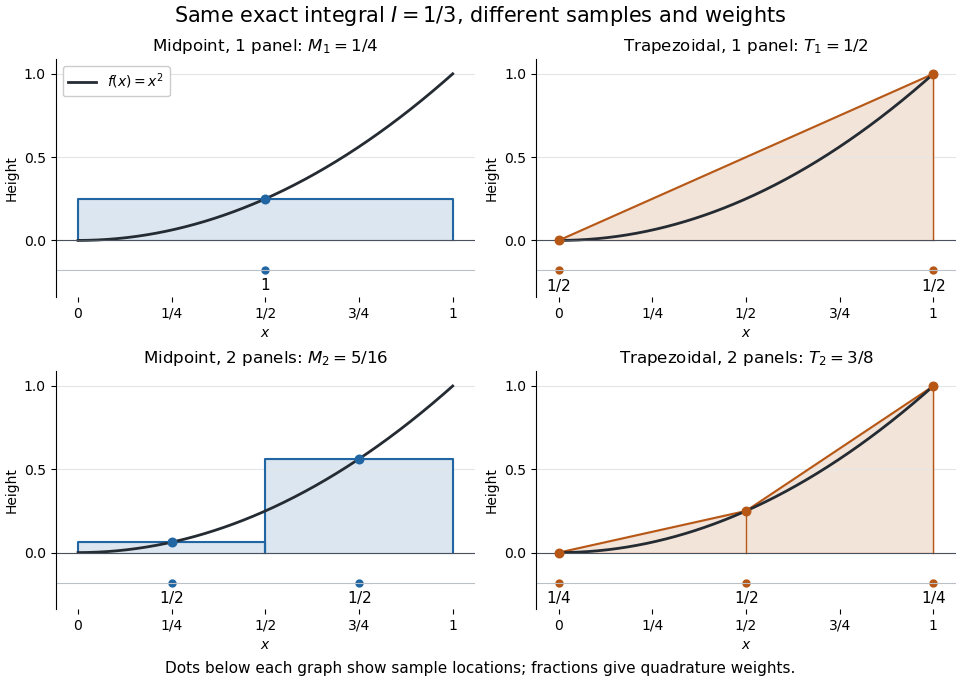
One and two panels for numerical integration of : midpoint and endpoint samples with their quadrature weights
. Details. Define the signed approximation error as . In this example the absolute errors are and : doubling reduces each by exactly four. A plot with both axes on a logarithmic scale therefore has slope , expressing order two with respect to panel refinement. This is an exact calculation for this polynomial, including , rather than an observed rate extrapolated from a few computed answers.
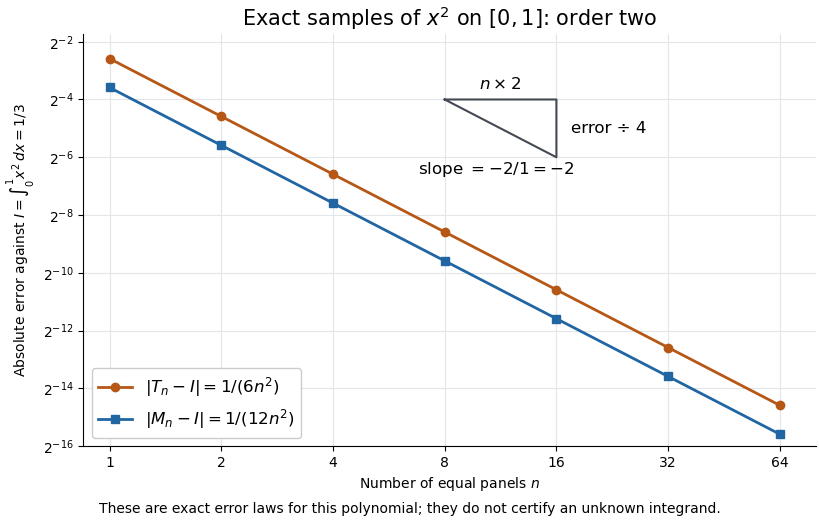
Exact absolute errors for midpoint and trapezoidal numerical integration of : slope and a factor-four reduction
. Details. For a general integrand, the composite midpoint quadrature rule and composite trapezoidal rule give second-order quadrature error bounds when has two continuous derivatives on and a known bound on . These hypotheses describe behavior between samples. A formal error formula containing an unknown derivative is not a numerical accuracy certificate or a justified sample count. Finite samples do not certify quadrature accuracy makes the missing information explicit. Errors in the evaluations and roundoff error must also be considered; noise sensitivity of a quadrature rule treats the former.
More elaborate choices exploit other information: Gaussian quadrature obtains high polynomial exactness from carefully chosen quadrature nodes, and Simpson's rule uses a quadratic interpolant. Adaptive numerical integration compares approximations and concentrates samples where they disagree, often saving evaluations. Such a difference is an error estimate, not a certified bound without further assumptions: both approximations can miss the same feature.[ref]
5.7 Adaptive integration. Fundamentals of Numerical Computation by Tobin A. Driscoll and others; §5.7.1, equation 5.7.4: a difference-based error estimate; §5.7.2: interval bisection; Example 5.7.2 and concluding discussion: requested accuracy is not guaranteed
A finite difference compares the values of a function at finitely separated arguments. For example, the forward finite difference with step isIt is the discrete analogue of a derivative and lowers the degree of a nonconstant polynomial by one.
The midpoint quadrature rule replaces the integrand on , , by its value halfway across the interval:Geometrically, is the signed area of a rectangle with width and height . Its single quadrature node is and its quadrature weight is . Sampling in the interior is useful when endpoint evaluation is inconvenient, although an endpoint singularity can invalidate the quadrature error estimates below.
The midpoint quadrature rule is exact for every affine function : the average height over an interval equals its midpoint height. For example, on , gives and . Positive and negative area discrepancies cancel for a sloping straight line. For the polynomial on , however, and , giving approximation error . Thus its degree of precision of a quadrature rule is exactly one.[ref]
5.8 Numerical Integration. §5.8, printed p. 223: midpoint rectangles, linear exactness and signed quadratic errors
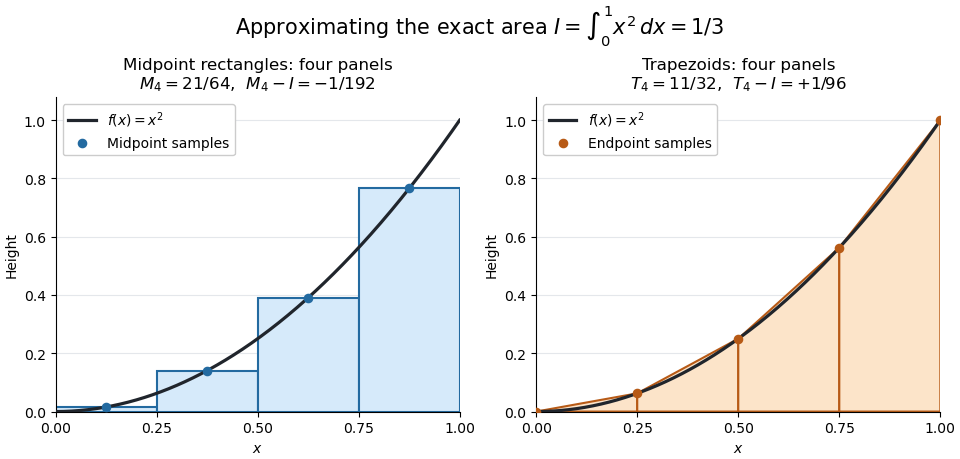
For the polynomial on , four panels give composite midpoint quadrature rule value and composite trapezoidal rule value , bracketing the exact integral . Individual midpoint rectangles can cross the curve; it is their total signed area that underestimates the integral.
For , meaning that its first two derivatives exist and are continuous functions on the closed interval, the signed approximation error has the formHence a convex function with is underestimated, and a concave function with is overestimated. A short justification uses the Taylor formula with integral remainder: writing , it gives , where for and for . This nonnegative Peano kernel has integral , so the weighted mean value theorem for integrals gives the stated sign and coefficient.
The Ore condition is a common-multiple condition that allows fractions in a noncommutative ring. For a multiplicative set containing one and excluding zero, the right Ore condition requires that for every and there are and with . It lets a numerator pass a denominator while keeping denominators on the right. The left version instead asks for .
If the denominators are regular elements of a ring, these conditions suffice for the corresponding Ore localization. For example, all nonzero elements of a commutative integral domain satisfy either condition, giving its field of fractions. In a right Noetherian domain, the nonzero elements satisfy the right condition and give a division ring. Without the condition, adjoining formal inverses need not retain the expected single-fraction form.
For a prime number , a p-adic number is an element of the field obtained by completing the rational numbers for the metric . Here is the p-adic absolute value. The Cauchy-sequence construction of a metric completion supplies limits for every Cauchy sequence, and addition, multiplication, and the p-adic absolute value extend to this complete metric space. The rational numbers form a dense subset. [ref]
For a concrete example with , consider the partial sums of a geometric series:The first values have distances from in the 2-adic absolute value. ConsequentlyThis is a statement about convergence in a metric space with the 2-adic absolute value. In the ordinary real number absolute value, the same partial sums grow without bound. Choosing a metric changes which approximation errors shrink.
More generally every nonzero P-adic number has a unique digit expansionOnly finitely many negative powers occur, while positive powers can continue indefinitely. Written with the highest powers on the left, the digits extend infinitely to the left; for example the P-adic number at is written . The p-adic integers are exactly the elements with , whose digit expansions use only nonnegative powers. [ref]
https://math.mit.edu/classes/18.785/2021fa/LectureNotes8.pdf. Andrew V. Sutherland, Number Theory I, Lecture 8, section 8.2, Proposition 8.17
The construction can be understood through modular arithmetic. Successively choose the low-order digits to agree modulo , , and higher powers. After fixing digits below , the remaining error has p-adic absolute value at most ; the partial sums form a Cauchy sequence, so completeness supplies a limit. If two expansions first differ at position , their difference has p-adic valuation , proving uniqueness. This turns compatible finite congruence classes into one exact number. In particular, Hensel's lemma upgrades suitable approximate roots of a polynomial modulo powers of into roots in the p-adic integers.
A non-Archimedean ordered field contains elements larger than every positive integer, equivalently positive infinitesimals smaller than every positive rational number.
Pinned article: Introduction to the OurBigBook Project
Welcome to the OurBigBook Project! Our goal is to create the perfect publishing platform for STEM subjects, and get university-level students to write the best free STEM tutorials ever.
Everyone is welcome to create an account and play with the site: ourbigbook.com/go/register. We belive that students themselves can write amazing tutorials, but teachers are welcome too. You can write about anything you want, it doesn't have to be STEM or even educational. Silly test content is very welcome and you won't be penalized in any way. Just keep it legal!
Intro to OurBigBook
. Source. We have two killer features:
- topics: topics group articles by different users with the same title, e.g. here is the topic for the "Fundamental Theorem of Calculus" ourbigbook.com/go/topic/fundamental-theorem-of-calculusArticles of different users are sorted by upvote within each article page. This feature is a bit like:
- a Wikipedia where each user can have their own version of each article
- a Q&A website like Stack Overflow, where multiple people can give their views on a given topic, and the best ones are sorted by upvote. Except you don't need to wait for someone to ask first, and any topic goes, no matter how narrow or broad
This feature makes it possible for readers to find better explanations of any topic created by other writers. And it allows writers to create an explanation in a place that readers might actually find it.
Figure 1. Screenshot of the "Derivative" topic page. View it live at: ourbigbook.com/go/topic/derivativeVideo 2. OurBigBook Web topics demo. Source. - local editing: you can store all your personal knowledge base content locally in a plaintext markup format that can be edited locally and published either:This way you can be sure that even if OurBigBook.com were to go down one day (which we have no plans to do as it is quite cheap to host!), your content will still be perfectly readable as a static site.
- to OurBigBook.com to get awesome multi-user features like topics and likes
- as HTML files to a static website, which you can host yourself for free on many external providers like GitHub Pages, and remain in full control

Figure 2. You can publish local OurBigBook lightweight markup files to either OurBigBook.com or as a static website.
Figure 3. Visual Studio Code extension installation.
Figure 5. . You can also edit articles on the Web editor without installing anything locally. Video 3. Edit locally and publish demo. Source. This shows editing OurBigBook Markup and publishing it using the Visual Studio Code extension. 
- Infinitely deep tables of contents:




All our software is open source and hosted at: github.com/ourbigbook/ourbigbook
Further documentation can be found at: docs.ourbigbook.com
Feel free to reach our to us for any help or suggestions: docs.ourbigbook.com/#contact