Topics (384k) Articles (398k) Users (410) Discussions (242) Comments (383) Files (13k) New article

Projected separation is the distance between two objects after their relative displacement is projected onto the plane of the sky.
Position angle specifies a projected direction on the sky, conventionally measured from North toward East.
A nonlinear ordinary differential equation depends nonlinearly on the unknown function or its derivatives: it cannot be written in the form defining a linear differential equation. For example, contains a square of the unknown function, and is a logistic differential equation. A coefficient such as depending only on the independent variable does not make an ordinary differential equation nonlinear. This distinction concerns dependence on the unknown, rather than the shape of its function graph.
For a concrete initial value problem, consider , . Its solution of a differential equation isTaking its derivative gives , and evaluating at zero checks the initial condition. The stated interval contains zero and ends at finite-time blowup: tends to positive infinity as approaches from below. Increasing the positive initial condition brings finite-time blowup closer. This is a simple mathematical example with dimensionless and , rather than a calibrated physical model.
Choose and , giving and . At they have values and , so their sum has value . On the common interval , both are valid solutions of a differential equation, but their sum fails the same ordinary differential equation:Already at , and its derivative is , whereas would require . At , the defect is . The cross term explains the failure of the superposition principle, even though each individual solution of a differential equation is a smooth function.
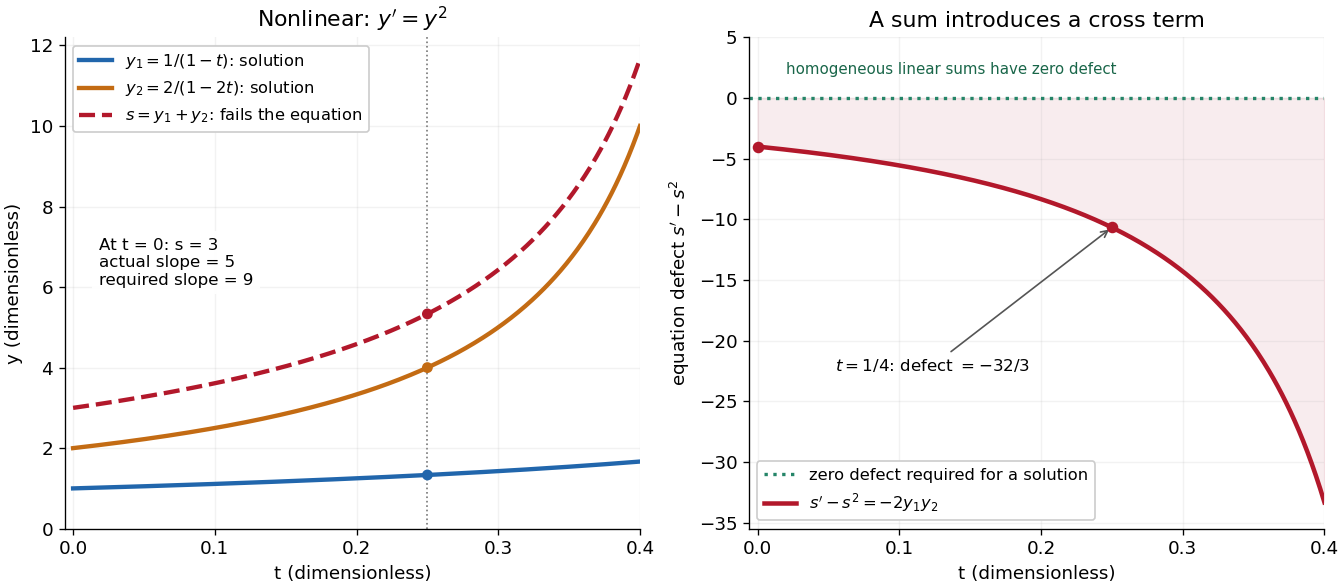
The first panel shows , and their invalid sum only up to , before either finite-time blowup. The second measures the defect in the ordinary differential equation, including the computed value at . For a homogeneous linear differential equation, the corresponding defect of a sum is zero. Nonlinear ordinary differential equations can describe state-dependent growth such as the logistic differential equation, whose negative quadratic term limits growth instead of accelerating it without bound. Recognizing the distinction tells us when we may assemble solutions of a differential equation from simpler pieces and when we must account for their interaction. See MIT's worked counterexample to nonlinear superposition.
The lower main sequence consists of relatively cool, low-mass hydrogen-burning stars whose luminosity is supplied mainly by the proton–proton chain.
The magnetic-field-line equation states that the tangent to a field line is parallel to . In spherical coordinates for an axisymmetric poloidal field, it can be written .
A fluid element is a small material parcel followed as it moves with a velocity field. It contains the same particles throughout its motion when no molecular exchange is included in the idealization. The continuum approximation requires it to be large enough to average microscopic structure while small enough to assign approximately local fields.
Its centre follows a Lagrangian trajectory, and its shape can stretch and rotate. For its volume , . Mass conservation keeps constant, so expansion decreases the parcel's mass density. An incompressible flow preserves the parcel's volume, but can still distort it strongly through shear strain. A fixed box in space is a different object: material can enter and leave that box, requiring boundary fluxes in its balance laws.
Stellar-wind drag is the tangential force exerted by a star's outflow on an orbiting grain. Like Poynting–Robertson drag, it removes orbital energy and angular momentum.
An orthonormal set consists of vectors that have norm one and are pairwise orthogonal. Its Gram matrix is the identity matrix.
A plane-parallel atmosphere neglects curvature over its vertical thickness, so thermodynamic variables depend on one Cartesian height coordinate.
With the -term convention, the Fejér sum of an integrable -periodic function isThe Fejér kernel formula gives the finite frequency expansionEach mode is tapered linearly rather than sharply retained or discarded. The degree is at most , and is the mean of .
For and , the result is . This checks the precise finite-index error in Fejér saturation on a Fourier mode. The nonnegative kernel gives Fejér summation is a uniform-norm contraction, and Fejér's theorem explains uniform convergence for continuous input. Neither property asserts that a sum of a sign-changing function is pointwise nonnegative.
Specific enthalpy is enthalpy per unit mass. For a simple compressible fluid of fixed composition, the first law of thermodynamics giveswhere is temperature, is specific entropy, is pressure, and is mass density. Along an isentropic flow, . For a perfect gas with constant specific-heat ratio , .
Gravitational focusing enlarges the collision cross-section of gravitating bodies because attraction bends incoming trajectories toward one another. Let two spherical bodies have total mass , sum of radii , and relative speed at large separation. In the Newtonian two-body problem, an encounter that just grazes at separation satisfiesHere is the limiting impact parameter. Conservation of energy sets the speed at closest approach, and conservation of angular momentum relates that speed to the initial impact parameter.
The extra term is the squared ratio of the mutual escape velocity at contact to . Rapid encounters approach the geometric area , while slower encounters can have a substantially larger collision cross-section. This estimate assumes isolated two-body trajectories and counts physical contact rather than permanent gravitational capture.
The equipotential stellar-structure approximation replaces distorted closed equipotentials in a synchronized binary by one-dimensional shells labeled by enclosed volume and mass.
Angular momentum transport moves angular momentum between locations through matter, stresses, waves, or fields. An accretion disk must transport angular momentum outward for most of its mass to move inward.
Absolute vorticity is the vorticity measured in an inertial frame. In a frame rotating with angular velocity , it is .
Velocity divergence measures the local fractional rate of change of a moving material element's volume:Positive values indicate local expansion and negative values local contraction. For a uniform dilation in three dimensions, it equals ; a rigid rotation has zero velocity divergence.
Mass conservation gives , linking local expansion to decreasing mass density. An incompressible flow has zero velocity divergence, but can still stretch one material direction while compressing another, or shear a parcel without changing its volume. A narrowing steady pipe illustrates that distinction: fluid accelerates axially while transverse contraction balances that stretching so that the total velocity divergence can remain zero.
A Jackson-type estimate bounds an approximation error by a smoothness quantity such as a modulus of continuity, with the smoothness evaluated at a scale comparable to the reciprocal of the approximating degree.
Pinned article: Introduction to the OurBigBook Project
Welcome to the OurBigBook Project! Our goal is to create the perfect publishing platform for STEM subjects, and get university-level students to write the best free STEM tutorials ever.
Everyone is welcome to create an account and play with the site: ourbigbook.com/go/register. We belive that students themselves can write amazing tutorials, but teachers are welcome too. You can write about anything you want, it doesn't have to be STEM or even educational. Silly test content is very welcome and you won't be penalized in any way. Just keep it legal!
Intro to OurBigBook
. Source. We have two killer features:
- topics: topics group articles by different users with the same title, e.g. here is the topic for the "Fundamental Theorem of Calculus" ourbigbook.com/go/topic/fundamental-theorem-of-calculusArticles of different users are sorted by upvote within each article page. This feature is a bit like:
- a Wikipedia where each user can have their own version of each article
- a Q&A website like Stack Overflow, where multiple people can give their views on a given topic, and the best ones are sorted by upvote. Except you don't need to wait for someone to ask first, and any topic goes, no matter how narrow or broad
This feature makes it possible for readers to find better explanations of any topic created by other writers. And it allows writers to create an explanation in a place that readers might actually find it.
Figure 1. Screenshot of the "Derivative" topic page. View it live at: ourbigbook.com/go/topic/derivativeVideo 2. OurBigBook Web topics demo. Source. - local editing: you can store all your personal knowledge base content locally in a plaintext markup format that can be edited locally and published either:This way you can be sure that even if OurBigBook.com were to go down one day (which we have no plans to do as it is quite cheap to host!), your content will still be perfectly readable as a static site.
- to OurBigBook.com to get awesome multi-user features like topics and likes
- as HTML files to a static website, which you can host yourself for free on many external providers like GitHub Pages, and remain in full control

Figure 2. You can publish local OurBigBook lightweight markup files to either OurBigBook.com or as a static website.
Figure 3. Visual Studio Code extension installation.
Figure 5. . You can also edit articles on the Web editor without installing anything locally. Video 3. Edit locally and publish demo. Source. This shows editing OurBigBook Markup and publishing it using the Visual Studio Code extension. 
- Infinitely deep tables of contents:



All our software is open source and hosted at: github.com/ourbigbook/ourbigbook
Further documentation can be found at: docs.ourbigbook.com
Feel free to reach our to us for any help or suggestions: docs.ourbigbook.com/#contact