
Past exam of the mathematics course of the University of Cambridge 2006 ii Paper 2 14E Solution Created 2026-09-24 Updated 2026-10-14
A horseshoe for an interval map consists of an open interval containing two disjoint open subintervals each mapped onto . Glendinning chaos means that some positive iterate has a horseshoe.
Solving on the appropriate branches of the tent map givesHere and . On the second iterate isBoth endpoints map to , and the minimum is . Both monotone branches cover when , equivalently . Restricting them to preimages of the interior proves a horseshoe for when .
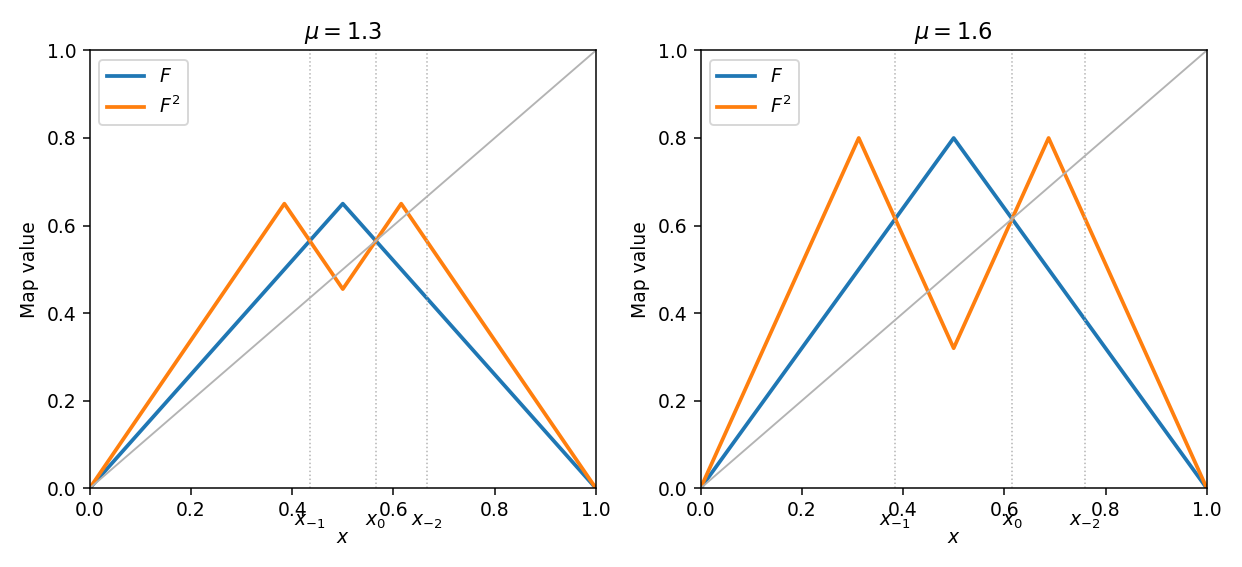
For , . Set and . This maps onto ; substitution in each linear piece gives . The renormalization of the tent map near its fixed point therefore makes conjugate on to . Applying the preceding threshold proves its horseshoe when .
For , the inverse branch of fixing contracts distance to by . Compose copies of it with the other inverse branch. This contraction has a fixed point with a periodic itinerary, distinct from and at distance . Hence nontrivial periodic points accumulate at .
For , the conjugate tent parameter has every nonzero periodic point in . This interval is forward invariant; below it, a nonzero point increases until entering it. The positive lower bound separates those periodic points from zero, which corresponds to . Thus no nontrivial periodic points are sufficiently close to from the left. A point sufficiently close on the right maps to such a left-hand point; periodicity would pass to its image and is impossible. Thus is isolated among periodic points, even though a fourth-iterate horseshoe exists elsewhere.
Past exam of the mathematics course of the University of Cambridge 2006 ii Paper 2 13B c Created 2026-09-24 Updated 2026-09-24
Past exam of the mathematics course of the University of Cambridge 2006 ii Paper 2 13B b Created 2026-09-24 Updated 2026-09-24
Past exam of the mathematics course of the University of Cambridge 2006 ii Paper 2 13B a Created 2026-09-24 Updated 2026-09-24
Past exam of the mathematics course of the University of Cambridge 2006 ii Paper 2 12G Solution Created 2026-09-24 Updated 2026-10-14
A cyclic binary code is a linear subspace of invariant under cyclic shifts. Identify a word with its coefficient polynomial in . Multiplication by is the shift, so the code is precisely an ideal of that quotient ring. Its inverse image in the polynomial ring is a principal ideal containing ; its unique monic generator divides . Conversely each monic divisor generates such an ideal. Thus the bijection is with monic divisors; gives the full code and the zero code.
For odd , some has , so the cyclic multiplicative group of contains a primitive th root . If a nonzero word with the specified roots had weight , write its nonzero positions as . The root equations giveTheir matrix has determinant , by the Vandermonde formula and distinctness of the positions. Thus all coefficients would vanish, a contradiction. Hence minimum distance is at least .
For , choose with minimal polynomial . The roots force also the conjugate , giving this cubic as generator. Its degree gives dimension four and its weight gives distance exactly three. Expressing in a basis of gives a parity-check matrix with the seven distinct nonzero vectors of as columns. This is the binary Hamming code. Its sixteen disjoint radius-one balls have words, so one-error correction is perfect. The other primitive cubic produces an equivalent coordinate-permuted code.
Past exam of the mathematics course of the University of Cambridge 2006 ii Paper 2 11G b Created 2026-09-24 Updated 2026-09-24
Past exam of the mathematics course of the University of Cambridge 2006 ii Paper 2 11G a Created 2026-09-24 Updated 2026-09-24
Past exam of the mathematics course of the University of Cambridge 2006 ii Paper 2 10D Solution Created 2026-09-24 Updated 2026-10-14
An adiabatic change of box size preserves the mode labels, whose momenta scale as . Since , differentiation gives . Occupation numbers are fixed under this slow mechanical change, so summing the changes in the individual particle energies givesComparison with at fixed entropy and particle number yieldsThe integration notation means summing over the original momentum-mode labels; it does not assume that the density in momentum space is unchanged after rescaling. In the ultrarelativistic limit , so and .
Adiabatic radiation obeys , giving energy density proportional to . Equilibrium photon energy density is proportional to , so . Therefore the photon number in a comoving volume, , is constant. Its entropy is also constant: photon entropy density is . Photon number is not a microscopic conserved charge, but equilibrium processes maintaining the spectrum do not alter this comoving-number scaling in adiabatic expansion; entropy-producing processes would invalidate the assumptions.
Past exam of the mathematics course of the University of Cambridge 2006 ii Paper 1 9C Solution Created 2026-09-24 Updated 2026-10-14
Let be the Jacobian of an invertible change of phase coordinates, and set . The chain rule gives , whenceTherefore the necessary and sufficient condition to retain Hamilton's equations for arbitrary Hamiltonians isequivalently . In one degree of freedom this is the Poisson bracket condition .
Put . On a smooth branch of the angular coordinate,Consequently . The transformation is canonical for every real on each angular-coordinate chart. The origin is excluded and a single-valued arctangent cannot give a global chart on the punctured plane; using an angle modulo accounts for the usual branch qualification.
Past exam of the mathematics course of the University of Cambridge 2006 ii Paper 1 8E Solution Created 2026-09-24 Updated 2026-10-14
Use the one-sided Laplace transform . Since on , substitution gives . ThusIts poles are and , with residues of respectively two and . For close the Bromwich inversion formula to the left, using horizontal heights avoiding those poles. The left-side integrand decays like , and on the right-side horizontal ends like , so the added integrals vanish with the usual symmetric limiting contour. The residue theorem giveswhere the series is summed symmetrically and at jumps has the midpoint value.
For the vanishing can be checked directly in the inversion integral, rather than inferred from the recurrence. On any vertical line expand the denominator geometrically, uniformly there:Each inversion term is . If , close this contour to the right: the exponential decays, and the pole at zero is outside, so every term is zero. Equivalently the geometric expansion bounds the full closing contour by the same decaying factors. Thus for .
The same integral gives elsewhere. For with integer , this is , which directly verifies the difference equation. Neither a Laplace transform nor a Fourier series determines values at isolated jumps; the printed series fixes the standard convention , including .
Past exam of the mathematics course of the University of Cambridge 2006 ii Paper 1 7E Solution Created 2026-09-24 Updated 2026-10-14
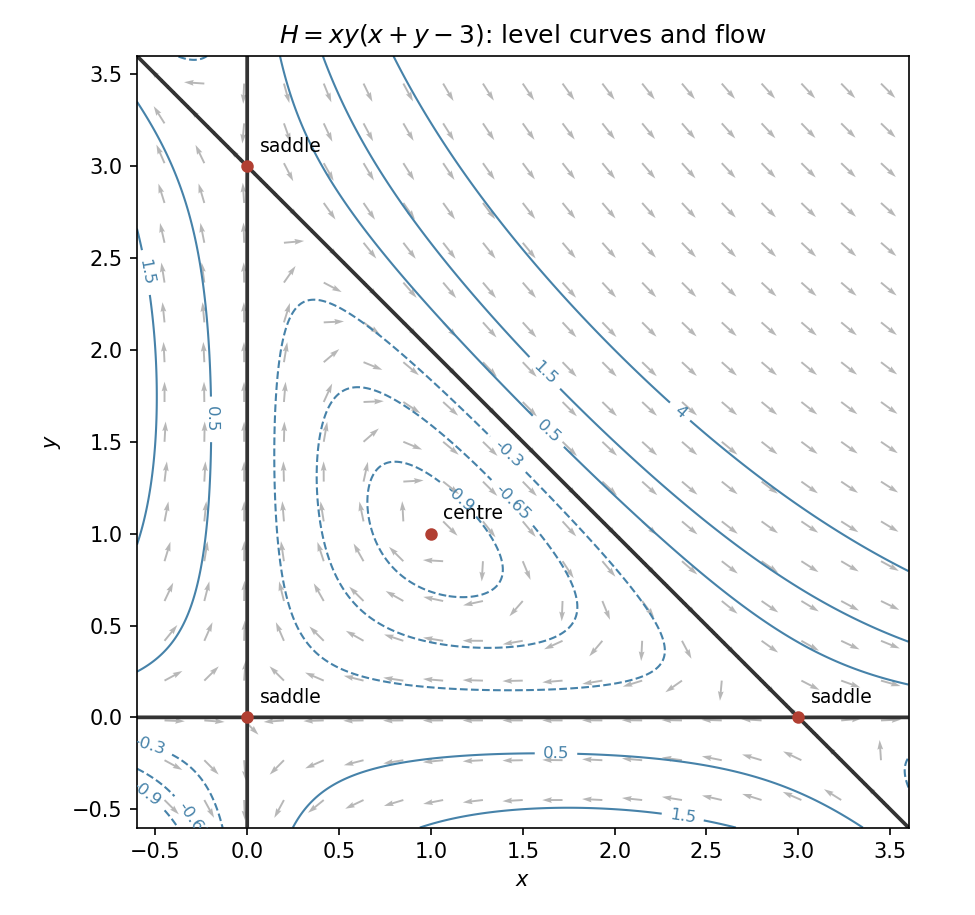
Solving the two factors in each equation gives . The Jacobian isAt the three boundary equilibria its eigenvalues are . These equilibria are hyperbolic fixed points; the Hartman-Grobman theorem gives local topological conjugacy to their saddle linearizations. At the matrix is , with eigenvalues . The linearization is a centre, but the hyperbolic theorem does not apply there.
The nonlinear classification follows from the actual HamiltonianAlong solutions . At , and its Hessian is , which is positive definite. Nearby regular level curves are closed ovals around this strict minimum. Their vector field is nonzero and tangent, so each is a periodic orbit. The nonlinear equilibrium is a centre.
The separatrix level consists of , , and . Within the triangle they connect the saddles as . The interior levels are nested clockwise periodic orbits; outside the triangle the remaining level branches are unbounded. On , flow is left for and right for or ; on , it is up for and down otherwise. These directions and the invariant levels determine the full phase portrait.


Past exam of the mathematics course of the University of Cambridge 2006 ii Paper 1 6B Solution Created 2026-09-24 Updated 2026-10-14
The probability generating function encodes the population distribution in one analytic function. Its coefficients and derivative recoverprovided the mean is finite. Higher derivatives at one give factorial moments, and normalization says .
Interpret the supplied birth and death expressions as transition rates: over a small time their probabilities are and . Incoming probability from and , minus both outgoing rates, giveswith . Multiplying by and summing yieldsAt stationarity, , so integration and normalization giveAlternatively differentiating the evolution equation at one gives , so . If , the displayed power expression is understood in its limit: , a Poisson distribution with mean .
Past exam of the mathematics course of the University of Cambridge 2006 ii Paper 1 4G Solution Created 2026-09-24 Updated 2026-10-14
A binary linear-feedback shift register of length keeps bits and produces a sequence satisfying a recurrenceAfter each output it shifts its stored bits and inserts the feedback bit. Its connection polynomial is . This convention reverses the usual characteristic polynomial .
The Berlekamp-Massey algorithm recovers the shortest recurrence compatible with observed bits. Maintain the current , length , an earlier polynomial that last caused a length increase, and the offset since that increase. Initially . At position calculate the discrepancy . If , advance . If , save and replace by . If also , replace by , by and by one; otherwise increase . Over a general field the correction is , where is the saved nonzero discrepancy. The correction cancels the failed equation while retaining the previous successful ones; when it forces a length increase the smallest possible new length is .
Here, indexing the first bit by zero, the nonzero discrepancies occur at positions . The corresponding updates areEvery subsequent supplied discrepancy is zero. ThusEquivalently the characteristic feedback polynomial is . No length-three recurrence works: positions force , but position six then has nonzero discrepancy. The recovered length is therefore minimal. Observing at least twice the true linear complexity ordinarily identifies the recurrence, after which a known consecutive block determines all future key bits. This is why a bare register is unsuitable as a cryptographic keystream generator; a finite prefix alone does not exclude a longer generator that later diverges.
Past exam of the mathematics course of the University of Cambridge 2006 ii Paper 1 3F Solution Created 2026-09-24 Updated 2026-10-14
Under the open set condition there is a nonempty bounded open set such that the sets are pairwise disjoint and all contained in . The Hausdorff dimension of the nonempty compact invariant set is the unique satisfyingFor the carpet here the 24 retained sub-squares give Euclidean similarities for , . Their images of are disjoint and lie in , so the condition holds even though some closed images share boundary points. All contraction factors are . Thus
Past exam of the mathematics course of the University of Cambridge 2006 ii Paper 1 38C c Created 2026-09-24 Updated 2026-09-24
Past exam of the mathematics course of the University of Cambridge 2006 ii Paper 1 38C b Created 2026-09-24 Updated 2026-09-24
Past exam of the mathematics course of the University of Cambridge 2006 ii Paper 1 38C a Created 2026-09-24 Updated 2026-09-24
Past exam of the mathematics course of the University of Cambridge 2006 ii Paper 1 37C Solution Created 2026-09-24 Updated 2026-10-14
For the reflection of a P-wave from a rigid plane, use the displacement convention , , where is the P potential and the SV potential. Put , , , and . The reflected waves must share the tangential wavenumber and frequency and propagate towards negative , so writeThe rigid barrier requires both displacement components to vanish. On this gives and . Solving,The total P potential is the given incident wave plus , and the S potential is . Reversing the sign convention for reverses but leaves the displacement unchanged. At normal incidence .
An evanescent reflected S wave would require , or . In a stable isotropic elastic solid , so this is impossible for real incidence angles: . The reflected S wave is never evanescent in the physical isotropic case. The inequality identifies the hypothetical critical-angle case if the speed ordering were reversed; it is S-to-P conversion, not this P-to-S conversion, that can become evanescent in an ordinary solid.
Past exam of the mathematics course of the University of Cambridge 2006 ii Paper 1 36B Solution Created 2026-09-24 Updated 2026-10-14
For a material interface with no mass transfer, the normal fluid velocity on both sides equals the interface's normal velocity. For ordinary viscous fluids without interfacial slip, tangential velocities also agree. The stress tensors have continuous tangential traction when surface tension is uniform; their normal traction jump balances surface-tension curvature. Nonuniform surface tension instead supplies a tangential Marangoni stress. These conditions express conservation of mass, no slip between the contacting fluids and force balance at the interface. For a flat interface of constant tension the full traction is continuous.
Choose down the plane and perpendicular outward from it. A steady parallel solution has velocity and equationsFor a uniform free layer, , , and . Integration givesIts flux per unit cross-slope width is
For the two-layer falling film of equal-density viscous fluids let and . Equal density gives the same continuous hydrostatic pressure in both, . The wall condition is , the upper condition , and at we require , . Integrating the two momentum equations with these conditions givesThe shear stress transmitted to the lower layer is the upper layer's downslope weight per unit area, , obtained by integrating the upper momentum balance from its stress-free surface. It depends on thickness but not upper viscosity. Changing changes the upper shear rate needed to transmit that stress, while the lower profile depends on alone.
Past exam of the mathematics course of the University of Cambridge 2006 ii Paper 1 35A Solution Created 2026-09-24 Updated 2026-10-14
For a scalar, , while its second covariant derivative is . Partial derivatives commute and the Levi-Civita connection is torsion-free, , proving the asserted symmetry.
Write the Einstein equation without cosmological constant as , . Tracing the given Ricci equation gives . HenceIn units the prefactor is absent. Metric compatibility, the product rule and the just-proved symmetric Hessian of a scalar field giveThe contracted Bianchi identity makes the left side zero. Wherever the gradient covector is nonzero, at least one component is nonzero, forcing , even when that gradient is null.
Finally , obtained by differentiating the metric determinant. Thus for any vector , . Applying it to proves
There are unlisted articles, also show them or only show them.