
If is Lipschitz continuous on with Lipschitz constant , then Cauchy-Schwarz inequality and the binomial distribution variance giveThis is an explicit error guarantee, rather than only an existence theorem. For the Bernstein approximation of a corner, choosing guarantees supremum norm error at most ; guarantees error strictly less than . The guarantee is sufficient, not optimal.
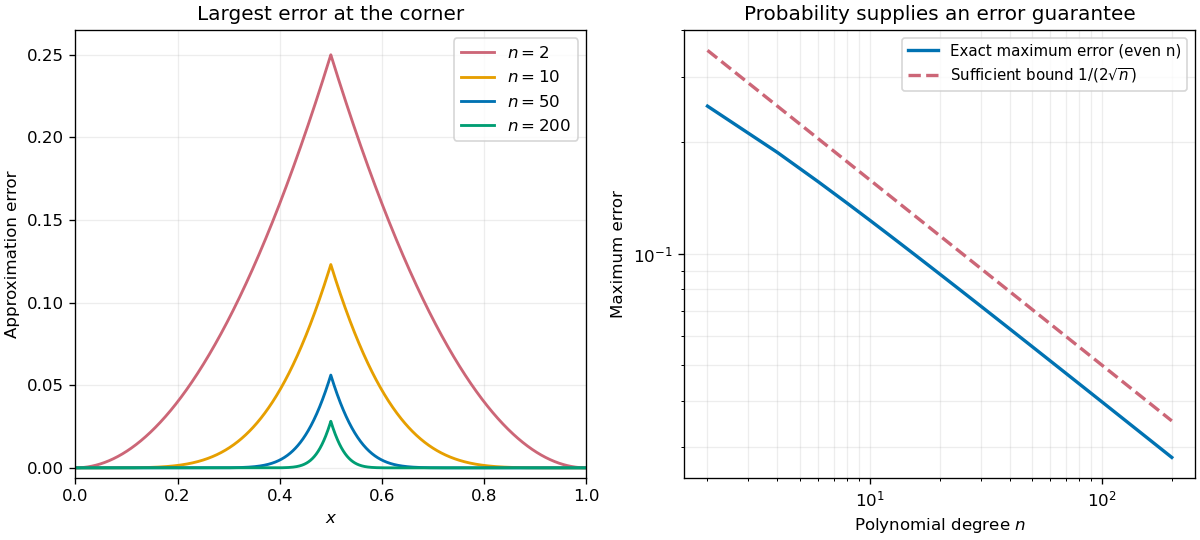

For this specific target, the error reaches its maximum at . Indeed the derivative of is a weighted average of the slopes , all in : see derivatives of Bernstein polynomials. Subtracting the target makes the error nondecreasing to the left of the corner and nonincreasing to its right. For even , the symmetric binomial distribution at gives the exact valueThe last equality follows by pairing terms about and telescoping the binomial coefficients. It gives for and for .
Bernstein approximation of a corner 2026-10-14
Take the continuous function on . It is Lipschitz continuous with Lipschitz constant one, but is not differentiable at . For , the sample values are , soThis is already a useful warning: the Bernstein polynomial is built from grid values but is not generally their polynomial interpolation.
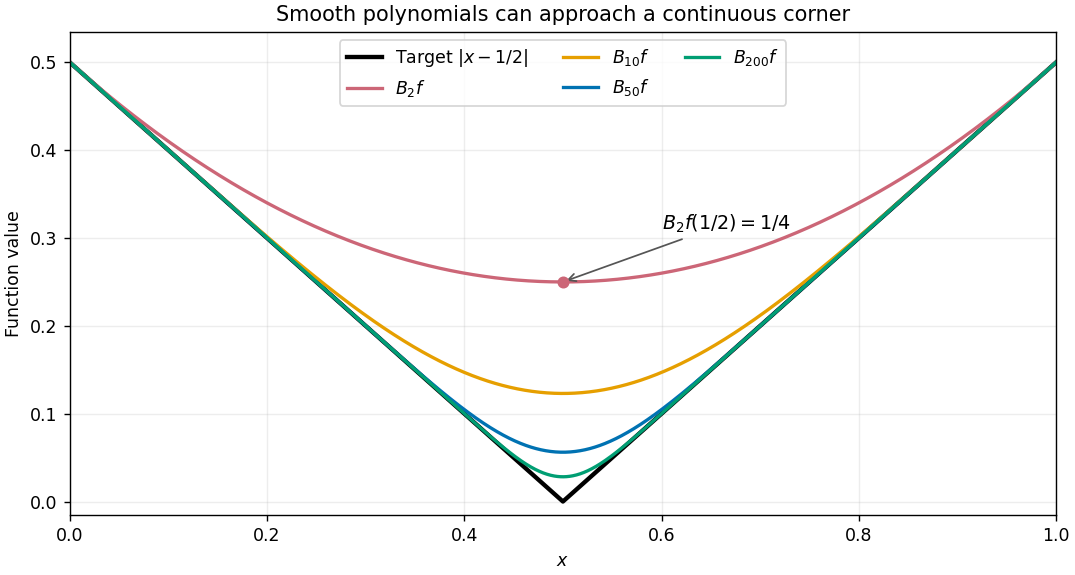

Every finite approximant is differentiable, and symmetry makes its derivative zero at the center. The target instead has left derivative and right derivative . Smooth curves can therefore approach a corner in supremum norm while their center derivatives have no target value to approach. The Lipschitz error bound for Bernstein approximation quantifies the improvement in values.
Bernoulli trial Created 2026-10-14 Updated 2026-11-05
A random experiment with two outcomes, success and failure, whose success indicator has a Bernoulli distribution. Repeated trials sharing success probability give a binomial distribution for their success count if they are independent conditional on ; integrating over an uncertain common generally makes the trials dependent marginally.
Estimating Bernoulli variance Created 2026-10-14 Updated 2026-11-05
For independent Bernoulli observations with sum , the extended maximum-likelihood estimator is . Its unbiased improvement is , obtained by conditioning on . The Rao-Blackwell theorem gives strict variance reduction for . With a uniform prior on and squared-error loss for , the Bayes estimator is . For parameter space strictly , samples with or have only a boundary likelihood supremum, not an attained maximum.
Write . The amplitude relaxes at rate two, while the phase is neutral under constant shifts. Eliminating the damped amplitude on long scales gives , where the linear phase branch has . Near , at leading order. Constant phase symmetry forbids undifferentiated phase terms; spatial parity of the leading amplitude equation forbids odd linear derivatives. Balancing negative phase diffusion against the fourth derivative produces the Kuramoto-Sivashinsky equation.
LOCC discrimination of four Bell states using two copies Created 2026-10-14 Updated 2026-11-05
Two identical copies of an unknown Bell state suffice for perfect identification by LOCC. Alice and Bob each measure on the first copy and on the second. Comparing their local signs supplies the eigenvalues of and . These are respectively for , for , for , and for . Each parity is certain even though individual local outcomes are random. Different copies provide the two complementary measurements, so measuring the first copy does not erase the phase information needed on the second.
Uniform-alternative binomial Bayes factor Created 2026-10-14 Updated 2026-10-25
For a binomial distribution count, compare a point null with the uniform alternative prior distribution on . The alternative Bayesian model evidence isso the exact Bayes factor favouring the point null is . With standardized deviation , the local normal distribution approximation is . At fixed the frequentist p-value remains approximately constant, while the factor grows like . This demonstrates the prior-width mechanism behind the Jeffreys-Lindley paradox for a Gaussian point null in a discrete sampling model.
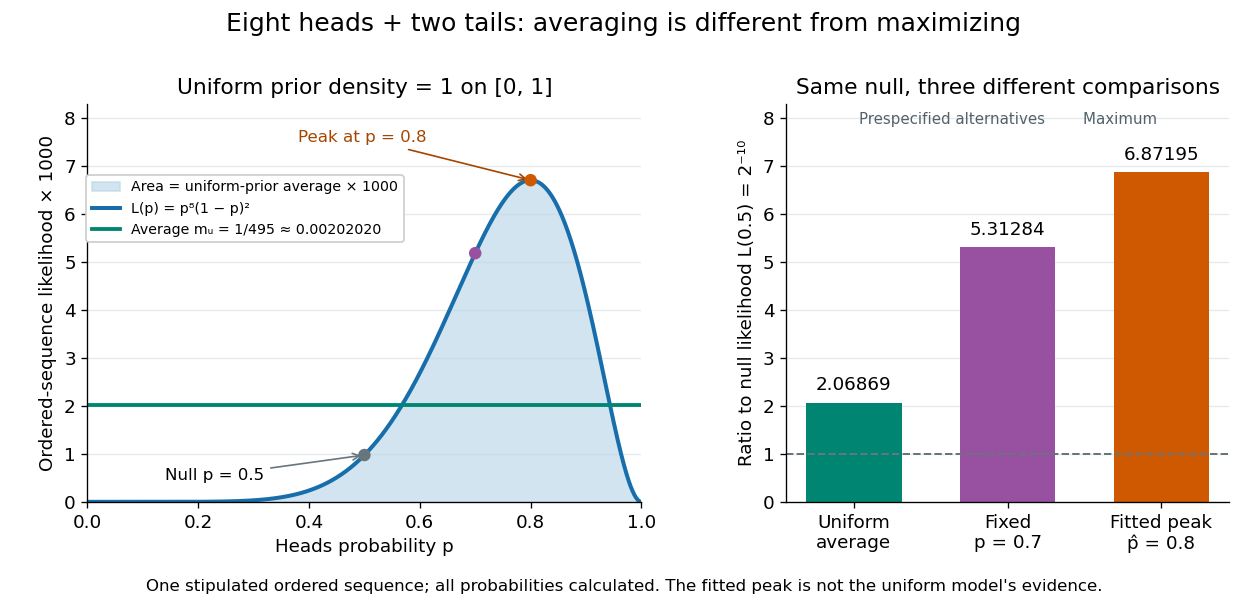
For a separate original example, change the point null to and take to have a uniform prior , fixed before the ten Bernoulli trials. Here is drawn once under and shared by all ten trials: they are independent conditional on . For one particular ordered sequence with eight heads and two tails, the Euler beta function givesThus the Bayes factor for the uniform alternative against the point null isThe binomial distribution count formulation gives and . Their ratio is again ; these count masses must not be combined with the ordered-sequence masses above. The general formula at the start of this article puts the point null in the numerator, so it equals here.
In contrast, maximum likelihood estimation gives : differentiating the log-likelihood yields , and the endpoints have zero likelihood. Its peak-to-null likelihood ratio isThis peak is chosen after seeing the data, so it is not the Bayes factor of the prespecified . The Bayesian model evidence for averages over its entire uniform prior; it is smaller than the peak. It is also smaller than . Against the same null, a point alternative fixed at would give a Bayes factor about , greater than . An integrated alternative need not outperform a point alternative.

For a general proper beta distribution prior distribution with , the same ordered-sequence marginal likelihood is . This follows by substituting the normalized prior density into the integral, and shows exactly where the parameter prior distribution changes the Bayes factor. Holding the parameter prior distributions fixed while changing model prior odds leaves that Bayes factor unchanged.
For independent observations, the quadratic-loss risk of the displayed estimator is . Within homogeneous rules its uniform minimum occurs at ; within affine rules a nonzero optimal intercept improves the integrated risk of a homogeneous rule unless , when the prior moments are finite. More generally a proper prior cannot produce an exactly homogeneous posterior mean: writing its marginal kernel for , the identity forces , whose induced density for is a pure power and is not integrable at both zero and infinity. Finite posterior quadratic losses, or finite Bayes risk for the integrated-risk argument, exclude vacuous infinite-loss minimization.
Extended Bayes rule 2026-10-14
A decision rule is extended Bayes if, for every , there is a proper prior with , where is the infimum Bayes risk. Equivalently a sequence of priors makes the rule's excess Bayes risk tend to zero. If its risk function is also the finite constant , then , so every rule has maximum risk at least . Letting proves that this equalizer rule is minimax.
Highest density region 2026-10-14
For a probability density and threshold , this region includes precisely the points at or above the threshold. It is a Bayes act for loss , since expected loss is . The minimal value is ; adding or removing threshold-equality points does not change it.
Dyadic affine Baumslag-Solitar group 2026-10-14
In the finite group presentation , let act by and by . The conjugates satisfy , so their increasing cyclic subgroups give the additive group . Every element has the form , and the affine action proves that this form can be the identity only if . Thus the displayed semidirect product identification holds. This is a finitely presented group with a series having torsion-free abelian factors, but it is not a poly-infinite cyclic group, since is not finitely generated.
Iterated endomorphism kernels in BS(2,3) 2026-10-14
For , the surjective endomorphism , has nontrivial kernel by Britton's lemma. The commutator subgroup is generated by for . For , its defining relations give . Hence whenever . The union of the increasing kernels is normal, and the images of all commute in its quotient, proving the first inclusion. The second follows from finite residual contains surjective endomorphism kernels applied to every iterate.
Represent by translation and by ; the relator holds and has infinite order. Base-three digits give words recursively by , . These have length at most and represent all , . Thus the growth function of a finitely generated group obeys . Counting freely reduced words in four letters gives . The growth is therefore exponential up to coarse equivalence.
Nullspace property 2026-10-14
The null space property relative to is for every nonzero . It is equivalent to exact basis pursuit recovery of every vector supported in . Sufficiency follows from the triangle inequality; for necessity, compare and , which have the same image under . Recovery of a single fixed signed vector can hold without this uniform property.
Toric basepoint-free criterion 2026-10-14
For an invariant Cartier divisor on a complete smooth toric variety, let satisfy for rays in a maximal cone . The divisor is basepoint-free exactly when every lies in the lattice polytope of a toric divisor . Its character section then trivializes the line bundle on the entire chart .
// Target: geometry-and-topology.bigb
Add diffusivities to the basally forced quadratic activator-inhibitor model. A Fourier mode with has matrix and determinant . When , its trace is negative for every . A positive-growth mode therefore occurs precisely when for some positive . The parabola has a positive minimizer only if , and its minimum is negative exactly when . Thus the ordinary Turing instability requires , and . At onset, and the critical wavelength is . A bounded spatial domain further requires an allowed mode inside the unstable band.
At , the reaction eigenvalues are . This linear marginal case is a weakly attracting focus, not a nonlinear center. To check it directly, put , , , , , and , . The equations become , , withOn the unit circle write , , . In polar coordinates, . The quadratic angular average vanishes. Integrating the quadratic correction over a whole cycle contributes its final squared integral, also zero, leaving the cubic average. Using the even trigonometric moments gives and . The Poincaré map is therefore . Since , it contracts sufficiently small positive radii and proves nonlinear asymptotic stability at the threshold.
Down-and-in claim 2026-10-14
A down-and-in claim with lower barrier pays a specified terminal payoff only if the stock reaches before maturity. Before activation its value solves a killed-domain pricing problem; at activation its value equals the ordinary terminal-payoff claim value.
Down-and-out claim Created 2026-10-14 Updated 2026-10-25
A down-and-out claim expires worthless if the stock reaches a lower barrier before maturity. A matching down-and-in claim plus a down-and-out claim pays the ordinary terminal claim on every path; this is in-out parity.
Up-and-out power claim 2026-10-14
An up-and-out power claim pays a power of the terminal stock price provided an upper barrier has never been reached. In the Black-Scholes model, set and , where , and . The risk-neutral pricing value isHere is the standard normal distribution function. Weighting the Brownian motion endpoint by changes the logarithmic drift to ; the finite-horizon maximum of Brownian motion with drift then supplies the survival factor.
There are unlisted articles, also show them or only show them.