
Calcite double-image experiment Created 2026-10-14 Updated 2026-10-18
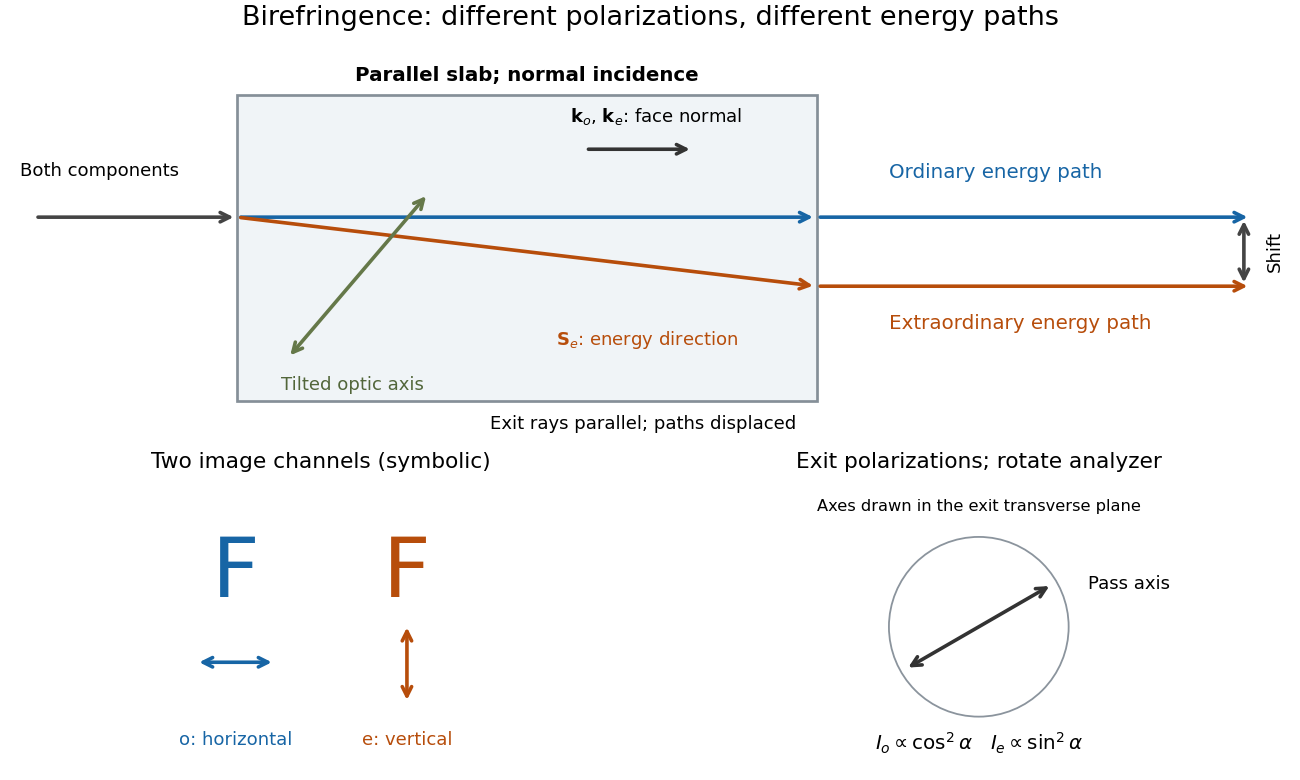
Place a clear calcite specimen on a transparency bearing printed words on an overhead projector. The projected readout is two copies of the lettering. Put a rotatable linear polarizer after the specimen: suitable orientations suppress one copy or the other. These are the actual apparatus and observations in the University of Iowa demonstration.[ref]
Polarization - Calcite & Iceland Spar by University of Iowa, Department of Physics and Astronomy. Demonstration 6H35.15, Equipment and Procedure: crystals, polarizers, printed overhead transparency, two sets of words and selective extinction; final note on natural defects
For a useful control, remove the specimen while keeping the transparency, projector and screen fixed: the doubling should disappear. Replace it, hold it stationary and rotate only the polarizer; complementary brightness changes distinguish two linear polarizations from an accidental duplicate transparency. These are suggested controls, rather than additional reported measurements. Ideally the two copies obey complementary Malus's law curves, and , with angle measured from the exiting ordinary wave's linear polarization. Unequal maxima do not invalidate the test. Finite polarizer extinction, poor focus and specimen defects limit visibility; image separation alone does not determine either refractive index without the specimen geometry.
Zero-truncated binomial distribution Created 2026-10-14 Updated 2026-11-05
The zero-truncated binomial distribution has probabilities for . Its natural parameter is and its cumulant is . mean and variance are and , where . The conditional normalizer depends on , so its likelihood is not proportional to the untruncated likelihood even after a positive observation. At and , its likelihood supremum is at rather than at .
Zero-event binomial upper confidence bound Created 2026-10-14 Updated 2026-11-05
If and is observed, the maximum-likelihood estimate of is zero. A one-sided upper confidence bound solves , so . For large , , giving approximately at 95% confidence. This describes uncertainty after no observed events, rather than proving that the underlying probability is zero. It assumes independent observations with a common event probability; clustered data require a different uncertainty calculation.
Binomial proportion Created 2026-10-14 Updated 2026-11-05
For with , the sample binomial proportion is . Its expectation is p and its variance is . The central limit theorem gives a normal approximation when both expected outcome counts are sufficiently large. These moments determine a standard error and model-based control limits.
Plane Poiseuille flow of a Bingham fluid Created 2026-10-14 Updated 2026-11-05
For fixed plates , no slip, viscosity , yield stress and , force balance gives shear stress . The central plug flow of a yield-stress fluid has half-width . If , the velocity isIt is even in ; its derivative is in the yielded layers and zero in the plug. If , there is no flow. Odd velocity is incompatible with this pressure-driven no-slip solution at nonzero flow.
A subspace is isotropic when the symplectic pairing vanishes between every pair of its vectors. Its binary Pauli labels therefore commute. Nondegeneracy identifies the ambient space with its dual, so the map to is surjective and . Since , it follows that . This explains the maximum number of independent generators of a stabilizer group.
Flips versus erasures in a binary channel 2026-10-14
A binary erasure channel marks its failed transmissions with a special output symbol, whereas a binary symmetric channel changes a bit without announcing whether it changed. At the same nominal failure probability , the two communication channels therefore leave different uncertainty. With a fair input, an unerased output determines the input exactly, while the erasure flag leaves one bit of conditional entropy. Thus and for the binary erasure channel. This is the binary case of capacity of a finite-alphabet erasure channel.
For the binary symmetric channel at , neither possible received symbol rules out either input, and . Its channel capacity is only . A receiver benefits from knowing where information was lost, even when the fraction of affected transmissions is the same.
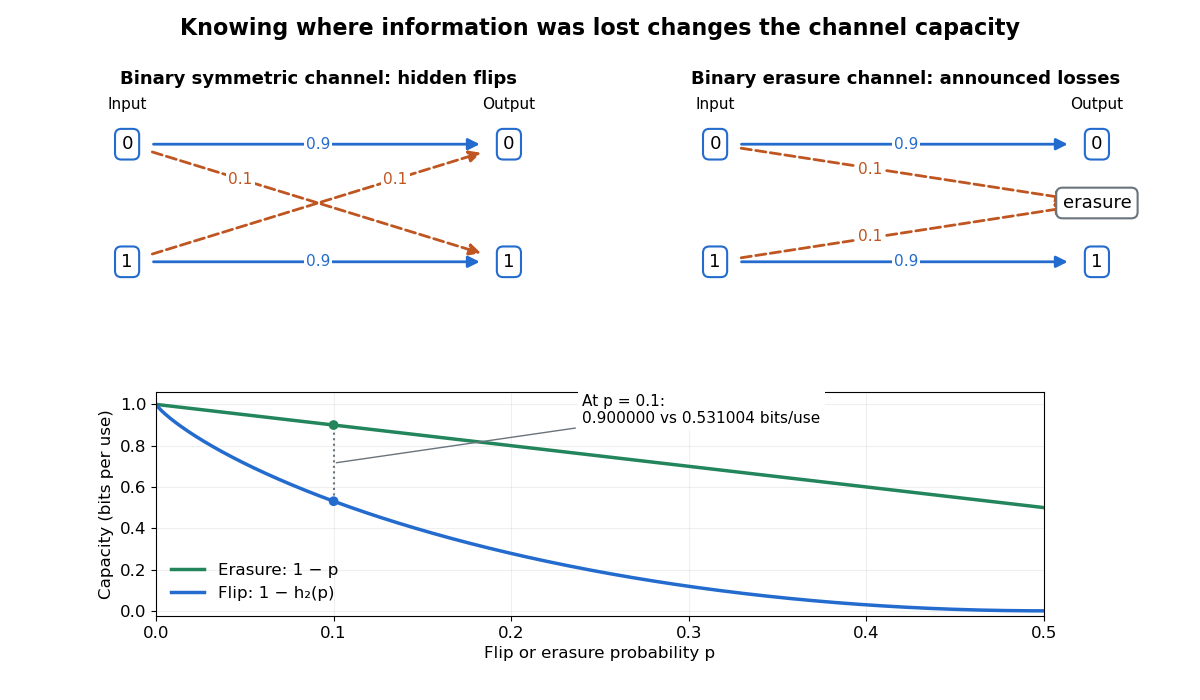


This comparison concerns the specified transition probabilities, rather than a general ordering of every error mechanism. In particular, at , an erasure flag conveys no input information, while deterministic inversion still conveys a full bit. Reporting only an error percentage loses the distinction between hidden corruption, announced loss, and a predictable reversible transformation.
Let for the input bit of a binary symmetric channel with crossover probability . The law of total probability givesConsequently its mutual information isHere specifies the noise and specifies the input bias; they are different choices. At and , the output has , giving and bits. With the same noise and the fair input , the output becomes fair and bits, attaining binary symmetric channel capacity.
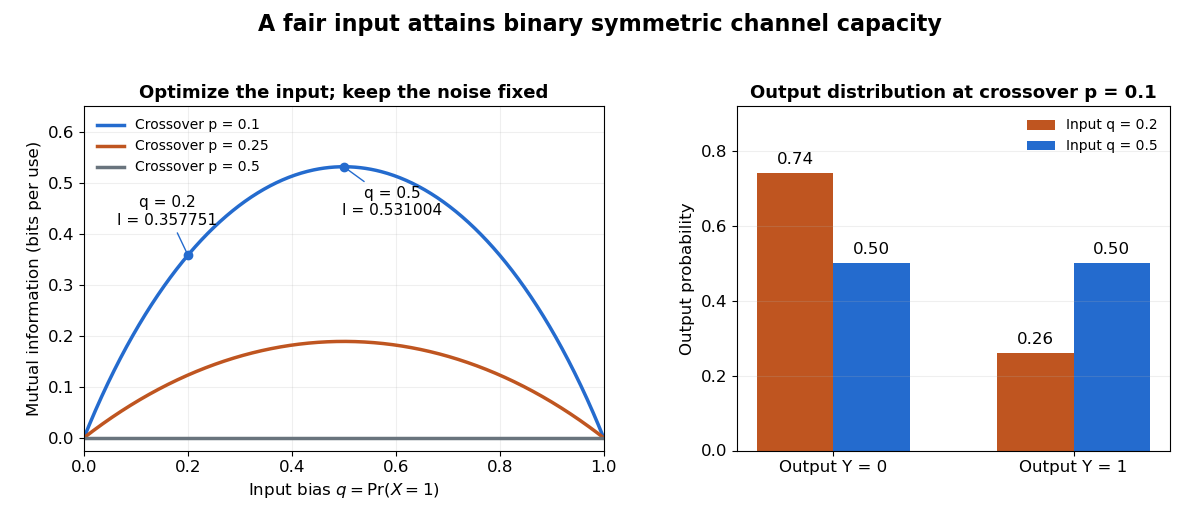

For , binary entropy reaches one only at output mass , and the equation forces . Thus the maximizing input is unique in those cases. For , every input produces the same fair output and zero mutual information, so every input bias is optimal and none transmits information. A fixed input or also carries zero mutual information for every : noise can make its output unpredictable without creating an unknown message to recover.
Constant weight of a binary simplex code 2026-10-14
When the columns of are every nonzero vector in , a nonzero row vector defines a nonzero linear functional . Exactly half the input vectors take value : translation by any vector on which the functional is pairs its zero and one fibres. Removing the zero input removes only a zero value. Thus every nonzero word in the binary simplex code has Hamming weight .
Two-transitive binary quadratic-form actions 2026-10-14
The symplectic group over a finite field is transitive on each of the two quadratic types. The stabilizer of a refinement is its orthogonal group over a finite field. In the displayed parametrization, other refinements of the same type correspond to nonzero singular vectors, and refinements of opposite type to nonsingular vectors. Witt's lemma makes the orthogonal stabilizer transitive on each of these vector sets. Thus both type actions are two-transitive for , and a minus stabilizer is transitive on the plus orbit. For the minus orbit is a singleton.
Innovations in a binary Markov source 2026-10-14
Generate the binary Markov source by taking independent and identically distributed Bernoulli random variables of parameter , independent of a fair initial bit, and setting . Here is exclusive or. Each is the unpredictable flip decision.
The transformation between and is a bijection. It preserves information entropy, soSending the initial bit and encoding the innovation sequence describes every source word exactly. This does not by itself specify a practical compressor, but it identifies the uncertainty which a prefix code or other lossless source coding method must handle.
For a word with flips among its transitions,There are such words: choose the initial bit and the flip positions. At and , each constant word has probability , whereas an independent fair source gives each word probability . Equal marginal probabilities plainly do not imply equal word probabilities.
Let be nonzero finite-dimensional complex vector spaces, and let have injective restrictions when either nonzero factor is fixed. It induces a map from to , where , , and . Pullback of the degree-two generator is , since both factor restrictions are projective linear embeddings. Its th power is in integral cohomology. The target must therefore have complex dimension at least . Positivity of both factor dimensions is necessary; a zero factor can make the claimed inequality false.
Derivative of a continuous bilinear map 2026-10-14
A continuous bilinear map obeys . Expanding leaves the displayed linear term and remainder . For product norm , the remainder has norm at most , hence is . This proves the Fréchet derivative formula.
Symmetric bilinear diagonal-parallel lemma 2026-10-14
Let be a symmetric bilinear map on a finite-dimensional real vector space. If is parallel to for every , then it has the displayed form for one covector . Write in a basis. Applying the condition to and excludes every component outside their span and gives . Set and extend by bilinearity. Dimension one follows by the same definition. The trace identity proves uniqueness without depending on the chosen basis.
Killing-form Einstein metric 2026-10-14
On a real semisimple Lie group, the nondegenerate invariant Killing form gives a bi-invariant pseudo-Riemannian metric. For left-invariant fields the Koszul formula gives and . Taking the trace gives , proving the Einstein property. On a compact semisimple group, is positive definite and has Einstein constant . The indefinite general construction is not a proof of existence of a positive-definite bi-invariant metric on a noncompact group.
Neutral invariant metrics on the free two-step Lie algebra on three generators Created 2026-10-14 Updated 2026-11-05
Let , and , with central. The symmetric tensor is invariant under the Adjoint representation of a Lie algebra: the derivation action of each of cancels in pairs. For , has determinant and inverse metric in the dual coframe. Its three hyperbolic planes give the displayed metric signature. On a connected Lie group this supplies a four-parameter family of bi-invariant pseudo-Riemannian metrics. Disconnected components must preserve the tensor separately; the automorphism reversing while fixing the other generators reverses and prevents this extension.
In the orientation-preserving affine group of the real line, translations converge to the identity element, but conjugation by dilation sends each one to . A compatible bi-invariant group metric would give for every , contradicting convergence. The group is nonetheless metrizable in its ordinary two real coordinates.
Resultant bound for intersections of plane curves Created 2026-10-14 Updated 2026-10-31
For projective plane curves without a common irreducible component, project from a point outside both curves. In coordinates where that point is , their defining homogeneous polynomials have constant nonzero leading coefficients in . The resultant in is nonzero by Gauss's lemma, and is homogeneous of degree in the remaining two coordinates. Every intersection projects to one of its zeros. Each projection line has only finitely many intersections with the curves, so their intersection is finite. Choose the center again outside all joining lines of pairs of intersection points; the projection is now injective on that finite set, proving the bound.
Two adjacent Bézier curves of degrees and interval lengths have a join precisely when their endpoint positions and their derivatives in the common parameter agree. Parallel endpoint polygon edges alone give tangent-direction agreement; their scaled vectors must be equal for parametric first-derivative continuity.
Poincaré polynomial 2026-10-14
For a space with finite-dimensional homology over a specified field and only finitely many nonzero Betti numbers, this polynomial records their graded dimensions. Its value at one is the total Betti number, and its value at minus one is the Euler characteristic. The Künneth theorem gives over a field. For integer homology ranks, use the rational Betti numbers.
There are unlisted articles, also show them or only show them.