
The oxygen-pressure exponents can be explained by a change in the dominant charge state of metal vacancies, with holes carrying the p-type current. For a divalent metal oxide, a doubly negative metal vacancy is in Kröger–Vink notation. A conventional oxygen-incorporation reaction isTreating regular oxygen-site activity as constant, the law of mass action gives . If these are the compensating defects, charge neutrality gives , hence and , assuming nearly constant hole mobility.
For singly negative vacancies, useNow and , so . The charge-state equilibrium gives : the singly charged fraction can therefore dominate as oxygen pressure and hole concentration increase. This is a consistent dilute-defect model, not a unique experimental identification of every defect. Changes in mobility, defect association or other compensating defects require independent tests.
For two equal spheres, the Derjaguin approximation uses . A planar nonretarded Van der Waals force interaction has energy per area , soThe force is attractive, with magnitude , taking separation increase as positive. Using the sphere–plane value of would overestimate it by a factor of two. The gap is much smaller than either radius, as required. Treat the supplied Hamaker constant as the effective one for the intervening medium; roughness, solvation and molecular-scale contact can modify a literal experiment.
Balance upward surface-tension force against the weight of the liquid column. The capillary action isWith perfect wetting, , , and , . The diameter, not the radius, is . This neglects the small meniscus-volume correction, gas-density buoyancy and contact-angle hysteresis.
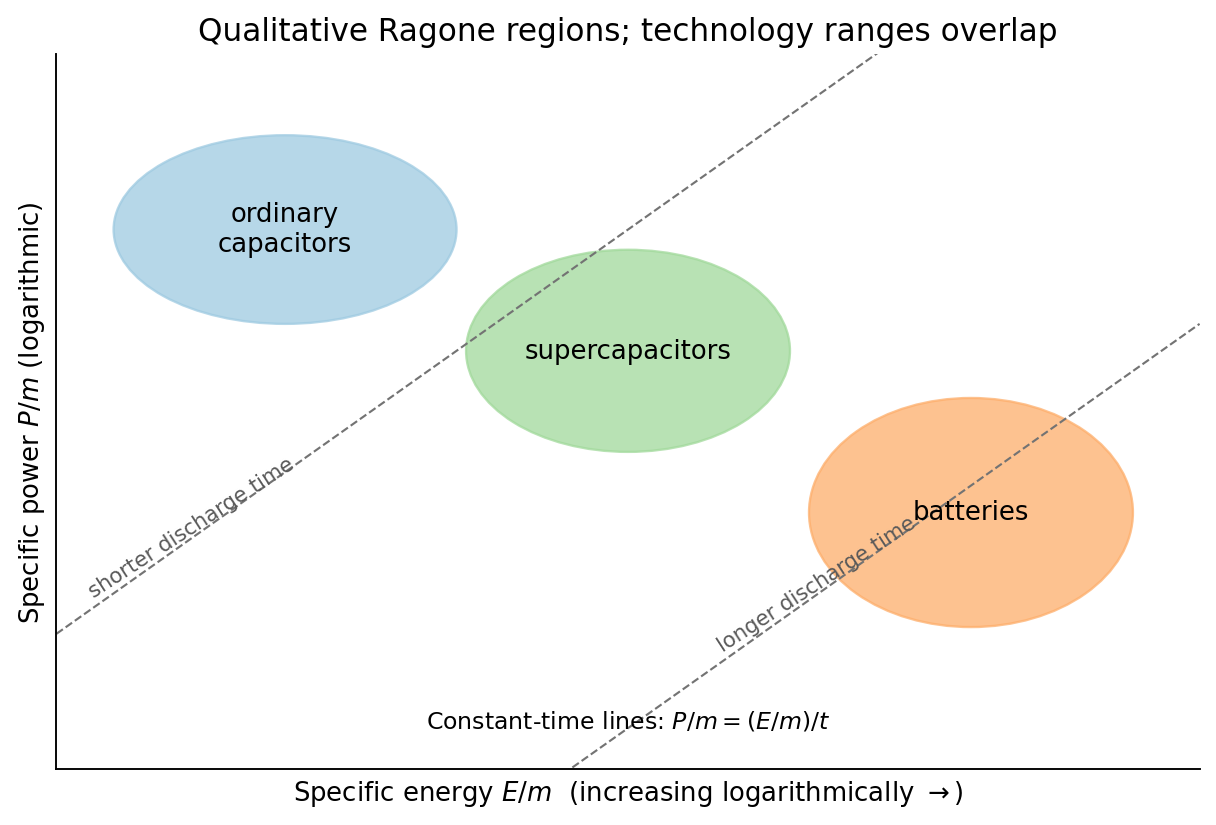
An ordinary capacitor stores energy by separating charge across a dielectric: and . Electronic charge redistribution is rapid, giving high specific power, but the dielectric breakdown field and modest capacitance limit specific energy. Series resistance limits pulse power and produces heating; a large nominal capacitance does not remove those losses.
A supercapacitor has a much larger interfacial area and nanometre-scale charge separation. An electric double-layer capacitor stores charge without a bulk redox transformation; pseudocapacitance adds sufficiently fast surface or near-surface redox storage. ion motion in pores, electrolyte stability and series resistance constrain its response. Its specific energy usually exceeds an ordinary capacitor's while high specific power and cycling durability remain possible.
An electric battery stores chemical free energy through coupled electrode oxidation-reduction reactions. It can store substantial energy per mass, but charge transfer, ionic transport, diffusion and heat removal constrain rapid discharge. The terminal voltage and accessible capacity depend on discharge rate and state of charge. Accordingly the plotted order follows the storage and transport mechanisms; it is not a claim that every battery has less power than every supercapacitor.
A Ragone plot has specific energy on its horizontal logarithmic axis and specific power on its vertical logarithmic axis, normally in and . The comparison must use the same mass convention: complete devices cannot fairly be compared with electrode-active-material values. At approximately constant delivered power, the discharge time isThus constant-time lines slope upward on the log–log plot. Ordinary capacitors lie toward high power and low energy; batteries toward higher energy and lower power; supercapacitors bridge the two. Technology and operating limits produce overlapping regions, not universal sharp boxes.
With , the standard reaction Gibbs free energy and dimensionless equilibrium constant areFor the reaction as written, , and the Nernst equation gives . Consequently zero cell potential requires under the specified unit-activity-coefficient assumption. Reversing that ratio reverses the conclusion. This mathematical ratio does not by itself guarantee experimentally attainable concentrations without precipitation or other chemistry.
In the high-surface-potential Schulze-Hardy rule, the critical coagulation concentration scales approximately as with the counterion valence. HenceThe more highly charged counterion therefore requires about eleven times less concentration in this idealized estimate. This assumes the cations are the counterions of a negatively charged surface, the surface-potential regime is appropriate, and the only changing mechanism is electrostatic stabilization. Specific adsorption and hydrolysis of aluminium ions can invalidate this scaling; matching ionic strengths instead is not the same prediction.
charge stabilization of colloids supplies repulsion when like-charged surfaces and their electric double layers approach. steric stabilization uses attached or adsorbed molecular layers whose overlap costs conformational and osmotic free energy. Combining both gives electrosteric stabilization; a solvated coating must remain attached and well solvated. A viscous medium slows encounters but does not by itself create an equilibrium repulsive barrier.
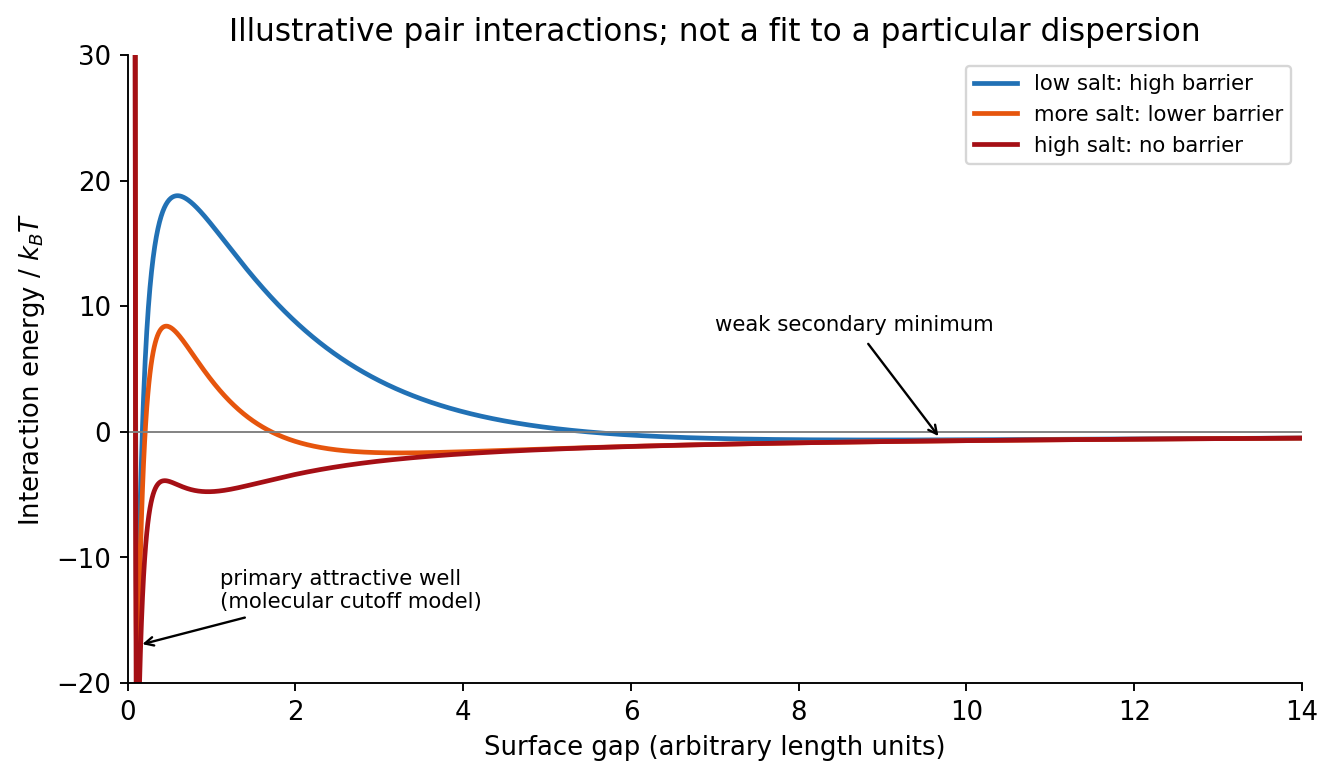
DLVO theory adds screened electrostatic repulsion to Van der Waals force. A representative close-gap form isfor equal spheres of radius , with Hamaker constant and inverse Debye–Hückel screening length . The formula is schematic near molecular contact, where hydration, surface roughness and finite ion size matter. A repulsive barrier many high produces kinetic stability even if the primary attractive minimum is deeper than the dispersed state. Entry into that primary minimum generally gives strongly bound aggregation; a shallow secondary minimum can give reversible flocculation.
Adding electrolyte increases , shortens the repulsion and can remove the barrier, enabling fast diffusion-limited aggregation. The critical coagulation concentration is the approximate salt concentration at which this rapid-coagulation regime begins under specified conditions. It is not a universal property of the salt alone. Test the prediction using time-resolved dynamic light scattering or turbidity at controlled particle concentration, pH and temperature; check that added ions do not specifically adsorb or change the surface chemistry.


First, use a phase-shift mask: neighbouring openings transmit appropriately phased light, increasing the intensity slope and improving separation of neighbouring bright regions. The benefit is pattern dependent and phase conflicts or mask defects must be controlled. Second, use off-axis illumination matched to the grating orientation, so useful diffracted orders fall inside the projection pupil and contribute interference contrast at smaller pitch. Check orientation dependence and the reduced process window; it does not enlarge the geometrical pupil.
Third, use optical proximity correction and subresolution assist features to compensate the pattern-dependent aerial-image distortion at edges and corners. Verify the printed critical dimensions using a focus–exposure matrix and scanning electron microscopy. These are three adaptations of the existing exposure process that lower effective ; none promises arbitrary subwavelength structure. A thinner, higher-contrast photoresist and an antireflection underlayer can further improve pattern transfer, but do not change the wavelength.
An immersion liquid increases numerical aperture through , if the optics can use the same ray angle inside a transparent, chemically compatible liquid of refractive index . With unchanged and vacuum wavelength, the width scales as at fixed angle. If the two empirical formulae printed in the question are used literally with fixed , they give .
For a physical axial displacement inside the medium, however, the familiar paraxial defocus range contains an additional index factor: . That convention gives at fixed ray angle, or an approximately -fold larger depth of focus at fixed and resolution. Thus immersion can improve lateral resolution, while its focus benefit depends on what is held fixed and on the axial-focus convention. It cannot improve resolution merely by inserting into while ignoring optical redesign, absorption or resist compatibility. No liquid index is supplied for a numerical prediction.
There are unlisted articles, also show them or only show them.