
Ext from a principal non-zero-divisor quotient Created 2026-10-14 Updated 2026-11-05
For a commutative ring and a non-zero-divisor , the free resolution gives degree-zero kernel and degree-one cokernel, and all higher Ext functors vanish. Directly in an injective resolution of the second variable, multiplication by is surjective in every term: the map taking to extends to . Thus is a short exact sequence of complexes and gives the same result. The displayed Hom functor is covariant in ; changing it to changes the variable that is resolved.
For , the open-chain Ising model coupling , , has a tridiagonal inverse. Its endpoint diagonal entries are , its interior diagonal entries are , and adjacent off-diagonal entries are . Direct matrix multiplication verifies the inverse because the geometric sequences cancel in every interior row. The displayed quadratic form follows with , and . For , and . Omitting the endpoint term requires an infinite chain, a correctly periodized coupling, or a bulk thermodynamic limit.
Under independent censoring, a model with known has score , where and . Expanding about the ordinary exponential estimate gives the displayed first-order correction when every added event-time hazard is small compared with . The integrated offsets contribute constants to the log-likelihood. If all , the positive interior estimate is exactly .
For symmetric negative-definite matrices, put , and . The spectral theorem gives exact exponential norm bounds, and . Integration in the exponential product defect identity proves the displayed estimate if . At equality its continuous limit is ; the quotient must not be interpreted as division by zero.
For , neglecting acceleration of the field and kinetic energy gives and . Integration yields the displayed field with . The exact flat scalar-dominated solution has the same power but . The two normalizations agree at leading slow-roll order. Inflation requires ; the stronger slow-roll conditions require .
AdaBoost training error bound 2026-10-14
For AdaBoost with initial uniform weights, labels and base predictions in , and edges , the training exponential classification risk equals the product of stage normalizers. A wrongly classified point has exponential loss at least one, so empirical classification error is bounded by this product. The final inequality uses . The result concerns training error, not a guarantee against overfitting or mislabeled observations.
// Target: probability-and-statistics.bigb
e (mathematical constant) 2026-10-14
Euler's number is the value of the exponential function, approximately . It is the base of the natural logarithm. Its factorial-series tail gives an elementary proof of the irrationality of e. The compounding limit for e shows how the same constant arises from repeated small multiplications.
Exponential growth Created 2026-10-14 Updated 2026-10-25
A positive quantity undergoes exponential growth at constant rate when . For , the solution of a differential equation is . Every interval of duration multiplies the value by the same factor , independently of its starting value.
Exponential dispersion model 2026-10-14
For independent observations with unknown mean and variance, the first natural parameter is . Its maximum-likelihood estimator is . The delta method and independent asymptotic mean/variance errors give limiting variance for . Knowing removes the second contribution and makes the estimator exactly normal with variance .
Natural exponential family 2026-10-14
A natural exponential family uses its observation vector itself as the canonical sufficient statistic. Its cumulant function is and its natural parameter space consists of parameters for which this integral is finite. On the interior, differentiating gives mean parameter of an exponential family and covariance matrix .
Minimal exponential family 2026-10-14
An order- exponential family is minimal if no nonzero linear combination of its canonical sufficient statistics is almost surely constant under the base measure. Equivalently, its sufficient-statistic support lies in no proper affine hyperplane. Its cumulant function then has positive-definite Hessian matrix on the interior natural domain, because that Hessian is a covariance matrix.
Curved exponential family 2026-10-14
A curved exponential family, with , restricts a -parameter canonical family to a smooth rank- parameter surface, usually a nonaffine surface. For example, with has sufficient statistics and natural parameters , constrained by . Canonical concavity in the ambient parameters need not imply concavity along the curved parameter surface.
Risk premium Created 2026-10-14 Updated 2026-10-25
Zig-zag product 2026-10-14
For a port-labeled -regular graph and a -regular graph on its port labels, replace every vertex by a copy of . An edge makes a step in , crosses the corresponding edge of , then makes another step in . The result has vertices and degree . Its normalized operator is , where and is the involutive edge rotation of . Decomposing a mean-zero vector into cloud-constant and cloud-orthogonal parts proves the bound .
Haze Created 2026-10-14 Updated 2026-11-05
Atmospheric haze consists of small suspended particles that scatter or absorb radiation, often formed through atmospheric photochemistry rather than direct condensation of a locally abundant vapour. In an exoplanet atmosphere, transport, growth and settling determine the particles' altitude and size distribution.
A haze can add a wavelength-dependent continuum to an exoplanet transmission spectrum and conceal molecular bands. The scattering slope of a transmission spectrum connects an idealized extinction law with the atmospheric scale height, but a measured slope alone does not establish a particular haze composition. Stellar contamination of a transmission spectrum can also alter the slope. Distinguishing these explanations requires spectral coverage and a joint model of the star and planet.
Atmospheric super-rotation Created 2026-10-14 Updated 2026-11-05
Atmospheric superrotation is circulation whose axial angular momentum per unit mass exceeds that of the underlying body's equator. An eastward equatorial jet is a common manifestation, but it requires a continuing source of equatorial momentum convergence rather than merely a local temperature difference.
In models of exoplanets under tidal locking, day-night heating excites large-scale Rossby waves and Kelvin waves. Their phase structure transports eastward momentum toward the equator and can maintain the jet against drag. This mechanism was demonstrated using an analytic model and numerical calculations of increasing complexity.[ref]
Equatorial superrotation on tidally locked exoplanets by Adam P. Showman and Lorenzo M. Polvani. Abstract: standing Rossby/Kelvin waves, phase tilts and equatorial momentum convergence
Such a jet can shift a bright atmospheric region eastward, affecting an exoplanet thermal phase curve, although a brightness offset alone does not uniquely measure a wind speed. Fagin's theorem 2026-10-14
Fix a finite relational first-order signature , and let be a class of finite nonempty -first-order structures closed under isomorphism. Fagin's theorem states that is definable by one existential second-order logic sentence under full semantics for second-order logic if and only if its language of standard finite encodings belongs to NP. A standard encoding numbers the domain and lists membership bits for each input relation, together with ; take an explicit encoding whose length is at least . The encoding language contains all numbered copies of members of , with malformed encodings rejected. The isomorphism condition makes membership a property of the structure rather than an arbitrary choice of labels. Changing between the usual explicit encodings preserves the NP characterization by polynomial time translations.
The forward direction is the witness-and-verifier calculation in existential second-order logic. For the reverse direction, the guiding idea is to encode an accepting nondeterministic computation using second-order relation variables: fixed-length tuples of domain elements index enough time steps and storage positions for a polynomial time computation. A first-order sentence checks the initial input, legal transitions, and acceptance. The number of tuples grows with the input, although the checking sentence stays fixed. No total order must be supplied as part of the input first-order signature: an auxiliary total order can itself be existentially guessed and constrained by a first-order sentence. Isomorphism invariance ensures that a change of this auxiliary numbering does not change membership in .
The second-order encoding of three-colorability is a small instance of the forward direction. The beauty of Fagin's theorem is the complete correspondence: the computational class NP can be characterized by the shape of a logical description, without mentioning a particular machine in the statement. The scope is finite relational first-order structures and fixed sentences; it is not a claim about deciding arbitrary second-order logic sentences or about arbitrary infinite domains.
Ronald Fagin published the result in Generalized First-Order Spectra and Polynomial-Time Recognizable Sets, SIAM-AMS Proceedings 7 (1974), pp. 43–73, Section 4. The original paper frames the correspondence using classes of finite expansions and their encodings. Fagin's author-maintained publication list explains that the abstract in the available copy was added in 2019; its modern summary should therefore not be mistaken for part of the 1974 printing.
Second-order encoding of three-colorability 2026-10-14
Represent a finite simple graph by a domain of vertices and a symmetric, irreflexive binary relation for graph adjacency. Introduce three unary second-order relation variables , one for each fixed named colour. Define the following abbreviations for first-order formulas in this expanded first-order signature:Then the existential second-order logic sentenceasserts that every vertex receives exactly one of the three colours and adjacent vertices receive different colours. The first clause gives coverage and pairwise disjointness of the three subsets; the second makes each subset an independent set. Empty colour classes are allowed, so expresses existence of a proper vertex coloring using at most three colours.
For the complete graph on the fixed vertices , one witness is , , . Each vertex satisfies exactly one predicate, and each of the three edges joins different predicates. Every valid witness assigns different colours to all three vertices; there are witness triples with these fixed vertex labels and fixed named colours. We are counting assignments, without identifying them under colour permutations or graph isomorphisms. For the complete graph , the pigeonhole principle forces two of its four vertices to share a colour, and those vertices are adjacent. Thus it has no witness triple. This calculation illustrates a complexity certificate without requiring the reader to reconstruct a machine computation.
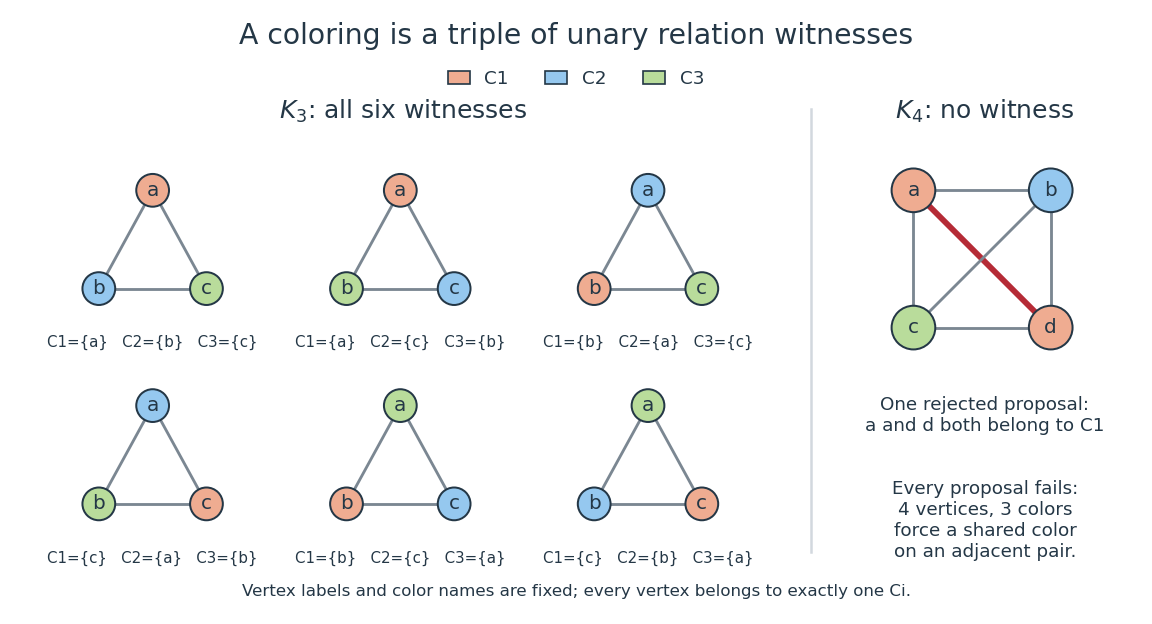
Six relation witnesses for the labeled complete graph K3, and why K4 has none
. Details. 
Reproduce the diagram by running
python ../second-order-coloring-witness.py from the repository's _media directory. The script checks all witness triples for these two complete graphs before drawing them. Exciton absorption experiment in copper(I) oxide Created 2026-10-14 Updated 2026-10-20
In Giant Rydberg Excitons in Cuprous Oxide by Tomasz Kazimierczuk and others, a polished copper(I) oxide crystal was mounted without strain at . A tunable single-frequency dye laser scanned photon energy; balanced detection compared transmitted light with a reference beam. Transmission dips resolved spectral lines assigned to bound excitons through principal quantum number . Their convergence towards an unbound threshold supports a hydrogen-like internal series, with small systematic deviations.[ref]
Controls mattered: restricting broadband illumination improved resolution of high- excitons; lowering laser power or expanding its spot reduced interaction-induced suppression. Balanced detection suppressed source fluctuations. The measurement probes optical resonances, not individual electron-electron hole trajectories or directly imaged radii. Electric-dipole selection rules favor P-envelope states in this material, unlike the hypothetical permitted lowest-state transition above. Finite resolution and crystal inhomogeneity affect spectral lines; the inferred binding series requires a continuum threshold and a model.[ref]
Giant Rydberg Excitons in Cuprous Oxide by Tomasz Kazimierczuk and others. pp. 3–5; supplement pp. 2–4 and 6–7, figure S3: selection rules, illumination tests, line corrections and deviations
There are unlisted articles, also show them or only show them.