
Yukawa fermion triangle Created 2026-10-14 Updated 2026-11-05
Three scalar Yukawa interactions on a closed Dirac field loop give two cyclic orientations. Odd gamma matrix traces vanish, while gives the displayed numerator. For external invariant mass squares , write and similarly for the other two lines. The numerator becomes , reducing the fermion loop to three scalar bubbles and a scalar triangle Feynman integral. The closed fermion loop sign must be included. A massive fermion produces a logarithmic local divergence.
Integrating out a charged vector boson Created 2026-10-14 Updated 2026-11-05
For a massive charged vector with interaction , neglect derivatives at momenta small compared with its mass. Completing the square in leaves . With this yields the Fermi constant relation . Corrections contain extra derivatives and are suppressed by momentum squared over the heavy mass squared.
Degenerate electron gas Created 2026-10-14 Updated 2026-11-05
An electron Fermi gas whose occupation is governed mainly by the Pauli exclusion principle, with thermal energy small compared with its kinetic Fermi energy. At zero temperature its momentum states are filled up to . In the ultrarelativistic limit , with . This supplies the pressure supporting a white dwarf until the relativistic mass limit is approached.
Fejér second-modulus approximation bound Created 2026-10-14 Updated 2026-11-05
The even positive Fejér kernel of total mass one gives . The scaling property of the second modulus of smoothness bounds this by . On , gives . Choose . For twice continuously differentiable functions, the second-difference integral formula makes the error .
Fejér first-moment approximation bound Created 2026-10-14 Updated 2026-11-05
The normalized Fejér kernel satisfies on . Splitting its first absolute moment at gives . The chaining inequality for the modulus of continuity, , then bounds the Fejér sum error by . Taking proves the stated bound for and hence uniform convergence for continuous periodic functions. The logarithm vanishes at , so the displayed estimate is not intended at that index.
Hölder error bound for Fejér summation Created 2026-10-14 Updated 2026-11-05
For a periodic Hölder continuous function of Hölder exponent and Hölder seminorm at most , the degree- Fejér sum has the displayed supremum norm error bound. In the half-kernel normalization , use . Splitting the convolution error integral at gives the valid constant . At the endpoint this argument instead gives .
Odd-address intervals lie in the first image of the central restrictive interval, away from the critical point. The derivative of the Feigenbaum map is bounded above and away from zero there, so the next even interval has comparable length by the mean value theorem. For the wraparound image, makes its length a fixed fraction of the central interval. Thus the odd and full partition length-power sums differ only by constant factors for each fixed real exponent, and have the same exponential growth rate.
Suppose a Fatou component satisfies , and some has . Every connected component of maps properly and surjectively to : properness follows by intersecting compact preimages with the relatively closed component; openness and closedness then give surjectivity. Such a component must meet the entire fiber over , which lies in . Since is itself one inverse-image component, there can be no other. Hence and , proving complete invariance.
Siegel disc 2026-10-14
A Siegel disc is a simply connected periodic Fatou component on which the first-return map is holomorphically conjugate to an irrational rotation of the unit disc: , with . Its return iterates are normal because any sequence of rotation factors has a convergent subsequence in the unit circle, giving locally uniform limits after conjugation. The iterates generally do not converge to a constant. This is a rotation domain, illustrating stability without attraction.
Herman ring 2026-10-14
A Herman ring is a doubly connected periodic Fatou component on which the first-return map is holomorphically conjugate to an irrational rotation of an annulus . Compactness of the circle of rotation factors proves normality of the return iterates, and the finitely many intervening iterates preserve normality. It is the annular rotation-domain counterpart of a Siegel disc.
Cooley-Tukey FFT algorithm Created 2026-10-14 Updated 2026-10-20
The radix-two Cooley--Tukey algorithm recursively splits a discrete Fourier transform into transforms of the even-indexed and odd-indexed samples. For a power-of-two length this evaluates the transform in arithmetic operations.
The saving comes from reusing the two shorter discrete Fourier transforms for both halves of the output, through an FFT butterfly. For , each level of the even--odd fast Fourier transform recursion needs work proportional to , and there are levels. This gives the time complexity without changing the discrete Fourier transform being computed.
James W. Cooley and John W. Tukey published An Algorithm for the Machine Calculation of Complex Fourier Series in Mathematics of Computation 19 (1965), pp. 297–301. Their original paper factors a composite length as , derives an operation count , and discusses powers of two and in-place storage. Its opening explicitly builds on earlier algorithms by I. J. Good; the 1965 paper is a landmark computational formulation, rather than the invention of the underlying Fourier analysis. Its positive-exponent convention also illustrates why a Fast Fourier transform's exponent sign must be specified.[ref]
https://janmr.com/files/papers/cooley-tukey.pdf. Cooley and Tukey 1965, original paper, pp. 297–300, equations (1)–(12); scan of the published article
Suppose a linear program has a Farkas' lemma certificate , , . A purported feasible point of , would imply . Hence every relaxation below the displayed positive threshold remains infeasible. For rational inputs, bounds on the encoding length of a certificate supply the precision gap used by the ellipsoid method.
Fano scheme of lines 2026-10-14
The Fano scheme for projective lines. For , it is a closed subscheme of and hence is projective. Requiring the defining homogeneous polynomials of to vanish along a line gives its closed defining conditions.
Normal fan of a polytope 2026-10-14
The normal cone of a face of a polytope consists of linear functionals whose minimum is attained on all of . These cones form the inward normal fan, complete in the dual of the polytope's affine span. For a full-dimensional lattice polytope, it is a complete rational fan in the full dual space.
// Target: geometry-and-topology.bigb
Infinite fan in toric geometry 2026-10-14
An infinite rational fan allows infinitely many cones in toric geometry while retaining the face and intersection axioms of a fan in toric geometry. Gluing its affine monoid charts constructs a possibly non-quasi-compact toric scheme over a base ring. Finiteness of the collection is unnecessary for the chart gluing, though it is needed for finite-type conclusions.
// Target: toric-geometry.bigb
For with distinct odd primes, choose a uniform unit and give only to an oracle returning any square root . Conditional on this square, is uniform among four roots and independent of the oracle's choice. With probability one half, is not , and is a nontrivial factor. Thus full inversion of the squaring map yields randomized integer factorization; this reduction does not equate arbitrary partial leakage with full inversion.
In the mostly-minus convention with vacuum gravitational action proportional to and , the displayed conformal transformation turns its vacuum equation into , with potential and the stress-energy tensor of a canonical scalar field. The conformal Ricci formula cancels the second derivatives of against the original field equation. Its remaining derivative tensor is . Expressing as a function of requires a locally invertible . When , this scalar-tensor parametrization degenerates and introduces no new propagating scalar degree of freedom.
With a future unit timelike normal in signature , this convention makes the extrinsic curvature trace equal to the normal congruence's expansion, . An expanding flat Friedmann-Lemaître-Robertson-Walker metric has and . This is the opposite sign to the negative-expansion convention used in many 3+1 decomposition of spacetime formulas. Projection identities and momentum constraints must use the same convention throughout.
Fano-plane Turán theorem 2026-10-14
For all sufficiently large , the extremal number of the Fano plane as a three-uniform hypergraph is the displayed count of all triples crossing a balanced bipartition. The plane has no Property B, so this construction avoids it. A stability argument makes near-extremal Fano-free hypergraphs nearly bipartite; vertex deletion obtains high minimum degree. Optimizing the approximate bipartition and applying Fano completion through three matchings then rules out all internal triples. The large-order qualification matters: for the complete hypergraph has no Fano copy but exceeds the displayed count.
Bivector Created 2026-10-14 Updated 2026-10-14
A bivector is an element of the second exterior power . A simple bivector is one exterior product ; in real Euclidean space, it records the oriented area generated by those two vectors. A general bivector is a sum of such elements and need not describe just one plane. Covariant counterparts are differential two-forms, which take two vectors as inputs rather than belonging to .
In , chooseExpanding by bilinearity givesThe three coefficients are signed areas of the projections onto the , , and coordinate planes. They are three components of one bivector, not the three coordinates of either input vector.
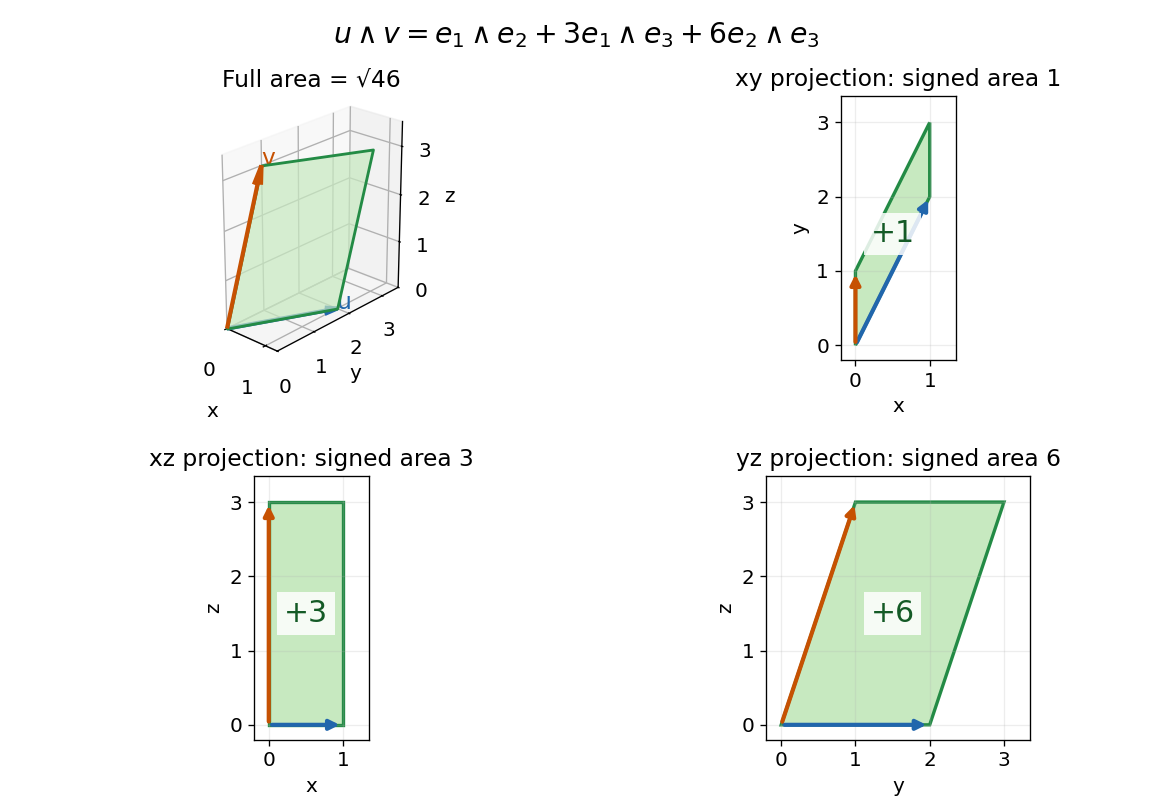

With the usual dot product and a fixed orientation of a vector space, the cross product represents this area element by the normal vector . The order of the components matters: corresponds to , while corresponds to . The Gram determinant checks the full area:Here the norm on bivectors is the one induced by the Euclidean inner product. The exterior product exists without that metric and in arbitrary dimension; the familiar cross product description relies on the additional three-dimensional geometry.
There are unlisted articles, also show them or only show them.