
Piecewise-exponential mortality comparison 2026-10-14
For specified exposure periods with constant death hazard functions , the integrated hazard through the endpoint is . The displayed event probability follows from the survivor function identity. For different latent exposure schedules mixed with probabilities , average the schedule-specific probabilities, , rather than exponentiating the average integrated hazard. When the hazards are small, gives a person-time approximation. A comparison must specify the entire custody or treatment schedule; later changes to exposure cannot be inferred from an endpoint rate alone.
Phototactic orientation Fokker-Planck equation Created 2026-10-14 Updated 2026-11-05
For isotropic rotational diffusion, orientation drift and probability density obey the displayed Fokker-Planck equation, normalized with respect to solid angle. Without flow, constant light gives the zero-current density , . Integration over the sphere gives unit mass; its mean projection is the Langevin function. The zero-light limit is the uniform density .
Phototactic concentration in a vertical channel Created 2026-10-14 Updated 2026-11-05
In a long channel , uniform horizontal mean swimming and isotropic translational diffusion coefficient give zero transverse cell flux when , . Normalizing the transverse mean concentration to gives the displayed exponential. For , cells form a layer of thickness at the illuminated wall. This is a bulk approximation; exact closed-end cell conservation equation also requires the integrated axial cell flux to vanish.
Color index 2026-10-14
A colour index is the difference of an object's measured apparent magnitudes in two photometric passbands, such as . Since magnitude is logarithmic, this difference measures a flux ratio after the respective magnitude zero points are accounted for. It describes spectral shape rather than the object's overall brightness, and changes with both intrinsic radiation properties and interstellar extinction.
Photometric calibration 2026-10-14
NIST Measurement Services: Photometric Calibrations by Yuqin Zong and others describes a concrete experiment (§§3.2–3.3.2): a silicon photodiode, multilayer photometric matching filter, precision aperture, temperature sensor and current-to-voltage converter. A monochromator supplies a small beam; scanning wavelength yields spectral responsivity, and scanning position checks response across the aperture. Finite spectral bandwidth requires correction. The average aperture response converts uniform illumination to illuminance.
On the photometric bench (§§3.4.1, 3.5.3, 3.5.6), align lamp and aperture reference planes, set the lamp's electric current, stabilize, and compare a check lamp with standard photometers. The readout is a voltmeter signal. Subtract the shutter-closed reading (§3.4.4), divide by converter gain to infer electric current, and use calibrated illuminance responsivity to obtain . For a distant source, luminous intensity follows from , with between reference planes.
Controls include repeat lamp operations, distance changes to test the inverse-square law, temperature corrections and gain linearity checks. Spectral mismatch correction is source dependent (§3.4.3). Unknown optical spectra, spatial nonuniformity and incorrect reference planes remain limitations.[ref]
NIST Measurement Services: Photometric Calibrations by Yuqin Zong and others. §§3.2–3.5.6, printed pp. 16–19, 22–28, 33–37: apparatus, dark subtraction, readout, corrections and check-lamp procedure
Photometric matching filter 2026-10-14
A photometric matching filter shapes a photodiode's combined spectral responsivity toward the photopic luminous efficiency function. Matching is imperfect, so photometric calibration must retain spectral information. [ref]
Spectral responsivity Created 2026-10-14 Updated 2026-10-18
For a photodiode in its linear regime, spectral responsivity is the dark-subtracted electric current per incident radiant flux in a narrow band at wavelength , measured in . More generally a photodetector's readout can be electrical voltage or another quantity, with corresponding units. A broad-band readout weights the incoming optical spectrum by the detector's spectral responsivity; it is not the unweighted total incident power. [ref]
https://www.nist.gov/programs-projects/spectral-responsivity-measurements-and-spatial-spectral-power-responsivity. NIST, Spectral responsivity measurements: wavelength-dependent sensitivity and spatial characterization
. Quadratic Boolean phase cancellation 2026-10-14
For a two-variable Boolean quantum oracle, quantum phase kickback produces the phase on . If the quadratic coefficient is known, apply the Controlled-Z gate to the power : its phase cancels the quadratic term. A Walsh-Hadamard transform then maps the remaining phase state to . The constant term is only a global phase, and both linear coefficients are read in one quantum measurement in the computational basis.
Score equation for a phase-averaged linkage likelihood Created 2026-10-14 Updated 2026-11-05
For a known-phase contribution and an independent phase-averaged contribution , an interior maximum satisfiesThis follows by differentiating and multiplying by . The constrained maximum-likelihood estimate on must also be compared with the endpoints. An interior root cannot be asserted without the observed pedigree counts; complete nonrecombinant data, for example, have their maximum at zero.
// Target: biology.bigb
Perturbation 2026-10-14
A perturbation is a small change in a model, operator, state or parameter. It can be organized as a family in a specified norm. If and is invertible, differentiating at zero gives . The implicit function theorem justifies this continued solution locally. Singular derivatives at a bifurcation instead require an unfolding or reduced equation; smallness of the change alone does not preserve a degenerate bifurcation.
Perron family of subharmonic functions 2026-10-14
A nonempty collection of real continuous subharmonic functions on a connected Riemann surface is a Perron family if it is closed under pairwise maxima and harmonic lifting of a continuous subharmonic function on every relatively compact coordinate disk. Its pointwise supremum is either everywhere infinite or a harmonic function on a Riemann surface. At a point where the supremum is finite, take increasing disk lifts approaching that value. The Harnack inequality for harmonic functions gives a finite harmonic limit on the disk. Lifting their maxima with any other member gives a larger harmonic limit with the same value at the chosen point, hence the same limit by the strong maximum principle for harmonic functions. The supremum is therefore harmonic on that disk; connectedness propagates finiteness to the whole surface.
For even degree the augmentation hyperplane has an alternating dot product whose radical is the all-ones line. Quotienting by that line gives a nondegenerate symplectic space of dimension two less than the permutation degree. Coordinate permutations preserve the form. In degree at least six their quotient action is faithful, since two distinct weight-two coordinate vectors cannot differ by the all-ones vector. In degree six this gives ; in degree four the quotient action instead has Klein-four kernel.
Permutation module Created 2026-10-14 Updated 2026-11-05
For a finite group action on a finite set , is the free -module with basis , with the group permuting that basis. For a transitive set it is . Disjoint unions of sets give direct sums of permutation modules.
Rank of a permutation action 2026-10-14
The rank is the number of orbits on ordered pairs under the diagonal group action. Its fixed-pair count at is , since the permutation character counts fixed points. Burnside's lemma identifies its average with the orbit count, while real-valuedness makes that average the character inner product of with itself. For a transitive action on at least two points, rank two is equivalent to transitivity on distinct ordered pairs.
Dense permanent approximation Created 2026-10-14 Updated 2026-11-05
If every row and column of an -by- zero-one matrix has more than ones, its permanent of a matrix has a fully polynomial randomized approximation scheme. The short augmenting paths in a dense bipartite graph bound makes the leading coefficient dominate the matching generating function at polynomially large activity. The weighted matching Markov chain samples polynomially bounded activities in polynomial mixing time. Estimate successive annealing ratios for a matching generating function and divide by the final activity to the power .
Permanent as probability of distinct independent choices Created 2026-10-14 Updated 2026-10-20
Let be independent random variables, each choosing a label from . Put their probabilities in the matrix , where . Each row sums to one. All choices are distinct precisely when their ordered list is one of the permutations of the labels. These are mutually exclusive events, and independence makes the probability of one list equal to . Adding the list probabilities gives the permanent of a matrix:In particular, this permanent lies between zero and one.
For a two-person example,The distinct outcomes and have probabilities and . ThereforeThe colliding outcomes and have probabilities and , totaling . All four outcomes are shown below; their probabilities sum to one.
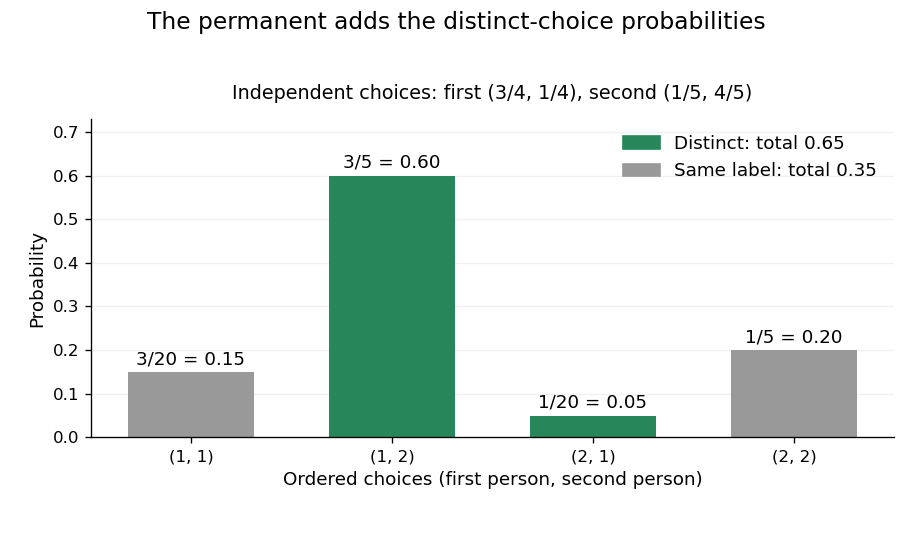
The permanent adds the probabilities of distinct choices: two successful outcomes have total probability 0.65
. Details. 
If every choice has the uniform distribution on a finite set of labels, then and the distinct-choice probability is . For three choices and three labels it is . This counts a subset of all ordered outcomes, not independent pairwise collision events. Independence of the original choices is essential: without it, the individual rows of do not determine the joint probabilities.
Weak peristaltic pumping of a collapsible tube Created 2026-10-14 Updated 2026-11-05
For negligible inertia, periodic forcing , resistance and prescribed mean area , write . First-order area obeys . Its mean square is . Averaging the second-order friction balance gives , proving the displayed forward pumping rate. Periodicity entails zero mean pressure drop; the mean-area convention fixes the expansion's otherwise free constant.
Attracting periodic point Created 2026-10-14 Updated 2026-11-05
A holomorphic periodic point is attracting when its return multiplier has modulus strictly less than one. For the return map , choose a local coordinate at the fixed point and a number strictly between and one. Taylor expansion gives on a sufficiently small disc. It maps that disc into itself, and successive returns converge uniformly to there. Composing with the finitely many intervening maps gives locally uniform convergence to the periodic orbit and places its basin in the Fatou set.
Repelling periodic point 2026-10-14
A holomorphic periodic point is repelling when its return multiplier has modulus greater than one. It belongs to the Julia set: if the iterates were normal near it, a subsequence of the return iterates, all fixing the point, would converge locally uniformly in the spherical metric. Near their fixed finite value the limit lies in a finite coordinate chart, so Cauchy's derivative estimate would bound their derivatives at the point. Those derivatives are the successive powers of the multiplier and are unbounded. The same argument in a reciprocal coordinate handles infinity.
Cycle of a holomorphic map 2026-10-14
An exact -cycle consists of distinct points with , indices read modulo . Every point has exact period . The return multiplier is , computed in local charts if necessary; cyclically changing the starting point leaves it unchanged. Thus an attracting, superattracting or repelling return is of the same type at every point of the cycle. If a period- root coincides with a lower-period point at a parameter limit, multiplicity in the equation need not represent distinct points of an exact cycle.
There are unlisted articles, also show them or only show them.