
Past exam of the mathematics course of the University of Cambridge 2001 iii Paper 69 1 Solution Created 2026-10-03 Updated 2026-10-14
Use and normalize the stationary time at infinity. For a regular stationary, asymptotically flat electrovacuum black hole, the Kerr-Newman metric hasInitially assume and , so the outer Killing horizon is nondegenerate. Its surface gravity, angular velocity, electric potential and area areThese are horizon quantities for the generator .
The laws of black-hole mechanics provide the first reason to regard and area as thermodynamic variables. The Zeroth law of black-hole mechanics makes constant on an equilibrium horizon. The first law for the Kerr-Newman family readsFor example, write the horizon relation as and use ; differentiating eliminates and to give this law. The last two terms are rotational and electric work. The classical second law of black-hole mechanics says that area cannot decrease under the null energy condition and appropriate global horizon assumptions. The third law of black-hole mechanics concerns unattainability of a zero-surface-gravity regular horizon by a finite physical process.
This analogy alone does not determine the temperature scale: if entropy were , the first law would only give . The decisive input is quantum field theory in the collapsing or stationary background. In a collapse vacuum that is regular for freely falling observers, the late outgoing retarded time and a regular affine null coordinate satisfy the Hawking exponential ray mapAn outgoing mode therefore behaves as . Continuing this power through the horizon changes its amplitude by the factor . Its positive- and negative-frequency decomposition consequently has the thermal ratio of Hawking Bogoliubov coefficientsCombining that ratio with bosonic normalization gives a Planck occupation . The fermionic normalization instead gives the corresponding Fermi factor. Thus Hawking radiation fixesFor rotating charged modes, the horizon energy is , so the emission spectrum contains the same temperature with angular-momentum and charge chemical potentials. Exterior scattering supplies greybody factors; it changes the received flux, not the horizon temperature. Superradiant bosonic modes require the usual signed absorption factor, and a globally regular thermal bath need not exist throughout an asymptotically flat rotating exterior. The collapse-state emission argument is the relevant one.
A complementary check is the Euclidean black-hole regularity condition. The local corotating nondegenerate horizon geometry is Rindler-like:Smoothness at requires to have period . Imaginary-time periodicity is precisely inverse temperature, agreeing with the radiation calculation. Matching the resulting temperature to the first law fixes the Bekenstein-Hawking entropy to . The generalized second law then uses : the classical area theorem alone does not apply to the negative-energy quantum flux responsible for evaporation.
Substitution gives the Kerr-Newman horizon temperatureIt reduces to for a Schwarzschild black hole. The nonextremal limit towards gives zero temperature. At exact extremality the Euclidean horizon is degenerate, so the elementary conical-period argument does not itself fix a period; zero temperature here is the limiting semiclassical result. The reasoning assumes ordinary Einstein–Maxwell dynamics, a regular horizon, the stated normalization at infinity and a regime where quantum fields on a slowly evolving classical geometry are a useful approximation. The mechanical laws, radiation spectrum and Euclidean regularity agree under these assumptions, which is substantially stronger evidence than the classical analogy alone.
Past exam of the mathematics course of the University of Cambridge 2001 iii Paper 68 4 Solution Created 2026-10-03 Updated 2026-10-14
The local metric tensors do not determine the global coordinate identifications. The usual complete two-dimensional de Sitter spacetime is the hyperboloid in ambient signature , withPulling back the ambient metric tensor gives , withUnwrapping gives the universal cover of two-dimensional de Sitter spacetime instead. The usual embedded two-dimensional anti-de Sitter spacetime has in signature andHere and is initially periodic modulo . The time circles are closed timelike curves. Its physically standard universal cover removes that identification:The two signs of describe two spatial ends; imposing would retain only half of this complete model.
Both spacetimes have constant curvature and are geodesically complete. In the paper's convention their Ricci scalars are respectively and . Their embeddings show that geodesics are intersections with planes through the ambient origin. They nevertheless have very different causal structures.
For the geodesics of two-dimensional de Sitter spacetime, use an affine parameter , normalization and conserved momentum . ThenTimelike geodesics extend to both infinite proper times; is a simple example. Null geodesics obey , so their affine parameter is also infinite at either temporal end. Spacelike geodesics have , obey and are closed curves on the embedded cylinder; is its simplest spacelike geodesic circle. Unwrapping the spatial circle removes closure but not completeness.
For the geodesics of two-dimensional anti-de Sitter spacetime, the timelike Killing vector gives . The normalization is , henceChoose a future-directed timelike geodesic, so andFor , it oscillates radially with proper period ; gives the central geodesic . In both cases, global time advances by over a proper time interval . The curve is closed on the original hyperboloid, while its lift on the universal cover is nonclosed and future-directed. Null geodesics have and reach either spatial end only at infinite affine parameter. Spacelike geodesics satisfy and also have infinite proper length toward either end. Thus the finite coordinate time discussed below does not imply physical geodesic incompleteness.
The conformal cylinder of two-dimensional de Sitter spacetime follows by setting :Its past and future conformal boundaries are spacelike circles. Null geodesics have and can travel only a finite angular distance over the entire infinite proper-time history. For the complete observer , an event can send a signal to that observer precisely when its shortest angular distance is less than . The observer horizons in two-dimensional de Sitter spacetime are therefore the null curves ; its past signal horizon has . These are observer horizons, without curvature singularities. Their intersection bounds a static patch with metric tensorThe horizons at are regular Killing horizons beyond which this static chart fails, while the global coordinates remain smooth.
For the conformal strip of two-dimensional anti-de Sitter spacetime, set . On its universal cover,The two conformal boundaries are timelike. A null ray from the center approaches a boundary after coordinate time , though its affine parameter diverges. Every interior event can signal to the complete central static observer in finite global time, so that observer has no event horizon. A Poincaré horizon concerns a restricted coordinate patch, and accelerated observers can have different causal horizons.
Finally, the global de Sitter cylinder and its spatial cover are globally hyperbolic: constant-time slices are Cauchy hypersurfaces. The anti-de Sitter universal cover is not globally hyperbolic, because timelike infinity admits incoming signals within finite global time. A field's evolution therefore requires boundary conditions at its two conformal boundaries in addition to initial data. The opposite placement of the conformal boundaries explains why de Sitter observers have cosmological horizons despite global hyperbolicity, while the central anti-de Sitter observer has no event horizon despite the failure of global hyperbolicity.
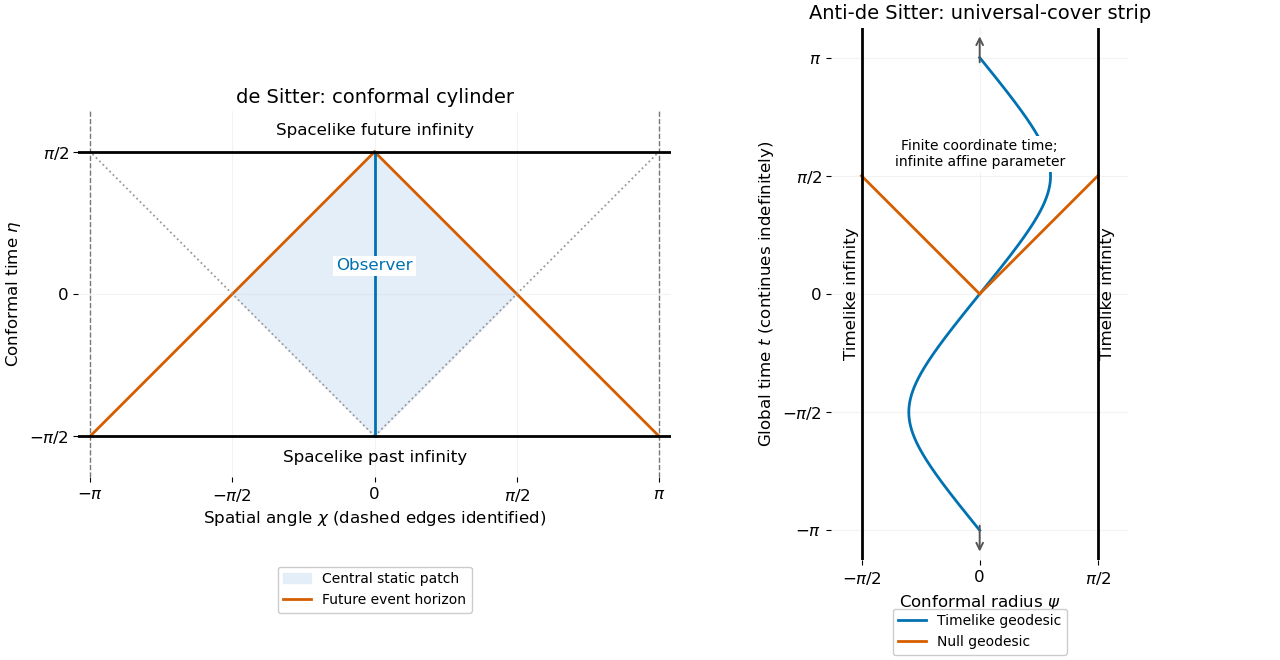
Conformal cylinder and observer horizons of de Sitter spacetime compared with the timelike boundaries of the anti-de Sitter universal cover
. Details. 
Past exam of the mathematics course of the University of Cambridge 2001 iii Paper 68 3 a Created 2026-10-03 Updated 2026-10-14
Past exam of the mathematics course of the University of Cambridge 2001 iii Paper 68 2 Solution Created 2026-10-03 Updated 2026-10-14
Use , background Minkowski spacetime metric tensor , and with small metric perturbation. All indices and derivatives in this linear approximation use . The linearized inverse metric is , and the linearized Levi-Civita connection isDefine the trace-reversed metric perturbation , with .
An infinitesimal coordinate change gives the linearized coordinate gauge transformationThe metric perturbation therefore has redundant components. The gauge invariance of the linearized Riemann tensor follows because its change contains third derivatives of cancelling by commutation of partial derivatives. Conversely, flat linearized metric perturbations are locally pure gauge on a contractible patch. Thus linearized curvature, rather than a particular coordinate value of , detects the physical disturbance. Gauge freedom can also be restricted by global topology or boundary conditions.
Keeping the paper's curvature sign convention, its linearized Ricci tensor and scalar areThese are the negatives of the alternative frequently used curvature convention. Put . The Linearized Einstein equations in vacuum areUnder a gauge change , so solving imposes the Lorenz gauge in linearized gravity. The field equations then become . The remaining residual gauge symmetry of linearized gravity has ; Lorenz gauge does not exhaust the coordinate freedom.
A Fourier mode obeys and . Hence the plane gravitational waves in linearized gravity propagate on the background light cones. Four transversality conditions and four residual gauge amplitudes leave physical degrees of freedom. The explicit plane-wave reduction to transverse-traceless gauge can set , spatial trace zero and . For a wave in the direction, write its physical spatial strain as , so the spatial metric tensor is :There are two gravitational wave polarizations, plus polarization and cross polarization. Rotating transverse axes through rotates their amplitude pair through . Nonconstant profiles with nonzero second derivative have nonzero linearized Riemann curvature tensor and cannot be removed as pure gauge.
The TT coordinate separation and measured separation distinction explains a detector's response. Freely falling particles initially at rest can keep fixed TT coordinates, since , while their proper separation changes. For a short arm along a unit vector ,This is the tidal response described by geodesic deviation; coordinate motion by itself is not the measured signal.
Finally, gravitational-wave energy is second order in the perturbation, so it is absent from a first-order vacuum equation. In a short-wavelength averaging regime the averaged stress-energy of transverse gravitational waves isFor a plane wave its energy flux is . The averaging scale and weak-field assumptions matter: this does not assign a coordinate-independent local gravitational energy density to an arbitrary first-order perturbation.
Past exam of the mathematics course of the University of Cambridge 2001 iii Paper 68 1 Solution Created 2026-10-03 Updated 2026-10-14
An affine connection on the tangent bundle of a smooth manifold assigns a vector field to two vector fields, is -bilinear, and satisfiesThus its first slot is tensorial and its second obeys the Leibniz rule. Its action on covectors is defined by differentiating the pairing, and this extends it to tensor fields. A torsion-free connection has .
Assume that is a smooth nondegenerate metric tensor. Metric compatibility and a vanishing torsion tensor imply the Koszul formula,The right-hand side is determined by and the Lie bracket of vector fields. Nondegeneracy determines uniquely; conversely this formula defines an affine connection with both required properties, proving existence as well as uniqueness. In a coordinate frame the brackets vanish. Combining the three differentiated metric tensor identities givesThis is the Levi-Civita connection. Positive definiteness is unnecessary: the argument also works for a pseudo-Riemannian metric.
For the other affine connection define . The derivative of cancels between the two Leibniz rules, so is -linear in both slots. The difference of affine connections is a tensor: here is a section of with components . Both affine connections are torsion-free, so .
Agreement of geodesics means agreement of their unparametrized curves; different affine parameters are allowed. For every nonzero tangent vector , existence of a geodesic with that initial velocity implies that is parallel to . The symmetric bilinear diagonal-parallel lemma now determines . Choose a basis and write . Applying the parallelism condition to and givesWith , bilinearity yieldsThis is projective equivalence of affine connections. It also covers dimension one. For two Levi-Civita connections, the projective covector from metric volume densities gives the explicit answerIndeed . The determinant ratio is a scalar, so this expression is a genuine covector, although either determinant alone is coordinate-dependent. This determinant expression requires nondegeneracy of ; the difference-tensor and earlier trace formula require only the two torsion-free affine connections.
Conversely, the displayed tensor gives along an affinely parametrized -geodesic. Choosing a new parameter satisfying removes that tangential acceleration. This geodesic reparametrization under projective equivalence proves sufficiency. If agreement were required with the very same affine parameter, polarization would instead force and .
There are unlisted articles, also show them or only show them.