
Rayleigh quotient Created 2026-09-24 Updated 2026-10-14
The Rayleigh quotient measures the quadratic form of a self-adjoint operator per unit squared norm. For a nonzero vector and a finite-dimensional Hermitian matrix ,For a real symmetric matrix, replace the conjugate transpose by . More generally, for a self-adjoint operator on a Hilbert space, use for nonzero in its operator domain. On an eigenvector it returns the exact eigenvalue. Multiplying the vector by any nonzero scalar leaves the quotient unchanged, so it measures a direction rather than a chosen length.
For the symmetric matrix from the finite-dimensional spectral theorem example,The first value is not an eigenvalue: it is an average of the two directional responses. To see every direction, write the unit vector in the orthonormal eigenbasis. ThenThe largest value is along ; the smallest is along . A direction halfway between them has quotient . In the left panel, the color on the unit circle represents the quotient; in the right panel, the same values are plotted against the angle measured from .
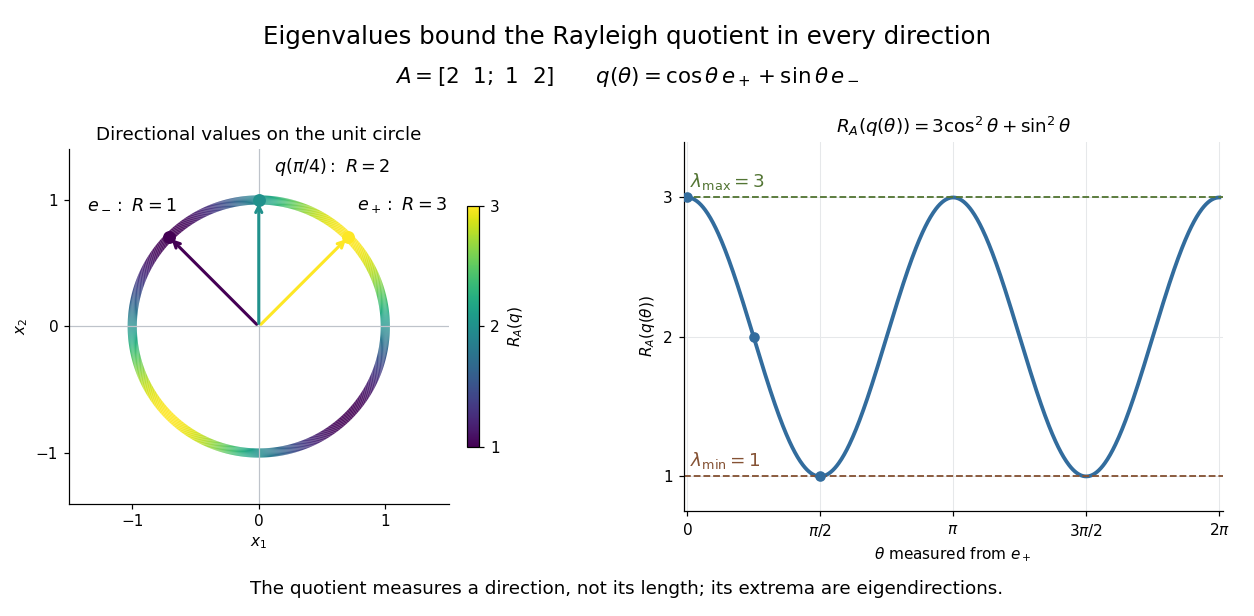

The Hermitian Rayleigh quotient range explains why this is useful: evaluating one trial vector gives an upper bound on the smallest eigenvalue and a lower bound on the largest one, without solving a characteristic polynomial. At an extreme eigenvector, a small angular error changes the quotient only quadratically. Near in this example, . This is the geometric reason for quadratic Rayleigh-quotient improvement for the power method and motivates the Rayleigh-Ritz method.
There is a concrete historical link with normal modes. In The Theory of Sound (1877), Volume I, Sections 88–89, Lord Rayleigh studies the period of a constrained trial vibration. He shows that the period has a stationary point at a normal mode and that a trial type bounds the longest natural period. These energy ratios are a mechanical setting for the modern Rayleigh quotient and generalized Rayleigh quotient; the book describes the result through vibration periods, rather than today's matrix notation.[ref]
https://archive.org/details/theorysound06raylgoog. Rayleigh, The Theory of Sound, Volume I, 1877, Sections 88–89, printed pp. 84–87
Unilateral shift operator Created 2026-09-24 Updated 2026-10-14
The unilateral shifts on sequences move every component one place left or right. Their spectra illustrate behavior absent in finite dimensions.
Normal matrix Created 2026-09-24 Updated 2026-09-28
Unitary matrix Created 2026-09-24 Updated 2026-10-14
A complex matrix is unitary when . Its columns form an orthonormal basis, and it preserves inner products and norms.
Eigenvalue Created 2026-09-24 Updated 2026-10-14
A scalar is an eigenvalue of a linear operator whenfor some nonzero vector , called an eigenvector. The scalar must belong to the field over which is a vector space. Geometrically, a real eigenvalue tells us what does along a special line: every vector on that line is multiplied by the same number. The eigenvector gives the line and the eigenvalue gives its scaling.
For a real eigenvalue, preserves the orientation along the line, reverses it, and collapses the line to zero. The length is multiplied by the modulus , so stretches and contracts. For example, the diagonal matrix doubles one coordinate direction, reverses and halves another, and annihilates the third. Its eigenvalues are ; the last direction lies in its kernel.
For a finite square matrix, the eigenvalues are the roots of a polynomial , its characteristic polynomial:Here is the identity matrix. The reason is that means with : the shifted matrix must have a nontrivial kernel, equivalently a zero determinant. The worked symmetric matrix example in eigenvector shows both stages: find the eigenvalues, then find their eigenspaces.
Eigenvalues are especially useful for repeated application of a linear map. If , thenOne multiplication proves the next step, so a matrix power becomes an ordinary power on each eigenvector. This explains growth, decay, and alternating signs along these directions. Gilbert Strang develops this connection, and its extension to the matrix exponential, in his lecture "Eigenvalues and Eigenvectors" (MIT 18.065, 2018).[ref]
A documented historical connection is C. G. J. Jacobi's "Über ein leichtes Verfahren die in der Theorie der Säcularstörungen vorkommenden Gleichungen numerisch aufzulösen" (1846, Journal für die reine und angewandte Mathematik 30, pp. 51–94). Its opening discusses symmetric matrices arising from small oscillations, with a common unknown subtracted from every diagonal entry. In modern notation this is ; Jacobi seeks the parameter and the ratios of the components of . This is evidence of an early physical and computational setting for the eigenvalue problem, without assigning its discovery to a single person.[ref]
https://doi.org/10.1515/crll.1846.30.51. Jacobi's 1846 paper: original publication
[ref]https://geographiclib.sourceforge.io/geodesic-papers/jacobi-V7.pdf. Jacobi's collected works, volume VII, opening section of the 1846 paper
Nilpotent linear map Created 2026-09-24 Updated 2026-10-06
Translation finite-difference operator Created 2026-09-24 Updated 2026-09-24
On all real-valued functions on , define . The operators commute, and every real number except is an eigenvalue. For eigenvalue , values may be chosen independently on the cosets of and extended by , so every eigenspace is infinite-dimensional.
Jacobson lemma for a commuting commutator Created 2026-09-24 Updated 2026-09-24
Minimal polynomial Created 2026-09-24 Updated 2026-10-18
For a square matrix over a field, the minimal polynomial is the unique monic polynomial of least degree satisfying . The Cayley-Hamilton theorem guarantees at least one such polynomial: the characteristic polynomial. The minimal polynomial divides every polynomial that annihilates , so reducing matrix powers modulo can need fewer coefficients than reducing modulo the characteristic polynomial.
For example, has minimal polynomial , whereas the Jordan block has minimal polynomial . Both have the same characteristic polynomial. Their different matrix powers are illustrated in repeated eigenvalues in the Cayley-Hamilton theorem.
Matrix exponential Created 2026-09-24 Updated 2026-10-03
For a square matrix , its exponential is the convergent power seriesIt is the fundamental matrix for and satisfies .
Jordan normal form Created 2026-09-24 Updated 2026-10-03
Eigenvalue interlacing Created 2026-09-24 Updated 2026-09-24
Eigenvalue interlacing bounds the ordered eigenvalues of a compressed or rank-modified operator between those of the original operator.
Characteristic polynomial Created 2026-09-24 Updated 2026-09-24
Power method Created 2026-09-24 Updated 2026-10-14
Iterate . For a self-adjoint operator with a unique dominant eigenvalue separated in modulus from the others, a starting vector that is nonorthogonal to its dominant eigenvector gives convergence of the eigendirection at the spectral-ratio rate. For a general diagonalizable matrix, the condition is a nonzero coefficient in the dominant component of its eigenbasis, detected by the corresponding left eigenvector; an ordinary dot product with the right eigenvector does not generally detect that coefficient.
The power method is power iteration; its convergence depends on the dominant spectral component of the starting vector.
For example, has dominant right eigenvector and a dominant left eigenvector . The starting vector has nonzero dot product with the right eigenvector, but : it stays forever in the eigenspace for the smaller eigenvalue . Its coefficient along the dominant direction is zero, as the left eigenvector detects. An orthonormal eigenbasis makes the two tests agree in the self-adjoint case.
Real spectral theorem Created 2026-09-24 Updated 2026-10-14
The real case of the finite-dimensional spectral theorem says that a self-adjoint operator on a finite-dimensional real inner product space has a real orthonormal eigenbasis. In orthonormal coordinates this is the spectral theorem for real symmetric matrices, . The worked ellipse under finite-dimensional spectral theorem shows why both orthogonal diagonalization and orthogonality matter: the new coordinates separate the quadratic form into squares without distorting lengths or angles.
A real normal matrix need not have real eigenvalues. For example, the quarter-turn is an orthogonal matrix, but its characteristic polynomial is and its eigenvalues are . Over the complex numbers it has an orthonormal eigenbasis; over the real numbers it has no eigenvector. Self-adjointness supplies the reality conclusion in the real spectral theorem.
Self-adjoint operator Created 2026-09-24 Updated 2026-10-07
A densely defined operator on a Hilbert space is self-adjoint when it equals its adjoint operator, including equality of their operator domains:For a bounded linear operator defined on the whole Hilbert space, this is equivalent tofor all vectors . For an unbounded self-adjoint operator, the domain condition is essential: the inner-product identity on alone gives only a symmetric operator.
Compression of a linear operator Created 2026-09-24 Updated 2026-10-14
If is a subspace of a space with an inner product and is its orthogonal projection, the compression of an operator to isIf the columns of are an orthonormal basis of , its matrix in that basis is .
Charnes-Cooper transformation Created 2026-09-24 Updated 2026-09-24
Baker lower bound for a homogeneous linear form in logarithms Created 2026-09-24 Updated 2026-10-14
This quantitative refinement belongs to the theory of Baker's theorem; its dependence on the scaled coefficient bound is more specific than that broad theorem.
Choose logarithms of nonzero algebraic numbers , putand choose large enough to bound the naive polynomial height of the minimal polynomial of and . After relabelling the terms if useful, setThere is an effectively computable constant , depending only on and the degree of the number field generated by the , such that
The division by is the useful refinement over the general lower bound for a linear form in logarithms when one algebraic number has a large height correlated with a coefficient.
General lower bound for a linear form in logarithms Created 2026-09-24 Updated 2026-10-14
Choose logarithms of nonzero algebraic numbers and algebraic numbers , and putLet bound , the naive polynomial height of the minimal polynomial of , and . Let bound all the corresponding heights of the and all . There is an effective constant , depending only on and the degree of the number field generated by the data, such that
There are unlisted articles, also show them or only show them.