
Nikolay Basov analyzed coherent molecular amplification with Alexander Prokhorov. Their 1956 maser theory relates the generated frequency to both the molecular transition and the cavity response, showing why a molecular oscillator can serve as a precise frequency reference. Below the condition for self-sustained oscillation, the same system can amplify an external microwave input. Distinguishing an amplifier from an oscillator therefore depends on feedback and loss as well as molecular excitation.[ref]
Theory of the Molecular Generator and Molecular Power Amplifier by Nicolay Gennadiyevich Basov and Aleksandr Mikhailovich Prokhorov. 1956, sections 2–3: frequency, self-excitation and molecular microwave amplification

Portrait of Nikolay Basov
. Nobel foundation, 1964. Public domain in Sweden (PD-Sweden photograph). Source usage terms, via Wikimedia Commons. Source.

Alexander Prokhorov and Nikolay Basov developed a theory of the molecular maser. Their analysis combines a prepared molecular beam, stimulated emission and feedback from a resonant cavity. Oscillation begins only when the molecular radiation supplies more power than the cavity and load lose. Including saturation determines a finite steady amplitude. The calculation connects molecular energy levels with practical requirements for a stable microwave oscillator.[ref]
Theory of the Molecular Generator and Molecular Power Amplifier by Nicolay Gennadiyevich Basov and Aleksandr Mikhailovich Prokhorov. 1956, introduction and generator theory: self-excitation threshold and saturation
A physicist.[ref]
https://quantum-electronics.ru/wp-content/uploads/2016/en/16172.pdf. Independent professional profile

Portrait of Alexander Prokhorov
. Nobel foundation. Public domain in Sweden (PD-Sweden, as stated on Commons). Source usage terms, via Wikimedia Commons. Source.
Julian Schwinger calculated the leading radiative correction to the electron's magnetic moment in quantum electrodynamics. In modern notation, its anomalous part is , where is the fine-structure constant. The small correction could be compared with magnetic and spectroscopic measurements. His 1948 paper therefore turned the interaction of the electron with the quantized field into a precise, finite prediction beyond the simplest magnetic-moment value.[ref]
On Quantum-Electrodynamics and the Magnetic Moment of the Electron by Julian Seymour Schwinger. 1948, additional spin magnetic moment, comparison with hyperfine and magnetic measurements
A physicist.[ref]
https://community.harvard.edu/event/memories-julian-celebration-centennial-birth-julian-schwinger. Independent professional profile

Portrait of Julian Schwinger
. AIP Emilio Segrè Visual Archives, Segrè Collection; American Institute of Physics (AIP). American Institute of Physics attribution-only permission, via Wikimedia Commons. Source.

Shin'ichirō Tomonaga developed a relativistically consistent formulation of quantum electrodynamics and a method of renormalization. The physical problem was that naive corrections to an electron's interaction with the electromagnetic field produced divergent intermediate expressions. Relating the theory's parameters to measured mass and electric charge allowed finite predictions to be extracted. His own recollections explain how the relativistic formulation and the treatment of those divergences developed into a calculable quantum theory.[ref]
Development of Quantum Electrodynamics: Personal recollections by Sin-Itiro Tomonaga. 1966 authored lecture, relativistic formulation, electron self-energy and renormalization

Portrait of Shin'ichirō Tomonaga
. Nobel foundation. Public domain in Sweden (PD-Sweden, as stated on Commons). Source usage terms, via Wikimedia Commons. Source.
Theodore Maiman demonstrated stimulated optical emission from ruby in 1960. Optical pumping transferred energy into the chromium ions in the crystal, producing the conditions for stimulated emission near 694 nm. This showed that a fluorescent solid could act as an optical amplifier and oscillator, carrying the principle of the maser into the visible spectrum. The result tied the material's energy levels to a practical laser source.[ref]
Stimulated Optical Radiation in Ruby by Theodore Harold Maiman. 1960 letter, optical pumping of chromium in corundum and emission at 6943 angstroms

Portrait of Theodore Maiman
. Unknown (Associated Press). Public domain in the United States (publication without copyright notice, as stated on Commons). Source usage terms, via Wikimedia Commons. Source.
Lev Landau developed descriptions of interacting quantum fluids through their elementary excitations. In the Landau critical velocity argument, creating an excitation of energy in flowing superfluid changes the relevant energy by . Requiring this to remain positive yields the ideal bound ; additional processes can limit actual flow at lower speeds.[ref]
The Theory of Superfluidity of Helium II by Lev Davidovich Landau. 1941 excitation-spectrum treatment; ideal flow criterion in modern notation
His Fermi liquid theory explains how strongly interacting fermions can retain long-lived low-energy quasiparticles, with interactions modifying their effective mass and collective response.[ref]The Theory of a Fermi Liquid by Lev Davidovich Landau. 1956 paper, introduction and energy as a functional of the distribution
A physicist.[ref]
https://kapitza.ras.ru/history/LDLandau/main.html. Independent professional profile

Portrait of Lev Landau
. Nobel Foundation; individual photographer unidentified. Commons PD-Sweden photograph designation; File requests a separate US public-domain tag. Not a worldwide clearance., via Wikimedia Commons. Source.
Pyotr Kapitsa measured extraordinarily small flow resistance in liquid helium below its lambda transition. Confining the flow to narrow passages made the failure of ordinary viscous-flow expectations experimentally striking. The observation helped establish superfluidity as a distinct quantum-fluid phenomenon. In a modern two-component interpretation, the low-resistance response does not mean that every component of the liquid has lost all viscous behavior; it motivates separating normal and superfluid contributions.[ref]
Viscosity of Liquid Helium below the λ-Point by Pyotr Leonidovich Kapitza. 1938 report, narrow-passage liquid-helium flow

Portrait of Pyotr Kapitsa
. Unknown photographer (Mondadori Publishers / Archivio Mondadori); 1930s; existing Commons adjustment by Materialscientist. Public domain in Italy: photograph copyright expired (PD-Italy). Source usage terms, via Wikimedia Commons. Source.
Hannes Alfvén predicted a wave coupling the motion of an electrically conducting fluid to a background magnetic field. In an Alfvén wave, bent magnetic-field lines provide a restoring effect while the material's inertia resists the displacement.
Linearizing ideal magnetohydrodynamics for a transverse disturbance along a uniform field gives the propagation speed , with background field strength , vacuum permeability and mass density . A stronger field increases the restoring effect; greater material inertia slows propagation. The idea connects plasma dynamics in the laboratory with the behavior of astrophysical magnetic structures.[ref]
Existence of Electromagnetic-Hydrodynamic Waves by Hannes Olof Gösta Alfvén. 1942 paper, combined fluid–magnetic disturbance and propagation-speed relation

Portrait of Hannes Alfvén
. Unknown author. Public domain in Sweden (PD-Sweden, as stated on Commons). Source usage terms, via Wikimedia Commons. Source.
Leon Cooper showed that a filled Fermi sea changes the physics of electron pairing. In the idealized problem, even a weak attractive interaction in an energy shell above the Fermi surface can produce a bound pair. The result concerns electrons in the presence of the filled sea, so it is not simply the problem of two isolated electrons in empty space. This instability supplied a key microscopic ingredient for BCS theory and the Cooper pair description of superconductivity.[ref]
Bound Electron Pairs in a Degenerate Fermi Gas by Leon Neil Cooper. Physical Review 104, 1189 (1956), bound-pair problem above a degenerate sea
A physicist.[ref]
Professional profile of Leon Neil Cooper. Independent professional profile
[ref]https://physics.brown.edu/news/2024-10-30/leon. Independent professional profile

Portrait of Leon Cooper
. Associated Press; 20 October 1972; existing Commons crop by Wabbuh. Public domain in the United States: publication without copyright notice (PD-US-no-notice). Source usage terms, via Wikimedia Commons. Source.
Clifford Shull and J. Samuel Smart used neutron diffraction to detect antiferromagnetism. Oppositely oriented magnetic sublattices can have no net bulk magnetization, yet their spatial order produces a distinct scattering pattern because neutrons interact with magnetic moments. The experiment therefore probes internal magnetic arrangement, not just the total magnetic moment of a sample. It established neutron scattering as a way to reveal ordered magnetism that bulk magnetic measurements can conceal.[ref]
Detection of Antiferromagnetism by Neutron Diffraction by Clifford Glenwood Shull and J. Samuel Smart. Physical Review 76, 1256–1257 (1949), magnetic diffraction from opposing sublattices
A physicist who developed neutron scattering experiments and became a professor of physics at MIT.[ref]
Clifford Glenwood Shull 1915–2001. Independent professional research and appointment; see profile text

Portrait of Clifford Shull
. U.S. Department of Energy (ENERGY.GOV); existing crop by Wabbuh. Public domain in the United States (U.S. Department of Energy official-duty work; Commons PD-US-DOE). Source usage terms, via Wikimedia Commons. Source.
Aage Bohr developed a description connecting individual nucleon motion with collective nuclear rotational bands and changes of nuclear shape. A deformed atomic nucleus has an intrinsic orientation, while its laboratory quantum states have definite total angular momentum. Quantizing the collective orientation produces sequences of excited levels, or nuclear rotational bands. Their energies and electric quadrupole transitions supply complementary tests of the connection between the intrinsic shape and the observed spectrum.[ref]
Rotational Motion in Nuclei by Aage Niels Bohr. Nobel lecture, p. 223, General Theory of Rotation; pp. 217 and 225, spectra and quadrupole-transition tests
A physicist.[ref]
https://nbarchive.ku.dk/about_us/people/in-memoriam/aage-bohr/. Independent professional identity

Portrait of Aage Bohr
. GFHund. CC BY 3.0, via Wikimedia Commons. Source.
Samuel C. C. Ting coauthored the 1974 observation of the narrow particle signal called J. A precise pair spectrometer measured the invariant mass of electron-Positron pairs produced when protons struck beryllium. A sharp feature near 3.1 GeV stood above the smooth background, indicating a new state rather than an arbitrary individual collision. This illustrates how a short-lived particle can be identified through reconstructed decay products.[ref]

Portrait of Samuel C. C. Ting
. DLR German Aerospace Center. CC BY 2.0, via Wikimedia Commons. Source.
Philip W. Anderson showed that disorder can prevent quantum transport in a lattice. His 1958 model assigns random energies to sites connected by hopping, demonstrating regimes in which diffusion fails even though motion between neighboring sites is allowed. The phenomenon now called Anderson localization depends on coherent wave propagation through a random system. It changed how an insulating response could be understood, connecting transport with the spatial character of quantum states.[ref]
Absence of Diffusion in Certain Random Lattices by Philip Warren Anderson. Physical Review 109, 1492 (1958), random-site model and absence-of-diffusion criterion

Portrait of Philip W. Anderson
. JdH; Yale University photograph, existing Commons crop. Creative Commons Attribution-ShareAlike 3.0 Unported selected from File's multiple available licenses; alternative GFDL/older CC licenses not needed., via Wikimedia Commons. Source.
Nevill Mott investigated electronic conduction in disordered solids, including glasses and amorphous semiconductors. When states are localized, a carrier can move by thermally assisted hopping rather than ordinary propagation through an extended band. The useful hopping distance balances weak overlap at long range against the availability of energetically accessible states. This connects a temperature-dependent conductivity with both the spatial localization and energy distribution of electronic states.[ref]
Electrons in Glass by Nevill Francis Mott. Nobel lecture, localized states, mobility and hopping conduction

Portrait of Nevill Mott
. GFHund / Friedrich Hund estate; existing portrait crop. Creative Commons Attribution 3.0 Unported selected from the File's alternatives; separate GFDL option not used., via Wikimedia Commons. Source.
Sheldon Glashow helped organize the weak interaction and electromagnetic interaction into a common gauge structure. Its neutral-current sector makes processes possible without changing the participating particle's electric charge. His lecture also explains why unwanted strangeness-changing neutral currents posed a consistency problem and how the developing quark framework addressed it. The work connects symmetry-based model building with the presence and suppression of specific experimentally observable reactions.[ref]
Towards a Unified Theory: Threads in a Tapestry by Sheldon Lee Glashow. 1979 authored lecture, electroweak synthesis and the strangeness-changing neutral-current problem
A physicist.[ref]
https://www.amacad.org/person/sheldon-lee-glashow. Independent professional identity

Portrait of Sheldon Glashow
. AIP Emilio Segrè Visual Archives, Segrè Collection; American Institute of Physics (AIP); existing Commons crop by Artem.G. American Institute of Physics attribution-only permission, via Wikimedia Commons. Source.

James Cronin coauthored the 1964 discovery of CP violation in neutral kaon decays. Magnetic analysis and spark chambers reconstructed two charged tracks from a long-lived neutral beam. The small two-pion component was incompatible with the simple CP-conserving assignment of that state. A rare decay channel thus tested a fundamental symmetry of the weak interaction.[ref]
Evidence for the 2π Decay of the K₂⁰ Meson by James H. Christenson and others. 1964, apparatus, two-pion reconstruction and CP-symmetry implication

Portrait of James Cronin
. Rungbachduong. CC BY-SA 3.0, via Wikimedia Commons. Source.
Kenneth G. Wilson developed the renormalization group as a quantitative method for studying a critical phenomenon. Repeatedly changing the length scale reorganizes a model's parameters, exposing fixed points and the perturbations that grow or shrink near them. With Michael Ellis Fisher, he calculated critical exponents by expanding about four spatial dimensions. This explains why systems with different microscopic details can share critical behavior and gives controlled corrections to simple mean-field predictions.[ref]
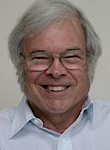
Portrait of Kenneth Geddes Wilson
. Georg Bednorz and K. Alex Müller investigated oxide compositions that displayed a striking electrical resistivity decrease on cooling. Their 1986 report described oxygen-deficient barium-lanthanum-copper compounds, with a superconducting-like onset in the 30 kelvin range. Because the samples contained several phases, a connected conducting path could dominate electrical resistance before the whole specimen behaved uniformly. The work connected materials chemistry and electrical measurements in the emergence of high-temperature superconductivity.[ref]
Possible high Tc superconductivity in the Ba-La-Cu-O system by Johannes Georg Bednorz and Karl Alexander Müller. Zeitschrift für Physik B 64, 189–193 (1986), abstract and multiphase interpretation
A solid-state physicist who researched metallic oxides at IBM's Zurich laboratory.[ref]
Professional profile of Johannes Georg Bednorz. Independent professional identity

Portrait of Georg Bednorz
. Adrian Tync. CC BY-SA 4.0, via Wikimedia Commons. Source.
K. Alex Müller and Georg Bednorz found evidence for superconductivity in copper-oxide compounds at unexpectedly high temperatures. Their 1986 barium-lanthanum-copper-oxygen samples contained multiple phases and showed a large electrical resistivity drop with onset in the 30 kelvin range. The strong dependence on applied current and sample connectivity required cautious interpretation. This initial result redirected the search for high-temperature superconductors toward chemically complex oxides.[ref]
A solid-state physicist who carried out physics research at IBM.[ref]
Professional profile of Karl Alexander Müller. Independent professional identity

Portrait of K. Alex Müller
. Ibmzrl, IBM Research – Zurich; existing Commons crop by Wabbuh. CC BY 3.0, via Wikimedia Commons. Source.
Leon M. Lederman coauthored the experiment showing that neutrinos associated with muons behave differently from those associated with electrons. The detector compared long charged tracks with electron-like showers after a shielded accelerator beam crossed it. The result established a second neutrino flavor through the identity of the produced lepton.[ref]
Observation of High-Energy Neutrino Reactions and the Existence of Two Kinds of Neutrinos by G. Danby and others. 1962, charged-track and shower comparison and two-neutrino conclusion
An experimental physicist who directed the Nevis laboratory and led accelerator experiments.[ref]
Professional profile of Leon Max Lederman. Independent professional identity

Portrait of Leon M. Lederman
. ENERGY.GOV (US Department of Energy). Public domain (US Department of Energy employee work). Source usage terms, via Wikimedia Commons. Source.
There are unlisted articles, also show them or only show them.