
Johannes Rydberg organized atomic spectral lines into series using wavenumbers. In modern notation, a typical series has the form , with successive integers and a fitted offset . The relation predicts a limiting wavenumber and increasingly close spacing of spectral lines. His empirical comparisons across chemical elements preceded the later explanation through transitions between quantized atomic energy levels, illustrating how precise regularities can guide a physical theory.[ref]
On the Structure of the Line-Spectra of the Chemical Elements by Johannes Rydberg. pp. 331–337: use of wavenumbers, series formula and comparisons
Physicist.[ref]
https://sok.riksarkivet.se/sbl/Presentation.aspx?forceOrdinarySite=true&id=6266. Independent professional profile

Portrait of Johannes Rydberg
. Per Bagge; Archives and Museum of the Academic Society in Lund (AFs Arkiv & Studentmuseum), via Wikimedia Commons. Public domain in the source country and jurisdictions using life plus 70 years or less, per Commons PD-old-70; Public Domain Mark. No separate U.S. determination added. Source usage terms, via Wikimedia Commons. Source.
Kai Siegbahn developed electron spectroscopy as a quantitative probe of chemical and electronic structure. In X-ray photoelectron spectroscopy, incident X-rays eject electrons whose measured kinetic energies reveal their binding energies after the instrument's reference offset is accounted for. Small changes of a core-level binding energy reflect the atom's chemical environment. Resolving and calibrating these shifts makes the spectrum sensitive to electronic surroundings as well as elemental identity, linking the spectrometer's design with a physical inference.[ref]
Physics.[ref]
https://www.pas.va/en/academicians/deceased/siegbahn.html. Independent professional profile

Portrait of Kai Siegbahn
. Jan Collsiöö, original photograph at Uppsala, 21 October 1981; derivative crop by Materialscientist. Nationaal Archief / ANEFO collection. Creative Commons Attribution-Share Alike 3.0 Netherlands., via Wikimedia Commons. Source.
Ernest Lawrence and M. Stanley Livingston developed repeated acceleration of ions in a cyclotron. An oscillating electric field accelerates a particle each time it crosses the gap between two hollow electrodes; a perpendicular magnetic field bends it back toward the gap. In the nonrelativistic approximation, the orbit period is independent of radius, allowing successive crossings to stay synchronized. Their 1932 report obtained proton energies of with a maximum applied voltage of .[ref]
A physicist.[ref]
https://www.llnl.gov/article/31061/feb-20-1934-huge-step-toward-atomic-energy. Independent professional profile

Portrait of Ernest Lawrence
. Donald Cooksey / Lawrence Berkeley National Laboratory; US National Archives, Morgue1958-8 (P-68), XBD200001-00048.tif; existing Commons crop. Commons PD-USGov-DOE claim for work made in official duties. File warns that national laboratories have varying licenses; retain that attribution and qualification., via Wikimedia Commons. Source.

M. Stanley Livingston and Ernest Lawrence developed the cyclotron as a practical source of energetic ions. Their 1932 paper explains how an alternating electric field gives a new acceleration on every gap crossing while the magnetic field supplies the return path. Keeping the half-orbit time synchronized with the field oscillation lets many small energy increments accumulate. The paper also emphasizes beam focusing and magnetic field correction, showing why successful acceleration required control of the trajectories as well as the resonance condition.[ref]
The Production of High Speed Light Ions Without the Use of High Voltages by Ernest Orlando Lawrence and Milton Stanley Livingston. 1932 abstract, synchronization, focusing and magnetic-field correction
A physicist.[ref]
https://dome.mit.edu/bitstream/handle/1721.3/82775/AC0598_001943.pdf?isAllowed=y&sequence=1. Independent professional profile

Portrait of M. Stanley Livingston
. National Archives / Department of Energy archive creator; original photographer not separately identified. Photograph dated 1934. Commons records public-domain status on the basis of NARA’s use restrictions being Unrestricted., via Wikimedia Commons. Source.
Patrick Blackett helped turn the cloud chamber into a selectively triggered particle detector. With Giuseppe Occhialini, he used coincident counter signals to operate the chamber when penetrating particles passed. Magnetic curvature and associated tracks then gave more information than a simple particle count, including evidence relevant to electron-Positron production. The experiment illustrates how triggering can make a slow, detailed recording device useful for rare events.[ref]
Some Photographs of the Tracks of Penetrating Radiation by Patrick Maynard Stuart Blackett and Giuseppe Paolo Stanislao Occhialini. 1933, apparatus and interpretation of associated positive/negative tracks
A physicist.[ref]
https://www.imperial.ac.uk/about/history/past-people/. Independent professional profile

Portrait of Patrick Blackett
. GFHund; photograph from Friedrich Hund’s estate, prepared for Wikipedia in August 2010. CC BY 3.0, via Wikimedia Commons. Source.
Giuseppe Occhialini and Patrick Blackett combined electronic counters with a cloud chamber to photograph rare penetrating-radiation events. A coincidence signal selected moments when a particle crossed the apparatus, greatly improving the yield over unselected expansions. The resulting magnetic-field photographs recorded groups of tracks and evidence for light positive particles. The method connected fast electronic selection with a detailed image that could be examined after the event.[ref]
Some Photographs of the Tracks of Penetrating Radiation by Patrick Maynard Stuart Blackett and Giuseppe Paolo Stanislao Occhialini. 1933, counter-controlled cloud chamber and charged-track photographs
A physicist.[ref]
https://www.fisica.unimib.it/it/dipartimento/beppo-occhialini. Independent professional profile

Portrait of Giuseppe Occhialini
. Unknown author; source Università degli Studi di Milano-Bicocca (unimib.it), Giuseppe Occhialini: dagli atomi alle stelle. Public domain (PD-anon-70-EU). Source usage terms, via Wikimedia Commons. Source.

Bruno Rossi used penetrating cosmic-ray particles to test relativistic particle lifetimes. His experiment with David B. Hall compared particles selected by momentum and examined how many survived propagation through the atmosphere.
The decay probability depends on the proper time elapsed along the particle's path. Faster particles can travel farther in the laboratory because their rest-frame clock accumulates less proper time over a given laboratory interval. The measured momentum dependence connected an observed particle population to time dilation.[ref]
Variation of the Rate of Decay of Mesotrons with Momentum by Bruno Rossi and David B. Hall. 1941 experiment: momentum selection, atmospheric survival and decay interpretation
Rossi also coauthored the early rocket detection of extrasolar X-rays, extending astronomical measurement beyond wavelengths accessible through the atmosphere.[ref]

Portrait of Bruno Rossi
. Massachusetts Institute of Technology. CC BY-SA 3.0, via Wikimedia Commons. Source.
César Lattes improved the measurement of particle tracks in nuclear emulsions and helped establish the pion-muon decay sequence. His own recollection describes range–energy calibrations and plates exposed at high altitude. Plates treated with borax preserved substantially more latent events than untreated controls, an unexpected practical advantage. More complete stopping-and-decay tracks then supported a comparison of the parent and daughter masses, showing why detector chemistry and calibration mattered to a particle discovery.[ref]
Meu Trabalho em Física de Mésons com Emulsões Nucleares by Cesare Mansueto Giulio Lattes. 1984 recollection, range calibration, borax-treated controls and connected meson-track measurements

Portrait of César Lattes
. Public domain / Arquivo Nacional Collection; Fundo Correio da Manhã, BR_RJANRIO_PH_0_FOT_28617_017. Unknown photographer; existing crop by JB Hoang Tam. Public domain in Brazil and the United States per Commons PD-Brazil-media and Arquivo Nacional GLAM public-domain reproduction notice. Source usage terms, via Wikimedia Commons. Source.

Willis Lamb and Robert Curtis Retherford measured a small separation between hydrogen energy levels that the simplest relativistic quantum mechanics placed at equal energy. Their 1947 experiment used microwave transitions involving metastable atoms, rather than trying to resolve the separation in an ordinary optical line. The Lamb shift required improved quantum electrodynamics, including the interaction of an electron with the quantized electromagnetic field. A small spectral discrepancy thereby became a quantitative test of the theory.[ref]
Fine Structure of the Hydrogen Atom by a Microwave Method by Willis Eugene Lamb Jr. and Robert Curtis Retherford. 1947 microwave experiment and measured separation of hydrogen levels
A physicist.[ref]
https://lib.arizona.edu/special-collections/collections/willis-e-lamb-jr-papers. Independent professional profile
[ref]https://optics.arizona.edu/person/willis-lamb-jr. Independent professional profile

Portrait of Willis Lamb
. Nobel foundation; 1955. Public domain in Sweden (PD-Sweden photograph). Source usage terms, via Wikimedia Commons. Source.
Walter Brattain and John Bardeen demonstrated amplification with a point-contact transistor. Closely spaced contacts on a semiconductor allowed a small controlling signal to alter the current in another circuit. Injection and transport of carriers near the surface made the solid an active amplifier, rather than only a passive resistor. Their report connects semiconductor surface physics with a practical three-terminal electrical device.[ref]
The Transistor, A Semi-Conductor Triode by John Bardeen and Walter Houser Brattain. Physical Review 74, 230 (1948), point-contact amplification

Portrait of Walter Brattain
. Nobel foundation; 1956. Public domain in Sweden (PD-Sweden photograph). Source usage terms, via Wikimedia Commons. Source.
Yang Chen-Ning and Tsung-Dao Lee questioned whether parity conservation had actually been tested in the weak interaction. Their 1956 paper separates established evidence from an assumed symmetry and proposes concrete tests in nuclear and particle decays. An angular correlation that changes sign under spatial reflection can distinguish a process from its mirror image.[ref]
Question of Parity Conservation in Weak Interactions by Tsung-Dao Lee and Chen Ning Yang. 1956, evidence review and proposed parity tests
A physicist.[ref]
https://www.nobelprize.org/prizes/physics/1957/yang/biographical/. Independent professional profile

Portrait of Yang Chen-Ning
. Academia Sinica (中央研究院); 30 March 2007. Academia Sinica attribution permission; Government Website Open Information Announcement, via Wikimedia Commons. Source.

Pavel Cherenkov investigated the visible radiation produced by fast charged particles in transparent materials. The emission's directional and polarization properties distinguished it from ordinary luminescence. Its interpretation as Cherenkov radiation relates the optical signal to a particle moving faster than the local phase velocity of light. His authored lecture connects the discovery with practical detectors, in which the presence and geometry of a light cone provide information about particle speed.[ref]
Radiation of particles moving at a velocity exceeding that of light, and some of the possibilities for their use in experimental physics by Pavel Alekseyevich Cherenkov. 1958 lecture, observations, radiation properties and detector applications; velocity threshold is in the medium
A physicist.[ref]
https://www.nobelprize.org/prizes/physics/1958/cerenkov/biographical/. Independent professional profile

Portrait of Pavel Cherenkov
. American Institute of Physics (AIP), Emilio Segrè Visual Archives, Weber Collection. Attribution permission: unrestricted reuse, derivatives and commercial use permitted with attribution to American Institute of Physics (AIP), via Wikimedia Commons. Source.
Ilya Frank worked on the experiments and theoretical interpretation of Cherenkov radiation. With Igor Tamm, he explained in 1937 why radiation from a sufficiently fast charged particle adds coherently in a medium. The emission direction is linked to the particle's speed and the refractive index, so an observed optical pattern can carry particle-identification information. His later work also established a substantial programme in neutron physics.[ref]
Ilya Mikhailovich Frank: first FLNP JINR director, laureate of Nobel Prize by Joint Institute for Nuclear Research. Participation in the liquid-irradiation work, 1937 theory and later neutron-physics programme
A physicist.[ref]
https://www.nobelprize.org/prizes/physics/1958/frank/biographical/. Independent professional profile

Portrait of Ilya Frank
. Nobel Foundation. Public domain in Sweden per Commons PD-Sweden photo tag; separate U.S. status tag not present on inspected File. Source usage terms, via Wikimedia Commons. Source.
Igor Tamm and Ilya Frank explained the coherent radiation emitted when a charged particle outruns the phase velocity of light in a material. The Cherenkov radiation condition is for refractive index , without requiring a particle to exceed the vacuum speed of light. Their theory connected the observed optical emission with a definite speed threshold, making it useful for identifying fast particles.[ref]
Ilya Mikhailovich Frank: first FLNP JINR director, laureate of Nobel Prize by Joint Institute for Nuclear Research. 1937 joint theoretical explanation of the observed Vavilov–Cherenkov effect; modern threshold notation
A physicist.[ref]
https://www.nobelprize.org/prizes/physics/1958/tamm/biographical/. Independent professional profile

Portrait of Igor Tamm
. CBS press photograph, identifier ner18397; individual photographer unidentified; existing Commons crop. Commons PD-US-no-notice claim: US publication during 1931–1977 without notice. Other jurisdictions may retain protection., via Wikimedia Commons. Source.
Thomas Ypsilantis coauthored the 1955 identification of the antiproton. Selecting a negative particle's momentum was insufficient because lighter negative particles were much more abundant. Measuring its speed as well supplied a mass test. The experiment combined magnetic selection, timed scintillation signals and velocity-sensitive Cherenkov detectors, connecting complementary measurements to a particle identity rather than relying on negative electric charge alone.[ref]
The early antiproton work by Owen Chamberlain. 1959 authored account, 1955 coauthor list and momentum/velocity discrimination
A physicist.[ref]
https://physicstoday.aip.org/obituaries/thomas-john-ypsilantis. Independent professional profile
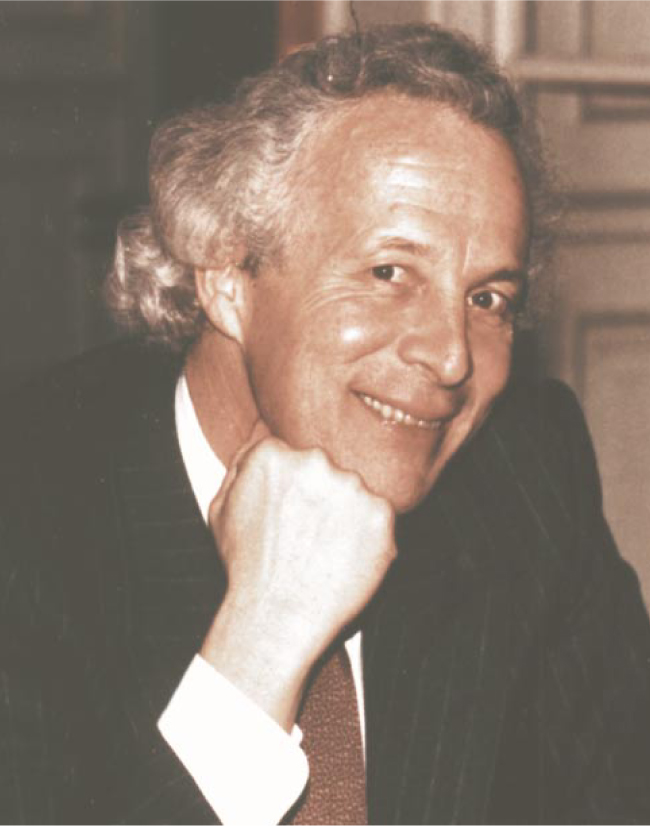
Portrait of Thomas John Ypsilantis
. Donald Glaser invented the bubble chamber to record charged-particle trajectories in a dense medium. A pressure change brings a liquid into a superheated state; deposited energy along an ionizing track allows bubbles to form. Photographing those bubbles turns a brief microscopic passage into geometry that can be measured repeatedly. His own biographical account explains the search for a detector that combined the advantages of a dense target with visible particle tracks.[ref]
A physicist.[ref]
Donald Glaser: Biography Submitted by Dr. Glaser to the Nobel Committee by Donald Arthur Glaser. Independent professional profile

Portrait of Donald Glaser
. Lawrence Berkeley Laboratory image library, image 96703552 / XBD 9607-03552.TIF; individual photographer not identified. Commons PD-USGov claim under 17 USC 105 for federal official-duty work; not a declaration about all national-laboratory photographs., via Wikimedia Commons. Source.
Rudolf Mössbauer discovered that some gamma ray emission and absorption events in a solid occur without changing the crystal's phonon state. The momentum can then be transferred to the whole lattice, with an effective recoil energy far smaller than for a free nucleus. This permits extremely narrow nuclear emission and absorption lines to overlap, producing the Mössbauer effect. The narrow resonance makes very small energy shifts observable, including shifts due to the local electronic and magnetic environment of a nucleus.[ref]
A physicist.[ref]
https://www.nobelprize.org/laureate/76. Independent professional profile
[ref]https://www.e15.ph.tum.de/staff/professors/prof_moessbauer/index.html. Independent professional profile

Portrait of Rudolf Mössbauer
. Unknown photographer; The Big T 1962, California Institute of Technology yearbook; existing Commons extract. Commons PD-US-no-notice claim: US publication during 1931–1977 without notice. Other jurisdictions may retain protection., via Wikimedia Commons. Source.
J. Hans D. Jensen developed a nuclear shell model in which strong spin-orbit coupling reorganizes the levels available to protons and neutrons. The mechanism connects the observed nuclear magic numbers with gaps in a one-particle spectrum: filling a level with total angular momentum accommodates magnetic substates. His historical lecture describes how measured nuclear spins, binding patterns and other spectroscopic evidence constrained the model, rather than treating the choice of level ordering as purely mathematical.[ref]
A physicist.[ref]
https://www.physik.uni-heidelberg.de/historisches?lang=de. Independent professional profile

Portrait of J. Hans D. Jensen
. Nobel Foundation. Public domain in Sweden per Commons PD-Sweden photo tag; separate U.S. status tag not present on inspected File. Source usage terms, via Wikimedia Commons. Source.
Eugene Wigner and Gregory Breit connected the capture of slow neutrons with resonant excited states of a target atomic nucleus. A capture probability can change rapidly when the projectile energy crosses one of these states. Their treatment relates the peak to the coupling into the intermediate state and its possible decay channels. It therefore explains why a small interval of incident energies can contain pronounced structure, rather than a smooth response determined by the target's size alone.[ref]
Capture of Slow Neutrons by Gregory Breit and Eugene Wigner. 1936 abstract and resonance treatment of slow-neutron absorption
A physicist.[ref]
https://phy.princeton.edu/about/history/faculty-history/princeton-physics-nobel-laureates. Independent professional profile

Portrait of Eugene Wigner
. Nobel Foundation. Public domain in Sweden per Commons PD-Sweden photo tag; separate U.S. status tag not present on inspected File. Source usage terms, via Wikimedia Commons. Source.
Charles H. Townes, James Power Gordon and Herbert Jack Zeiger developed the molecular maser, using stimulated emission to amplify or generate coherent microwaves. Their report treats the same device as an amplifier, oscillator and spectrometer. Preparing the molecular excitation and providing resonant feedback turns microscopic transitions between energy levels into a macroscopic signal. The measured frequency stability and narrow spectroscopic resolution showed why the maser could serve as both an instrument for studying molecules and a frequency reference.[ref]
The Maser—New Type of Microwave Amplifier, Frequency Standard, and Spectrometer by James Power Gordon and others. 1955 abstract and molecular-generator mechanism: oscillator stability, spectroscopy and amplification
A physicist.[ref]
https://www.nobelprize.org/prizes/physics/1964/townes/biographical/. Independent professional profile

Portrait of Charles H. Townes
. Woodruff T. Sullivan III; NRAO/AUI Archives, Sullivan Collection; rights NRAO/AUI/NSF. Creative Commons Attribution 4.0 International, with NRAO's displayed source-credit/non-endorsement and third-party-rights qualifications., via Wikimedia Commons. Source.
There are unlisted articles, also show them or only show them.