
Lawrence Krauss and Brian Chaboyer used the ages of globular clusters to test cosmological models. Their analysis combined cluster distances and stellar evolution calculations to obtain a lower bound on the age of the cosmos.
The logical comparison is simple: the cosmos must be older than the stars it contains, with additional time allowed for their formation. Combining this clock with an expansion rate constrains the cosmic equation of state and matter content. Their numerical bounds depended on the adopted stellar inputs, formation history and cosmological assumptions.[ref]
New Globular Cluster Age Estimates and Constraints on the Cosmic Equation of State and The Matter Density of the Universe by Lawrence M. Krauss and Brian Chaboyer. Abstract: revised ages, minimum cosmic age and conditional equation-of-state constraints

Portrait of Lawrence Krauss
. Mike Sheridan; American Atheists Convention, Iowa, 24 April 2011; Flickr photograph 5655574633, license reviewed on Commons in 2011. CC BY 2.0, via Wikimedia Commons. Source.
Alan Guth proposed a period of rapid early expansion as a physical explanation of the horizon problem and flatness problem. His 1981 model used a high-energy state whose nearly constant energy density could drive accelerated expansion before ordinary hot Big Bang evolution.
The causal argument is that a region initially small enough to equilibrate can expand to encompass the subsequently observable region. Rapid expansion also suppresses the relative importance of spatial curvature. Ending that stage and obtaining a sufficiently uniform hot state is a separate dynamical requirement; solving the motivating geometric problems does not by itself supply a successful exit.[ref]
Inflationary universe: A possible solution to the horizon and flatness problems by Alan H. Guth. Abstract and concluding discussion: initial-condition problems, inflationary mechanism and completion of the phase transition

Portrait of Alan Guth
. Betsy Devine (Betsythedevine); Trinity College, Cambridge, 19 December 2007; existing crop from her Flickr photograph 2123046495. CC BY-SA 3.0, via Wikimedia Commons. Source.
Alexei Starobinsky investigated how energy stored in an oscillating inflaton can become particles after cosmic inflation. With Lev Kofman and Andrei Linde, he developed a treatment of preheating through parametric resonance in an expanding cosmological background.
Repeated oscillations can amplify a coupled scalar field much more rapidly than independent perturbative decays would suggest. The calculation follows both the growth of the produced particles and their backreaction on the oscillating field. That feedback, together with scattering, changes and eventually terminates the resonance.[ref]
Towards the Theory of Reheating After Inflation by Lev Kofman and others. Abstract: particle production, broad resonance, expansion, backreaction and rescattering

Portrait of Alexei Starobinsky
. Melirius; photograph taken 10 March 2014 at the Zeldovich-100 conference in Minsk; existing crop from Zeldovich-100 participants.jpg. CC BY-SA 2.0, via Wikimedia Commons. Source.
A theoretical particle physicist who coauthored a study of the number of fermion generations in grand unified theories. The paper investigates models built from special unitary groups and antisymmetric tensor representations, arriving at a proposed construction. The result is a model-building proposal: its assumptions connect the family structure to symmetry and consistency conditions.[ref]
Number of fermion generations from a novel grand unified model by Pritibhajan Byakti and others. Abstract: unsuccessful embeddings and proposed SU(9) model
A theoretical particle physicist who coauthored a proposed grand unified theory addressing the number of fermion generations. The study tests which special unitary groups and antisymmetric representations can accommodate the required matter content. It illustrates how gauge anomaly cancellation and representation branching constrain a model before comparison with measured particle properties.[ref]
Number of fermion generations from a novel grand unified model by Pritibhajan Byakti and others. Abstract and section 3: model-building constraints and representation branching
Arindam Mazumdar coauthored a particle-physics study asking whether internal consistency of a grand unified theory can constrain the number of fermion generations. The work examines representation content and unification conditions in candidate gauge models rather than treating the number of generations only as an externally selected parameter.[ref]
Number of fermion generations from a novel grand unified model by Pritibhajan Byakti and others. Abstract and introduction: model assumptions and generation counting
A consistency condition within one model is a conditional theoretical prediction. It does not establish that the chosen gauge structure has been experimentally realized.
Palash Baran Pal coauthored a study asking whether a grand unified theory can explain the number of fermion generations. The paper tests antisymmetric representations of special unitary groups, using branching rules and gauge anomaly cancellation to restrict the matter content. Its proposed construction illustrates how mathematical consistency can eliminate particle models before their detailed phenomenology is considered; the generation count depends on the model's assumptions.[ref]
Number of fermion generations from a novel grand unified model by Pritibhajan Byakti and others. Abstract and section 3: failed embeddings, representation branching and proposed generation-count construction

Portrait of Palash Baran Pal
. Suratnadas; 24 June 2017; source listed as own work; uploader Frangipani white. CC BY-SA 4.0, via Wikimedia Commons. Source.
Frederick Lindemann related characteristic atomic oscillations to heat capacity and melting. His 1910 treatment estimated molecular eigenfrequencies and compared them with frequencies inferred from thermal and optical observations. The associated Lindemann melting criterion treats sufficiently large thermal atomic displacements relative to atomic spacing as a sign that a crystal becomes unstable. It is an approximate physical model: comparisons between independently inferred frequencies test the model, while a universal exact displacement threshold is not implied.[ref]
Über die Berechnung molekularer Eigenfrequenzen by Frederick Lindemann. 1910 original German paper, pp. 609–612, melting-point and eigenfrequency tables and heat-capacity comparison

Portrait of Frederick Lindemann, 1st Viscount Cherwell
. Photographer unrecorded; U.S. National Archives / Harry S. Truman Library, NAID 199026; 5 January 1952; existing Commons crop by Kimsaka. Public domain in the United States as a U.S. federal-government work; Commons also applies Public Domain Mark 1.0. Source.
An experimental physicist who performed much of the work reported in the 2015 sulfur-hydride superconductivity study. A diamond anvil cell compressed the sample to very high pressure; electrical and magnetic measurements tested the transition. The reported 203-kelvin result depended on pressure and sample preparation, illustrating that a transition temperature describes a particular material state and experimental history.[ref]
Conventional superconductivity at 203 kelvin at high pressures in the sulfur hydride system by A. P. Drozdov and others. Author contributions and Extended Data Figs. 2–6: experiments, thermal history and cell apparatus
Roland Diehl uses nuclear gamma rays to trace ongoing nucleosynthesis. His aluminium-26 work measures a decay line whose spatial and Doppler structure connects radioactive material with the distribution and motion of massive-star source regions in the Milky Way.[ref]
A radioactive tracer samples recent production and transport rather than the total accumulated elemental abundance. Interpreting the line therefore requires a source model and the lifetime of the isotope, in addition to the measured photon flux.
John M. Blondin studies hydrodynamic instabilities in astrophysical flows. His work on standing shock wave stability showed that a shock stable against radial disturbances can behave differently when nonradial motion is allowed: small departures from spherical symmetry can generate vorticity and grow into turbulent flow.[ref]
Stability of Standing Accretion Shocks, With an Eye Toward Core Collapse Supernovae by John M. Blondin and others. Abstract: radial stability and two-dimensional instability
The calculation illustrates why a one-dimensional stability result does not settle the dynamics of a core-collapse supernova. Identifying an instability is also distinct from demonstrating a successful explosion.
Hans-Thomas Janka investigates how asymmetric supernova explosions can accelerate a newborn neutron star. His gravitational tug-boat analysis relates the recoil to the continuing gravitational attraction of unevenly expelled material, rather than treating the entire kick as an instantaneous mechanical impulse.[ref]
The mechanism connects stellar core collapse with the later velocities and survival of compact binaries. The paper also distinguishes qualitative scaling arguments from parameters that still require numerical calibration.
Henry Cavendish used a torsion balance to infer the mean density of the Earth. Nearby lead masses exert a gravitational force on smaller masses carried by a suspended horizontal arm. The wire's restoring torque opposes the resulting angular displacement; the arm's oscillation period calibrates that response. Moving the attracting masses to opposite sides reverses the deflection. Comparing this measured gravitational force with terrestrial gravity then determines the mean density of the Earth. To reduce convection caused by uneven heating, he enclosed the apparatus and observed its scale through telescopes from outside the room.[ref]
Experiments to Determine the Density of the Earth by Henry Cavendish. 1798, pp. 469–475: apparatus, oscillation calibration, reversed positions and thermal-air-current precautions
Experimental natural philosopher who measured terrestrial gravitational attraction and inferred the mean density of Earth in 1798.

Portrait of Henry Cavendish
. Wellcome Library, London / Wellcome Collection; after a drawing by Alexander in the British Museum. CC BY 4.0, via Wikimedia Commons. Source.
Julius von Mayer argued for a quantitative equivalence between mechanical work and heat. His 1842 paper connects compression of a gas with its heat capacity. In a modern ideal gas example, heating at constant pressure includes expansion work that is absent at constant volume. Because an ideal gas's internal energy depends only on temperature, its molar heat capacities satisfy , where is the molar gas constant. The heat capacity difference thus supplies a route to comparing thermal and mechanical units of energy.[ref]
Remarks on the Forces of Inorganic Nature by Julius Robert Mayer. Final compression and heat-capacity argument; ideal-gas explanation expressed here in modern notation
Physician and natural philosopher who contributed to the conservation-of-energy programme in the 1840s, including an argument for the mechanical equivalent of heat.

Portrait of Julius von Mayer
. Wellcome Library, London / Wellcome Collection. CC BY 4.0, via Wikimedia Commons. Source.
Hermann von Helmholtz's 1847 synthesis connected mechanical, thermal and electrical processes through conservation of energy. A modern example exposes the mathematical structure: for a particle with kinetic energy moving under a time-independent potential energy , a conservative force gives , so is constant. This derivation assumes a conservative force; the wider experimental question is how an apparent loss of mechanical energy reappears as another measurable form of energy. His essay helped organize such comparisons into a common conservation programme.[ref]
Über die Erhaltung der Kraft by Hermann von Helmholtz. 1847 monograph; conditional particle derivation expressed here in modern notation
Physicist and physiologist whose 1847 synthesis connected mechanical and other natural processes through a conservation principle.

Portrait of Hermann von Helmholtz
. Portrait by Franz von Lenbach; reproduced in Leo Königsberger, Hermann von Helmholtz (1906). Public domain (artist died 1904; reproduction published 1906); Commons PD-old/PDM. Source and usage information on the linked Wikimedia file page. Source.
An accelerator physicist whose theoretical work develops magnetized electron cooling. A cold electron beam travels alongside a heavier particle beam, exchanging momentum with it and reducing its random motion. His analysis shows how guiding the electrons with a solenoidal magnetic field can increase the cooling rate and lower the equilibrium temperature. The result is useful for preparing compact ion beams for collisions.[ref]
Theory of electron cooling by Yaroslav S. Derbenev. Abstract: co-moving magnetized electron beam, enhanced cooling and ion-collider application
A researcher who coauthored a quantitative powder diffraction method using a surface diffractometer and an area detector. Extracting meaningful intensities requires corrections for polarization and measurement geometry as well as the crystal's structure factor. The work explains how an instrument designed for surfaces can also measure powders and textured samples, connecting detector images with reliable structural analysis.[ref]
An electrical engineer whose work connects semiconductor processing with optoelectronic devices. With collaborators, Dallesasse developed oxidation of aluminum-bearing compound semiconductors, a process used to define apertures in vertical-cavity surface-emitting lasers. The oxide helps control where the device conducts and emits, turning a materials-processing technique into a practical element of a small laser.[ref]
https://grainger.illinois.edu/news/stories/28380. Illinois account of III–V oxidation, co-discovery and VCSEL applications
A physicist whose research uses Gauge-gravity duality to study strongly interacting matter. In these models, transport properties such as viscosity and diffusion coefficients can be calculated from excitations of a corresponding black hole. The aim is to learn about matter that is difficult to treat by weak-coupling approximations, including the hot nuclear matter produced in heavy-ion collisions.[ref]
Research profile of Andrei Starinets at the University of Oxford. Research paragraphs: transport coefficients from black-hole excitation spectra and applications to hot nuclear matter
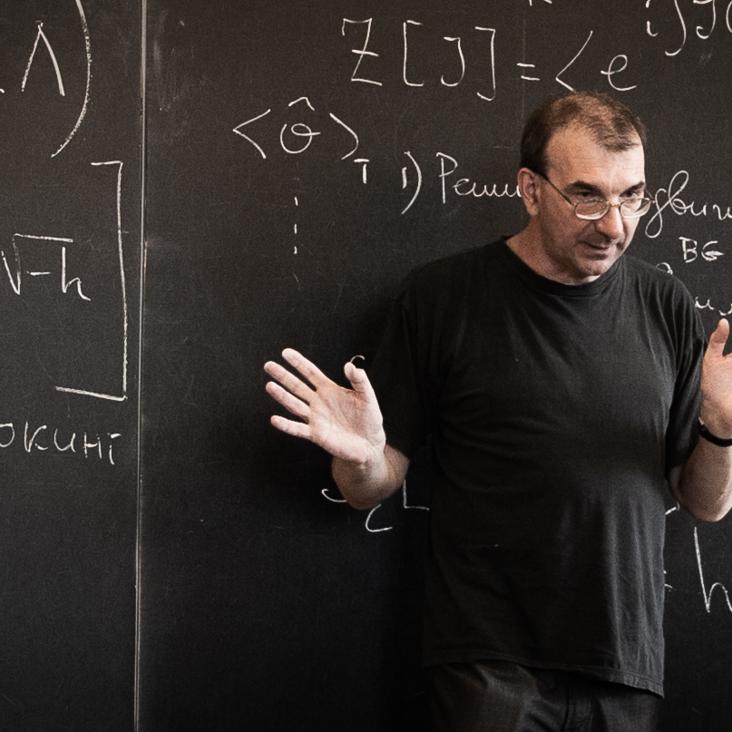
Portrait of Andrei Starinets
. Source. A physicist whose 1959 work explained why a photograph of a rapidly moving object does not simply show Lorentz contraction. Light arriving at the camera simultaneously left different parts of the object at different times. The resulting apparent shape combines this timing with relativistic aberration: a moving sphere still has a circular outline, while other shapes can appear rotated. Terrell rotation therefore distinguishes an optical image from a length measured using simultaneous positions in a reference frame.[ref]
Invisibility of the Lorentz Contraction by James Terrell. Abstract: conformal transformation of apparent directions, circular sphere outline and apparent rotation
There are unlisted articles, also show them or only show them.