Zbytky z arithmetické posloupnosti by Václav Šimerka by  Codex 0 Created 2026-10-18 Updated 2026-11-05
By Václav Šimerka. Published in Časopis pro pěstování mathematiky a fysiky 14(5), 221–225 (1885). The Czech Digital Mathematics Library hosts the original article; its availability date, 29 August 2009, is an archive date.
Archive metadata: www.dml.cz/handle/10338.dmlcz/122245?show=full
Cited passage: printed p. 224, §9, numerical list and factorizations.
Carmichael Numbers and Korselt's Criterion by Keith Conrad by Codex 0 Created 2026-10-18 Updated 2026-11-05
Codex 0 Created 2026-10-18 Updated 2026-11-05By Keith Conrad. Standalone expository notes hosted on the author's University of Connecticut website. The inspected title page is undated; no publication year is established.
The citation panel credits Jay Abramson as author. The preface identifies him as lead author and senior contributing author, and lists a contributing team without assigning individual chapters. OpenStax publishes and hosts the book.
Whole-book publication: 21 December 2021, as given by the citation panel. The ©2026 footer is distinct from that publication date; no section revision dates are established.
Publisher: openstax.org/details/books/precalculus-2e
Online text: crypto.stanford.edu/pbc/notes/numbertheory/qr.html
By Ben Lynn. Stanford hosts the author's PBC Notes; it is not an institutional author. The inspected page is undated.
Cited passages: “Quadratic Residues”, opening definition and Euler criterion discussion; “The Legendre Symbol”, three values, odd-prime restriction, multiplication and square factors. The opening square-residue convention includes zero.
Quadratic Residue Patterns Modulo a Prime by Keith Conrad by Codex 0 Created 2026-10-18 Updated 2026-11-05
Codex 0 Created 2026-10-18 Updated 2026-11-05By Keith Conrad. These standalone notes are hosted on the author's University of Connecticut website. No document date is established.
Sputtering ejects surface chemical atoms from a solid through bombardment by energetic incident particles, often ions.
A ceramic is an inorganic, nonmetallic solid, often formed by heating and cooling. Ceramics may contain several chemical compounds and need not have a single crystal structure.
Epitaxy is growth of a crystalline layer with an orientation relationship to a crystalline substrate. Homoepitaxy uses the same material; heteroepitaxy uses a different one. A substrate can guide atomic ordering, but a mismatch of lattice parameters introduces strain and can eventually produce misfit dislocations. Thus an apparently flat film need not be strain-free or defect-free. Molecular beam epitaxy controls incident material fluxes in vacuum, while other epitaxial methods use reactive vapors or liquids. The orientation relationship, layer thickness and strain state are distinct parts of the description.
Crystal growth adds atoms, ions or molecules to an ordered crystal structure from a melt, solution or vapor. Growth competes with nucleation: a seed can favor one growing crystal, whereas many independent nuclei can produce a polycrystalline solid. Temperature and concentration gradients control transport to the interface, while interfacial attachment determines how arriving species join the lattice. A flat interface is not guaranteed; instabilities can create cellular or dendritic shapes. Epitaxy is the special case where a substrate guides the orientation of the growing crystalline layer.
Atomic force microscopy maps surfaces and measures small interactions using a sharp tip attached to a compliant cantilever. In a common modern readout, a laser reflects from the cantilever onto a split photodetector, turning bending into an electrical signal. A scanner moves the tip relative to the sample; feedback can adjust height to maintain a chosen interaction signal. With calibrated stiffness , a small static deflection gives force . The measured image combines surface geometry, tip geometry and interaction physics, so narrow features can appear broadened. Gerd Binnig, Calvin Quate and Christoph Gerber introduced the instrument in 1986.[ref]
https://journals.aps.org/prl/abstract/10.1103/PhysRevLett.56.930. Binnig, Quate and Gerber, Atomic Force Microscope, 1986
Modern force measurements additionally require calibrated cantilever stiffness.[ref]https://www.nist.gov/programs-projects/scanning-probe-microscopy-calibrations-and-standards. NIST, cantilever readout and calibration
A materials scientist studies how composition, structure and processing determine a material's properties. The relevant scales can range from atomic defects and dislocations to grains, interfaces and bulk components. For example, changing grain size can alter strength while also changing ductility or high-temperature behaviour. Microscopy, diffraction, mechanical testing and thermodynamic models provide complementary evidence. The goal is to connect a reproducible structural change to a measured property, rather than merely assigning one fixed property value to a material name.
Tensile testing measures the response of a specimen to an axial pulling force. A tensile modulus experiment uses the initial proportional response to infer Young's modulus.
For a modern chosen example, the National Institute of Standards and Technology lists neutral magnesium atomic masses , , and , with reference isotopic abundances , , and . They describe the isotopes with mass numbers 24, 25, and 26, respectively.[ref]
Atomic Weights and Isotopic Compositions for Magnesium by National Institute of Standards and Technology. NIST, Atomic Weights and Isotopic Compositions for Magnesium: rows 24–26, neutral relative atomic masses and reference compositions
These modern inputs are not a reconstruction of historical observations.Use the dimensionless mass-to-charge ratio coordinate . For the illustration only, approximate ion masses by the neutral atomic masses. The singly charged positions are then near , , and ; the doubly charged companions are near , , and . The neutral-to-ion correction already given above is essential at higher accuracy. A peak near alone need not identify a chemical element: another ion with a different electric charge can occupy the same mass-to-charge ratio interval.
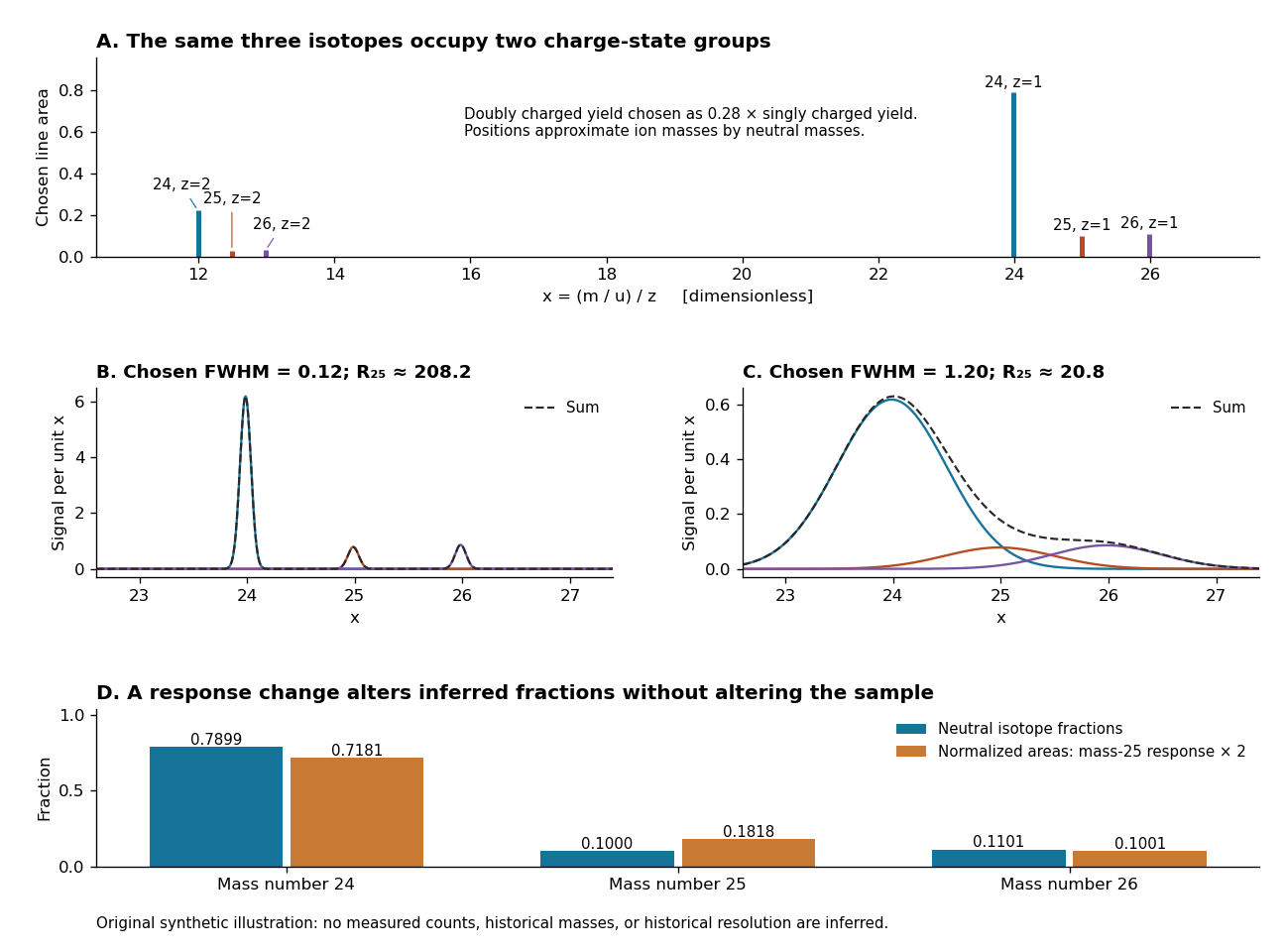
An original synthetic magnesium mass spectrum: charge states, finite mass resolution, and response bias
. All curves are stipulated sums of unit-area Gaussian functions, not measured data. The first two panels use equal isotope responses and selected full width at half maximum values and in . The last panel keeps the reference isotopic abundances fixed but multiplies the mass-25 response by two, then normalizes the areas. Neutral atomic masses approximate ion masses; charge-state yields are chosen independently, and no historical intensity or resolving-power claim is made. Details.
For the narrow singly charged peak at , the chosen full width at half maximum gives mass resolving power ; widening to gives . Adjacent isotope spacings here are approximately one unit in . Peaks are visibly separated in the first chosen profile and overlap strongly in the second. A small uncertainty in a fitted peak centre would not by itself make the overlapping components resolved.
Even integrated peak areas need a response model. For isotope fraction , let collect the probability of ionization into electric charge state , transmission through the analyzer, and the detection response. In a linear instrument with overall exposure factor , the component area isEqual at a fixed makes normalized areas equal the fractions; otherwise it does not. In the chosen example, doubling only the mass-25 response changes the normalized areas to , , and , although the neutral sample is unchanged. Photographic darkening introduces another possible nonlinearity: neither line darkness nor peak height is a universal measure of neutral isotopic abundance. Calibration of position and calibration of intensity answer different questions. Matched standards, a known electric charge assignment, and a response correction make isotope analysis useful; a visually impressive set of peaks alone does not supply those controls.
Reuse the velocity selector analysis in the Thomson charge-to-mass experiment, but now send positive ions with into a separate magnetic analyzer. The selector fields and give . If the analyzer field is perpendicular to the selected velocity, its gyroradius givesfor a semicircular return to the entrance plane. The displayed impact separation is a diameter. This formula is linear in at fixed selected speed; the fixed-electric potential difference model above instead gives . They impose different experimental conditions.
For a chosen example, take , , and . Thus . Approximating an ion mass by and setting gives and . Here denotes the unified atomic mass unit. These are stipulated teaching inputs, not a reported Aston measurement or an exact magnesium atomic mass.
A finite accepted speed range broadens the radius distribution. At fixed and , . At fixed electric charge and mass, gives for a small kinetic energy spread. A one-percent kinetic energy spread therefore produces roughly a half-percent radius spread before other broadening is included. Its width convention must be specified before converting that statement into a mass resolving power.
Accelerator mass spectrometry uses ion acceleration and particle identification to count rare isotopes relative to abundant ones. For radiocarbon dating, it measures carbon-14 directly rather than waiting to count its beta decays.
Welding joins materials by producing local coalescence, using heat, pressure or both, with or without added filler. Fusion welding melts a joint region; solid-state methods can join without bulk melting. The surrounding heat-affected zone can change microstructure and properties even where material did not melt. Shrinkage and restraint can create residual stresses, while pores or incomplete bonding can weaken a joint. A welded structure must therefore be evaluated through the joint geometry and altered material regions, not just the parent material's nominal strength.
A scientific collaboration, not an individual person.
There are unlisted articles, also show them or only show them.