
The inbreeding coefficient is the probability that the two allele copies at a locus within an individual are identical by descent. It equals the kinship coefficient of the individual's parents. It concerns ancestral identity, rather than merely homozygosity of observed allelic states.
// Target: biology.bigb
Magnification compares an image's scale with a specified reference. Transverse magnification compares signed lengths in object and image planes; angular magnification compares viewing angles at an observer. Both are dimensionless quantities, but they answer different questions. A projected real image twice as tall has ; an optical telescope's advertised viewing enlargement normally concerns angular magnification. [ref]
2.8 Microscopes and Telescopes. Ling, Sanny and Moebs, University Physics Volume 3, §2.8: Angular magnification and telescopes
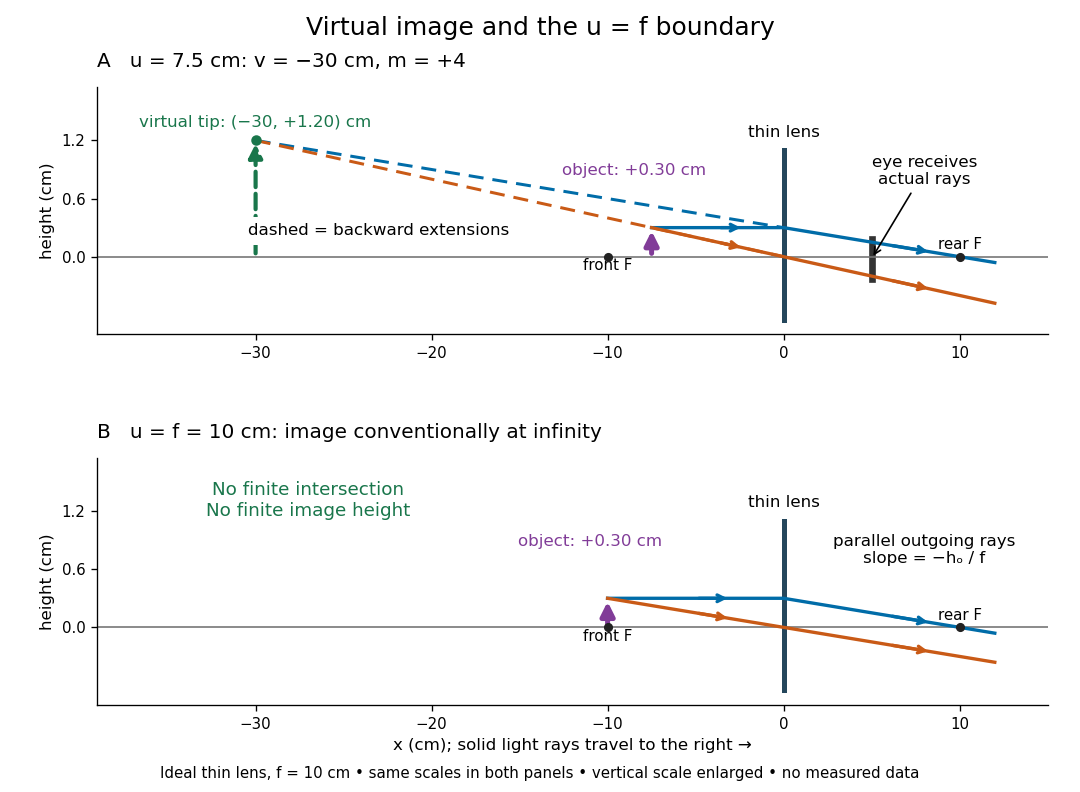
.Always specify the sign and the reference arrangement. For signed transverse magnification, means inverted and means upright; means enlarged and means reduced. A larger virtual image can subtend a modest viewing angle if it is farther away. At , an ideal converging thin lens has no finite image height and hence no finite transverse magnification, while angular magnification can remain finite. Enlargement also does not guarantee extra detail: diffraction-limited resolution and optical aberrations limit the information available to enlarge. [ref].
A virtual image is the apparent origin of an outgoing diverging bundle: the backward extensions of its light rays intersect at the image point. Those extensions are geometric constructions, not backward-travelling light. A screen placed there cannot intercept the outgoing bundle to display that virtual image. An eye or a second optical lens receiving the actual outgoing light rays can nevertheless form a subsequent real image. “Virtual” describes this imaging stage, not whether the image can be seen or photographed. [ref]
https://tecnoedu.com/recursos/UNLCHidrologia/ManualesOriginalesPasco/Basic-Optics-System-Manual-OS-8515C.pdf. PASCO, Basic Optics System manual, Experiment 14, pp. 41–43: viewing and reimaging virtual images
.For a converging thin lens with , the same equations give and : the virtual image is upright and enlarged. For the illustrative choice , , ,The image appears farther from the optical lens than the object. A diverging thin lens with a real object instead has and , so a virtual image need not be enlarged. A plane mirror provides another virtual image, located behind the reflecting surface by backward extensions of the reflected light rays. [ref]
https://openstax.org/books/college-physics-2e/pages/25-7-image-formation-by-mirrors. Urone and Hinrichs, College Physics 2e, §25.7: Plane-mirror images
.

For a direct viewing test, bring the target to , search for a sharp screen image on the outgoing side, then remove the screen and look through the optical lens toward the target. Expect an upright enlarged view if the eye receives the bundle and can focus. Record the eye position: beyond the optical lens gives a predicted apparent distance . This adapts the Northern Virginia laboratory's comparison. [ref]
https://sites.nvcc.edu/alphy/_files/Manuals/Physics%20242%20Lab%2011%20-%20Thin%20Lenses.pdf. Northern Virginia Community College, Physics 242 Lab 11, pp. 4–5: Virtual images with a converging lens
.For a position measurement, use parallax localization of a virtual image. Place a movable pencil tip or narrow comparison marker beside the apparent image, and view that marker directly beside or above the optical lens, while viewing the image through it. Move the head a little sideways and move the marker along the bench until relative lateral motion vanishes. Read its coordinate ; the estimate is . Deliberately place the marker nearer and farther to check that relative motion reverses on opposite sides of the match. This follows Orhan Aytür's lens laboratory, which uses a pencil to locate a virtual image. [ref]
https://www.ee.bilkent.edu.tr/~ee428/manual/html/node6.html. Orhan Aytür, Bilkent University, Experiment 2: Imaging with mirrors and lenses, §2
.Keep target and optical lens fixed, use one eye and the central image detail, and ensure the marker itself is not viewed through the optical lens. A marker blocked by the target, or a head movement that loses the bundle through the aperture, invalidates that trial. Repeat the match from both directions and record its depth range. This measures apparent depth; comparing apparent sizes at different depths does not directly measure transverse magnification. Near , apparent depth becomes very large and the match is poorly constrained. A failed screen search alone therefore needs the distance check and the viewing test.
A real image lies where the outgoing light rays from each object point actually intersect in geometrical optics. A screen or detector placed at that image plane receives the focused pattern. The screen reveals the real image; it does not create the intersection. A viewer can also see a real image without a screen if their eye receives the diverging light rays beyond the intersection. [ref]
https://openstax.org/books/college-physics-2e/pages/25-7-image-formation-by-mirrors. Urone and Hinrichs, College Physics 2e, §25.7: Real images and their observation
.For a converging thin lens and real object with , the real image has and signed transverse magnification . Inversion is a property of this particular setup, not the definition of a real image. With and , the following are predictions:
| Object distance | Image distance | Transverse magnification | Signed image height |
|---|---|---|---|
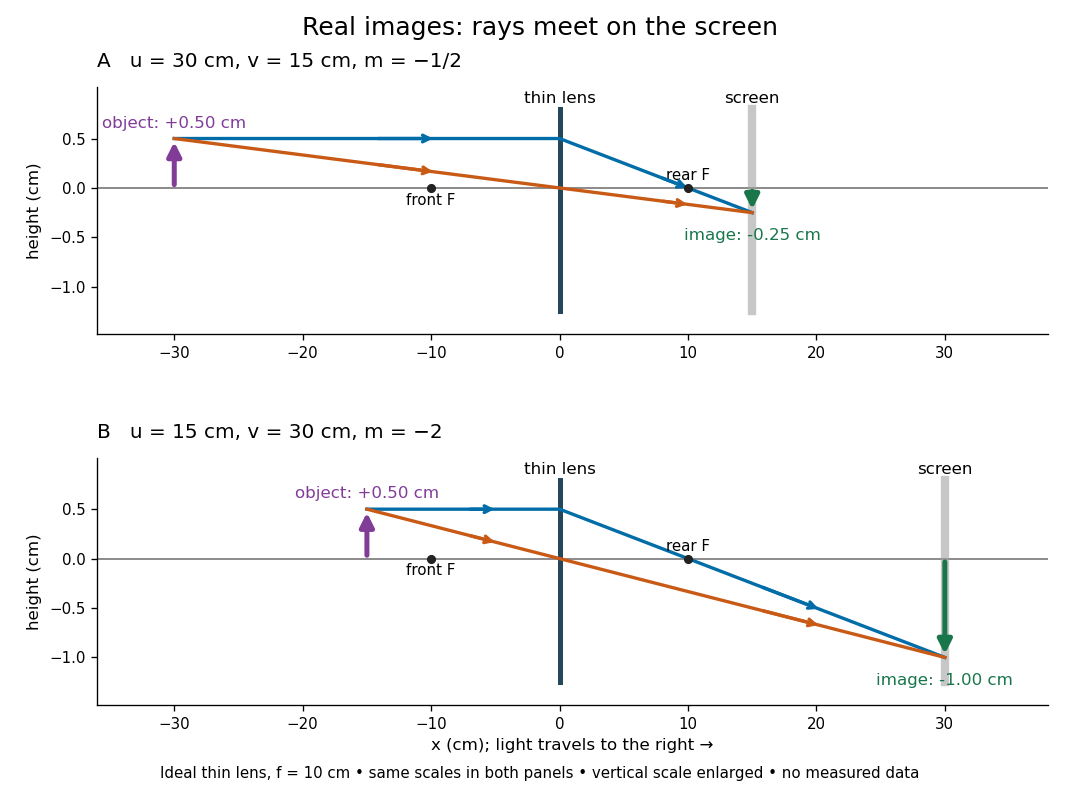

To test both image position and transverse magnification, use an optical bench with an illuminated arrow or millimetre target, a converging optical lens of nominal focal length , a movable white screen and a ruler. Measure corresponding target and image intervals, rather than guessing the whole image size when it exceeds the screen. PASCO's Experiment 12 compares distance-based and size-based magnification; the following procedure uses several object distances, as in the Northern Virginia laboratory. [ref]
https://tecnoedu.com/recursos/UNLCHidrologia/ManualesOriginalesPasco/Basic-Optics-System-Manual-OS-8515C.pdf. PASCO, Basic Optics System manual, Experiment 12, pp. 33–36
; [ref].- Align target centre, optical lens centre and screen along one optical axis, with target and screen perpendicular to it. Record bench positions of the actual target plane, optical lens plane and screen surface; distances between holder edges introduce an offset.
- Start at . Move the screen through the expected region until the target's central detail is sharpest. Record , measured , the corresponding target and image intervals, and whether the arrow is inverted. Give the measured size ratio a negative sign if inverted.
- Repeat at and . Compare the measured signed size ratio with , and calculate for each pair. The three ideal rows above are predictions to compare against, not entries to copy into the measurement record. [ref]https://sites.nvcc.edu/alphy/_files/Manuals/Physics%20242%20Lab%2011%20-%20Thin%20Lenses.pdf. Northern Virginia Community College, Physics 242 Lab 11, pp. 2–4: screen focusing, orientation and size measurements.
Keep the optical lens, illumination and central target detail fixed between trials. Approach best focus from both sides and record the interval over which sharpness is difficult to distinguish; repeat focusing to estimate its reproducibility. A modest central aperture stop tests whether peripheral light rays change the result, but also reduces brightness. Spherical aberration, chromatic aberration and diffraction can broaden the optimum; a thick optical lens also makes the chosen reference plane imperfect. Treat nominal as an initial prediction, and report position and interval-reading limits instead of forcing exact agreement. [ref]
https://www.feynmanlectures.caltech.edu/I_27.html. Feynman, Leighton and Sands, §§27-5–27-7: principal planes and imaging limits
.Moving the object toward the front optical focus from outside makes the real image larger and farther away. A failed screen search near can therefore mean that the real image is beyond the bench, rather than that a virtual image has formed. At exactly , the outgoing bundle from each point is parallel and no finite screen position focuses it.
An optical bench is a rail or aligned platform carrying an object, optical lens elements and a screen or detector at readable positions. It turns image formation into measurements of position and transverse magnification. Read distances between the optical planes rather than arbitrary holder boundaries; keep heights and optical axis alignment controlled. [ref]
https://www.pasco.com/resources/lab-experiments/484. PASCO, Object and Image Distances Thin Lens: bench apparatus and measurements
.The free-drift velocity of an iceberg follows from air and water drag, the Coriolis force, pressure gradients, currents and other external forces. Large submerged area and mass make its wind response weak compared with that of a thin floe.
For a vertical-sided floating iceberg of height , Archimedes' principle equates displaced water mass to ice mass. Its draft is and its freeboard is the remaining height above water. A depth-dependent mass density must be integrated; using the densest layer throughout overestimates the draft.
For an initially cold iceberg, melting to liquid at temperature requires both latent heat of fusion and sensible warming determined by the ice specific heat capacity . Spatial mass density and temperature profiles determine their mass-weighted integrals. Additional warming of the meltwater requires a separate heat contribution.
The complete simply connected Riemannian manifold of dimension with constant sectional curvature is hyperbolic space. In the upper half-space model its metric is for . Its ideal boundary in dimension three is the Riemann sphere.
In the Poincare disc model, a hyperbolic circle in the Poincare disc consists of points at one fixed hyperbolic distance from a center. At center zero it is the Euclidean circle , since radial hyperbolic distance is . A Poincare disc automorphism sending a general center to zero transports this description. Conversely every Euclidean circle entirely inside the disc is such a circle: the product of inversion in that circle and unit-circle inversion has reciprocal fixed points, one inside; sending the inner fixed point to zero makes the circle concentric with the unit circle.
A tessellation is a covering by tiles with pairwise disjoint interiors; a locally finite tessellation meets any compact set in only finitely many tiles. In a tessellation by congruent compact hyperbolic polygons, the adjacency graph records side-crossing steps. The area growth and bounded tile diameter imply exponential growth of the number of tiles within steps: a unit geodesic segment meets a uniformly bounded number of tiles, by packing congruent interior balls, so a metric ball of radius proportional to lies in the step ball. Conversely the step ball lies in a metric ball of radius proportional to . The regular right-angled pentagons with four around every vertex give the tiling .
For a right-angled geodesic triangle in curvature minus one, with legs and hypotenuse , the displayed identity replaces the Euclidean theorem. Normalize the right vertex to in the upper half-plane, one endpoint to with , and the other to with and . The Hyperbolic distance in the Poincare half-plane gives , and , proving the identity. For small lengths its expansion gives to leading order.
For a continuously differentiable dynamical system , a fixed point is hyperbolic if no eigenvalue of its Jacobian has zero real part. In a neighborhood of a hyperbolic fixed point, the nonlinear flow is locally topologically conjugate to its linearized flow. Thus the saddle, attracting or repelling character persists under the nonlinear terms. The theorem does not decide the nonlinear character of an equilibrium with purely imaginary or zero eigenvalues: a conserved Hamiltonian, Lyapunov function or higher-order analysis may be needed instead.
Gauge pressure is pressure measured relative to the surrounding atmospheric pressure; absolute pressure is instead measured relative to an ideal vacuum. At an open surface , so the constant-mass density hydrostatic pressure law becomes . Here at the surface denotes equality with atmospheric pressure. It does not denote zero absolute pressure. [ref]
A negative hydrogen ion is a hydrogen nucleus with two bound electrons. Its weakly bound extra electron permits absorption at visible and infrared wavelengths in cool stellar atmospheres.
Metallic hydrogen is a high-pressure conducting state of hydrogen. Its fluid form in the deep interiors of gas giants supplies a conducting medium for a planetary dynamo, unlike the iron-alloy conducting cores of terrestrial planets.
A spatially nonuniform system is globally unstable when a normal mode satisfying its global spatial boundary conditions has positive temporal growth rate. This differs from purely local temporal amplification or convective wave-packet instability. A locally absolutely unstable region can be necessary without being sufficient for a growing global mode of finite spatial extent.
A global hydrodynamic mode is a separated solution satisfying the complete spatial boundary conditions of a linearized flow problem. Its eigenvalue depends on the spatial domain and variable coefficients, rather than solely on a local dispersion relation.
Ethane is the alkane , containing two tetrahedral carbon centers joined by a single bond. Rotation about that bond connects staggered and eclipsed conformations.
The staggered arrangement is lower in energy, so ethane provides a basic example of torsional preferences in a molecule whose connectivity remains unchanged. The rotational barrier is finite: a single-bond drawing does not mean every torsion angle has the same energy.
There are unlisted articles, also show them or only show them.