
For a field periodic on a circle of radius , a Fourier series gives modes with quantized internal momentum . Each mode is a lower-dimensional field with the displayed squared mass. The entire sequence is the tower; retaining only modes below a chosen energy gives an effective field theory. The tower is distinct from any individual Kaluza-Klein mode.
Let be the largest number of chromosome copies that can be paired across the two full siblings as identical by descent, counting repeated copies when a child is autozygous. For offspring of otherwise outbred first cousins, with probability the parental copies have no common ancestral origin, giving ordinary sibling sharing . With probability , write the parental copies as and with three distinct origins. Each child independently has one of , equally likely. Among sixteen ordered child pairs, two share no copy, ten share one, and four share two. The mixture gives the displayed probabilities. These three numbers do not determine all Jacquard identity coefficients; the formula is restricted to noninbred individuals and fails here.
For coprime positive odd integers , the Jacobi symbol satisfies . It follows by factoring and into primes and multiplying the quadratic reciprocity for each prime pair; the parity of the sums of prime half-differences agrees with and . A Jacobi symbol equal to one does not imply that its numerator is a quadratic residue for a composite denominator.
An isotopic abundance is an atom fraction within a specified population of one chemical element.[ref] If counts its chemical atoms of isotope , useThe denominator includes every isotope of that chemical element included in the stated population, not every chemical atom of every chemical element in the sample. Thus an oxygen atom fraction among all chemical elements is a different quantity.
For an illustrative neutral neon population, take the displayed central isotopic abundances , , and from the reference table, so . Its mean atomic mass is the weighted arithmetic meanThese are rounded reference inputs with uncertainties, not exact universal isotopic abundances; the long decimal shows their arithmetic result, not measurement precision.[ref]
The population convention matters. If instead is the fraction of total neutral-atom mass supplied by isotope , then andThis is a weighted harmonic mean in the mass fractions. Using with those mass fractions would answer a different question. The conversion follows directly by counting chemical atoms and adding their masses.
The rest mass of a chemical atom in its ground state, a physical quantity expressed in SI mass units or the unified atomic mass unit. Here means the atomic mass of a neutral chemical atom of isotope , not the mass of its bare atomic nucleus and not a population average.[ref]
Atomic mass includes electrons and depends on nuclear binding energy; it is not just mass number times a universal nucleon mass. The atomic mass of neutral carbon-12 in its ground state is exactly by definition of the unified atomic mass unit. That exactness establishes the reference scale, rather than making the atomic masses of all isotopes exact integers in the same unit.
The mass number is the total number of nucleons, namely protons plus neutrons, in an atomic nucleus:It is an exact positive integer with no units, rather than a measured mass. Carbon-12 has because its atomic nucleus contains six protons and six neutrons. No improvement in a mass measurement can turn that count into or .[ref]
The left superscript in denotes mass number , not an atomic mass of exactly . For neon-22, the displayed reference atomic mass is about . Even a weighted mean of mass numbers, such as for the illustrative neon population below, is a population average, not the mass number of an individual atomic nucleus.[ref]
A cesium chloride density gradient forms when the salt redistributes in a rotating chemical solution. It can supply matching-density positions for DNA during isopycnic centrifugation.[ref]
https://www.beckman.com/resources/technologies/centrifugation/density-gradient-centrifugation/. Types of Density Gradients and Types of Gradient Material: self-forming CsCl gradients and nucleic-acid separation
Buoyant density is the surrounding liquid density at which a species has no net centrifugal drift under the stated conditions. It depends on interactions with the medium, including associated solvent, rather than necessarily equaling the dry substance's density. Equal buoyant densities can give overlapping bands even for differently sized proteins or DNA fragments.[ref]
https://www.beckman.com/resources/technologies/centrifugation/ultracentrifugation/. An Introduction to Ultracentrifugation, Isopycnic Centrifugation: buoyant density depends on the surrounding medium
Every nonempty open real interval contains an irrational number. Choose a rational number strictly inside the interval using density of the rational numbers; then remains inside for sufficiently large positive integers and is irrational. Thus the irrational numbers form a dense subset of the real line. Together with rational density, this gives approaching sequences of both types at every real point, useful for testing continuity of functions defined differently on the two sets.
If in lowest terms, then makes even. Substituting then makes even, contradicting that the integers are coprime. More quantitatively, for every nonzero integer , and factoring the difference of squares gives . To verify the constant, for the other factor is less than four; outside this interval the approximation error is at least .
In this structural use, the coordination number counts nearest neighbouring constituents. State which neighbours are counted and which ionic crystal structure is being described; it is not an ion's electric charge number.
The rock salt structure of ordinary sodium chloride has a coordination number of six for each kind of ion: six nearest neighbours of the opposite sign surround each ion along three perpendicular directions. Its conventional cubic unit cell contains four formula units; sharing corner, face, and edge sites between adjacent cells must be included in that count. Sixfold local coordination is compatible with overall stoichiometry.[ref]
The checkerboard plane in the diagram is a slice through this three-dimensional arrangement. It leaves out the two nearest neighbours above and below the plane. Repeating a complete even-by-even patch gives equal numbers of signs; the displayed odd-by-odd crop has a boundary imbalance and is not a complete neutral ionic crystal or a unit cell. Other salts need not have the rock salt structure or the same coordination number.
An ATP-sensitive potassium channel couples membrane potassium conductance to cellular nucleotide state. A familiar pancreatic complex combines Kir6.2 pore subunits with SUR1 regulatory subunits. Increased intracellular ATP tends to inhibit channel opening; in a pancreatic beta cell, reduced potassium conductance can promote membrane depolarization and subsequent insulin secretion. Nucleotide regulation therefore links glucose metabolism to electrical activity, with regulatory-subunit and nucleotide-context dependence. [ref]
UniProtKB by the UniProt Consortium. Q14654, Function, Catalytic activity and Subunit structure
For one-dimensional inverse scattering, the Gelfand-Levitan-Marchenko equationrecovers the transformation kernel from scattering data encoded by . In the convention used for the Korteweg-De Vries equation above, the potential is
Put , and . For the dressing operator , differentiating gives and , where and . Uniqueness of the linear integral equation therefore supplies a Lax pair. Its commutator identity is , which gives the KdV equation when the eigenfunction is not identically zero. Differentiation under the integral and the uniqueness assumption are essential hypotheses.
Scattering data describe connections between normalized solutions of an auxiliary spectral equation, together with any discrete spectral points and their norming data. In an inverse scattering transform, the nonlinear potential is reconstructed from these data; boundary spectral connection matrices must additionally obey a global relation.
The X-ray transform records integrals of a function or tensor evaluation over a specified family of curves. The curve family, parametrization and any weights are part of the definition. Straight lines, geodesics and magnetic flows give different versions; their injectivity and unavoidable potential kernels depend on that geometry.
An inverse problem is an ill-posed problem if it fails any requirement of a well-posed problem: existence for every admissible datum, uniqueness, or continuity of the reconstructed object as the data change. These requirements depend on the chosen spaces and norms, not just the equation. Clason's regularization notes formulate this distinction explicitly.[ref]
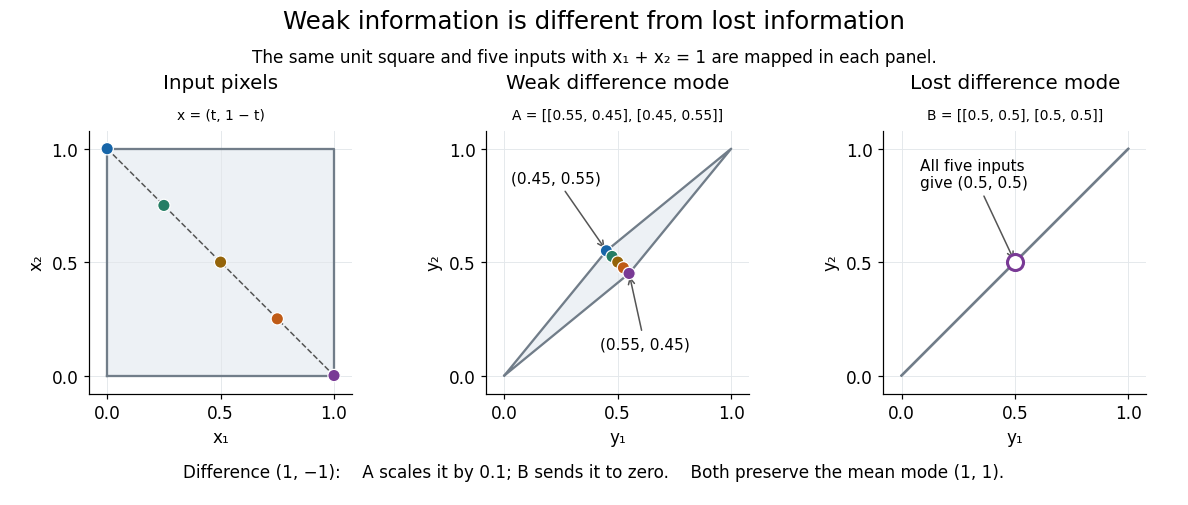
Complete averaging illustrates lost information:The difference mode belongs to the null space because . Even restricting both pixels to leaves infinitely many indistinguishable inputs. This is failure of uniqueness. Data such as also have no exact preimage under , illustrating failure of existence when arbitrary two-component observations are admissible.
The two-pixel matrix in the inverse problem example has a weakly observed difference mode, not a null space mode. Its inverse is continuous: this finite-dimensional problem is a well-posed problem with noise-sensitive conditioning. Small positive singular values alone do not imply mathematical ill-posedness. In infinite-dimensional problems, positive singular values approaching zero can make inversion unbounded: unit solution modes then produce data tending to zero. This destroys continuity even without a null space. Regularization of an inverse problem must distinguish missing information from information recoverable only at the cost of amplifying measurement noise.

Tomography reconstructs an interior distribution from measurements along multiple lines or paths through it. A linear unattenuated model is the Radon transform; absorption changes it to an attenuated Radon transform.
There are unlisted articles, also show them or only show them.