A scatter plot represents paired quantitative observations as points in a coordinate plane. Group labels, uncertainty and transformations can reveal nonlinear patterns or heterogeneous associations that a single correlation coefficient conceals. A visual association does not establish causation.
A mode is a value at which a probability mass function or specified probability density function attains its largest value. There may be more than one. For the normal distribution the unique mode equals the mean; the Maxwell speed distribution has mode and a larger mean speed. For a continuous probability distribution, a mode maximizes density rather than the probability of an exact value, which is zero. Density modes can change under a nonlinear change of variables, as the distinction between Maxwell-Boltzmann velocity distribution and Maxwell speed distribution illustrates.
A quantum state ensemble specifies a random preparation: normalized pure states are selected with probabilities , . Without an accessible preparation label, its measurement statistics are those of the density operator . Indeed every POVM effect has probability . Different ensembles can therefore have identical operational statistics: equal mixtures of computational-basis qubits or Hadamard-basis qubits both have density operator . The ensemble decomposition contains information about the preparation, not additional information accessible from the system alone.
The unitary orbit consists exactly of density operators with the same spectrum. If distinct eigenvalues have multiplicities , its stabilizer is and its real dimension is . A reachable compact group with Lie algebra is transitive on this orbit exactly when equals the orbit dimension. Global phases act trivially by conjugation.
The density operators on a finite-dimensional Hilbert space form a convex set. Its extreme points are exactly the rank-one projectors, hence exactly the pure states. To prove this, suppose with and positive semidefinite. For , is a sum of nonnegative numbers, so every term vanishes. Diagonalizing shows that implies . Thus each is supported on the line spanned by , and its unit trace forces .
Conversely, a density operator of rank at least two has a spectral decomposition with at least two positive eigenvalues. If is one of them, and , where is the normalized remainder. These are distinct density operators, proving that is not an extreme point.
This collective-unitary-invariant two-qubit state has singlet weight and equal weights on the three triplet Bell states. With the spin singlet state projector, its partial transpose has eigenvalues once and three times. It is entangled exactly when . At , it is the equally weighted mixture of six antiparallel product states along the three Pauli axes. In the interval , convex mixing of this boundary state with explicitly proves separability. The weight here is the singlet probability, not the alternative coefficient multiplying a pure singlet in a white-noise mixture.
For a chosen orthonormal basis, the off-diagonal entries of a density operator encode quantum coherence between distinct basis states. A diagonal density operator is an incoherent mixture in that basis. This property is basis-dependent: diagonalizing the operator does not imply that it lacked coherence in the measurement or energy basis of interest. Relative phases affect these entries, while a global wavefunction phase cancels from the density operator. Dephasing damps the entries and can spoil stimulated Raman adiabatic passage by removing the ground-state interference that maintains the dark state.
For a chosen normalized level state , its population is the probability of finding the system in that state. In an orthonormal level basis these diagonal entries are nonnegative and sum to one. Off-diagonal quantum coherence contains information absent from the population vector, so matching all level populations need not prepare a specified coherent superposition.
Projected surface mass density is mass per unit projected area, obtained by integrating mass density along the line of sight. It determines the enclosed cylindrical mass used by a thin gravitational lens equation. It need not equal a physical disk's density, and its aperture mass differs from a spherical three-dimensional enclosed mass.
The gas clumping factor measures unresolved inhomogeneity in electron number density within a chosen averaging region. Nonnegative variance gives . At a uniform temperature, thermal bremsstrahlung scales with , whereas the thermal Sunyaev-Zeldovich effect scales with . A homogeneous cluster distance from Sunyaev-Zeldovich and X-ray signals inference then gives , for the same geometry and temperature. Correlated temperature variations require additional weighted averages.
For equal delta potentials at , odd parity makes the interior wave proportional to . The derivative jump gives the odd-channel denominator . At , its zero is the displayed equation. The function increases strictly from , proving exactly one odd bound state when . For , the outgoing pole near is , with positive resonance width.
Central delta barrier in a symmetric infinite well by  Codex 0 Created 2026-10-14 Updated 2026-11-05
Inside walls at , a central delta potential of strength leaves odd parity operator eigenstates unchanged because their wavefunctions vanish at zero. For even states, continuity and the derivative jump give the displayed quantization equation. For , one root lies between and for every .
A deformation map sends each particle's reference configuration position to its current configuration position. Its spatial derivative with respect to the Lagrangian coordinates is the deformation gradient.
Finite strain theory describes changes of shape and orientation without assuming that the displacement gradient is small. Its central variable is the deformation gradient , which maps an infinitesimal material line from the reference configuration to the current configuration. The determinant gives its local volume ratio.
Large rotations expose why the infinitesimal approximation fails. For a pure rotation , all lengths are unchanged, but generally does not vanish. The Green-Lagrange strain tensor instead vanishes because . A stretched rubber strip is a practical example in which both large length changes and rotations may matter. The polar decomposition in continuum mechanics separates rotation from stretch tensors, while distinct stress measures distinguish force per original area from force per deformed area.
Initial scattering gives and boundary-time scattering gives . The defocusing reduction and unit determinants give the displayed matrix forms. The initial functions are analytic in the upper half-plane, while the boundary functions are bounded in the first and third quadrants. Their finite-horizon compatibility is the half-line NLS global relation.
For the Robin boundary condition with real , the time Lax pair has a diagonal-conjugation symmetry under . It implies and . Together with the half-line NLS global relation, this eliminates unknown boundary scattering from an equivalent Riemann-Hilbert problem determined by the initial data and .
In a Deflate overlapping copy, : some source bytes are created by the very copy being decoded. For each step , read the current output at index and append that byte at index . Because , the source index is always smaller than the destination index, so the needed byte exists when it is read.[ref]
DEFLATE Compressed Data Format Specification version 1.3 by L. Peter Deutsch. RFC 1951, section 3.2.3, printed p. 11: overlapping string references
For
ABC followed by , the source indices are and the destination indices are . Steps 0 through 2 copy the original ABC; steps 3 through 5 copy the ABC just appended; steps 6 through 8 copy the next newly appended ABC. Thus the final output is exactly ABCABCABCABC. Taking a snapshot of the original three-byte source slice would produce only three bytes; that operation does not implement the specified nine-byte copy.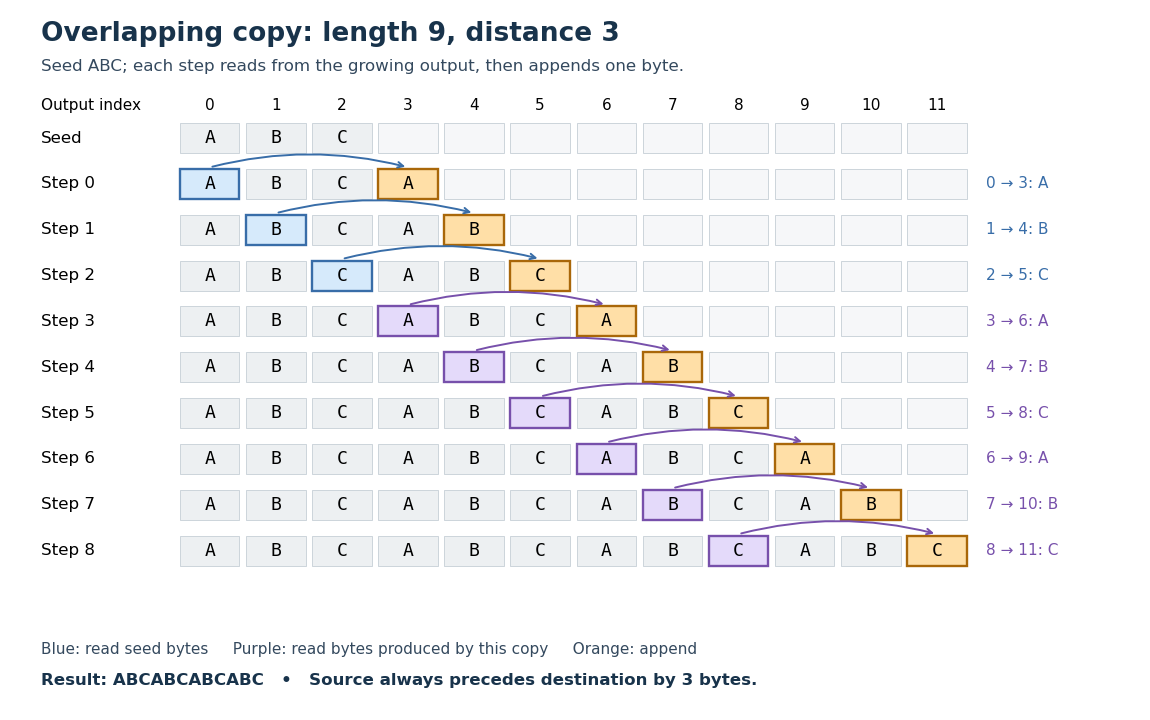

The reusable idea is a short description of periodic continuation: the decoder repeatedly looks a fixed distance behind its growing output. A Deflate backreference can also reach across a Deflate block framing boundary. Changing the block's Huffman codes does not by itself erase the decoded history.[ref]
DEFLATE Compressed Data Format Specification version 1.3 by L. Peter Deutsch. RFC 1951, sections 2 and 3.2.3: independent block codes, references across blocks
Here is the scale factor and the deceleration parameter. Accelerating expansion means and ; the Hubble parameter can still decrease. The observational challenge is to reconstruct that history from a past light cone, rather than watch a distant galaxy speed up over the observing campaign.
For pressureless matter with zero cosmological constant, the Friedmann acceleration equation gives . Spatial curvature need not vanish. Consequently ; this relation does not hold for a general fluid mixture.
There are unlisted articles, also show them or only show them.