Deceleration parameter from the Hubble derivative by  Codex 0 Created 2026-10-14 Updated 2026-10-24
Differentiating gives , which proves the displayed identity. A falling Hubble parameter does not by itself imply deceleration: linear growth has but .
The vacuum Einstein field equations with positive cosmological constant admit a closed spherical slicing with scale factor . The time-symmetric slice is at . The substitution gives and , so the metric is . The conformal metric is a finite-time slab of the Einstein static universe, with spacelike conformal infinities .
Unit-radius two-dimensional de Sitter spacetime is the hyperboloid in three-dimensional Minkowski spacetime. Its closed coordinates are , , , with and periodic modulo . Unwrapping gives its universal covering spacetime instead.
With no matter or radiation, and , the Friedmann equation in units is . Separating variables on the expanding branch and choosing its coordinate origin at gives the displayed scale factor. Normalization imposes and . The zero of the scale factor is the boundary of this open coordinate patch, rather than a curvature singularity of de Sitter spacetime.
A weakly interacting massive particle is a massive dark-matter candidate whose interaction strength permits thermal production and later cosmological particle freeze-out. Its relic abundance depends on the annihilation rate and cosmological history, not on its mass alone. At nucleosynthesis temperatures a 50 GeV example is nonrelativistic: its equilibrium density is reduced by Boltzmann suppression, while an already frozen relic population need not follow the equilibrium density. Its effect on nucleosynthesis depends on whether the surviving energy density is appreciable or whether it injects reaction-altering products.
If a dark matter particle of mass radiates power independently of its neighbours, optically thin isotropic emission has volume emissivity . Its surface brightness is and therefore traces the mass column rather than its square.
For identical self-conjugate dark matter particles, the pair-annihilation rate per volume is . If each annihilation releases radiated energy , volume emissivity is . Optically thin isotropic surface brightness is . The squared-density dependence assumes a spatially constant rate coefficient and a smooth density; unresolved substructure changes the average of the square.
A propagating adiabatic fluid with the constant closure has . For , a short-wavelength Fourier perturbation obeys , producing gradient growth. This does not exclude a negative-pressure perfect-fluid stress tensor with nonadiabatic pressure response, or a canonical scalar with rest-frame sound speed one. A cosmological constant has no independent propagating fluid density mode.
// Target: cosmology.bigb
The motivating observation is that a chemical reaction can produce a signed electrical reading even when its reacting materials occupy separate vessels. UC San Diego's teaching demonstration places a copper strip in and a zinc strip in , using two beakers with about of chemical solution in each. The strips connect to a voltage meter. Initially there is no ionic connection; the demonstration specifies a zero reading. A filter-paper salt bridge containing aqueous then connects the chemical solutions. With the meter's positive lead on copper and negative lead on zinc, its reported readings are about ; exchanging the leads reverses the reading. These are observations reported by the university, not data generated for this article. See UC San Diego, demonstration 9B: apparatus, bridge control and meter polarity.
The controls answer different questions. Exchanging only the meter leads checks the sign convention; it does not reverse the chemical reaction or swap the anode and cathode. Interrupting only the salt bridge tests the need for an ionic return path. Its absence prevents sustained cell electric current, but a very high-input-resistance meter may still show a transient or unstable reading while interfaces store electric charge. The zero reading specified for the university's apparatus is therefore not a universal theorem for every meter. Reconnecting the same salt bridge distinguishes a reversible interruption from a disconnected wire or exhausted chemical solution. This interpretation follows from electric charge conservation in a model allowing interfacial electric charge storage; see IUPAC Gold Book: integral capacitance of an electrode for the capacitance associated with electrode charge.
To distinguish terminal electric potential difference from delivered power, compare the nearly open-circuit reading with readings across a known resistor load. In the nearly open-circuit condition, a meter with input electrical resistance much larger than the cell's effective internal electrical resistance draws little electric current. With a load, measure its terminal electric potential difference and infer using Ohm's law; track the readings over time and repeat the nearly open-circuit reading afterwards. Keep the temperature, chemical solution compositions, immersed electrode areas, bridge geometry and electrical contacts comparable. This is a model-based extension of the documented demonstration, not a claim that UC San Diego published a load sweep. A finite-current drop can reflect ionic electrical resistance, changes of interfacial reaction rates, or depletion near an electrode; a single voltage reading cannot identify which dominates. The interfacial and composition contributions are distinguished in IUPAC Gold Book: overpotential and [ref].
For a deliberately simplified calculation, model the cell by a constant electromotive force in series with a constant internal electrical resistance , and a passive load . Take positive from the cathode through the load to the anode. ThenThe nearly open-circuit limit gives but and . A straight -versus- line is a prediction of constant , not a general law for electrochemistry. See Ling, Sanny and Moebs, University Physics II, §10.1: internal resistance, terminal voltage and load.
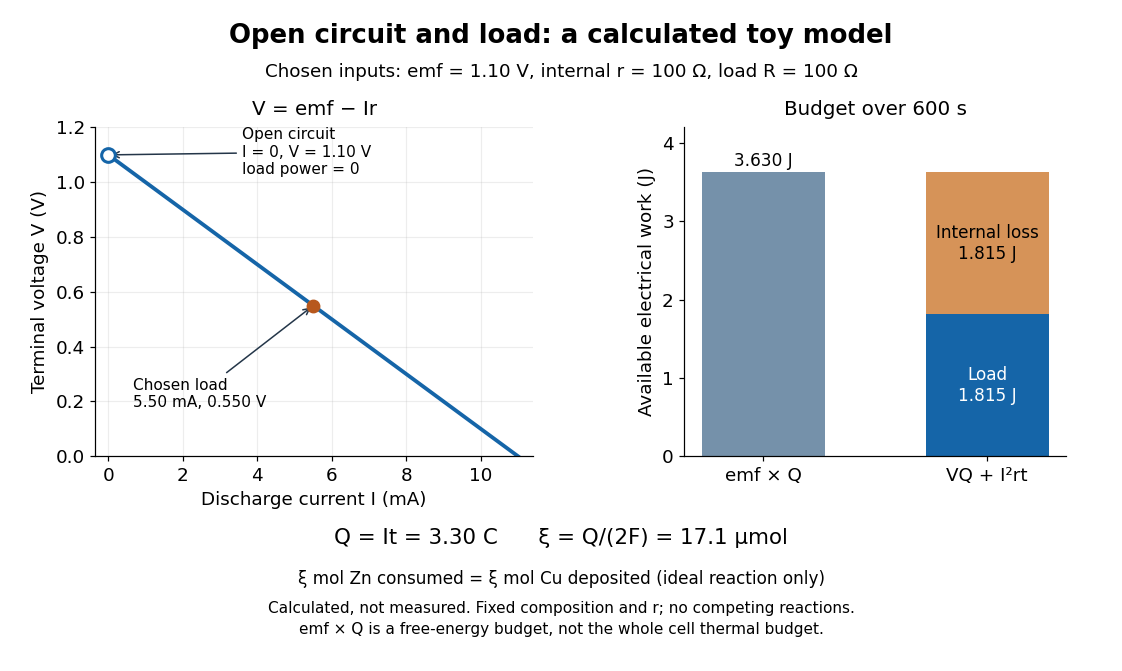
Toy Daniell cell load calculation: terminal electric potential difference, electric charge and available work
. Calculated line and energy bars, not measurements. Chosen inputs are , , and a interval. The fixed-composition approximation and unit efficiency for the two intended half-reactions are assumed. The open-circuit marker is an ideal limit; no fit to experimental data is made. Details.
For the chosen values, and . Holding these toy parameters fixed for gives transported electric charge and an extent of reaction , assuming all the electric current serves the two specified half-reactions. The same counts zinc consumed and copper deposited, rather than equal masses. The energy budget isThe load's electrical work also becomes Joule heating when the load is a resistor. Here accounts for the reaction's available reversible electrical work; a full cell thermal budget would also require its thermodynamic entropy contribution. Real measurements need uncertainty estimates, a specified meter input electrical resistance and calibration, and allowance for changing composition and unwanted chemical reactions. The toy value is not a measured property of the university's cell.
Two-time expansion of a weakly damped linear oscillator by Codex 0 Created 2026-10-14 Updated 2026-10-18
Codex 0 Created 2026-10-14 Updated 2026-10-18The fixed-time regular perturbation is . Retaining the exponential decay and the first accumulated phase correction gives on . When its phase series is unordered. For positive damping the absolute error is nevertheless exponentially small on that later scale, so phase failure and failure in absolute displacement must be distinguished.
The Dirac-Born-Infeld action describes the leading derivative dynamics of one D-brane, including nonlinear dependence on slowly varying worldvolume field strengths. Its induced tensors are D-brane worldvolume pullbacks. The combination is invariant under the combined two-form and boundary gauge transformation. The dilaton factor reflects a disk's Euler characteristic. Expanding about flat space with small field strengths and embedding gradients gives the worldvolume gauge and scalar kinetic terms. A coincident stack has a non-Abelian low-energy Yang-Mills action; this does not imply that a naive traced determinant is exact at every order.
A D0-brane is a point-like D-brane in space, with a one-dimensional worldvolume consisting only of time. It belongs to type IIA superstring theory and couples electrically to its one-form Ramond–Ramond potential. “Zero” counts spatial dimensions, rather than asserting zero mass or absence of dynamics.
Its mass scales as , so it is heavy at weak string coupling. Unlike an ordinary perturbative string excitation, its open-string endpoints are fixed in every spatial direction for a static brane, while the brane's own position is a dynamical collective coordinate. The low-energy description of several nearby D0-branes is quantum mechanics of their worldvolume fields; it is not a field theory with an additional extended spatial direction.[ref]
String Theory by David Tong. chapter 3, definition of Dp-brane dimension and dynamical transverse positions; §3.1.4, type-II even/odd distinction
A D1-brane has one spatial dimension and couples to the two-form Ramond–Ramond potential. Its tension differs from the fundamental string tension by a factor at zero axion.
A D2-brane is a membrane-like D-brane with two spatial directions and a three-dimensional worldvolume including time. It is a charged extended object of type IIA superstring theory, coupling electrically to a three-form Ramond–Ramond potential.
The three-form can be integrated over its worldvolume to give the charge coupling, just as a one-form electromagnetic potential is integrated along a charged particle's trajectory. Open strings ending on the membrane supply a worldvolume gauge field and fields describing transverse motion. The relation between this three-dimensional gauge field and a scalar is useful in connecting the D2 description with an M2-brane, while the bulk and worldvolume descriptions address different degrees of freedom.
A D3-brane has three spatial dimensions. The low-energy fields of an isolated flat D3-brane form an abelian theory with sixteen linearly realized supersymmetry generators. Its transverse scalar fields describe its geometric position, and its gauge field can carry the charges of strings ending on it.
A D4-brane is a D-brane with four spatial directions and a five-dimensional worldvolume, belonging to type IIA superstring theory. It supports the low-energy modes of open strings ending on it, while also coupling to bulk closed-string fields.
Its electric coupling uses a five-form Ramond–Ramond potential, dual to the three-form potential coupled electrically to a D2-brane. Thus brane dimension determines which differential-form field measures its charge, not merely the size of a geometric object. At long wavelengths, an isolated brane's slowly varying fields are described by a Dirac-Born-Infeld action, with transverse scalar fields encoding its position and fluctuations.
A D6-brane is a D-brane with six spatial dimensions. Its seven-dimensional worldvolume includes time, leaving three transverse directions in ten-dimensional type IIA superstring theory. Open-string endpoints can move along the brane while satisfying fixed-position Dirichlet boundary conditions in the transverse directions.
It couples electrically to the seven-form description of a Ramond–Ramond potential, equivalently carrying magnetic charge for the IIA one-form potential. This electric–magnetic distinction relates the D6-brane to the D0-brane: their relevant field strengths are dual in ten dimensions. The open-string description supplies worldvolume fields, whereas the closed-string description treats the same brane as a source for bulk fields.
A D8-brane is a D-brane with eight spatial directions and a nine-dimensional worldvolume. In ten-dimensional type IIA superstring theory, it has one transverse spatial direction, so it acts as a domain wall. Its charge is associated with a nine-form Ramond–Ramond potential.
The dual zero-form field strength is the Romans mass; its value can jump across a charged D8-brane. Consequently a D8-brane cannot simply be inserted into the elementary massless M-theory circle duality dictionary used for lower-dimensional IIA branes. Its gravitational matching and scalar-field profiles must be treated consistently on both sides of the wall.[ref]
Non-BPS D8-branes and Dynamic Domain Walls in Massive IIA Supergravities by A. Chamblin and others. abstract and domain-wall formulation: D8 sources in Romans theory and matching of the two sides
Identical, parallel, equally oriented type-II D-branes preserve the same sixteen spacetime supercharges. Their annulus oscillator sum has the displayed numerator, which vanishes by the Jacobi abstruse identity. In the closed-string channel this is cancellation of attractive NS-NS exchange and repulsive RR exchange. The force vanishes in the flat supersymmetric configuration; anti-oriented branes, relative angles or supersymmetry-breaking backgrounds need not have this cancellation.
For the asymptotically flat extremal D solution with , is harmonic away from the source and . The electric potential can be chosen as ; magnetic descriptions use the dual flux, and a D3-brane has self-dual five-form flux. An equally oriented probe has DBI density and Wess-Zumino density , whose sum is position independent. This proves the corresponding parallel D-brane no-force identity in the classical background. The supergravity approximation requires controlled curvature and coupling; it does not resolve every brane core.
There are unlisted articles, also show them or only show them.