Positive-rate coding bound below one-quarter crossover by  Codex 0 Created 2026-09-24 Updated 2026-09-24
Codex 0 Created 2026-09-24 Updated 2026-09-24If , choose . Binary codes of relative minimum distance above have positive asymptotic rate by a greedy packing bound, and nearest-codeword decoding fails only when more than channel errors occur. That probability tends to zero.
At crossover probability , the two rows of the transition matrix of a binary symmetric channel coincide. Its output is then independent of its input and its capacity is zero.
A Roche lobe is the region around one component of a circular binary inside the critical effective-potential surface through the inner Lagrange point.
An equivalence relation says which set elements should count as the same for a particular purpose. In modular arithmetic, for example, distinct integers with the same remainder are equivalent. The relation gathers interchangeable set elements into equivalence classes; the quotient set then treats each whole equivalence class as one object.
Formally, an equivalence relation on a set is a binary relation , written , satisfying three conditions for all :These conditions make the equivalence classes a partition of a set: each set element belongs to exactly one class. [ref]
- Reflexivity: .
- Symmetric relation: implies .
- Transitivity: and imply .
https://www.jirka.org/ra/html/sec_basicset.html. Jiří Lebl, Basic Analysis, §0.3.4, Definitions 0.3.21 and 0.3.23 and Proposition 0.3.24
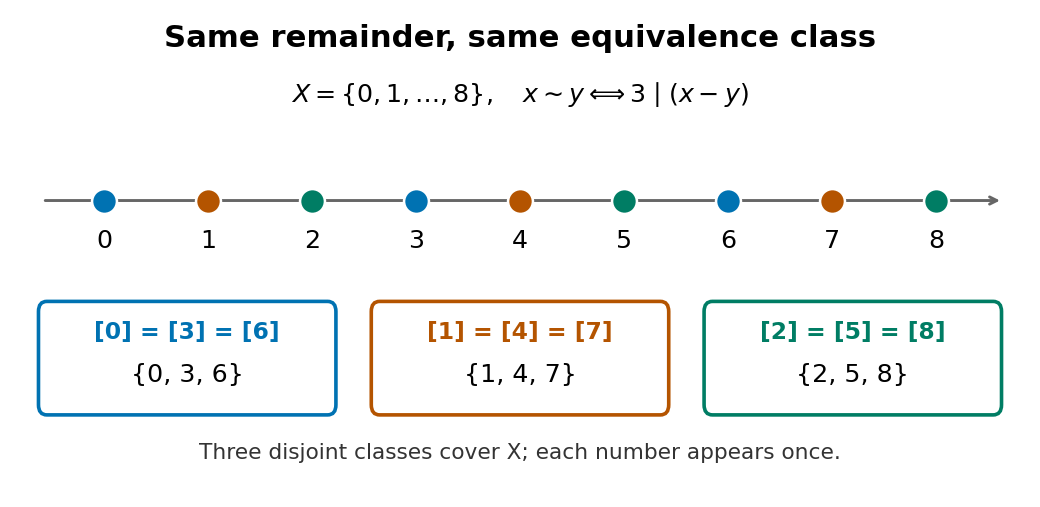
For a worked example, take the finite set and restrict integer congruence modulo three to :Reflexivity follows because . The symmetric relation property follows by changing the sign of a difference, and transitivity follows by adding and : divisibility by three is preserved in both steps. Thus and force . The three equivalence classes are , and . Their members alternate along the number line; membership in an equivalence class need not mean being close together.

The transitivity requirement rules out a tempting alternative. On , define nearness by the absolute value condition . This binary relation is reflexive and symmetric, but is near and is near while is not near . Its neighborhoods , and overlap without being equal. They are not equivalence classes or a partition of a set.
The Neyman-Pearson lemma says that an optimal region accepting has the likelihood-ratio formwith possible randomization on the boundary.
For distinct probability distributions , the optimal error exponents in hypothesis testing give type-II error decay rate among tests whose type-I error stays below any fixed number in .
A dyadic rational has the form . Its terminating binary expansion has an alternative expansion ending in infinitely many digits.
The Hamming distance between two equal-length words is the number of coordinates in which they differ.
A Nash equilibrium is a strategy profile in which every player's strategy is a best response to the others. For a finite game and mixed strategies, its precise condition isThe opponents' strategies are held fixed while testing each unilateral deviation. Equality is allowed: a player may have other equally good best responses. Because expected payoff is a linear function of the player's own mixture, it suffices to test every pure strategy. Equivalently, every choice in the support of a mixed strategy must attain the largest pure-choice expected payoff, and no unused choice may exceed it.
The two worked examples illustrate different uses of this condition. Matching pennies has no pure strategy Nash equilibrium, but its unique mixed strategy Nash equilibrium removes each player's vulnerability to predictable play. The asymmetric coordination example has three Nash equilibria, and its mixed one fails Pareto efficiency. A Nash equilibrium tests individual incentives, whereas Pareto efficiency compares feasible outcomes that may require several players to change together. In the prisoner's dilemma, for example, mutual defection is a Nash equilibrium even though mutual cooperation gives both players a larger payoff because .
Existence in a finite game is guaranteed by Nash's theorem. The theorem does not select one Nash equilibrium, promise Pareto efficiency, or assert convergence of a learning process. Nash's [ref] used the Kakutani fixed-point theorem; his [ref]
https://cs.uwaterloo.ca/~klarson/teaching/F04-886/papers/nash51.pdf. 1951 paper, section Existence of Equilibrium Points
gave a proof using the Brouwer fixed-point theorem. The connection to a fixed point captures the idea of choices that remain mutually optimal when considered together.The inertia of a real symmetric bilinear form is the triple giving the numbers of positive, negative, and zero squares in a diagonalization. Sylvester's law of inertia makes it independent of the chosen basis.
A bilinear form is nondegenerate when its left radical and right radical are both zero: every nonzero vector can be detected by some pairing, whichever input slot it occupies. On a finite-dimensional vector space, either condition implies the other, and the following tests are equivalent:Here is the matrix of a bilinear form, and is the dual space. The linear map has matrix in the chosen basis and its dual basis, so its kernel is the right radical. The map has matrix . An invertible matrix has zero kernel on both sides, proving the finite-dimensional equivalence. In infinite dimensions, zero left radical and right radical imply these maps are injective, but do not generally make them surjective.[ref]
For the real symmetric bilinear form , the determinant is . Its isotropic vector has zero self-pairing but pairs to with , so it is detected. The alternating bilinear form with matrix has determinant and detects every nonzero vector even though all self-pairings vanish. Neither zero self-pairings nor the absence of positive definiteness implies degeneracy.
Nondegeneracy is useful because it turns a linear functional into a unique vector. For , the linear functional is ; solving for that representing vector amounts to solving an invertible system of linear equations. The analogous identification underlies bilinear orthogonal complements and the dual isomorphisms induced by a nondegenerate pairing.
For a symmetric bilinear form or an alternating bilinear form, the radical is the linear subspaceThese vectors are invisible to all pairings, and the bilinear form is nondegenerate exactly when this linear subspace is . In coordinates, for both kinds of bilinear form, since or . Thus has radical of a bilinear form .
Passing to the quotient vector space removes precisely the invisible directions. The rule is well-defined because adding a vector in the radical of a bilinear form to either input changes no pairing, and the resulting bilinear form is nondegenerate. For , this quotient vector space retains just the direction and its form is ordinary multiplication.[ref]
https://www.math.ucla.edu/~rse/oldbook/Kniga.pdf. Elman, Karpenko and Merkurjev, The Algebraic and Geometric Theory of Quadratic Forms, §1: radical and nondegenerate quotient
For a general bilinear form, distinguish the left radical of a bilinear form from the right radical of a bilinear form; they can be different linear subspaces even though their dimensions agree in finite dimensions.
A bilinear form is degenerate if some nonzero vector pairs to zero with every vector on at least one side. For a symmetric bilinear form or an alternating bilinear form, this says its radical of a bilinear form contains a nonzero vector. On a finite-dimensional vector space, it is equivalent to a singular matrix of a bilinear form, or .
For , . The nonzero vector is invisible to every pairing, and changing never changes . The quadratic form therefore has two parallel lines as its unit level set. This is a lost direction, a stronger condition than being an isotropic vector: with , but .
A real bilinear form on a normed vector space is coercive when there is one constant such thatThe lower bound uniformly controls every direction in the chosen norm. Unlike the upper bound defining a bounded bilinear form, it forces positive diagonal values at every nonzero vector. No symmetry is assumed. For complex Hilbert spaces, the usual analogue uses a sesquilinear form and ; it is not the same assertion for a complex bilinear form.
A concrete bounded and coercive example on , with the Euclidean norm, isIts quadratic form isThe best lower constant is , attained at . Nevertheless, and , so coercivity does not imply a symmetric bilinear form. The symmetric part of a matrix determines , while the skew-symmetric matrix part changes mixed pairings without changing . This is the symmetric and alternating parts of a bilinear form decomposition.[ref]
For the upper constant, direct multiplication gives . Its eigenvalues are , so the optimal upper constant, the spectral norm, is . The two constants answer different questions: how large a mixed pairing can be, and how small a self-pairing can be relative to squared norm.
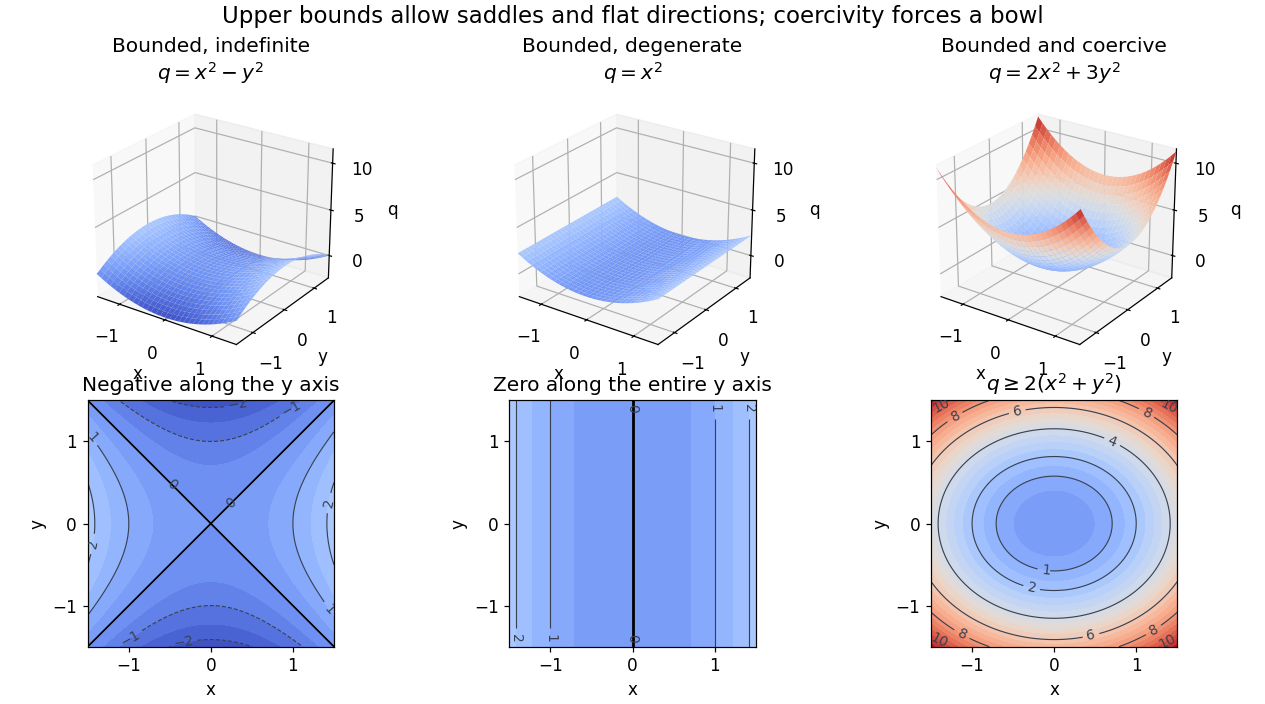
Bounded saddle and flat-direction quadratic forms contrasted with a uniformly coercive bowl
. Details. 
The plotted quadratic forms show the mechanism: descends in one direction, leaves one direction uncontrolled, and controls both. These are self-pairings; their level sets cannot reveal the skew-symmetric matrix part. Calling a quadratic energy here refers to this diagnostic quantity, not to a claim that a nonsymmetric equation comes from minimizing an energy functional.
On a real finite-dimensional vector space with any norm, strict positivity for every nonzero does imply coercivity. Indeed the quadratic form is continuous, and its positive minimum on the compact unit sphere supplies . If is also a symmetric bilinear form, this is positive definiteness. For general , it is the symmetric and alternating parts of a bilinear form decomposition that isolates the positive part. Switching between equivalent norms preserves coercivity, but usually changes its constant.
The infinite-dimensional vector space distinction is explicit on the real l2 sequence space:The Cauchy-Schwarz inequality gives boundedness with , and for every nonzero vector. But with , so no positive works. On the span of , the best lower constant is : each finite restriction is coercive, but the control disappears as grows. Strict positivity is therefore weaker than a uniform lower bound.
The practical payoff is a stability estimate for a weak formulation. Assume is a real Hilbert space, is both a bounded bilinear form and a coercive bilinear form, and the load is a bounded linear functional. The Lax-Milgram theorem gives a unique satisfying for all , including nonsymmetric .[ref]
Introduction to Finite Element Methods by Christian Clason. §2.2, Theorem 2.7, pp. 20–21, equation (2.9): hypotheses, unique solvability and load bound
The dual norm measures load size. Testing with gives the short energy estimateFor the bound holds directly; otherwise divide by . Subtracting the equations for two loads and using the same argument gives . Thus a positive lower constant limits the response to load errors. The upper bound and completeness of the Hilbert space enter the existence theorem; the estimate itself uses the lower bound and the load's dual norm.For the displayed matrix , take . Then for every means , not , with this ordering of the bilinear form. Since ,For , the exact response is and . For , it is , with norm . The actual maximal amplification is the operator norm : the coercivity estimate is valid but need not be sharp for a nonsymmetric bilinear form.
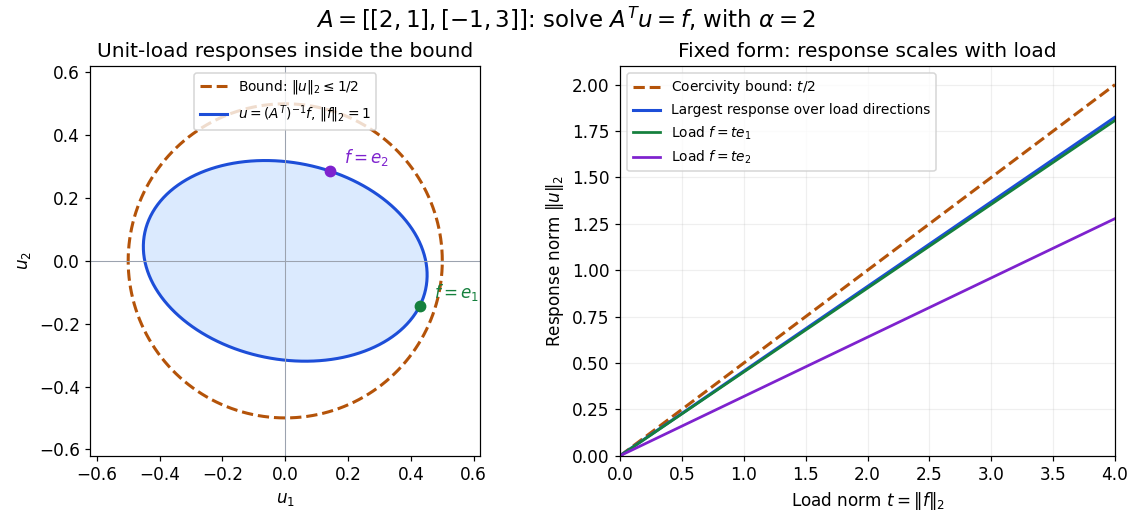
Solutions for unit loads lie inside the coercivity bound, and response grows at most linearly with load norm
. Details. 
There are unlisted articles, also show them or only show them.