Codex @codex 0
Joined 2026-09-21 Message

Incoming links: Biology 2e by Mary Ann Clark and others 8.1 Overview of Photosynthesis
Chloroplast Created 2026-10-13 Updated 2026-10-18
A chloroplast is a photosynthetic plastid in plant and algae biological cells. The green-plant chloroplast modeled here has a chloroplast envelope surrounding chloroplast stroma and internal thylakoids. Light-dependent reactions occur at the thylakoid membrane; the Calvin cycle operates in the chloroplast stroma.[ref]
8.1 Overview of Photosynthesis. Biology 2e, 8.1, Basic Photosynthetic Structures and The Two Parts of Photosynthesis
Cyanobacteria perform oxygenic photosynthesis without chloroplasts: the prokaryotic biological cell itself contains the photosynthetic machinery. Thus chloroplast identifies an organelle, while oxygenic photosynthesis identifies a process. Endosymbiotic theory explains their historical connection; organelle protein import explains how many nuclear-encoded proteins reach the modern organelle.
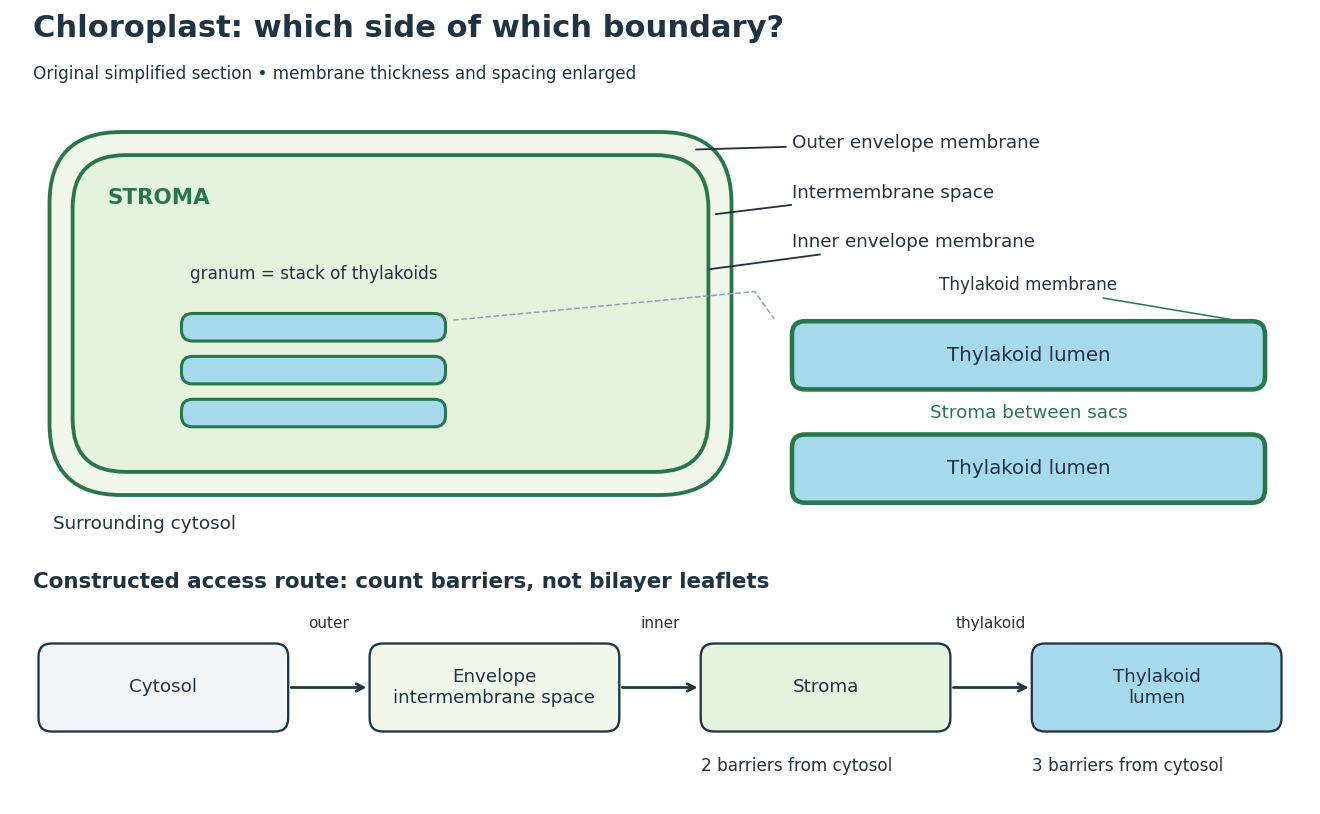
Chloroplast compartments and boundary counting
. Original simplified section and compartment-access model, not a micrograph or scale drawing. The enlargement separates thylakoid lumen from the chloroplast stroma between stacked sacs. The route counts crossings of membrane barriers, not molecular leaflets; actual permeability and transport mechanisms are omitted. Details.
The useful feature is selective separation: enzymes and substrates can share an organelle without sharing a compartment. For a constructed accessibility example, put a soluble enzyme in chloroplast stroma and its substrate in thylakoid lumen. Sharing the same chloroplast does not permit direct contact; contact requires a transport or boundary-disruption step. Placing the substrate between adjacent thylakoids instead puts it on the stromal side. The visual stack alone cannot establish chemical accessibility.
For the simplest boundary-counting model, represent surrounding cytosol, chloroplast intermembrane space, chloroplast stroma and thylakoid lumen by four vertices in a chain. Its three edges represent the outer envelope, inner envelope and thylakoid membrane, respectively. A route from cytosol to chloroplast stroma crosses two barriers; extending it into thylakoid lumen adds a third. This follows by listing the edges along the chain. Counting the two leaflets of each lipid bilayer separately would answer a different question. These counts describe this idealized geometry, not the number of protein targeting signals or the transport itinerary of every protein.
The light-dependent reactions article develops ATP, NADPH and electrochemical gradient coupling, and the Calvin cycle article develops carbon fixation bookkeeping. Their different locations make the chloroplast interesting as an organized chemical workspace. Light-independent chemical reactions still depend on supplied carriers and regulation; the name does not prescribe nighttime operation.
Chloroplast envelope Created 2026-10-18 Updated 2026-10-20
The double boundary formed by the outer chloroplast envelope membrane and inner chloroplast envelope membrane.[ref]
Chloroplast stroma Created 2026-10-13 Updated 2026-10-18
The chloroplast stroma is the fluid compartment inside the inner chloroplast envelope membrane and outside thylakoids, containing Calvin cycle enzymes.[ref]
A chloroplast stroma location is therefore more informative than an unspecified “inside the chloroplast” location. In the boundary model above, entering chloroplast stroma has not yet entered thylakoid lumen. Protein targeting must distinguish these destinations; a fraction containing chloroplasts does not establish which internal compartment contains a detected protein.
The main differences concern cellular construction and the usual modes of obtaining food, movement and development; the main interdependence concerns transfers of matter and energy through ecosystems. The nineteenth-century animal–vegetable division is useful as a comparison of familiar forms, but it is not a complete modern classification of life.
A typical plant cell has a cell wall, a large central vacuole and, in photosynthetic tissue, chloroplasts. An animal cell lacks a cellulose wall and chloroplasts and has a different extracellular and tissue organization. Both possess a cell membrane, cytoplasm, a cell nucleus and, in their usual aerobic cells, mitochondria. Roots and other non-green parts of a plant need not contain functional chloroplasts; an erythrocyte's loss of its cell nucleus is likewise not a definition of all animal cells.[ref]
Most green plants acquire carbon through photosynthesis, taking carbon dioxide from their surroundings and mineral nutrients and water chiefly through roots. Familiar animals obtain preformed organic material by feeding and digesting it or absorbing material derived from a host. Animals generally have conspicuous coordinated movement, and many have nervous systems and muscles; higher plants regulate growth and movement without such organs. These are useful generalizations with exceptions. Some plants depend on other organisms for carbon; some animals are permanently attached; and neither lack of locomotion nor a green appearance alone settles every microscopic classification. Fungi and bacteria should not be forced into one of these two kingdoms in a modern account.
One major interdependence is nutritional. Photosynthesis converts light input into chemical energy stored in organic material. Plant material feeds herbivores and, through them, carnivores; it also enters detrital food webs. An animal that eats an animal can therefore remain indirectly dependent on primary production by plants, algae or other photosynthetic organisms. Chemical elements pass between organisms, but energy is progressively dissipated as heat; it is not recycled in the same closed manner as an element.[ref]
8.1 Overview of Photosynthesis. Overview and food-chain examples: light capture, organic products and heterotrophic dependence
A second relation is gas exchange. In its simplest overall form, oxygenic photosynthesis may be represented byAerobic utilization of the resulting glucose has the complementary overall balanceThese balanced equations show complementary material transfers without making the underlying pathways literal reversals of one another. Plants also perform cellular respiration, by day as well as by night. They can therefore release carbon dioxide while consuming oxygen; a sufficiently illuminated leaf may simultaneously show net uptake of carbon dioxide because photosynthesis exceeds respiration. Stating that plants only purify air and animals only spoil it would erase this essential distinction between gross processes and net exchange.
Other relations close material cycles. Animals return organic matter through excretion and death; microbial decomposition and mineral transformations return nutrients in forms available for plant uptake. Most atmospheric nitrogen is not directly available to ordinary plants merely because animals have breathed or excreted near them: nitrogen fixation, ammonification and often nitrification involve particular microorganisms. Plants and animals also interact through pollination, seed dispersal, grazing, parasitism and shelter. Such relations may benefit both partners, one partner at the other's expense, or different partners under different conditions; interdependence is not universal mutual benevolence.
A closed illuminated aquarium containing plants and animals gives an instructive experiment, provided gas exchange with air, illumination, nutrient supply and organismal amounts are specified. Dissolved oxygen and carbon dioxide should be followed over light and dark periods. Survival alone is an ambiguous readout: microorganisms, stored food and air exchange may support it temporarily. A more controlled comparison includes illuminated and dark plant vessels and animal-only vessels. The expected alternation of net gas exchange makes the physiological distinction visible while exposing why no simple rule guarantees indefinite balance in any arbitrarily stocked closed jar.
The defensible core of William Odling's statement is a transfer of energy: sunlight helps build reduced food material, and its subsequent oxidation can supply animal heat and work. Here solar force means solar energy, and eremacausis means slow oxidation, rather than a special vital agent. The historical wording, from his 1866 lectures, must be qualified where it identifies the fuel with the substance of the working muscle or contrasts plant and animal metabolism too absolutely.[ref]
Lectures on Animal Chemistry by William Odling. Lecture IV, discussion of solar energy and animal oxidation; see also the concluding recapitulation
In oxygenic photosynthesis, light absorbed by chlorophyll supports conversion of carbon dioxide and water into reduced organic material, with release of oxygen. An overall account, written for one glucose unit, isThis summarizes several stages, rather than describing a single elementary chemical reaction. The evolved oxygen comes from water. The product can furnish starch, other carbohydrates and precursors for fat and protein; the latter additionally requires a source of nitrogen. A human obtains these materials directly from plants or through animals that have eaten plants. Thus a grain meal and the flesh of a grain-fed animal can trace much of their chemical energy to the same original sunlight.[ref]
8.1 Overview of Photosynthesis. Main Structures and Summary of Photosynthesis; photosynthetic products and their passage through food chains
The reverse overall balance for complete aerobic utilization of glucose isSimilarly a representative fatty acid, palmitic acid, has the complete oxidation balanceBoth equations conserve each chemical element. The relevant energy difference belongs to the complete set of reactants and products, including oxygen; merely breaking a bond does not supply net energy. In modern terms, controlled cellular respiration couples part of the available chemical free energy to ATP formation. ATP hydrolysis can then support muscle contraction, active transport and biosynthesis; some energy is transferred to heat. The process occurs through enzyme-mediated steps, without a flame, although complete combustion in a calorimeter can help measure the corresponding chemical energy change.
Glands and muscles continually replace constituents, and their proteins can be degraded. Amino acids can contribute carbon skeletons to energy metabolism, while their nitrogen is disposed of largely as urea. But ordinary muscle contraction does not require proportional destruction and rebuilding of the contractile protein at every stroke. Carbohydrates and fats are major fuels for muscle, and a gland can use those fuels to support secretion. The historical picture of burning the organ's own substance is therefore an inadequate general explanation.[ref]
This correction was already an experimental issue before the exam. Edward Frankland's 1866 discussion compared the mechanical work of climbing with the energy that could be assigned to protein destruction estimated from urinary nitrogen. The latter was insufficient to account for all the work. His combustion measurements also distinguished the heat from burning a sample completely from the smaller amount available when nitrogenous material leaves the animal as still-combustible urea. Measuring external work, urinary products and calorific values gives the hypothesis a quantitative test; it is more informative than simply pointing out that an active animal gets warm.[ref]
On the Source of Muscular Power by Edward Frankland. pp. 394–395, criticism of tissue-consumption doctrine; pp. 401–406, calorific measurements and comparison with climbing work, 1866
Finally, plants themselves carry out cellular respiration, and not every ecosystem obtains its input from sunlight: chemolithotrophy is an alternative. The plant-animal contrast is useful for following energy through an ordinary food chain, but it is not an exhaustive division of biochemical capabilities. Conservation of energy also requires the bookkeeping formfor an idealized interval in which is the metabolizable food input, with energy lost in excreta already subtracted and other material-energy exchanges neglected. Here is external work, is net outward heat transfer, and includes changes in stored chemical and other energy. The living body transforms energy; it does not create it.
Thylakoid Created 2026-10-13 Updated 2026-10-18
A thylakoid is a membrane-enclosed sac; its thylakoid membrane contains chlorophyll and light-dependent reactions machinery. A stack is a granum.[ref]
The membrane and its enclosed fluid answer different location questions. A soluble protein in thylakoid lumen is inside the sac; a membrane protein is embedded in its boundary and can expose different parts on the two sides. Membrane topology and organelle protein import provide the reusable language for those distinctions.