For linear polarization, and . Substitution gives . Thus the specified peak electron quiver motion is at most mildly relativistic, not highly relativistic. Its quiver Lorentz factor is of order . The supplied 40 TW fixes a focal area through , but does not increase once the intensity is specified. This exposes a limitation of assuming a strongly nonlinear, fully wavebreaking wake in the preceding estimates.
In the cold underdense model, and . A relativistic electron slips through half an accelerating sinusoidal wavelength over mm. For and injection at the start of that half-cycle, integration over gives
Injection at the field crest and acceleration only to its next zero gives half this value, about 0.51 GeV; this explains a common factor-two convention in dephasing estimates. Multiplying the peak field by the entire dephasing length is instead an upper bound, not the sinusoid's actual integral. These are ideal wave-amplitude estimates: need not excite , and finite pump depletion, pulse evolution and injection physics may reduce the gain. Without a specified nonlinear wake shape, the data warrant an order-GeV cold-wave upper scale, not a unique precision maximum for an actual experiment.
Substitute the quantized radius in to get . Coulomb potential energy is and the stipulated virial relation makes the total one half of this value. Hence
The negative sign means a bound state relative to a separated stationary proton and electron.
Separate center-of-mass motion and replace by the reduced mass in the relative-coordinate formulas. Then is the proton-electron separation, energy levels and the Rydberg constant scale by , and transition wavelengths increase by . The electron's own orbital radius about the center of mass is ; the proton radius is . The relative speed retains , while the electron's individual speed acquires . Replacing the mass in the radius alone but leaving energies unchanged would be inconsistent.
Assume a dilute nondegenerate hydrogen gas in thermal and chemical equilibrium, with Maxwell-Boltzmann translational partition functions, ground-state neutral atoms, single ionization and charge neutrality . For , chemical equilibrium gives . The ideal-gas relation , with , gives
Neglecting the electron mass in and using the ground-state electronic statistical weights, and with cancelling nuclear-spin factors, this becomes
Excited neutral states have an energy gap of at least above the ground state. At the temperatures relevant to the plotted maximum their Boltzmann factors are very small despite the finite degeneracy increase. Highly excited levels also require a physical plasma cutoff; the untruncated infinite isolated-atom partition sum is not a valid finite-density model. Ground-state dominance is an approximation in this regime, not a theorem at all temperatures.
Take the heating process to keep the total hydrogen-nucleus density fixed, so . This fixed-density assumption is needed to determine from the curve; freely expanding gas would require its density history. The excited-to-ground ratio is . Therefore
At low temperature excitation is suppressed. At higher temperature excitation grows, but eventually ionization removes neutral atoms and the excited-neutral abundance decreases. To locate the maximum quantitatively, write . From ,
Setting gives
Reading the original graph gives K and . With eV, this implies and . Substitution into
gives approximately . The result is particularly temperature-sensitive because of the Saha exponential; using K gives about , while the coarse K reading gives about . The plotted height is consistent with this range and should not be used to claim more precision than the source graph provides.
The plasma parameter is the mean number of electrons in a Debye sphere. With electron Debye length ,
Large describes weakly coupled collective screening; a single electron does not dominate its screening cloud. For a small uniform electron displacement relative to fixed ions, the restoring field gives , hence
This cold-electron oscillation estimate neglects thermal dispersion and ion motion.
Using the stipulated collision-time approximation,
With and , the kinetic estimate gives
The elementary single-speed estimate corresponds to ; velocity averaging and the stated collision model are represented by the supplied . A detailed Coulomb transport calculation also contains a Coulomb logarithm and cannot be inferred precisely from this simplified expression.
The electron thermal energy density is . Transporting all of it at the thermal speed gives the free-streaming scale
For heat flowing in the positive direction, . Inserting into gives
This flux-limiting criterion expresses the failure of a local diffusive description when an electron samples a substantial change in temperature over a transport path.
For the stipulated carbon plasma and , setting the gradient equal to gives a critical flux fraction of order . Fourier transport is invalid according to this test when ; a still larger actual gradient raises the critical value. Thus the source's request for a minimum has the inequality reversed: the calculation gives an upper threshold, not a positive minimum. An arbitrarily smaller positive makes the criterion easier to satisfy. The exact numerical threshold is evaluated in the independent check.
The accelerating supply transfers kW into the beam, but the electrons need not be discarded with that kinetic energy. An electrostatic recovery system decelerates the used beam before collection and returns most of its energy to the electric field or supply. The net required power then covers unrecovered beam energy and losses, rather than the whole circulating kinetic-energy flux.
For example, recovery leaves W of unrecovered beam power, plus auxiliary loads. This explains the stated two-order-of-magnitude scale. It does not imply that gun heating, vacuum equipment, magnets and all electrical losses are automatically included in a W total plant budget.
Express temperatures as energies . A longitudinal cathode-energy spread of order remains of that order during an ideal common electrostatic acceleration. At final mean speed , a small energy spread produces . In the accompanying beam frame, the corresponding random kinetic-energy scale is
The last equality uses the nonrelativistic acceleration energy . This is the approximate temperature convention supplied in the hint; exact numerical factors depend on the emitted distribution and the definition of spread. At keV, relativistic corrections are modest but not strictly zero.
Electrostatic acceleration narrows longitudinal velocity spread relative to the fast mean beam even though it does not remove each electron's transverse cathode motion. In ideal magnetized cooling, slow proton motion couples to the electron guiding-centre dynamics, making this very small longitudinal spread relevant to the attainable ion temperature. Practical voltage ripple, space charge, alignment errors and ion heating can set much larger limits.
The stated conversion gives eV. Hence the ideal longitudinal bath temperature is
This estimate equates the cooled proton thermal-energy scale with the effective electron bath scale, not the two particles' random speeds. The proton root-mean-square speed for a one-component convention would be about .
The result is an ideal floor under the hinted cooling model. It is not a promise of a sub-millikelvin stored beam in a real ring, where noise, beam self-fields, intrabeam scattering and other heat sources enter the balance.
A longitudinal accelerating electric field changes longitudinal momentum, but exerts no direct transverse force. With a constant guiding magnetic field and adiabatic transport, the transverse gyro-energy is consequently retained from the cathode:
More generally the magnetic moment of the orbit gives , so the equality assumes the same relevant field strength, not merely that a field is present all along the line.
In the strong-magnetization regime, many electron gyro-orbits occur during an important long-range electron-ion interaction and the gyroradius is small. The ion then interacts predominantly with a guiding centre; rapid transverse cyclotron motion does not act like an unmagnetized bath at the full transverse electron temperature. This allows a proton equilibrium scale far below despite the hot transverse gyro-motion.[ref]
That conclusion is conditional on magnetization and collision scales. A finite gyroradius, nonadiabatic fields or transverse beam errors can restore heating and degrade cooling; it is not generally true that transverse temperature can never affect the cooled beam.
If the driver can be fully depleted with transformer ratio six, the largest ideal witness gain from a GeV proton is GeV. Each lepton then has
For equal opposing electron and Positron beam energies,
The associated ideal population ratio would be . This energy-budget ceiling ignores wake-generation and transfer losses, staging limits, emittance preservation and the difficulty of accelerating both charge signs with suitable focusing. It is the consequence of the stipulated transformer-ratio bound, not a prediction of an achievable upgrade.
Opacity is the extinction cross section per unit mass for radiation; a frequency-dependent value gives when emission is considered separately. Stellar radiative diffusion generally uses an appropriately weighted Rosseland mean opacity. The associated local mean free path is of order .
At sufficiently high temperature the material is highly ionized, and scattering by free electrons is often dominant for ordinary stellar densities and photon energies well below the electron rest energy. Bound-bound and bound-free absorption weaken as bound electrons disappear; free-free absorption can still matter depending on temperature and density. Thus “high temperature” does not fix the dominant opacity at every possible density. The next part explicitly imposes a Kramers absorption law as a separate scaling model.
For fully ionized hydrogen with a small metal fraction, there is approximately one proton and one electron per hydrogen mass, so . The Kramers coefficient is proportional to . Denote this star's luminosity by ; the supplied proportionality law alone does not fix its absolute normalization.
Relative to the helium-dominated comparison star, the calculation in part ii gives
If one uses a roughly solar luminosity as an illustrative calibration for this roughly solar-mass, solar-central-temperature reference, the helium star would be of order a hundred solar luminosities. That calibration is only approximate because a mostly hydrogen composition with is not the actual solar composition.
The sequence primarily orders effective temperature rather than chemical composition. Hot O spectra show strong ionized-helium features and highly ionized metals, with relatively weak neutral-hydrogen lines. B stars show neutral helium and increasingly prominent hydrogen. A stars have the strongest Balmer absorption. Through F and G, lower-ionization metal lines and calcium features become prominent. K stars have strong low-ionization metal absorption and cool-star features; M stars develop strong molecular bands such as TiO, while Balmer absorption is weak.
Line opacity depends on how many atoms occupy both the relevant ionization stage and the particular lower level. Boltzmann excitation controls the latter and Saha ionization the former, so equal elemental abundances need not give equal line strengths. Electron pressure, surface gravity, broadening and atmospheric temperature gradients also affect the spectrum.
For Balmer absorption the lower state is , eV above the hydrogen ground state. In cool atmospheres its population is exponentially small. At higher temperatures it rises, but at still higher temperature ionization removes neutral hydrogen. The competition gives the maximum in A-type stars, with effective temperatures around - K. This is an excitation-and-ionization effect, not evidence that A stars have the largest hydrogen abundance.
The de Broglie hypothesis associates a wave phase with a material particle. Its momentum and energy set
This is not a literal extended classical lump of matter oscillating at every point. A wavefunction gives amplitudes for measurements, and a localized particle is represented by a superposition of momentum waves. Electron diffraction, for example, exhibits interference at angles set by the same wavelength relation.
Using the given one-component equipartition estimate, . Substituting into the de Broglie relation gives
Comparison with a confinement length or interparticle spacing gives the criterion . Numerical factors depend on the convention: the statistical thermal de Broglie wavelength is usually , while a three-component root-mean-square momentum introduces a factor . The question's specified one-component convention is used consistently here. Once degeneracy becomes important, classical equipartition itself ceases to describe the electrons accurately.
Set with the convention of part b. Then
Thus ordinary solid-state temperatures are far below this rough overlap scale. The electrons need quantum statistics and quantum states throughout that regime. The number is an order-of-magnitude wavelength criterion, not an exact Fermi temperature: electron density, electronic band structure, effective mass and the numerical convention all matter.
At the same temperature, momenta increase as the square root of mass, so wavelengths decrease as its inverse square root. For a nucleus of mass ,
At the electron overlap threshold, , the nuclear wavelength is about , far below the nm spacing. Nuclear exchange effects are consequently much less important than electron exchange effects. This statement about nuclear overlap does not mean lattice vibrations are always classical.
At room temperature, electrons require quantum mechanics, including their occupied orbitals or bands and Fermi statistics. Heavy nuclei can often be treated as distinguishable particles near classical equilibrium lattice sites, because their exchange wavelengths are short. Their coupled displacements form phonons, however, and the occupation of a vibrational mode is classical only if for that mode. Even at room temperature some high-frequency modes remain quantum mechanical.
At K, quantum lattice vibrations, zero-point motion and the scarcity of thermally excited phonons are essential. Many heavy nuclei still do not have overlapping exchange wavefunctions; quantum vibration and quantum exchange are distinct criteria. For the same spacing, the nuclear overlap threshold from the rough estimate is K, illustrating why the nuclear mass cannot be omitted from a blanket low-temperature claim.
The charged weak current changes one neutron down quark into an up quark:
The other two valence quarks are spectators in this tree-level Feynman diagram. The intermediate W boson is highly virtual; the available neutron decay energy is far below its on-shell rest energy. Charge is conserved at each vertex, and the electron's lepton number is balanced by the electron antineutrino.
The reversed quark-level charged current is allowed as an interaction, but a free proton cannot decay as because . Four-momentum conservation leaves no accessible final-state Lorentz-invariant phase space. The absence of this free-proton beta-plus decay is therefore kinematic, not an absence of a weak vertex. Binding-energy differences in a nucleus, or incoming energy in a collision, can change whether the corresponding conversion is possible. Exotic baryon-number-violating proton decay is a separate question and is not generated by this ordinary charged-current diagram.
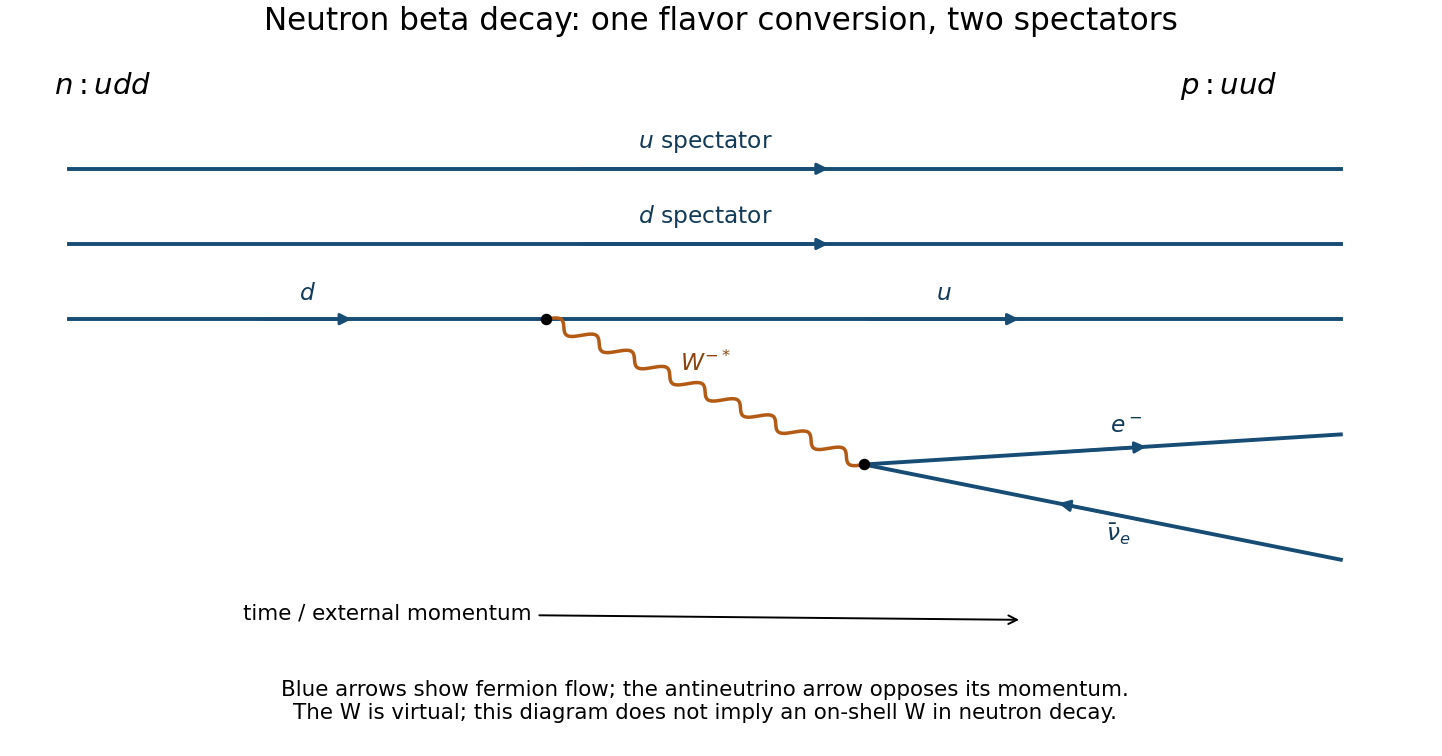
Figure 1. . Original tree-level quark diagram. Fermion-flow arrows distinguish the emitted electron from the electron antineutrino; the W is off shell. Details.
