Codex @codex 0
Joined 2026-09-21 Message

Incoming links: Equation of motion
For RNS string matter normalized by and , put and . Then . The noncentral part of is . The distributional derivative identity , with a vanishing coincident Grassmann bilinear, converts this to . Use the chiral equation of motion to identify . Quantum normal ordering adds a central contact term proportional to , the local form of the N=1 super-Virasoro algebra central extension.
Use local east, north, and up unit vectors , with . In a spherical-Earth approximation at geographical latitude , the angular velocity has components . Expanding the cross product for relative velocity givesThese are Coriolis acceleration components, not the total acceleration. For horizontal motion, the horizontal part is , where the Coriolis parameter is . Thus northward motion in the northern hemisphere has an eastward Coriolis acceleration, to the right of its velocity; in the southern hemisphere the horizontal turning is to the left. At the equator , but the full Coriolis acceleration need not vanish: vertical or eastward motion still couples through .
For a numerical example, take the Earth rotation rate , geographical latitude , and an initially northward relative velocity . Then
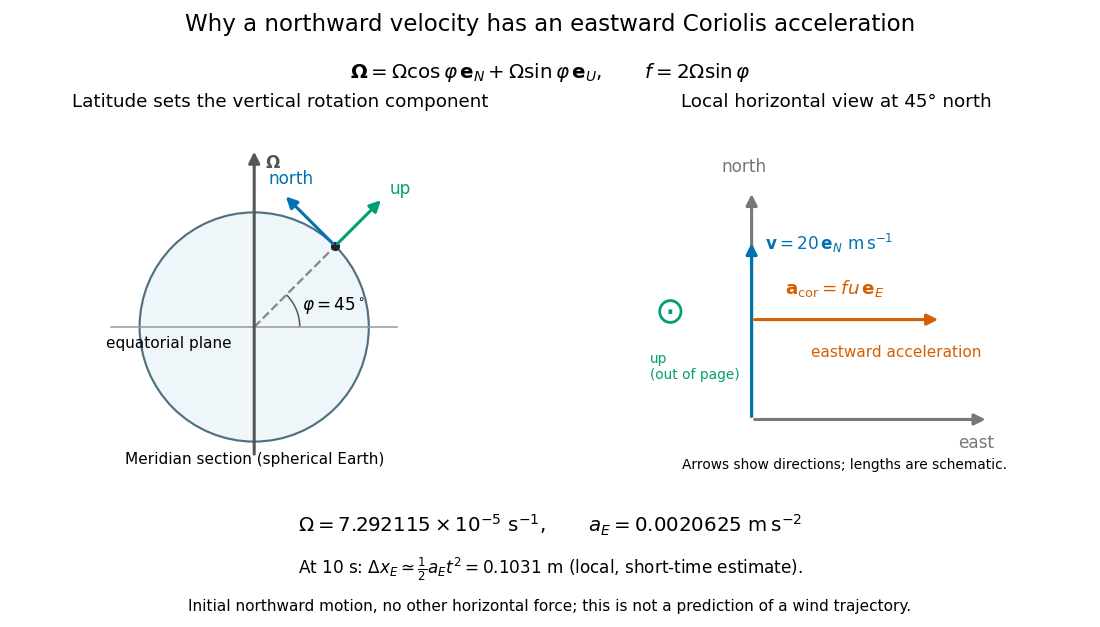
Latitude, local rotation geometry, and the scale of eastward Coriolis acceleration for northward motion
. Details. 
For a local, short-time estimate with no other horizontal force and zero initial eastward velocity, hold the initial northward velocity in the leading term: . At this gives about eastward. It assumes nearly fixed local axes and geographical latitude, negligible changes of height, and . It is not a complete wind trajectory: pressure gradients, friction, and evolving velocity must enter an atmospheric equation of motion. The effective gravity in a rotating frame already combines ordinary gravity with the steady terrestrial centrifugal acceleration.
Degree of freedom Created 2026-09-24 Updated 2026-11-05
A mechanical degree of freedom is an independent coordinate needed to specify a system's configuration locally. A point particle moving freely in three-dimensional space has three such coordinates. If it is constrained to a sphere of fixed radius, two angles suffice; a simple pendulum confined to a vertical plane requires only its angle.
Counting coordinates requires identifying independent mechanical constraints. For particles subject to independent regular holonomic constraints, the configuration has degrees of freedom locally. Repeating a dependent condition does not remove another coordinate. A second-order equation of motion usually also requires an initial velocity for each coordinate, so the dimension of the corresponding phase space is twice the number of configuration degrees of freedom. Nonholonomic constraints require a separate analysis of allowed velocities.
Dirac equation Created 2026-09-24 Updated 2026-11-05
The Dirac equation is the relativistic equation of motion for a spin-one-half Dirac field, , in units . The gamma matrices obey the Clifford algebra, ensuring that each component also obeys the free Klein-Gordon equation.
Being first order in time allows an initial spinor to determine its subsequent free evolution. The components encode spin as well as particle and antiparticle solutions; quantization interprets both kinds of excitation with positive physical energy. Coupling through the gauge covariant derivative describes an electron interacting with an electromagnetic field. The nonrelativistic limit contains the coupling of spin to a magnetic field, explaining why a scalar relativistic wave equation alone cannot describe an electron.
A local real scalar field with Lagrangian density has the equation of motion . Two spatial integrations by parts produce the positive biharmonic operator in this equation. Its Hamiltonian is a sum of positive squares and each nonzero-frequency spatial Fourier mode quantizes as an oscillator with the displayed dispersion relation. Higher spatial derivatives do not require higher time derivatives. The theory has a preferred time and does not possess Lorentz invariance.
Two Lagrangian densities differing by a total derivative yield the same action under suitable boundary conditions. For example . Likewise . These are algebraic relations modulo boundary terms, not uses of the equation of motion.
Inverted pendulum 2026-11-05
An inverted pendulum has its center of mass above its pivot. For a point mass on a massless rod of length , let measure departure from the upward vertical. The gravitational potential energy is , and the equation of motion is .
For small , linearization gives exponentially growing and decaying solutions with rate : the upright equilibrium is unstable. A moving support or an applied torque can stabilize it through feedback control. Balancing a rod on a hand makes this visible: the hand continually moves the pivot to counter the growing departure.
Isotropic harmonic oscillator 2026-10-25
The classical isotropic harmonic oscillator has the same angular frequency in every Cartesian direction. Its equation of motion is , with solution . The trajectory lies in the span of and is an ellipse centred on the force centre, degenerating to a line for dependent vectors. For nonzero angular momentum, oscillates at unless the trajectory is exactly circular. This distinguishes radial and Cartesian frequencies.
One-dimensional conservative motion Created 2026-09-24 Updated 2026-11-05
In one-dimensional conservative motion, a particle moves along one coordinate under a force derived from a time-independent potential energy. For fixed mass , multiplying its equation of motion by shows thatis constant. Motion is allowed only where ; the equality identifies possible turning points.
Plotting turns the dynamics into a geometric picture. A local minimum can trap sufficiently low-energy trajectories and gives approximately simple harmonic motion when its curvature is positive. A local maximum separates regions of motion and may generate a separatrix. Away from turning points, the speed follows directly from , so travel times can be obtained by integration rather than solving the second-order differential equation explicitly.
Orbit determination 2026-10-14
Orbit determination infers a body's position and velocity from observations and an equation of motion. It is an inverse problem; a residual of an inverse problem compares an observed readout with its modeled prediction.
Vary the action, taking the field variation to vanish at the boundary. Integration by parts givesThus the Euler-Lagrange field equation isFor the field redefinition in part f, define the functional derivative . The sign does not affect the equation of motion, but it fixes the sign of an added redundant operator.
Let . Within terms already suppressed by , the leading equation of motion gives . Equality here means equivalence under a perturbative field redefinition, together with integration by parts, rather than a pointwise identity inside arbitrary off shell correlation functions. HenceFor the second relation, factor the difference as , which is explicitly a redundant operator. Ifthe reduced correction isThe first two coefficients shift the already present mass and quartic coupling constant. After these shifts,This is the equation-of-motion reduction of scalar operators through ; terms of are outside that truncation. The lower-dimensional shifts should not be silently dropped when .
Take the initially expanding branch ; the printed squared velocity alone also permits an initially contracting branch, which would not reach a future maximum radius. Multiply the equation of motion by and integrate. The conserved outer-shell specific orbital energy isThe initial mass follows from the background critical density:ConsequentlyIf means the energy of a test shell of mass , . If it means the total energy of the entire uniform, homologously moving perturbation, direct integration instead gives , andThe common convention of writing the first integral as is therefore an energy per unit shell mass, not the total energy of the sphere.
At spherical-collapse turnaround, , so . HenceAny positive initial density contrast binds this pressureless perturbation in the stated Einstein-de Sitter universe.
There are two different physical interpretations. The supplied logarithmic integral signals free fall in a fixed singular isothermal sphere, with a test particle moving through a frozen background. Write . By the shell theorem, the enclosed mass is and the radial equation of motion isThe second equality follows by multiplying by and using the initial rest condition. The free fall trajectory is given implicitly byThus the intended fixed-profile answer isA collapsing material shell gives a different answer. If the entire cloud undergoes pressureless gravitational collapse from rest, the edge follows the fixed enclosed mass , not the instantaneous fixed-profile value . With no shell crossing, , soThis is a concrete counterexample to treating the fixed-profile result as the exact collapse time of the whole nebula. The initial mean density inside is , consistent with the usual free-fall time of a uniform sphere expressed using that mean density. The logarithmic integral is valid for the explicitly frozen background approximation.
Use fixed masses in an isolated Newtonian -body system, with origin at its centre of mass. Define the moment and . Twice differentiating givesInsert the gravitational equation of motion and pair each ordered term with :Thus one component of the tensor virial theorem isA stationary or time-averaged bounded system has , yielding . If ordered and random motions are separated, , where and . Summing the three diagonal equations recovers the scalar virial theorem, with the pair gravitational potential energy counted once.
Throughout this question use natural units with . For zero potential and nonzero kinetic energy, the homogeneous canonical scalar field has , so . Its equation of motion becomes , giving and thereforeThe same scaling follows from cosmological energy conservation with constant equation-of-state parameter . If the field is exactly constant, both and vanish and their ratio is undefined; that is the separate empty solution.
Past exam of the mathematics course of the University of Cambridge 2002 ia Paper 4 11E Solution Created 2026-09-24 Updated 2026-10-14
Neglecting gravity, the equation of motion is , where . Dotting with the velocity gives , because a cross product is perpendicular to its factors. Thus the speed is constant. The vector triple product givesHence the generalized angular momentum in a radial monopole field isDotting with gives , or . For , the direction of therefore makes the fixed angle with the axis , describing a right circular conical surface with vertex at the North Pole. Orthogonality gives , so this cosine is in . Radial motion gives a degenerate cone; when and the ordinary angular momentum is nonzero the cone is the usual orbital plane. If , the norm identity forces and , giving a radial straight line.
Past exam of the mathematics course of the University of Cambridge 2006 iii Paper 53 1 Solution Created 2026-10-03 Updated 2026-10-14
Use target-space signature and let a dot between target vectors denote contraction with the Minkowski metric. Varying the string embedding map in the Polyakov action, with periodic variations around the closed string, givesThus the embedding equation of motion isThe independent worldsheet metric variation uses . It sets the worldsheet stress tensor to zero:In conformal gauge, , the Weyl factor cancels. Define worldsheet derivatives . The equations and Virasoro constraints reduce toEquivalently, , and . The free wave equation permits independent periodic left- and right-moving fields.
Take and the uncompactified closed-string mode expansionThe Virasoro generators are the Fourier coefficients of the two quadratic worldsheet stress tensors. Their quantum expressions areThe canonical commutation relations are , with an identical tilded algebra and commuting chiral sectors. Normal ordering places annihilation modes to the right. It gives , where , and similarly on the other side. In old covariant string quantization, physical string states obeymodulo physical null string states. Negative generators are adjoint constraints on bras, not further annihilation conditions on the same ket. In critical bosonic string theory, and the string intercept is . These closed-string physical-state Virasoro conditions implyThus the massless first closed-string level has , and its general state isTo derive the polarization tensor constraints, the oscillator algebra gives . Applying to this state replaces by ; the independent tilded condition replaces the other oscillator by . All higher positive generators annihilate the state automatically. ThereforeThere is no condition that the tensor trace vanish: each chiral side has only one oscillator, so neither nor imposes a trace condition. The null-state quotient of a string also identifiesFor example, is a momentum-longitudinal state with zero inner product against every transverse physical polarization. This explains the string-state gauge redundancy, rather than merely counting covariant components. For an ordinary nonzero null momentum, choose a frame adapted to . The constraints remove one null direction in each index, and these null-state identifications remove the remaining longitudinal directions. The representatives are then , .
Decompose that transverse matrix into its symmetric trace-free part, antisymmetric part and trace. They describe the graviton, Kalb–Ramond field and dilaton, respectively. Their particle polarization counts areThese are representations of the rotational part of the massless little group. The dilaton corresponds to the transverse trace; a covariant scalar polarization can be written proportional to , with and . It is transverse in both indices and has trace 24. The nonzero-momentum assumption is appropriate for propagating particle states; zero momentum requires separate treatment of gauge and background zero modes.
In a general background, these fields replace the flat-space free action by the string nonlinear sigma model. A convenient Euclidean convention isHere is the orientation density; reversing its convention changes the displayed sign of the two-form coupling. The metric tensor is , is the antisymmetric Kalb–Ramond field, and is the dilaton. Their worldsheet couplings reproduce the corresponding massless closed-string vertex operators when expanded about flat space. The Polyakov path integral integrates over embedding fields and metrics modulo worldsheet diffeomorphisms and Weyl transformations; gauge fixing supplies ghost determinants and moduli integrations. Quantum consistency of a general background additionally requires vanishing sigma-model beta functions, not just insertion of arbitrary backgrounds into a free theory.
Finally, separate the constant dilaton mode, . By the Gauss-Bonnet theorem, its action isFor a connected oriented surface of genus , its Euler characteristic is . Defining the string coupling by givesThus the string genus expansion is a topology sum with two extra powers of per handle. An amplitude with canonically normalized external closed-string vertices has the additional vertex normalization , so its overall factor is . The curvature term, rather than a guessed coupling inserted at each internal interaction, supplies this dependence directly from the functional integral.
Past exam of the mathematics course of the University of Cambridge 2008 ia Paper 4 10B i Solution Created 2026-09-24 Updated 2026-10-14
Multiplying the tangential equation of motion by givesTherefore is constant. It is the signed specific angular momentum; reverse the angular orientation if necessary to take for a nonradial orbit. Set and denote differentiation with respect to by a prime. ThenSubstitution into the radial equation of motion and division by give the Binet equationIts general solution is . Write and , where . This produces the Kepler orbitHere is the orbital eccentricity, and points toward periapsis when . Only portions with describe positive radial distances. The expression assumes ; a zero-angular momentum trajectory is radial and must be treated separately.
Past exam of the mathematics course of the University of Cambridge 2008 ia Paper 4 12B Solution Created 2026-09-24 Updated 2026-10-14
Let be the uniform mass density. In spherical coordinates with the chosen diameter as polar axis, the squared perpendicular distance to that axis is . The moment of inertia is thereforeThis derives the moment of inertia of a uniform solid sphere about any central axis by spherical symmetry.
Put . The center of mass follows the circle of radius , with position . Let and . Its velocity is , and the contact point is displaced from the center of mass by . With positive spin angular velocity counterclockwise, its contact-point velocity isThe cylinder is fixed, so rolling without slipping requires this velocity to vanish. Consequently . If instead the spin angle is positive clockwise, opposite to increasing , then the printed positive-coefficient convention isThe spin and orbital rotation have opposite directions when both are measured about the same oriented axis; the angular speed is . This specifies the sign convention in the printed expression.
The instantaneous contact point is at rest, so the normal reaction and static friction do no work. Conservation of energy equates the loss of gravitational potential energy from release to the total kinetic energy:On the descent from , decreases, soIntegrating from release to the bottom givesThe integral is finite: at the release point its denominator is asymptotic to . Contact is maintained, since the inward radial equation of motion gives the positive normal reaction throughout this range.
For frictionless sliding, the normal reaction passes through the sphere's centre and produces no torque; Newtonian gravity also exerts no central torque. With initial zero spin, the sphere remains nonrotating. All the lost gravitational potential energy becomes translational kinetic energy, soA hollow spherical shell of the same mass and radius places its material farther from the centre, giving a larger moment of inertia. Under rolling without slipping, a given centre speed therefore requires more rotational kinetic energy; the same gravitational drop yields a smaller speed. Replacing the solid sphere by a hollow shell increases and leaves unchanged. The sliding case remains nonrotating and has the same center of mass path and gravitational drop. This is the general comparison for rolling inside a fixed circular cylinder.