Codex @codex 0
Joined 2026-09-21 Message

Incoming links: Formal charge
Bond pair Created 2026-10-14 Updated 2026-10-31
A bond pair is an electron pair allocated to a connection between two chemical atoms in a Lewis structure. A single line stands for one bond pair, or two electrons. A double connection contains two bond pairs, or four electrons; a triple connection contains three bond pairs, or six electrons. A bond pair is shared bookkeeping for the combined arrangement, rather than two distinguishable electrons each permanently owned by one endpoint.
In water, two bond pairs use of the eight valence electrons. In Ammonia, three bond pairs use of the eight valence electrons. In , each C=O connection contains two bond pairs, so there are four bond pairs in the entire carbon dioxide molecule. Counting connections and counting bond pairs therefore give different answers for multiple connections.
The same bond pair is treated differently for different questions: both endpoints count its two electrons for the octet rule, whereas each endpoint receives just one electron for formal charge. Neither convention asserts equal physical electron density at the endpoints. For electronic shapes, occupancy, and energy, see molecular orbital theory rather than treating a bond pair line as an entire wavefunction.
Electronegativity Created 2026-10-13 Updated 2026-10-20
Electronegativity describes a chemical atom's tendency to attract electron density towards itself in a chemical bond. It helps answer a useful question: when two different chemical atoms share electrons, which end of the chemical bond tends to be richer in electron density? For hydrogen chloride, the answer is chlorine: the covalent bond is a polar covalent bond, conventionally written . The symbols indicate partial atomic charges, not isolated ions carrying whole elementary electric charges.[ref]
Electronegativity is a comparison scheme, not the number of electrons on a chemical atom. A partial atomic charge depends on how the electron density is partitioned; formal charge instead follows an integer allocation in a Lewis structure. Neither is numerically equal to electronegativity. Nor is electronegativity identical to electron affinity, which concerns adding an electron to an isolated species. Different electronegativity scales use different measured inputs and conventions; compare numbers only after specifying the scale.[ref]
For a concrete comparison, the Royal Society of Chemistry lists Pauling electronegativities and . Their difference is , so the electronegativity rule predicts bond polarization towards chlorine in hydrogen chloride. An isolated molecular hydrogen molecule has identical ends and zero electronegativity difference. These examples explain a direction of unequal sharing, not a quantitative partial atomic charge.[ref][ref]
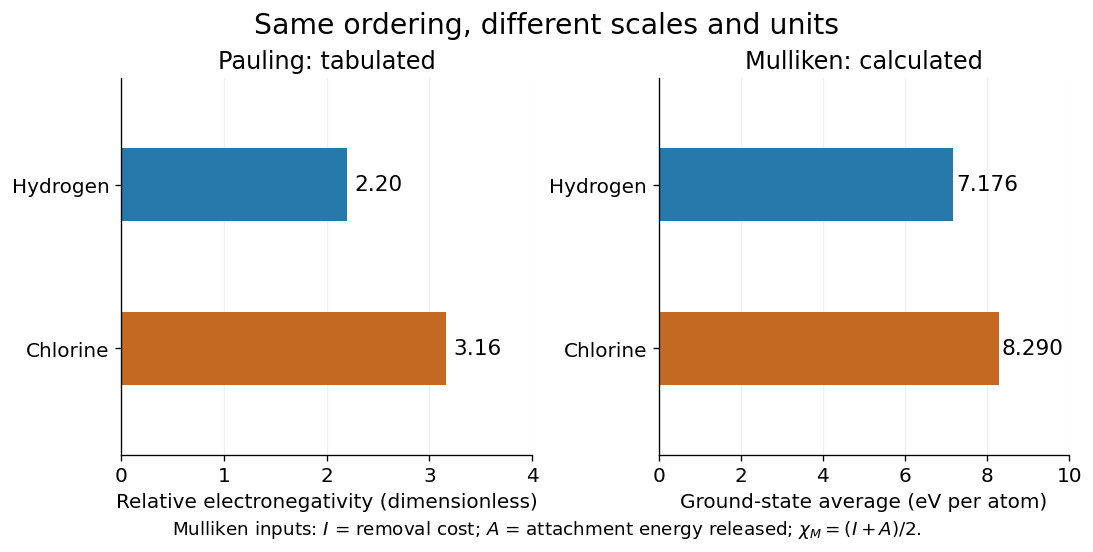
Pauling electronegativity and Mulliken electronegativity for hydrogen and chlorine: separate scales, separate units; the Mulliken electronegativity values are calculated from the stated ground-state inputs
. Details. 
A larger electronegativity difference often suggests stronger bond polarization, but there is no universal numerical boundary where a covalent bond suddenly becomes ionic bonding. Tables of cutoffs are classification aids with exceptions. Hydrogen fluoride, for example, is described by a polar covalent bond even when its electronegativity difference exceeds a textbook's nominal ionic threshold. The actual electron density, physical setting, and chemical substance's structure matter.[ref]
Chemistry 2e. §7.2, “Electronegativity and Bond Type”, general-guide warning and HF exception
The distinction from ionization energy is equally useful: an ionization energy measures the cost of removing an electron from a specified isolated species, whereas electronegativity compares attraction for electron density in a bonded environment. Neither the removal cost alone nor the attachment release alone supplies a unique bonded-atom electronegativity. A scale combines selected measured inputs with a model and a convention.[ref]
electronegativity. E01990: multiple definitions; Mulliken average versus Pauling bond-energy differences
For an original relative comparison, stipulate fictitious bonded sites on one chosen dimensionless electronegativity scale:The electronegativity heuristic predicts bond polarization towards in , towards in , and towards in . Shifting leaves every comparison unchanged. Although the difference is twice the difference, this does not make its partial atomic charge or bond dipole twice as large: those require additional information about electron density and bond length. These symbols describe a stipulated ordering, not a table of measured chemical elements.
Keep the chemical context attached to that ordering. A chemical atom in a molecule has neighbours and an electron configuration; an isolated-atom energy scale and a bonded-atom comparison are different constructions. The chemical environment dependence of electronegativity explains why a table is a useful approximation rather than an immutable property of every site. Furthermore, an applied electric field can induce bond polarization even between identical chemical atoms, through electric polarizability; equal tabulated electronegativity does not forbid that response.
Electron transfer and ionic character Created 2026-10-13 Updated 2026-10-20
The bookkeeping steps and conserve electric charge and describe the electron inventories of separated species. They do not establish a chronological mechanism in which a labeled electron jumps between two pre-existing chemical atoms and becomes a classical object owned exclusively by one of them. In a bound material, quantum mechanics determines the electron density and the total energy.
Ionic bonding and a covalent bond are useful limiting descriptions with a continuum between them. Electronegativity helps anticipate unequal sharing of electron density, but a numerical cutoff does not measure a universal fraction of ionic bonding. A partial atomic charge depends on how the electron density is partitioned; integer formal charges are a bookkeeping convention. Using in a point-charge model therefore does not claim that every partition of the actual electron density assigns exactly those values.[ref]
The Feynman Lectures on Physics, Volume II by Richard Feynman and others. §30–2, “Chemical bonds in crystals”: gradations between covalent and ionic bonding
[ref]Chemistry 2e. §7.2, “Electronegativity and Bond Type”: general guide and exceptions
Formal charge Created 2026-10-14 Updated 2026-10-20
The formal charge of a chemical atom in a Lewis structure assigns it all of its nonbonding electrons and half of the electrons in its connections:Here is the neutral chemical atom's valence electron count, is the number of nonbonding electrons assigned to it, and is the number of bonding electrons incident on it. Count electrons, not electron pairs: two lone pairs mean , and two double connections mean . The number gives electric charge in units of the positive elementary charge. Equal splitting is a bookkeeping convention, regardless of the actual electron density. See the IUPAC Gold Book, formal charge.
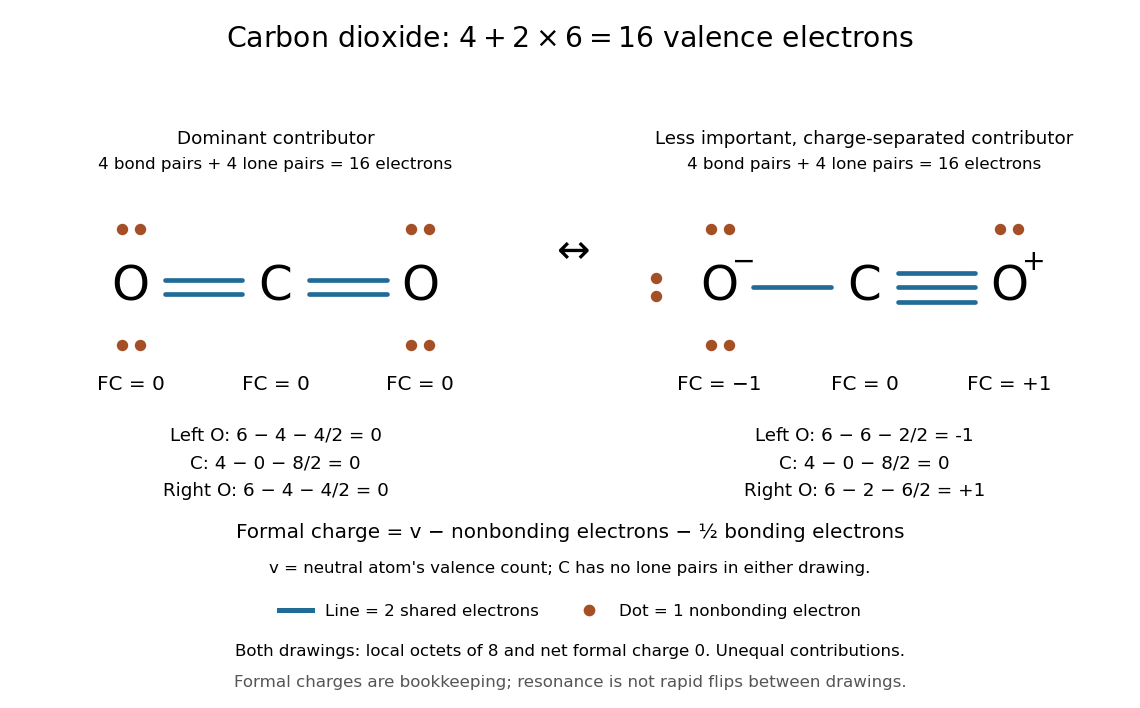
Sixteen valence electrons in two carbon dioxide Lewis structures: has zero formal charges, while has separated formal charges
. The first Lewis structure has two lone pairs on each oxygen. The second has three lone pairs on the singly connected oxygen, one on the triply connected oxygen, and none on carbon. Both use four bond pairs and four lone pairs; both satisfy the octet rule. Their contributions to chemical resonance are unequal, and the drawn formal charges are not partial atomic charges. Details.
For , each oxygen has , , , giving formal charge . Carbon has , , , giving formal charge . For , the left oxygen has formal charge , carbon still has formal charge zero, and the right oxygen has formal charge . The net electric charge is zero in either drawing.
The Lewis structure with no separated formal charges is the dominant contributor in this elementary comparison; the charge-separated drawing is a less important contributor, rather than an equally dominant alternative. This is a qualitative selection rule, not a calculation of energy or numerical chemical resonance weights. See Flowers et al., Chemistry 2e, 7.4: comparing carbon dioxide structures. A zero formal charge does not imply zero partial atomic charge: the latter depends on partitioning the actual electron density, which a Lewis structure does not supply.
As a short consistency derivation, summing over all chemical atoms counts every drawn electron once: a nonbonding electron is assigned once, and a bonding electron contributes half at each of its two endpoints. Thuswhere is the total drawn valence electron count. The right side is the net electric charge in units of elementary charge. This catches a wrong budget even when individual octet rule checks look plausible.
Lewis structure Created 2026-10-13 Updated 2026-10-31
Before calculating electronic energy, ask a simpler question: where can the available valence electrons go? A Lewis structure makes that budget visible, and nitrate shows why a correct budget can still require several resonance structures.
A Lewis structure records which chemical atoms are connected in a molecule or ion and how its valence electrons are allocated. One line represents one bond pair, two lines two bond pairs, and three lines three bond pairs; two dots beside a chemical atom represent one lone pair. The marks are a counting language, rather than measured electron positions. See the IUPAC Gold Book, Lewis formula.
For water, , the budget is valence electrons. Two O–H lines use four electrons; the other four form two lone pairs on oxygen. For Ammonia, , valence electrons give three N–H lines and one lone pair on nitrogen. Both molecules contain four electron pairs, but their allocations differ. Each shared bond pair is counted once in the total budget, even though both endpoints count it when checking the octet rule.
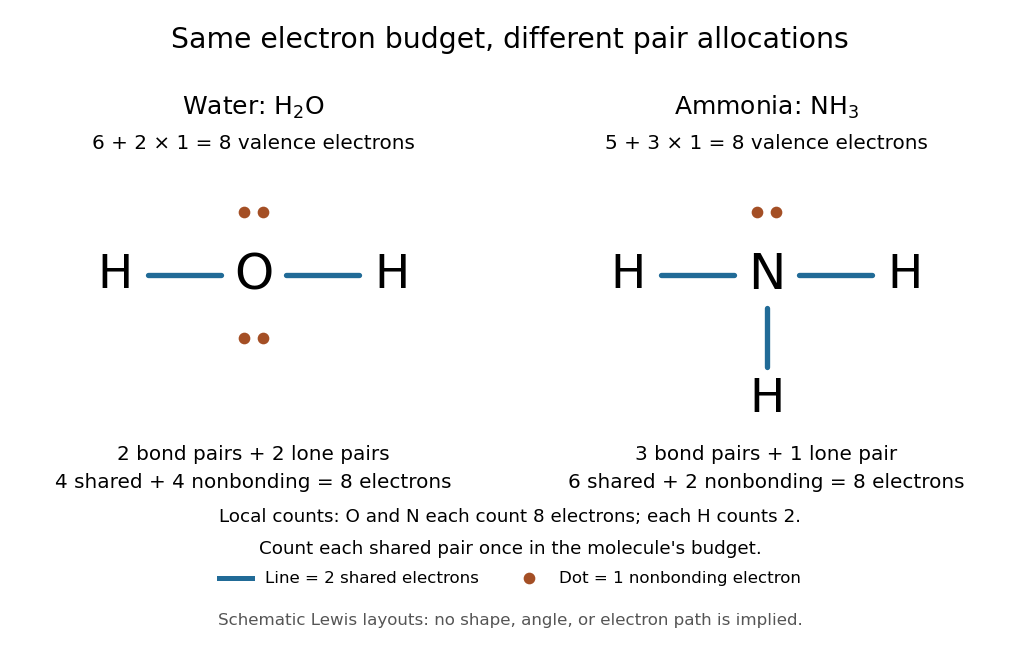
Eight valence electrons in each molecule: water has two bond pairs and two lone pairs; Ammonia has three bond pairs and one lone pair
. Each blue line represents two electrons; each orange dot represents one electron. The oxygen and nitrogen each count eight electrons locally, while each hydrogen counts two. These are schematic Lewis structures, not predictions of molecular shape or electron trajectories. Details.
A practical construction method is:
- Add the neutral chemical atoms' valence electron counts. Add one electron for each unit of negative electric charge, or subtract one for each unit of positive electric charge.
- Choose candidate connections and put one bond pair on each. Hydrogen normally has one connection in these simple Lewis structures.
- Place remaining electrons as lone pairs, checking the octet rule. If an endpoint has eight electrons but the central chemical atom lacks them, try converting an endpoint lone pair into an additional bond pair, keeping the total budget fixed.
- Compute every formal charge and check its sum against the net electric charge. Compare reasonable candidates, including chemical resonance when several allocations share the same connections.
For carbon dioxide, valence electrons. Starting with two single C–O connections leaves twelve electrons, enough for three lone pairs on each oxygen, but only four electrons around carbon. Converting one lone pair from each oxygen into a second bond pair gives . Eight electrons are in the four bond pairs, and eight are in four lone pairs, two on each oxygen. Carbon has no lone pair; all three chemical atoms satisfy the octet rule, and all three formal charges vanish.
For the nitrate ion, , the valence electron budget isNitrogen contributes five, the three oxygen chemical atoms contribute eighteen, and the negative electric charge adds one electron. Start with nitrogen connected to each oxygen by one bond pair: those three lines use six electrons. Put the remaining eighteen electrons into three lone pairs on each oxygen. Each oxygen now satisfies the octet rule, but nitrogen counts only six electrons. Reassign one oxygen lone pair as a second bond pair on its N–O connection. This changes the allocation without adding an electron; it applies the construction procedure in Flowers et al., Chemistry 2e, 7.3: drawing Lewis structures.
The resulting nitrate Lewis structure has one N=O connection and two N–O connections. Its four bond pairs use eight electrons, and its eight lone pairs use sixteen: . The doubly connected oxygen has two lone pairs; each singly connected oxygen has three; nitrogen has none. All four chemical atoms satisfy the octet rule. Any of the three oxygen chemical atoms can supply the additional bond pair, giving the three equivalent resonance structures below.
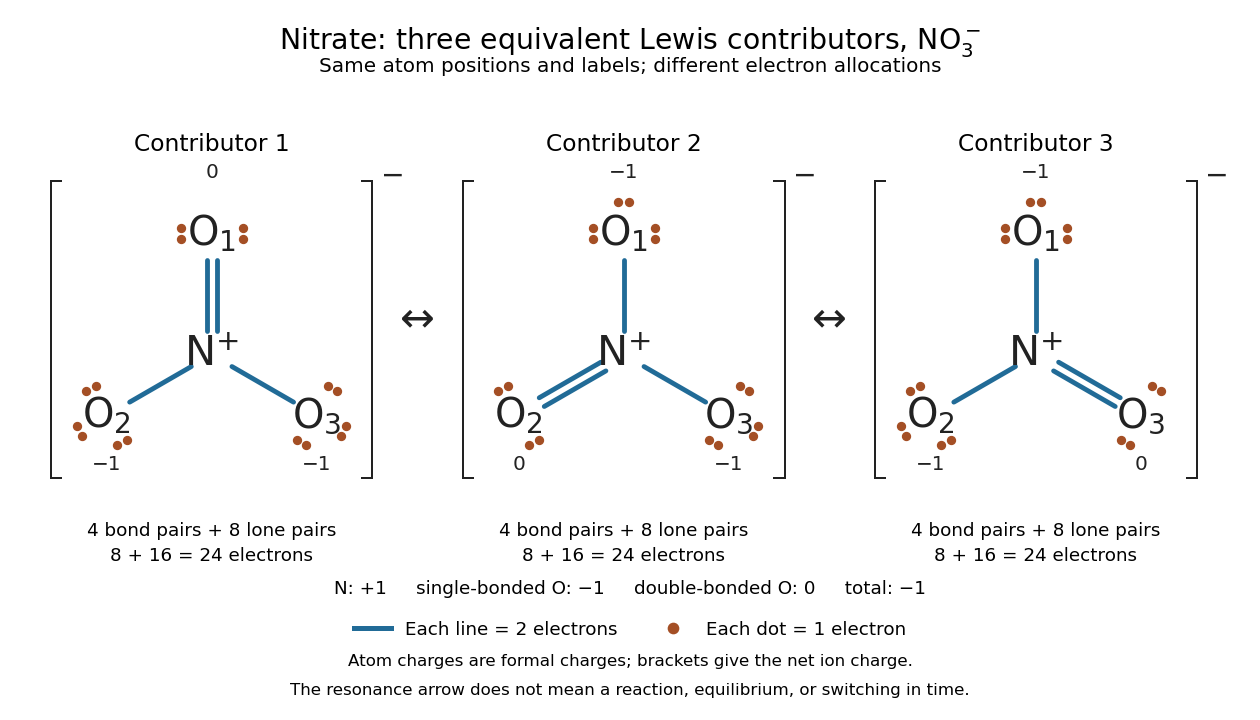

Why not draw three N=O connections to make the ion look symmetric? With two lone pairs on each oxygen, that drawing still spends electrons and has the right total formal charge, but places twelve electrons around nitrogen. It fails the octet rule for this second-period chemical element. Three equivalent resonance structures express the symmetry without that invalid local count.
The economy is beautiful: a handful of dots and lines rules out many impossible counts and identifies lone pairs that can participate in acid-base chemistry. A Lewis structure helps choose rational candidate connections before a detailed quantum chemistry calculation. It does not specify a complete many-electron wavefunction, actual electron density, or molecular geometry. Adding the separate VSEPR model, described in Chemistry 2e, 7.6: molecular structure and polarity, predicts bent water and pyramidal Ammonia; the layouts above alone make no such prediction. Molecular orbital theory supplies a richer electronic description, including the unpaired electrons of molecular oxygen that an all-paired Lewis structure misses.
In 1916 Gilbert N. Lewis proposed two-dot notation for the shared electrons of a chemical bond and fuller dot formulae for the outer electrons, explicitly relating a shared pair to the existing single-line notation. See Lewis, The Atom and the Molecule, JACS 38, 762–785 (1916), pp. 777–778, available as an [ref]
https://zenodo.org/records/1429068. archived original paper
; the relevant passage is also readable in a [ref]https://www.chemteam.info/Chem-History/Lewis-1916/Lewis-1916.html. transcription of the original paper
. The modern quantum mechanics interpretation should be distinguished from his historical model of fixed outer electrons. Lone pair Created 2026-10-14 Updated 2026-10-31
A lone pair is an electron pair assigned to one chemical atom without a connecting line to another chemical atom in a Lewis structure. It is usually shown as two dots. Water has two lone pairs on oxygen, accounting for four valence electrons; Ammonia has one lone pair on nitrogen, accounting for two. In , each oxygen has two lone pairs, and carbon has none.
A lone pair can be reactive. In protonation of Ammonia, the nitrogen lone pair becomes a new bond pair to a proton:The proton supplies no electron, so the eight valence electrons are retained: three bond pairs plus one lone pair become four bond pairs. The resulting nitrogen has formal charge ; each hydrogen has formal charge zero. This is why identifying an available lone pair helps explain the chemical base behaviour of Ammonia, rather than merely decorating its formula.
Lewis already used the Ammonia to example in The Atom and the Molecule (1916), pp. 777–778. In modern terms the dots identify an allocation of electrons, not two stationary particles or an isolated patch unaffected by the rest of the molecule. A molecular orbital description can spread electronic amplitude over several chemical atoms while a localized Lewis structure remains useful for acid-base chemistry.
Octet rule Created 2026-10-14 Updated 2026-10-31
The octet rule is a useful empirical guide: many Lewis structures of chemical compounds containing carbon, nitrogen, and oxygen give each of those chemical atoms eight electrons when nonbonding electrons and all incident bonding electrons are counted. Hydrogen instead normally counts two electrons. These are local counts, not independent budgets: a shared bond pair counts at both endpoints but only once in the molecule's valence electron total.
In water, oxygen counts electrons; in Ammonia, nitrogen counts ; in , carbon counts and each oxygen counts . The charge-separated carbon dioxide drawing also satisfies the octet rule, so the octet rule alone cannot select the dominant contributor. Formal charge provides another check.
The octet rule is a heuristic rather than a theorem about every chemical bond. Odd valence electron totals cannot be partitioned entirely into electron pairs, and some valid Lewis structures have fewer or more than eight electrons around a chemical atom. See Chemistry 2e, 7.3: exceptions to the octet rule. The capacity of the and electron subshells, , helps motivate the guide for these chemical elements, but does not prove universal compliance. Lewis discussed a stable outer group of eight, together with a two-electron arrangement for hydrogen, in The Atom and the Molecule (1916), pp. 768 and 774.
Oxidation state Created 2026-10-14 Updated 2026-10-20
An oxidation state is an electron-bookkeeping assignment to a chemical atom: its electric charge number after the ionic approximation of bonds. It helps identify oxidation and reduction and determine stoichiometry, even for covalent bonds without separate charged ions. In water, each hydrogen has oxidation state and oxygen has ; this does not assert that a water molecule contains two free protons and a free oxide ion.[ref]
Comprehensive definition of oxidation state (IUPAC Recommendations 2016) by Pavel Karen and others. Karen, McArdle and Takats, Comprehensive definition of oxidation state (IUPAC Recommendations 2016), §2, pp. 832–833: definition and equal splitting of same-element bonds
Three conventions answer different questions. Formal charge divides each bonding electron pair equally in a chosen Lewis structure. Oxidation state uses the ionic approximation of bonds. Partial atomic charge instead partitions the actual electron density and depends on that partition. In the ordinary water Lewis structure, every formal charge is zero although the oxidation states are not. Neither bookkeeping convention supplies numerical partial atomic charges.
Partial atomic charge Created 2026-10-13 Updated 2026-10-20
A partial atomic charge assigns an electric charge to a chemical atom by partitioning the actual electron density. The result depends on the partitioning convention and need not be an integer. It differs from formal charge, which divides bonding electrons equally in a specified Lewis structure.
Past exam of the chemistry B course of the University of Cambridge 2022 Paper 2 B6 b i Solution 2026-10-20
Neutral pyridine contributes no formal charge. If of the two dioxolene ligands are dianions, the combined ligand charge is , so the cobalt oxidation state is . The distinct charge assignments are thereforeInterchanging the two ligand labels in the middle row does not make another charge combination. Co(IV) belongs in this unrestricted charge-balance list even though the subsequent magnetic analysis excludes it.
There are valence electrons, all paired, so diazomethane exhibits diamagnetism. A localized orbital occupancy consistent with the double-bond construction in 2(c)(i) isHere mean central and terminal. Each listed occupied spatial orbital contains two electrons of opposite spin. The central N's two p atomic orbitals are perpendicular, so they can support the two perpendicular pi bonds. No central-N lone pair is left over: its positive formal charge accompanies four bonding pairs in this Lewis structure.
Allowing resonance mixes a terminal-N lone pair into the C–N–N orbitals. In the alternative terminal- basis, the same electron count is four occupied orbitals ( electrons), one terminal- lone pair (), one perpendicular N–N orbital (), and two occupied orbitals of a three-centre C–N–N system (). The -electron count and the paired ground state survive this change of description; the localized picture does not assert two perfectly isolated double bonds.
Polar covalent bond Created 2026-10-13 Updated 2026-10-20
The word “polar” qualifies the sharing within a covalent bond; it does not require complete transfer of an electron or an isolated cation–anion pair. In , the signs identify the relatively electron-poor and electron-rich ends, while leaves the amount unspecified. A neutral Lewis structure can give both chemical atoms zero formal charge and still correspond to a polar covalent bond: equal division of the bond pair is a formal allocation, whereas bond polarization concerns the actual electron density.
Local and molecular descriptions answer different questions. Calling one chemical bond a polar covalent bond does not establish that the whole molecule is a polar molecule. Combine the bond dipoles with the molecular geometry, then check for molecular dipole cancellation. This lets a short electronegativity comparison explain a local tendency without confusing it with the observable electric dipole moment of the whole molecule.
Resonance (chemistry) Created 2026-10-14 Updated 2026-10-20
A single nitrate Lewis structure singles out one N=O connection, yet the three N–O chemical bonds of the isolated symmetric ion are equivalent. Chemical resonance reconciles that symmetry with the integer electron pair allocations of a Lewis structure. The equal chemical bond lengths in nitrate are discussed in The Open University, Discovering chemistry: resonance structures.
Chemical resonance uses several Lewis structures with the same chemical atom connections and total electric charge to describe electronic structure that one allocation cannot fully express. The chemical atoms stay in place; the positions of bond pairs, lone pairs, and formal charges differ between drawings. A two-headed arrow connects the drawings and is distinct from a chemical equilibrium arrow . See the IUPAC Gold Book, resonance form.
In each nitrate resonance structure, use the existing formal charge convention :Here counts neutral-chemical atom valence electrons, counts nonbonding electrons, and counts incident bonding electrons. The sum is , agreeing with the nitrate ion's net electric charge. The formal charge rules and their distinction from actual atomic electric charge are given in Flowers et al., Chemistry 2e, 7.4: formal charges and resonance.
Keep one labelled oxygen fixed while reading the three nitrate resonance structures. Its connection is double in one drawing and single in two. Equal weighting within this three-contributor Lewis structure model gives the average bond orderThe same calculation applies to all three N–O connections. Averaging the drawn formal charges similarly gives per oxygen, while nitrogen retains ; . These fractions summarize the chosen contributors. They are not a measurement of partial atomic charge, a literal fraction of an electron sitting on an oxygen, or time spent in one drawing.
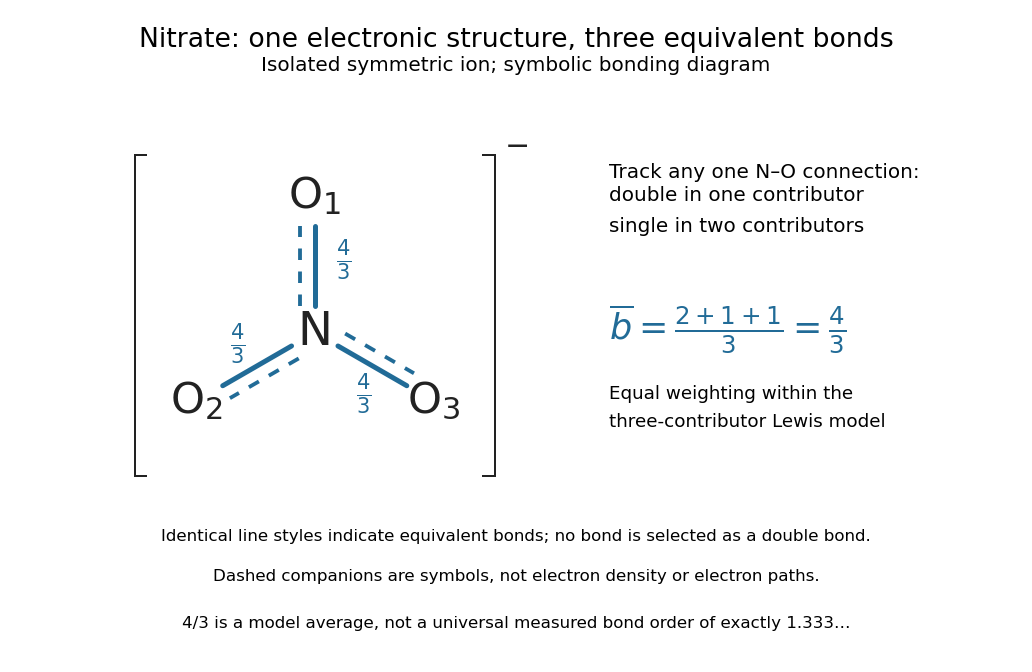

The resonance hybrid has one spatially continuous electron density extending over the ion. None of its N–O chemical bonds is permanently selected as the double connection of one contributor. The dashed marks above are symbols; electrons do not travel along them or make the marks float between chemical atoms. For isolated symmetric nitrate, symmetry makes the three N–O chemical bonds equivalent; an environment that distinguishes the oxygen sites can remove that equivalence. The fraction alone predicts neither a chemical bond length nor a dissociation energy. The general relation between multiple chemical bonds, lengths, and strengths is discussed in 7.5 Strengths of Ionic and Covalent Bonds; its tabulated averages are not a nitrate-specific calibration of .
Ozone provides a useful two-contributor comparison. Its valence electrons give three bond pairs and six lone pairs. One resonance structure has a double O–O connection on the left and a single one on the right; the other reverses these allocations while retaining the same chemical atom positions and connections. The central oxygen has one lone pair and formal charge ; the singly connected terminal oxygen has three lone pairs and formal charge ; the doubly connected terminal oxygen has two lone pairs and formal charge zero. Thus electrons and zero net electric charge are conserved. The equal-contributor bond order count is for either connection. See MIT 5.111, lecture 10, pp. 4–5: ozone resonance structures.
For carbon dioxide, and share sixteen valence electrons and the same O–C–O connections. The mirror drawing is also possible. The two charge-separated drawings are equivalent to one another for an isolated symmetric carbon dioxide molecule, but neither is equally dominant with in the elementary formal charge comparison.
Chemical resonance does not mean that a molecule rapidly flips between drawings, nor that separate molecules at chemical equilibrium carry the individual drawings. The actual electron density belongs to one combined electronic description. In a quantum mechanics treatment, contributors enter a linear combination of many-electron wavefunctions; a molecular orbital treatment can describe the extended electronic arrangement through molecular orbitals. The drawings alone provide neither a measured density nor numerical weights. Their usefulness is to expose the limitations of one localized allocation without pretending that every algebraically allowed Lewis structure contributes equally.
Resonance structure Created 2026-10-14 Updated 2026-10-20
A resonance structure is one Lewis structure contributing to a chemical resonance description. The contributors retain the same atomic nuclei in the same positions, the same connections, and the same total valence electron count and electric charge; allocations of bond pairs, lone pairs, and formal charges differ. They are alternative representations of one electronic structure, not distinct substances with different atomic arrangements. See Chemistry 2e, 7.4: resonance forms.