
Chain-growth polymerization 2026-10-13
In chain-growth polymerization, each growth step joins a monomer to a reactive site on a polymer chain and regenerates that reactive site. This is the precise mechanistic restriction in IUPAC's definition: growth occurs exclusively through these monomer–chain-site reactions. The word chain refers to the succession of site-regenerating chemical reactions. It does not merely mean that the product looks like a long chain. Chain-growth initiation starts this succession; chain-growth propagation continues it; chain-growth termination and chain transfer in chain polymerization can change its fate.[ref]
IUPAC Compendium of Chemical Terminology, fifth edition (Gold Book) by International Union of Pure and Applied Chemistry. chain polymerization, C00958, definition and notes 1–2; source recommendation p. 2306
The contrast with step-growth polymerization concerns the permitted joining partners. There, suitable reactive groups can join two existing chains, for example a two-unit chain and a three-unit chain. In chain-growth propagation, a free monomer adds to a polymerization-active site. Release of a small byproduct is a separate classification question: IUPAC explicitly allows condensative chain polymerization.[ref]
IUPAC Compendium of Chemical Terminology, fifth edition (Gold Book) by International Union of Pure and Applied Chemistry. chain polymerization, C00958, notes 3–6
The useful consequence is that a few growing chains can incorporate many monomer molecules while much of the feed remains unreacted. Their degree of polymerization depends on how those units are shared among chains, as finite chain-growth bookkeeping makes explicit.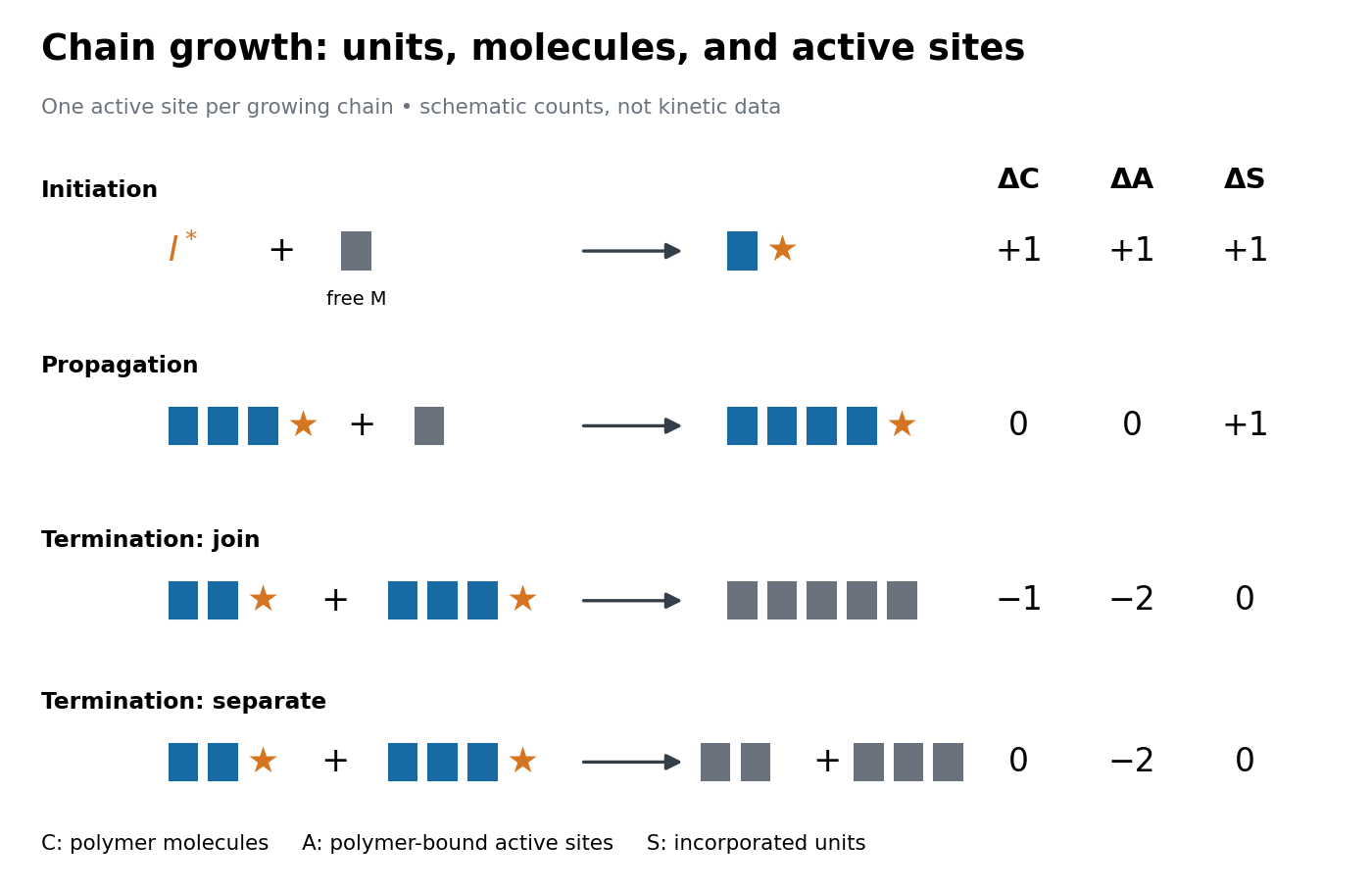

Chain-growth termination 2026-10-14
Chain-growth termination removes the ability of a reactive chain carrier to continue the succession of growth steps.[ref]
IUPAC Compendium of Chemical Terminology, fifth edition (Gold Book) by International Union of Pure and Applied Chemistry. termination, T06274, definition; source recommendation p. 1173
Two illustrative outcomes have different molecule counts:The first joins the two chains into one inactive polymer molecule. The second leaves two inactive polymer molecules, as can occur when one chain end transfers hydrogen to the other instead of their ends joining. End-group chemistry is suppressed in these unit-count symbols; they are not complete molecular formulas. Losing two polymerization-active sites does not mean losing two chains or any incorporated monomeric units. A temporarily inactive, reactivatable site must not be counted as irreversible chain-growth termination. Chain transfer in chain polymerization 2026-10-14
In chain transfer in chain polymerization, a growing chain can lose its polymerization-active site while another molecule acquires reactivity. In a common atom-transfer picture, the old chain becomes inactive and the new carrier can initiate further chain-growth propagation.[ref]
IUPAC Compendium of Chemical Terminology, fifth edition (Gold Book) by International Union of Pure and Applied Chemistry. chain transfer, C00963, definition and subsequent-polymerization example; source recommendation p. 1094
The number of reactive carriers can survive even though the identity of the growing chain changes. If the new carrier successfully starts a new chain, increases; a fixed active-carrier count therefore does not imply a fixed polymer molecule count. Whether transfer is irreversible, reversible, or involves an already existing chain matters for the final bookkeeping. Living versus terminating chain populations 2026-10-14
The defining idealization of living polymerization excludes chain-growth termination and irreversible chain transfer in chain polymerization. Fast, effective chain-growth initiation is an additional condition behind a nearly fixed growing-chain population, not a guarantee contained in the name alone.[ref]
IUPAC Compendium of Chemical Terminology, fifth edition (Gold Book) by International Union of Pure and Applied Chemistry. living polymerization, L03597, definition and initiation/propagation comparison; living polymer, LT07156, definition specifies irreversible transfer
If all four chains in finite chain-growth bookkeeping remain active, completing the feed keeps and gives . Stipulate six further additions to each chain, obtaining . Other allocations with the same total also satisfy : living does not mean identical lengths.Alternatively, stipulate that the first two length-four chains undergo chain-growth termination without joining, while the other two each receive twelve more monomer molecules. The final lengths are , with . The mean degree of polymerization is still , but two chains have stopped and two carry the remaining growth. The population variance of lengths is , compared with zero in the deliberately equal living allocation. These are synthetic populations, not measured molecular distributions and not a claim that all terminating processes are broader than all living processes. Indeed, assigning all twenty-four remaining additions to one still-active chain gives the living allocation , with the same mean but variance . Comparable start times and opportunities for chain-growth propagation are extra assumptions behind an expectation of more uniform lengths.
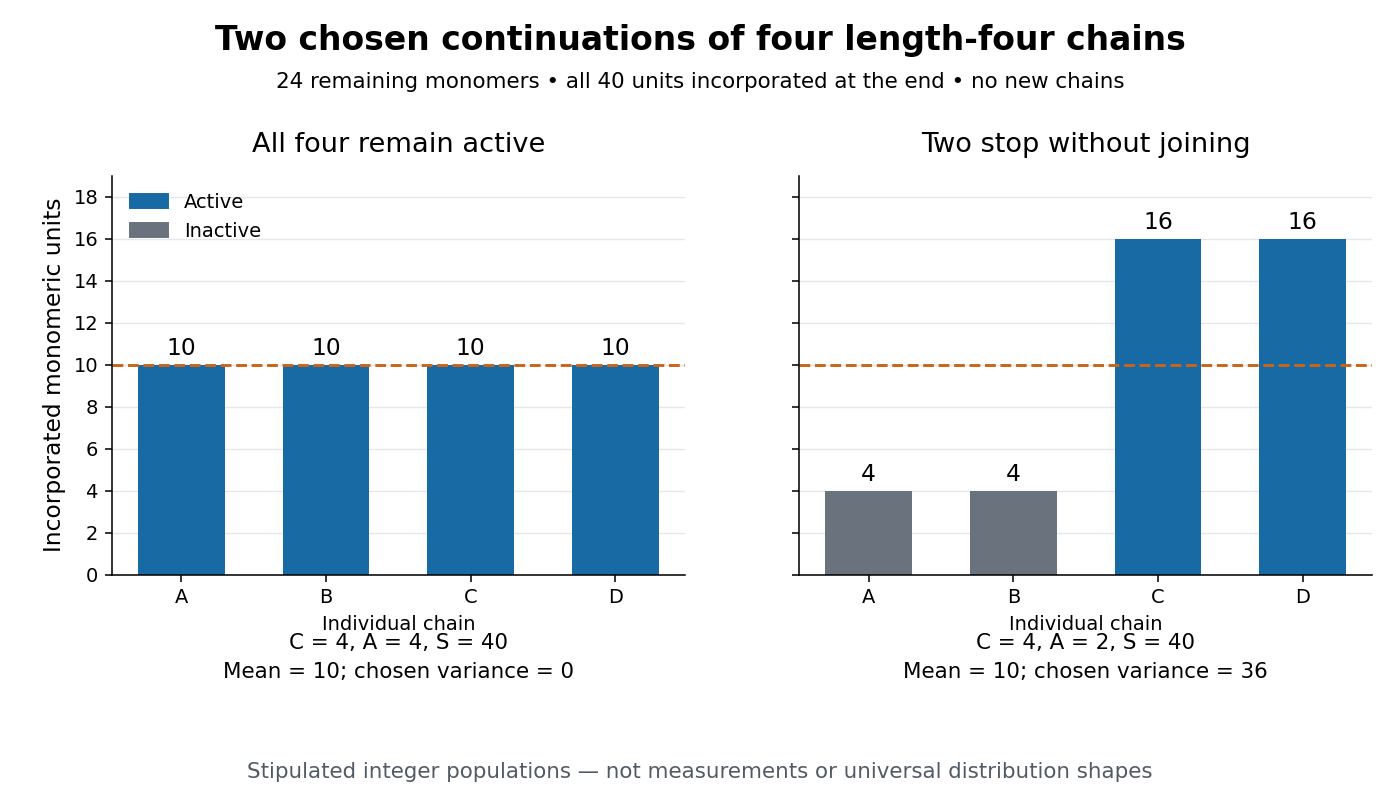

If the two terminated length-four chains instead join, their inactive product has length eight; with the same remaining additions the final lengths are . Now , , and . Thus chain-growth termination can change both which chains grow and which chains enter the denominator. Continuing chain-growth initiation, inefficient initiation, chain transfer in chain polymerization, and reactivation require their own counts. Predicting an entire length distribution additionally needs a specified reaction mechanism and growth statistics. A measured mean alone cannot establish living polymerization.
A simple route to deuterated polystyrene block copolymers by reverse iodine transfer polymerisation by Trevor Gavin Wright and Harald Pasch (2015, Experimental section, pp. 3237–3238) provides a concrete study of consumption and chain products. The authors used a valve-sealed J Young tube, freeze–pump–thaw preparation and argon. NMR monitoring of chain polymerization compared a reference with spectra acquired at every fifteen minutes for twenty-four hours. Their formulation contained an azo initiating reagent, molecular iodine and a vinyl monomer. Companion flask syntheses used stirring and a heated silicone-oil bath.
The authors followed initiating and transfer-agent signals; Figure 3 reports a transfer-agent signal rising during induction and then falling as polymerization proceeds. Their size-exclusion characterization of chain polymers used porous columns, refractive-index detection and polystyrene calibration. These distinct consumption and size readouts concern transfer-mediated chemistry; they do not establish strict living polymerization. [ref]
A simple route to deuterated polystyrene block copolymers by reverse iodine transfer polymerisation by Trevor Gavin Wright and others. Wright and Pasch, pp. 3237–3239: Experimental section, Analyses and Figure 3
Useful proposed controls, rather than reported measurements, are a matched mixture omitting the initiating reagent, an unheated mixture, and a repeat of the complete formulation. Keep monomer amount, solvent, tube preparation and acquisition conditions matched where possible. The unheated comparison needs a readout that does not itself initiate polymerization; placing it in the hot probe would defeat that control. A mixture omitting iodine asks a different question: it changes chain transfer in chain polymerization and induction chemistry, so it is not necessarily a no-polymerization control. Record the pre-reaction baseline and compare crude material with isolated product; isolation can selectively remove shorter chains. These comparisons help separate initiation-dependent monomer consumption from signal drift and unrelated chemical reactions.
The mechanistic inference is deliberately limited. Consumption plus independently characterized larger chain products supports polymerization; evidence of an induction stage helps test a proposed reaction mechanism. Neither readout directly counts stars in , proves the absence of chain-growth termination, nor recovers every chain length. A chain-extension test would probe retained growth capability, but even a successful extension would not by itself establish that all original chains extended. No measured molecular distribution is reconstructed here. IUPAC cautions that reversible deactivation can produce living-like behaviour even when some termination occurs.[ref]
IUPAC Compendium of Chemical Terminology, fifth edition (Gold Book) by International Union of Pure and Applied Chemistry. reversible-deactivation radical polymerization, 08916, notes 2 and 4: living terminology and remaining active/dormant population
Step-growth polymerization 2026-10-13
In step-growth polymerization, suitable reactive groups on molecules of different chain lengths can join. The linear count and its assumptions are given in polymerization.
A one-unit monomer, a two-unit chain, and a twenty-unit chain can all be joining partners if their functional groups are compatible and accessible. Schematically, : the subscripts count monomeric units, and end-group chemistry is suppressed. In chain-growth propagation, by contrast, requires a free monomer and a polymerization-active site. An arbitrary pair of existing chains is not a propagation pair in that mechanism. The practical consequence of step-growth polymerization is that most monomers can have joined something while the average chain is still short.
Whether a joining step releases a small molecule is a separate question. Polycondensation releases small products during the joining chemistry, as in the Nylon 6,10 demonstration in polymerization. Polyaddition joins suitable chains without that elimination: reacting a diol with a molecule bearing two isocyanate groups can build a polyurethane. Thus step-growth polymerization and polycondensation are not synonyms.[ref]
IUPAC Compendium of Chemical Terminology, fifth edition (Gold Book) by International Union of Pure and Applied Chemistry. polyaddition, P04720, definition and note 1; polycondensation, P04722, definition and growth-step equation; source recommendation p. 2307