
Entry I02938 in IUPAC Compendium of Chemical Terminology, fifth edition (Gold Book) by International Union of Pure and Applied Chemistry, issued by International Union of Pure and Applied Chemistry. No individual entry author is credited; editors and authors of underlying recommendations are not treated as entry authors. The citation gives 2025 for the fifth edition and online version 5.0.0.
Inspected official indexed entry: goldbook.iupac.org/terms/view/I02938/plain
Canonical entry: goldbook.iupac.org/terms/view/I02938
Cited passages: Definition; Source; Citation. The underlying 1994 recommendation, p. 543, is cited by the entry and was not independently inspected. Direct entry retrieval failed; the complete official indexed text was inspected.
Entry in IUPAC Compendium of Chemical Terminology, fifth edition (Gold Book) by International Union of Pure and Applied Chemistry, issued by International Union of Pure and Applied Chemistry. No individual entry author is established. The official citation identifies online version 5.0.0, 2025; this is a compendium version date. The entry cites the Orange Book, second edition, p. 48 as its underlying source.
Online text: goldbook.iupac.org/terms/view/S05924/1000
Metadata verification: Official indexed entry and citation; direct request unavailable
Cited passages: Definition paragraphs: primary standard, secondary standard solution; underlying source Orange Book, second edition, p. 48.
Living versus terminating chain populations 2026-10-14
The defining idealization of living polymerization excludes chain-growth termination and irreversible chain transfer in chain polymerization. Fast, effective chain-growth initiation is an additional condition behind a nearly fixed growing-chain population, not a guarantee contained in the name alone.[ref]
IUPAC Compendium of Chemical Terminology, fifth edition (Gold Book) by International Union of Pure and Applied Chemistry. living polymerization, L03597, definition and initiation/propagation comparison; living polymer, LT07156, definition specifies irreversible transfer
If all four chains in finite chain-growth bookkeeping remain active, completing the feed keeps and gives . Stipulate six further additions to each chain, obtaining . Other allocations with the same total also satisfy : living does not mean identical lengths.Alternatively, stipulate that the first two length-four chains undergo chain-growth termination without joining, while the other two each receive twelve more monomer molecules. The final lengths are , with . The mean degree of polymerization is still , but two chains have stopped and two carry the remaining growth. The population variance of lengths is , compared with zero in the deliberately equal living allocation. These are synthetic populations, not measured molecular distributions and not a claim that all terminating processes are broader than all living processes. Indeed, assigning all twenty-four remaining additions to one still-active chain gives the living allocation , with the same mean but variance . Comparable start times and opportunities for chain-growth propagation are extra assumptions behind an expectation of more uniform lengths.
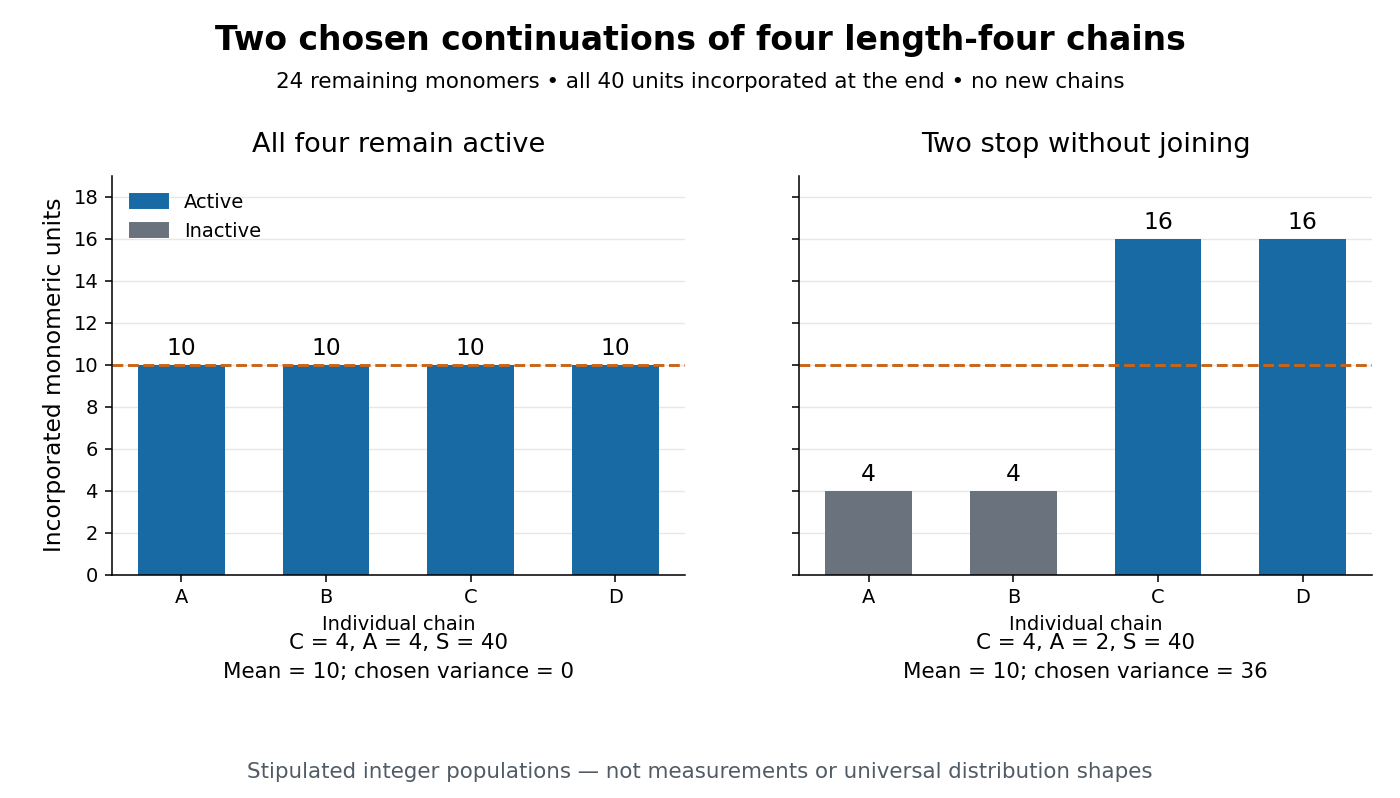

If the two terminated length-four chains instead join, their inactive product has length eight; with the same remaining additions the final lengths are . Now , , and . Thus chain-growth termination can change both which chains grow and which chains enter the denominator. Continuing chain-growth initiation, inefficient initiation, chain transfer in chain polymerization, and reactivation require their own counts. Predicting an entire length distribution additionally needs a specified reaction mechanism and growth statistics. A measured mean alone cannot establish living polymerization.
Mass concentration Created 2026-10-31 Updated 2026-11-05
Mass concentration is the mass of a specified constituent divided by the final sample volume, . Its SI unit is ; laboratory data also commonly use mass per litre.[ref]
For example, of a solute in a final solution volume of gives . The denominator is the solution volume after mixing, not necessarily the volume of solvent initially added.
If is mass fraction and the mixture mass density, then . Heating or compressing the sample can change the mass concentration through a change of volume while leaving the mass fraction unchanged.
Molecular complex 2026-11-05
A molecular complex is an associated unit containing two or more component molecular entities, often held together by interactions weaker than ordinary covalent bonds. The components may be neutral or charged. The term needs context: coordination chemistry uses more specific descriptions for metal–ligand assemblies.[ref]
IUPAC Compendium of Chemical Terminology, fifth edition (Gold Book) by International Union of Pure and Applied Chemistry. C01203, complex: component entities and contextual limitations
A water dimer illustrates the idea: two water molecules associate through a hydrogen bond, while each retains its own ordinary O–H covalent bonds. Its overall composition is . Distinguishing a bound pair from two independent molecules requires evidence about their association, rather than merely observing two water molecules in the same sample. Association and dissociation can coexist in an chemical equilibrium.
Molecular entity 2026-11-05
A molecular entity is an individually identifiable chemical unit, such as an atom, molecule, ion or molecular complex, distinguished by its composition and structure. The term is broader than molecule: a single sodium ion is a molecular entity even though it is not a neutral assembly of several atoms.[ref]
One methane molecule, , is a molecular entity; a collection of chemically identical methane molecules is a chemical species. This distinction helps separate the individual objects in a reaction mechanism from the macroscopic amount of substance used in laboratory bookkeeping.[ref]
IUPAC Compendium of Chemical Terminology, fifth edition (Gold Book) by International Union of Pure and Applied Chemistry. M03986, note distinguishing a single methane molecule from an amount of a chemical species
A simple route to deuterated polystyrene block copolymers by reverse iodine transfer polymerisation by Trevor Gavin Wright and Harald Pasch (2015, Experimental section, pp. 3237–3238) provides a concrete study of consumption and chain products. The authors used a valve-sealed J Young tube, freeze–pump–thaw preparation and argon. NMR monitoring of chain polymerization compared a reference with spectra acquired at every fifteen minutes for twenty-four hours. Their formulation contained an azo initiating reagent, molecular iodine and a vinyl monomer. Companion flask syntheses used stirring and a heated silicone-oil bath.
The authors followed initiating and transfer-agent signals; Figure 3 reports a transfer-agent signal rising during induction and then falling as polymerization proceeds. Their size-exclusion characterization of chain polymers used porous columns, refractive-index detection and polystyrene calibration. These distinct consumption and size readouts concern transfer-mediated chemistry; they do not establish strict living polymerization. [ref]
A simple route to deuterated polystyrene block copolymers by reverse iodine transfer polymerisation by Trevor Gavin Wright and others. Wright and Pasch, pp. 3237–3239: Experimental section, Analyses and Figure 3
Useful proposed controls, rather than reported measurements, are a matched mixture omitting the initiating reagent, an unheated mixture, and a repeat of the complete formulation. Keep monomer amount, solvent, tube preparation and acquisition conditions matched where possible. The unheated comparison needs a readout that does not itself initiate polymerization; placing it in the hot probe would defeat that control. A mixture omitting iodine asks a different question: it changes chain transfer in chain polymerization and induction chemistry, so it is not necessarily a no-polymerization control. Record the pre-reaction baseline and compare crude material with isolated product; isolation can selectively remove shorter chains. These comparisons help separate initiation-dependent monomer consumption from signal drift and unrelated chemical reactions.
The mechanistic inference is deliberately limited. Consumption plus independently characterized larger chain products supports polymerization; evidence of an induction stage helps test a proposed reaction mechanism. Neither readout directly counts stars in , proves the absence of chain-growth termination, nor recovers every chain length. A chain-extension test would probe retained growth capability, but even a successful extension would not by itself establish that all original chains extended. No measured molecular distribution is reconstructed here. IUPAC cautions that reversible deactivation can produce living-like behaviour even when some termination occurs.[ref]
IUPAC Compendium of Chemical Terminology, fifth edition (Gold Book) by International Union of Pure and Applied Chemistry. reversible-deactivation radical polymerization, 08916, notes 2 and 4: living terminology and remaining active/dormant population
In gel sieving of synthetic polymers, gel electrophoresis combines drift under an electric field with size- and conformation-dependent obstruction by a porous matrix. In weak-field free solution, force balance gives and, in a simple effective-charge/effective-friction model, . The mobility is motion relative to the medium, so fluid motion from electro-osmosis must be accounted for separately. This is the operational mobility convention, not a claim that the bare structural charge is always the effective driving charge.[ref]
IUPAC Compendium of Chemical Terminology, fifth edition (Gold Book) by International Union of Pure and Applied Chemistry. entry E02024, electrophoretic mobility: migration speed divided by electric field strength
For a chain with free-draining polymer friction with approximately constant effective electric charge per segment, both charge and friction scale with . The free-solution mobility can therefore become nearly independent of length, making size separation poor. A gel adds steric constraints. Coils smaller than the mesh can pass relatively easily; larger coils require deformation and pore-to-pore rearrangement. A schematic weak-sieving law is , where matrix concentration and retardation coefficient are defined by a calibration; it is not a universal size law.
When a long flexible charged polymer is confined to a tube of available paths, reptation supplies another regime. An additive-friction model gives contour diffusion and renewal time . For ideal large-scale chain statistics, , so centre-of-mass diffusion scales as . With total effective driving charge proportional to , weak-field mobility can then scale as . This assumes screened/ideal large-scale conformations and linear response; strong-field alignment, trapping and nonideal matrices can alter the scaling.
Operationally, load narrow zones of independently characterized synthetic standards and sample into a controlled gel, apply a known field and detect migration positions after a measured time. Compare with a free-solution measurement, vary matrix concentration and field, and control temperature, ionic strength, pH and matrix charge. Larger gel pores or lower matrix concentration usually reduce sieving within a given calibrated material system. Excessive field causes Joule heating and can change conformation and mobility. adsorption or electro-osmotic drift can mimic a size effect; standards should match charge chemistry and topology as well as nominal mass.
Band centres move as while ordinary diffusion gives . Resolution depends on separation of centres relative to band widths, not travel distance alone. A neutral tracer helps identify bulk flow, and multiple concentrations test adsorption or overloading. A mobility or band position does not uniquely determine size without a regime-specific calibration. TODO: biomolecular examples, sample preparation and biological applications are user deferred; the account here concerns synthetic charged polymers only.
Photochemical quantum yield 2026-11-05
The photochemical quantum yield measures the number of specified chemical events per excitation photon absorbed by the system. For an integrated product measurement,Counts or amounts of substance must be used consistently. State the product or reactant-change event, excitation wavelength and experimental conditions. A wavelength-specific yield strictly refers to monochromatic excitation.[ref]
IUPAC Compendium of Chemical Terminology, fifth edition (Gold Book) by International Union of Pure and Applied Chemistry. Entry Q04991: definition, integral/differential quantum yield and monochromatic-excitation note; goldbook.iupac.org/terms/view/Q04991/plain .
Absorbed and incident light are different denominators. Under the simple transmission model, the fraction absorbed at absorbance is . If of photons arrive at a sample with , then are absorbed, neglecting reflection and scattering. Formation of of the chosen product gives ; dividing by incident exposure instead gives . These are invented bookkeeping values, not a measured reaction yield.[ref]
IUPAC Compendium of Chemical Terminology, fifth edition (Gold Book) by International Union of Pure and Applied Chemistry. Entry Q04991: absorbed-flux correction in the differential expression.
A measurement therefore combines two calibrations: quantify the chemical change and determine absorbed photon exposure. A differential yield uses the reaction rate divided by absorbed photon flux; an integrated yield averages the specified change over an exposure. Changing absorption as products accumulate can make those quantities differ.
Photoisomerization supplies one application, but the definition requires the chosen event rather than an assumption that every absorbed photon makes one permanent product. A yield for chemical conversion also differs from a fluorescence quantum yield, which counts emitted photons. The numerical example does not impose a universal upper bound on every possible definition of a photochemical event.
Polyaddition 2026-10-14
Polyaddition is step-growth polymerization by joining reactions without elimination of small molecules. Compatible functional groups on different chain lengths remain eligible to join; the word addition alone does not imply chain-growth polymerization.[ref]
Polycondensation 2026-10-14
Polycondensation is step-growth polymerization in which joining reactions eliminate small molecules. Its chain-bearing molecule count excludes those byproducts; otherwise two chains joining while releasing one small product would misleadingly appear to conserve the counted population.[ref]
IUPAC Compendium of Chemical Terminology, fifth edition (Gold Book) by International Union of Pure and Applied Chemistry. polycondensation, P04722, definition and growth-step equation
Radiationless transition 2026-11-05
A radiationless transition changes a system's electronic state without absorption or emission of a photon in that transition. Energy is redistributed among coupled degrees of freedom; it does not disappear. In molecular photophysics, the electronic change can populate vibrational motion before subsequent energy transfer to the surroundings.[ref]
IUPAC Compendium of Chemical Terminology, fifth edition (Gold Book) by International Union of Pure and Applied Chemistry. radiationless transition, R05057
Molecular internal conversion connects electronic states of the same spin multiplicity, while intersystem crossing connects states of different multiplicity. These must be distinguished from vibrational relaxation within an electronic state and from nuclear internal conversion. A radiationless step need not instantaneously deliver all the electronic energy as heat to a solvent.
A simple competing-rate experiment illustrates why a dark channel can be inferred from light measurements. Suppose an emitting excited population loses members by fluorescence at rate and by nonfluorescent channels at total rate . With no population returning,These are the stated one-population assumptions of the fluorescence quantum yield model. For chosen rates and , the lifetime is and the yield is . A shorter lifetime here does not mean a larger radiative rate.
With a measured lifetime and yield, the model gives and . Measuring only an emission intensity is less specific because it also depends on absorbed excitation and detection efficiency. Additional intermediate states, energy transfer or population return require a more complete model; the inferred missing fluorescence does not uniquely identify one radiationless mechanism.
Time-resolved emission paired with transient absorption can therefore test a proposed pathway: the first observes photons from an emitting state, while the second can reveal population in a state that does not emit in the monitored band. A mechanism must account for both signals and their time dependence.
Radical polymerization 2026-10-20
A chain-growth polymerization whose propagating active centres are free radicals. Initiation creates active chains, propagation adds monomers while regenerating an active centre, and termination or transfer changes the population of growing chains.[ref]
IUPAC Compendium of Chemical Terminology, fifth edition (Gold Book) by International Union of Pure and Applied Chemistry. radical polymerization, term R05075: radical kinetic-chain carriers
Step-growth polymerization Created 2026-10-13 Updated 2026-10-20
In step-growth polymerization, suitable reactive groups on molecules of different chain lengths can join. The linear count and its assumptions are given in polymerization.
A one-unit monomer, a two-unit chain, and a twenty-unit chain can all be joining partners if their functional groups are compatible and accessible. Schematically, : the subscripts count monomeric units, and end-group chemistry is suppressed. In chain-growth propagation, by contrast, requires a free monomer and a polymerization-active site. An arbitrary pair of existing chains is not a propagation pair in that mechanism. The practical consequence of step-growth polymerization is that most monomers can have joined something while the average chain is still short.
Whether a joining step releases a small molecule is a separate question. Polycondensation releases small products during the joining chemistry, as in the Nylon 6,10 demonstration in polymerization. Polyaddition joins suitable chains without that elimination: reacting a diol with a molecule bearing two isocyanate groups can build a polyurethane. Thus step-growth polymerization and polycondensation are not synonyms.[ref]
IUPAC Compendium of Chemical Terminology, fifth edition (Gold Book) by International Union of Pure and Applied Chemistry. polyaddition, P04720, definition and note 1; polycondensation, P04722, definition and growth-step equation; source recommendation p. 2307
Structural formula 2026-11-05
A structural formula represents how chemical atoms in a molecule are connected. It adds information that a molecular formula alone does not provide. Depending on the notation, bonds and grouped atoms may be drawn explicitly or represented in a condensed structural formula.[ref]
IUPAC Compendium of Chemical Terminology, fifth edition (Gold Book) by International Union of Pure and Applied Chemistry. Entry S06061, structural formula: information about atom connectivity; DOI10.1351/goldbook.S06061.
For ethanol, can be unpacked as a carbon with three hydrogens, joined to a carbon with two hydrogens, joined to oxygen, joined to hydrogen. Counting the groups recovers , since . That count is a useful check, but it discards the connectivity information that distinguishes ethanol from dimethyl ether, .
A structural drawing also needs a clear convention about spatial meaning. A plain line usually represents a chemical bond, rather than a measured length on the page. Rotating the paper does not change the represented molecule. If a drawing is intended to specify a three-dimensional configuration, the additional conventions belong to stereochemistry; a connectivity formula should not silently be treated as complete molecular geometry.
Tautomer 2026-11-05
A tautomer is one of the readily interconvertible constitutional isomers related by tautomerism. In a proton-transfer example, the forms retain the same atom inventory and net charge but differ in where a hydrogen is attached and in associated bond orders. A molecular formula alone therefore cannot identify which tautomer is meant.[ref]
IUPAC Compendium of Chemical Terminology, fifth edition (Gold Book) by International Union of Pure and Applied Chemistry. Entry T06252: tautomers and the prototropic case
Xanthine supplies a concrete example. ChEBI distinguishes 7H-xanthine, with the indicated hydrogen on nitrogen7, from 9H-xanthine, with it on nitrogen9. Both neutral forms have formula , and the curated records explicitly identify them as tautomers. The atom inventory is identical while the indicated hydrogen placement differs.[ref]
Tautomerism 2026-11-05
Tautomerism is the relationship between readily interconvertible constitutional isomers, called tautomers. In a common case, a proton changes its attached atom while associated bond orders change. The atoms are conserved, but their bonding arrangement is different. The IUPAC definition also allows transfer of groups other than a proton, so tautomerism is broader than one hydrogen-transfer pattern.[ref]
IUPAC Compendium of Chemical Terminology, fifth edition (Gold Book) by International Union of Pure and Applied Chemistry. Entry T06252, tautomerism; IUPAC1994 glossary, tautomerism/prototropy
For a keto-enol tautomerism example, acetaldehyde and its enol form have the structuresBoth have formula . A hydrogen changes attachment from carbon to oxygen, the carbon–carbon bond becomes double, and the carbon–oxygen bond becomes single. Drawing the net change does not specify a complete reaction mechanism or imply that the two forms occur in equal amounts.
Tautomerism differs from resonance: tautomers have different atom attachments, whereas resonance drawings describe different electronic representations without moving the nuclei to new bonding positions. Nor is a pair of protonation states automatically a tautomer pair: losing a proton changes the hydrogen inventory and net charge. These distinctions matter when interpreting a chemical drawing or comparing a database's specific tautomer record with a broader compound name, as for xanthine.
Viral load 2026-11-05
Viral load is the measured amount of a virus in a specified sample, commonly expressed relative to sample volume. The measured target and units must be stated. For human immunodeficiency virus, a familiar result is the number of viral RNA copies per millilitre of blood; reverse transcription polymerase chain reaction is one method used in viral-load testing.[ref]
Normalization turns an assay count into a concentration. In a hypothetical calibrated measurement, 250 RNA copies attributed to of the original specimen correspond toThe example assumes that extraction, dilution and assay calibration have already been accounted for. Counting a portion of an extract without that relationship would not establish the same sample-normalized value.
Ratios are often more informative than raw differences. A constructed decrease from 100,000 to 10,000 copies per millilitre is a tenfold reduction, a decrease, and a change of in the base-ten logarithm. Those are three descriptions of the same numerical comparison, rather than three independent observations.
Measurement has limits. A limit of detection concerns the smallest signal or corresponding amount distinguishable with stated certainty by a procedure; an undetected signal does not prove an exactly zero amount.[ref]
IUPAC Compendium of Chemical Terminology, fifth edition (Gold Book) by International Union of Pure and Applied Chemistry. entry L03540, limit of detection; DOI 10.1351/goldbook.L03540
Moreover, a count of viral RNA is a molecular measurement, not a direct count of infectious virions or a complete description of disease state.