Mikhail Gromov is a mathematician whose work connects Riemannian geometry, symplectic geometry and geometric group theory. His 1985 paper introduced powerful methods based on J-holomorphic curves and established the ball-embedding obstruction underlying the Gromov non-squeezing theorem.[ref]
Pseudo holomorphic curves in symplectic manifolds by Mikhail Gromov. section 0.3.A, Corollary, printed page 310
The obstruction says that a standard symplectic ball of radius cannot fit symplectically into when . In higher dimensions the target has infinite volume, so preserving volume is weaker than preserving the symplectic form. This gives a concrete example of the global rigidity his work uncovered. His IHES profile records his permanent professorship from 1982 to 2015 and subsequent emeritus status.[ref]
https://www.ihes.fr/professeur/mikhail-gromov/. Institutional profile
He received the 2009 Abel Prize.[ref]https://abelprize.no/abel-prize-laureates/2009. Official laureate announcement

Mikhail Gromov, portrait identified and credited by IHES
. Robert E. Gompf studies four-dimensional topology, symplectic topology and contact topology. His University of Texas research profile also identifies Stein surfaces as a focus.[ref]
His symplectic sum construction glues symplectic manifolds along suitable codimension-two submanifolds. Among its consequences, every finitely presented group occurs as the fundamental group of a compact symplectic manifold in each even dimension at least four. This shows how flexible symplectic geometry can be compared with the additional restrictions imposed by a Kähler manifold.[ref]
A new construction of symplectic manifolds by Robert E. Gompf. Abstract and construction; Annals of Mathematics 142, 527–595
Ivan Smith works on symplectic topology. His Cambridge profile identifies him as a geometer working in that subject.[ref]
https://www.maths.cam.ac.uk/person/is200/1000. Institutional research profile
With Denis Auroux, he wrote lectures connecting Lefschetz pencils, branched covers and symplectic invariants. A Lefschetz pencil describes a manifold by a family of surfaces with controlled singular members; blowing up the base points produces a fibration. The approach makes a global geometric object accessible through fibres, singularities and the way the fibres fit together.[ref]
Lefschetz pencils, branched covers and symplectic invariants by Denis Auroux and Ivan Smith. Abstract and sections 1–2, local models and base-point blowup

Ivan Smith
. Portrait identified by the Cambridge mathematics profile. Source.Denis Auroux studies symplectic geometry, with work linking geometric constructions to topology and algebraic geometry. His Harvard research profile identifies the specialization.[ref]
https://www.math.harvard.edu/graduate/senior-faculty-research-interests/. Institutional research listing
His lectures with Ivan Smith develop descriptions of symplectic manifolds through Lefschetz pencils and branched covers of the projective plane. The resulting invariants combine the algebra of monodromy with geometric information from pseudoholomorphic curves. This creates a bridge between concrete maps and the classification of manifolds.[ref]

Alan Weinstein studies the mathematical interface between classical mechanics and quantum mechanics, particularly symplectic geometry. His Berkeley research profile identifies this connection.[ref]
https://vcresearch.berkeley.edu/faculty/alan-d-weinstein. Institutional research statement
With Sean Bates, he wrote Lectures on the Geometry of Quantization by Sean Bates and Alan Weinstein. Their treatment of half-densities explains how to integrate products of wave-like objects intrinsically: the product of two half-densities is a density, giving a coordinate-independent inner product and hence a Hilbert space. This is part of the geometric infrastructure needed to relate classical phase spaces to quantum states.[ref]
Lectures on the Geometry of Quantization by Sean Bates and Alan Weinstein. Preface and Appendix A, pp. 119–121
Sean Bates coauthored Lectures on the Geometry of Quantization by Sean Bates and Alan Weinstein with Alan Weinstein. The manuscript's title page verifies the byline; its preface traces the notes to Weinstein's courses on symplectic geometry and geometric quantization.[ref]
The lectures connect Hamiltonian mechanics on a symplectic manifold with unitary evolution on a Hilbert space. Their account of half-densities supplies an intrinsic way to define an inner product, avoiding dependence on a chosen coordinate volume element. The contribution is an exposition of the geometry linking the two mathematical descriptions of motion.[ref]
Lectures on the Geometry of Quantization by Sean Bates and Alan Weinstein. Preface and Appendix A
Hans Grauert developed methods in complex analysis and complex geometry. His 1960 paper on analytic sheaf theory studies how sheaf cohomology behaves in families of complex spaces.[ref]
Ein Theorem der analytischen Garbentheorie und die Modulräume komplexer Strukturen by Hans Grauert. Original byline and final section
A central theme is cohomology and base change: under appropriate properness, coherence and constancy hypotheses, fibrewise cohomology groups assemble into a locally free sheaf, and restriction to a fibre recovers the expected cohomology. This turns dimensions of solution spaces into geometric information about a family. The original archive also records a correction to the paper.[ref]
Ein Theorem der analytischen Garbentheorie und die Modulräume komplexer Strukturen by Hans Grauert. Satz 5, pp. 63–64; archive correction notice
Mihnea Popa works on algebraic geometry, including the birational classification of varieties and the geometry of families. His Harvard course on Kodaira dimension documents the connection with positivity and Hodge theory.[ref]
https://people.math.harvard.edu/~mpopa/271/index.html. Author course description and instructor identity
His Kodaira dimension of algebraic varieties by Mihnea Popa explains how sections of powers of the canonical bundle measure the growth of pluricanonical maps. For a smooth projective curve, the trichotomy between genus zero, genus one and higher genus appears as Kodaira dimension , zero and one. This gives a concrete entry into a classification invariant that remains meaningful in higher dimensions.[ref]

Igor Dolgachev studies algebraic geometry, including the classical geometry of plane curves and their symmetries. With Michela Artebani, he wrote a study of the Hesse pencil and its associated configurations.[ref]
The Hesse pencil of plane cubic curves by Michela Artebani and Igor Dolgachev. Original author byline, abstract and section 2
The pencil combines plane cubic algebraic curves sharing nine base points. Those points encode the flex geometry of a smooth cubic, while special members split into lines. The paper connects this classical configuration with elliptic surfaces and K3 surfaces, illustrating how a one-parameter family of equations organizes several geometric objects at once.[ref]
Michela Artebani works on algebraic geometry. Her joint paper with Igor Dolgachev examines the Hesse pencil of plane cubic algebraic curves, its flex configuration and associated K3 surfaces.[ref]
The Hesse pencil of plane cubic curves by Michela Artebani and Igor Dolgachev. Original byline and abstract
A useful feature of the example is that a smooth cubic and its Hessian belong to a tightly organized family. Incidences among the nine common points and twelve distinguished lines expose symmetries that are harder to see in an arbitrary cubic equation. Their treatment connects explicit coordinates with the global geometry of surfaces.[ref]
The Hesse pencil of plane cubic curves by Michela Artebani and Igor Dolgachev. Section 2, Hesse equations and configuration
Rick Miranda works on algebraic geometry and has written expositions of algebraic curves and elliptic surfaces. His Colorado State University page identifies both the research field and his books.[ref]
In The Basic Theory of Elliptic Surfaces by Rick Miranda, a pencil of plane cubics gives a concrete surface construction. Blowing up its nine base points resolves the rational map to the parameter line and produces an elliptic fibration. The example connects equations for curves, blowups and the geometry of an entire surface.[ref]

Rick Miranda
. Portrait identified by the linked primary author or institutional profile. Source.Robert L. Bryant studies differential geometry and geometric partial differential equations. His Duke research statement describes the use of geometric structures to understand differential equations.[ref]
His An Introduction to Lie Groups and Symplectic Geometry by Robert L. Bryant develops symplectic reduction and its compatibility with the geometry of Kähler manifolds. In the scalar-circle example, reduction of a complex vector space at a positive level yields Complex projective space. The construction explains how imposing a constraint and identifying points along a symmetry can produce a new geometric space.[ref]
An Introduction to Lie Groups and Symplectic Geometry by Robert L. Bryant. Lecture 8, Theorem 3 and projective-space example, pp. 135–138
Christian Schnell studies Hodge theory and the geometry and topology of complex algebraic varieties. His Stony Brook research page emphasizes applications of mixed Hodge modules to algebraic geometry.[ref]
His lecture on the Appell–Humbert theorem describes holomorphic line bundles on a complex torus using a Hermitian form and compatible lattice data. Tensor product becomes addition of the forms and multiplication of the accompanying characters. The classification turns an abstract Picard group into explicit data that also help decide when a torus is projective.[ref]
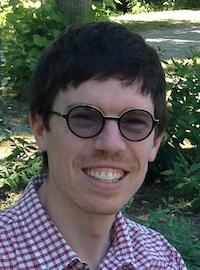
Christian Schnell
. Portrait identified by the linked primary author or institutional profile. Source.Jean-Pierre Demailly developed analytic methods in complex geometry and algebraic geometry. His author bibliography includes extensive treatments of Hodge theory, positivity and the analysis of complex manifolds.[ref]
His Complex Analytic and Differential Geometry by Jean-Pierre Demailly connects local analytic tools with global geometric objects: Cauchy integral formulas and the Dolbeault operator lead into sheaf cohomology, divisors and line bundles. His geometric lectures also derive the Ricci form from the logarithmic determinant of a Kähler metric, making curvature computable in complex coordinates.[ref][ref]
Raoul Bott made fundamental contributions to topology and differential geometry, with applications to Lie groups and differential operators. Harvard's departmental memorial documents this range of work.[ref]
https://people.math.harvard.edu/history/bott/index.html. Institutional memorial and research description
With Michael Atiyah, he developed a holomorphic Lefschetz fixed-point formula for elliptic complexes. In the holomorphic setting, global traces on cohomology become a sum of local contributions from nondegenerate fixed points. This connects a map's behavior at isolated points with its action on global solution spaces.[ref]
Michael Atiyah connected topology, geometry and analysis. With Isadore Singer, he proved the Atiyah-Singer index theorem, relating an analytic index of an elliptic operator to topological data. Oxford's mathematical memorial explains its connection with Riemann-Roch theorem and Gauss-Bonnet theorem formulas.[ref]
https://www.maths.ox.ac.uk/node/31190. Institutional mathematical account of the index theorem
His work with Raoul Bott provides another local-to-global bridge: a holomorphic Lefschetz fixed-point formula expresses a global alternating trace in terms of contributions at fixed points. Such results make local geometric calculations determine invariants of global spaces of solutions.[ref]
Mark Powell studies the topology of manifolds, especially in dimensions three and four, together with homological algebra. His Glasgow profile verifies this research specialization.[ref]
https://www.gla.ac.uk/schools/mathematicsstatistics/staff/markpowell/. Institutional research statement
His Introduction to Differential Geometry by Mark Powell connects the local geometry of curves and surfaces with global invariants. Curvature and torsion of a curve describe how a curve bends in space, whereas the Gauss-Bonnet theorem turns integrated surface curvature and boundary terms into an Euler characteristic. These examples show how local differential measurements can constrain a whole geometric object.[ref]
Isadore Singer connected analysis, topology and differential geometry. With Michael Atiyah, he proved the Atiyah-Singer index theorem, linking the analytic index of an elliptic operator to topological data.[ref]
https://www.maths.ox.ac.uk/node/31190. Institutional mathematical account of the joint index theorem
With Daniel Ray, he introduced analytic torsion using spectral information from Laplacians on differential forms. Their construction uses derivatives of spectral zeta functions to regularize otherwise divergent products of eigenvalues. The original paper proved invariance results and proposed equality with combinatorial torsion; that equality was a conjectural step in their paper.[ref]
R-torsion and the Laplacian on Riemannian manifolds by Daniel Ray and Isadore Singer. Introduction, Definition 1.6 and section 2
Daniel Ray coauthored the 1971 analytic torsion paper with Isadore Singer. The original prints D. B. Ray; the author-hosted account by Singer's former student John Lott explicitly identifies him as Daniel Ray.[ref]
https://math.berkeley.edu/~lott/torsion.pdf. Introduction, p. 17, identifies Daniel Ray and Isadore Singer
Their construction extracts a geometric invariant from spectra of Laplacians on differential forms. A spectral zeta function makes it possible to define a regularized determinant, which contributes to analytic torsion. Their paper establishes metric-independence under its hypotheses and motivates comparison with a combinatorial invariant.[ref]
R-torsion and the Laplacian on Riemannian manifolds by Daniel Ray and Isadore Singer. Introduction, Definition 1.6 and section 2
Graham Niblo works on geometric group theory. With Indira Chatterji, he explained a construction taking a group action on a wallspace to an action on a CAT(0) cube complex.[ref]
From wall spaces to CAT(0) cube complexes by Indira Chatterji and Graham Niblo. Original byline and abstract
Walls separate pairs of points; counting the separating walls gives a pseudometric. Consistent choices of sides become vertices of a cubical space. This transforms separation data into a geometric object on which the group acts, making combinatorial information available to nonpositive-curvature methods.[ref]
From wall spaces to CAT(0) cube complexes by Indira Chatterji and Graham Niblo. Section 1, pp. 2–3, and construction
Indira Chatterji studies geometric group theory. Her joint work with Graham Niblo develops a route from actions on a wallspace to actions on a CAT(0) cube complex.[ref]
From wall spaces to CAT(0) cube complexes by Indira Chatterji and Graham Niblo. Original byline and abstract
The distinction between a distance and a pseudometric matters here: different points can be separated by no walls. Counting walls still records enough separation information to support a cubical construction and transfer proper-action properties under the paper's hypotheses.[ref]
From wall spaces to CAT(0) cube complexes by Indira Chatterji and Graham Niblo. Section 1 and main construction
Daniel T. Wise studies geometric group theory through cubical geometry. With Frédéric Haglund, he introduced and studied special cube complexes, whose hyperplanes satisfy restrictions preventing certain self-interactions.[ref]
Special cube complexes by Frédéric Haglund and Daniel T. Wise. Original byline, introduction and Theorem 1.1
A compact nonpositively curved cube complex satisfying their criterion admits a local isometry into the standard complex of a Right-angled Artin group. Consequently its fundamental group embeds in a linear group. The contribution connects visible geometric conditions on hyperplanes with algebraic properties of the fundamental group.[ref]
Frédéric Haglund works on geometric group theory and cubical geometry. His joint work with Daniel T. Wise introduced special cube complexes and related them to Right-angled Artin groups.[ref]
Special cube complexes by Frédéric Haglund and Daniel T. Wise. Original byline and introduction
The key conditions control how hyperplanes embed, whether they are two-sided and how they meet. A local isometry to a standard cubical model then yields an embedding of the fundamental group. This is a concrete mechanism for obtaining algebraic information from the internal geometry of a complex.[ref]
Special cube complexes by Frédéric Haglund and Daniel T. Wise. Theorem 1.1 and definition of specialness
Juan Pablo Rossetti works on geometry and spectral questions. With Peter G. Doyle, he proved that closed hyperbolic surfaces with the same Laplacian spectrum have matching closed geodesics, separately counting orientation-preserving and orientation-reversing ones at each length.[ref]
The orientation distinction matters on nonorientable surfaces: different types of closed geodesic contribute differently to a trace formula. Their result explains exactly which geometric data can be recovered from the spectrum, extending the orientable setting of Huber's theorem.[ref]
Alexander Strohmaier studies global analysis, spectral geometry and quantum field theory in curved spacetime. His Hannover research page connects spectra of geometric differential operators with classical dynamics.[ref]
With Emily B. Dryden, he extended Huber's theorem to compact orientable hyperbolic orbisurfaces: the Laplacian spectrum determines the lengths of closed geodesics and the number of singular points of each order, with a converse. The result uses a Selberg trace formula to relate spectral and geometric terms.[ref]
Emily B. Dryden studies spectral geometry: the relationship between geometric spaces and spectra of differential operators. Her Bucknell profile identifies this research specialization.[ref]
https://www.bucknell.edu/fac-staff/emily-dryden. Institutional research profile
With Alexander Strohmaier, she proved an orbisurface version of Huber's theorem. For compact orientable hyperbolic orbisurfaces, the Laplacian spectrum determines both closed-geodesic lengths and singular-point orders with multiplicities; the corresponding geometric data also determine the spectrum. Thus spectral information records some singular geometry as well as ordinary closed paths.[ref]
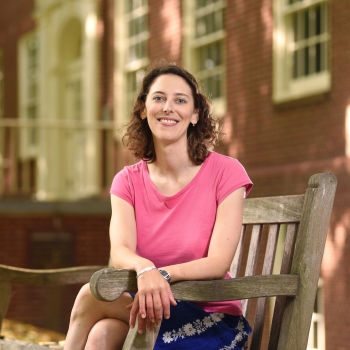
Emily B. Dryden
. Portrait identified by the linked primary author or institutional profile. Source.Vladimir Turaev develops invariants in low-dimensional topology. His work on Reidemeister torsion refines invariants using Euler structures and relates them to Seiberg-Witten invariant of a three-manifold of three-manifolds.[ref]
A formula for Dehn surgery describes how an invariant changes when a manifold is assembled by filling boundary tori. Tracking the coefficient system and the extra geometric structures is essential: the same underlying filling can have different invariant data. His paper supplies formulas in this refined setting.[ref]
Robion Kirby developed tools for low-dimensional topology, including Kirby calculus. His 1978 paper describes three-manifolds by surgery on framed links in the three-sphere.[ref]
A calculus for framed links in S3 by Robion Kirby. Original byline and section 1
Different link diagrams can describe the same manifold. Kirby's theorem identifies moves—handle slides and the addition or removal of an isolated appropriately framed unknot—that relate such descriptions. This turns an equivalence problem about manifolds into controlled operations on diagrams, while also connecting the diagrams to four-dimensional handle attachments.[ref]
Louis H. Kauffman studies knot theory and its connections with statistical mechanics, quantum theory and combinatorics. His University of Illinois at Chicago research page identifies these connections.[ref]
His Kauffman bracket computes a polynomial by resolving each crossing into simpler diagrams and combining the resulting states. A correction using the diagram's writhe produces the Jones polynomial. The construction explains how a local crossing rule can yield a global invariant of a knot and gives applications to reduced alternating diagrams.[ref]
State models and the Jones polynomial by Louis H. Kauffman. Introduction and section 2, Definition 2.1 and writhe normalization
E. C. Zeeman developed constructions in geometric topology. His paper on twist-spun knots studies higher-dimensional knots obtained by rotating a classical knot while adding twists.[ref]
Twisting spun knots by E. C. Zeeman. Original byline and introduction
The construction makes knot complements accessible through fiber bundles over a circle. A striking consequence is that the one-twist spin is unknotted, even when the original classical knot is nontrivial. The theorem connects an explicit motion of a diagram with the global topology of its complement.[ref]
V. O. Manturov works on knot theory. With S. Kim (knot theory), he authored lectures connecting fundamental groups with diagrams of knots. The displayed title page verifies both sets of initials.[ref]
Lecture 3. Fundamental groups and knot groups by S. Kim and V. O. Manturov. Title page, 19 May 2022
Their presentation of knot groups explains how loops in a knot complement can be encoded by generators and relations. Wirtinger presentations use arcs, whereas a Dehn presentation of a knot group uses regions and crossing relations. The two constructions show how a picture supplies algebraic information about an otherwise difficult three-dimensional complement.[ref]
S. Kim (knot theory) coauthored lectures on fundamental groups and knot groups with V. O. Manturov. The primary title page identifies the author only as S. Kim; a fuller personal identity is not inferred from those initials.[ref]
Lecture 3. Fundamental groups and knot groups by S. Kim and V. O. Manturov. Title page, 19 May 2022
The lectures explain the van Kampen theorem and derive diagrammatic group presentations. A Dehn presentation of a knot group assigns generators to regions and a relation at each crossing, converting topological gluing into algebra. This supplies a reusable route from knot diagrams to invariants of their complements.[ref]
Lecture 3. Fundamental groups and knot groups by S. Kim and V. O. Manturov. Slides 12–21, especially the region/crossing figure
Charles Livingston studies knot theory and algebraic concordance of knots. His paper on algebraic concordance order develops effective tests for deciding whether a class has finite or infinite order.[ref]
The algebraic concordance order of a knot by Charles Livingston. Original byline and abstract
A Seifert matrix translates a knot problem into a question about bilinear forms. The resulting algebraic concordance class can be analyzed through Witt groups and P-adic numbers. Livingston's criteria reduce the primes that need consideration and can sometimes avoid p-adic computations, making abstract concordance invariants accessible to explicit knot calculations.[ref]
James D. Stasheff works on topology and its algebraic structures. With John Milnor, he wrote Characteristic Classes by John Milnor and James D. Stasheff, developing invariants that detect how vector bundles twist over a space.[ref]
Characteristic Classes by John Milnor and James D. Stasheff. Original book byline and characteristic-class development
The total Pontryagin class illustrates the importance of coefficient conventions: its product formula is stated modulo elements of order two in their theorem. Keeping that qualification prevents an integral statement from being inferred from a result valid only after removing a torsion ambiguity.[ref]
James Simons worked on differential geometry and geometric invariants. With Shiing-Shen Chern, he introduced the secondary characteristic forms now associated with Chern-Simons forms.[ref]
Characteristic forms and geometric invariants by Shiing-Shen Chern and James Simons. Original byline, introduction and equation 3.1
The construction produces a form whose exterior derivative is a characteristic curvature form. The introduction explains how a search for a combinatorial formula for a number obtained from a Pontryagin class led to an interesting boundary term. That term became a geometric object in its own right, illustrating how an obstruction in one calculation can generate a new invariant.[ref]
Shiing-Shen Chern developed methods connecting curvature, differential geometry and topological invariants. His joint work with James Simons constructs secondary characteristic forms from connections.[ref]
Characteristic forms and geometric invariants by Shiing-Shen Chern and James Simons. Original byline and introduction
The key relation expresses a characteristic curvature form as an exterior derivative on an appropriate total space. Its primitive carries geometric information beyond the original cohomology class. The resulting Chern-Simons forms connects local differential forms with global invariants and later applications in mathematical physics.[ref]
Jan Techter works on discrete geometric structures. The Discretization in Geometry and Dynamics project identifies his participation in research on discrete surfaces.[ref]
https://gitlab.discretization.de/projects/A02/. Primary project participant record
With Alexander I. Bobenko, Carl O. R. Lutz and Helmut Pottmann, he studied Laguerre geometry in spaces of different curvature and its application to incircular nets. The work treats contact between oriented spheres and planes as geometric data preserved by transformations.[ref]
Helmut Pottmann works on applied and discrete geometry, computational design and geometric methods for architecture and manufacturing. His KAUST research profile identifies this connection between mathematical structure and practical construction.[ref]
His joint work with Alexander I. Bobenko, Carl O. R. Lutz and Jan Techter studies Laguerre geometry and incircular nets. Such nets organize quadrilaterals with inscribed circles, connecting exact tangency constraints with discrete surface geometry.[ref]
Laguerre geometry in space forms and incircular nets by Alexander I. Bobenko and others. Abstract and checkerboard-net development
Carl O. R. Lutz coauthored research on Laguerre geometry with Alexander I. Bobenko, Helmut Pottmann and Jan Techter. The primary manuscript verifies the full printed name and TU Berlin affiliation at the time of the work.[ref]
The paper generalizes oriented sphere-and-plane contact geometry to hyperbolic and elliptic settings, then applies it to incircular nets. This combines transformation geometry with discrete configurations satisfying exact contact conditions.[ref]
Alexander I. Bobenko studies differential geometry, discrete geometric structures, integrable systems and Riemann surfaces. His TU Berlin homepage also emphasizes mathematical visualization as part of this work.[ref]
With Carl O. R. Lutz, Helmut Pottmann and Jan Techter, he studied Laguerre geometry in spaces of different curvature and its use in incircular nets. The project connects continuous contact geometry with discrete geometric constraints.[ref]
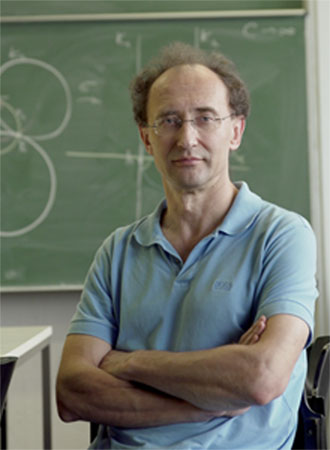
Alexander I. Bobenko
. Portrait identified by the linked primary author or institutional profile. Source.Branko Grünbaum studied geometric and combinatorial structures, including uniform polyhedra. His survey on uniform polyhedrals extends the investigation from finite objects to locally finite ones, requiring regular polygonal faces and a single vertex orbit under spatial symmetries.[ref]
The broader setting admits infinite structures such as rods, slabs and sponges. Explicitly stating which overlaps and coincidences are permitted becomes essential: changing the definition changes the class being investigated. His exposition shows how precise combinatorial and symmetry conditions organize visual geometry.[ref]
Benson Farb works on topology and geometric group theory. His University of Chicago page identifies his research publications and books.[ref]
With Dan Margalit, he wrote A primer on mapping class groups (Version 5.0) by Benson Farb and Dan Margalit. The book studies symmetries of surfaces up to deformation. A Dehn twist is supported in an annulus, yet repeated twisting has a precisely calculable effect on intersection numbers of curves. This links a local geometric operation with the algebra of a mapping class group.[ref]
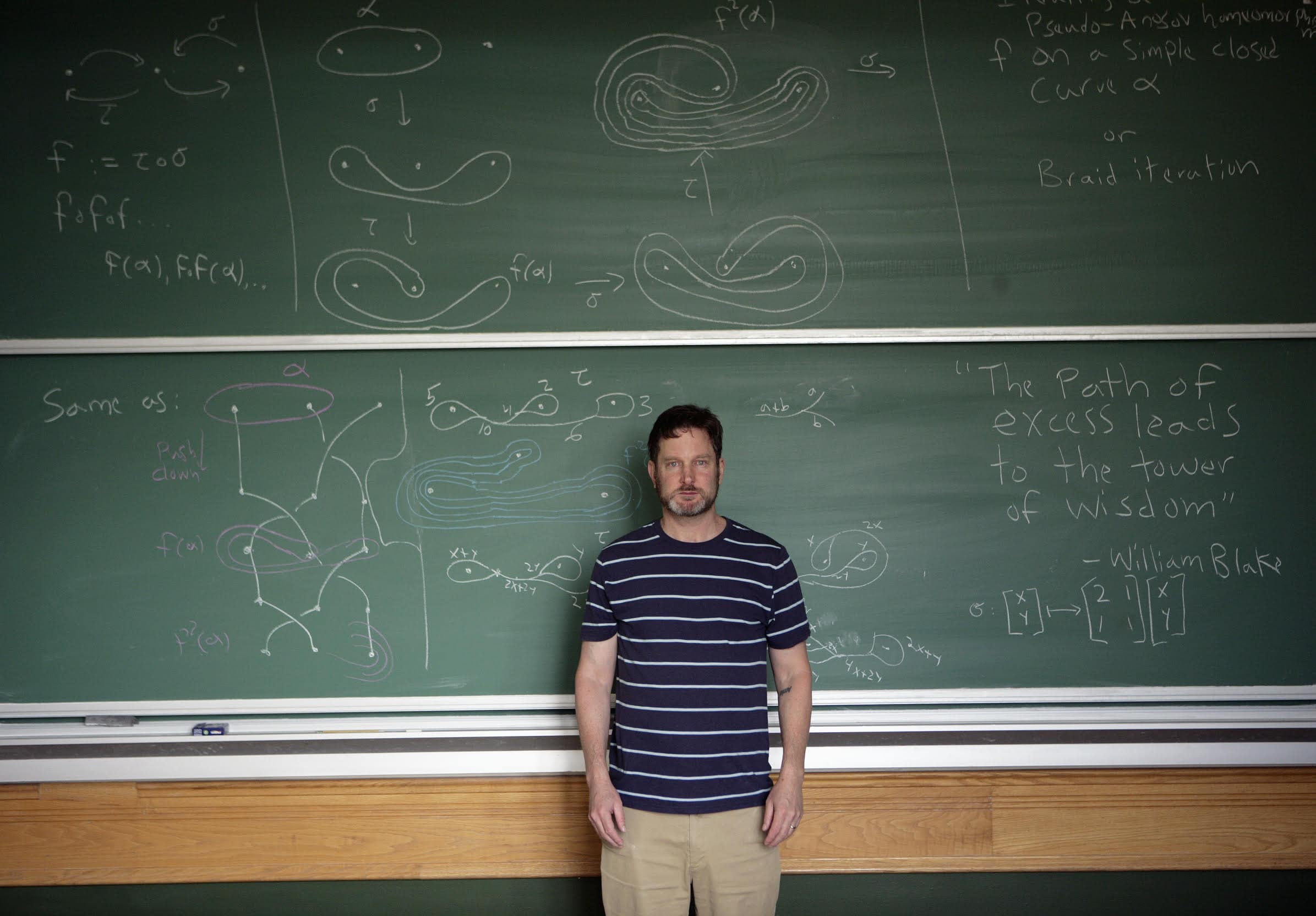
John Douglas Moore studies differential geometry and geometric analysis. His UCSB research page describes work on minimal surfaces and related variational problems.[ref]
His Lecture Notes on Seiberg-Witten Invariants by John Douglas Moore develop gauge-theoretic methods for four-manifolds. The treatment of Hodge theory connects the curvature of a line-bundle connection with its harmonic representative: analytic equations select distinguished representatives of topological classes. This provides a bridge from differential equations to invariants of smooth manifolds.[ref]

John Douglas Moore
. Portrait identified by the linked primary author or institutional profile. Source.Peter Ozsváth and Zoltán Szabó developed Heegaard Floer homology, constructing invariants of three-manifolds from holomorphic-disk counts associated with Heegaard splittings. Their Berkeley lecture record explicitly identifies the joint discovery.[ref]
https://math.berkeley.edu/about/upcoming-events/lecture-series/chern-lectures/2010-chern-lectures. Institutional lecture abstract and joint attribution
Their four-manifold work uses pseudoholomorphic curves on triangular domains to define maps associated with cobordisms and assemble a smooth four-manifold invariant. The construction connects surface diagrams with information about smooth structures in four dimensions.[ref]
Zoltán Szabó co-developed Heegaard Floer homology with Peter Ozsváth. The theory obtains invariants of a three-manifold by turning a Heegaard splitting into a Floer-theoretic chain complex.[ref]
https://math.berkeley.edu/about/upcoming-events/lecture-series/chern-lectures/2010-chern-lectures. Institutional account of joint discovery
Their Holomorphic triangles and invariants for smooth four-manifolds by Peter Ozsváth and Zoltán Szabó extends the framework through Heegaard Floer cobordism maps. Compatibility under gluing lets data from pieces combine into an invariant of a closed smooth four-manifold, while blowup formulas describe its behavior under a controlled geometric modification.[ref]
Dennis Sullivan developed algebraic methods for topology, particularly rational homotopy theory. His Sullivan minimal model replaces a space's differential-form information by a controlled differential graded algebra.[ref]
Infinitesimal computations in topology by Dennis Sullivan. Original byline, introduction and sections 2 and 5
Generators are added to represent missing cohomology classes and impose necessary relations. Under the theory's hypotheses, the model records rational homotopy information that ordinary cohomology alone can miss. This makes nonlinear questions about spaces accessible through algebra while retaining more structure than a list of Betti numbers.[ref]
John Milnor works across topology, geometry and dynamical systems. His expositions connect local calculations with global structure: Morse Theory by John Milnor develops the topology of a manifold through critical points, while his complex-dynamics lectures study iteration of holomorphic maps.[ref][ref]
Near a nondegenerate critical point, the Morse lemma reduces a smooth function exactly to a signed quadratic form in suitable coordinates. Its index controls the topological change in sublevel sets. With James D. Stasheff, Milnor also wrote Characteristic Classes by John Milnor and James D. Stasheff, developing invariants of vector bundles.
Ravi Vakil works on algebraic geometry. His Stanford page identifies the specialization and his exposition The Rising Sea: Foundations of Algebraic Geometry by Ravi Vakil (2017 draft).[ref]
The book builds the geometry of polynomial equations through schemes, beginning with affine constructions and developing local-to-global methods. A rational map may be defined only on a dense open set; a birational morphism can change a geometric model while preserving its function field. These distinctions connect concrete equations with the abstract language needed to compare algebraic spaces.[ref]
The Rising Sea: Foundations of Algebraic Geometry by Ravi Vakil (2017 draft). Section 0.4, chapter 3 and rational-map development

Jean Serra developed methods in mathematical morphology, using geometric operations on sets to analyze images. His 1986 introductory paper presents the subject as a mathematical approach to image structure.[ref]
Introduction to mathematical morphology by Jean Serra. Original publisher byline and introductory scope
In a binary image, the foreground can be treated as a set. Morphological erosion keeps positions where a translated test shape fits completely inside it; morphological dilation takes the union of translated copies of that shape placed on foreground points. These operations connect local shape tests with global effects such as removing narrow features or joining nearby regions. Their geometric assumptions are explicit, so the operation can be chosen for the scale and shape being investigated.
Norman Steenrod developed operations on cohomology that reveal structure beyond the cohomology groups alone. His original work constructs the mod-two Steenrod squares, organized under composition in the Steenrod algebra.[ref]
Products of cocycles and extensions of mappings by Norman Steenrod. Original paper and cochain-construction contribution
An operation sends a class in degree to one in degree and behaves naturally under continuous maps. The top square satisfies , connecting the operations with the cup product. Such compatibility makes them useful for distinguishing spaces and detecting restrictions on maps, even when simpler algebraic invariants agree.
Articles by others on the same topic
There are currently no matching articles.