The London equations relate the superconducting electric current to the electromagnetic field: and . In a gauge with constant condensate phase the second follows from ; it implies exponential magnetic field screening.
For uniform vortex-free superconductivity, the London equation and stationary Maxwell equations give . A field tangential to a planar superconducting half-space decays as . A nonzero normal boundary field is incompatible with this translation-invariant decaying Meissner solution, because divergence-free magnetic flux would require that component to remain constant.
The Meissner effect is the equilibrium expulsion of a sufficiently weak, static magnetic field from the bulk of a material exhibiting superconductivity. Expulsion includes a magnetic field that was already present before cooling: zero electrical resistance alone does not predict this. The Field-cooled Meissner experiment tests that distinction. A finite London penetration depth means that the magnetic field and screening electric current occupy a surface layer, rather than disappearing at a mathematical boundary.[ref]
Lecture notes on the electrodynamics of metals and superconductors. §2, pp. 12–13, Eqs. (64)–(74): acceleration, additional magnetic constraint and penetration length
This makes superconductivity useful for shielding weak magnetic fields, and makes its magnetic response an independent test of the phase. The striking result is that the same screened equilibrium can be reached by two different preparation histories. The assumptions matter: Finite-thickness Meissner screening can leave an appreciable magnetic field throughout a small sample, and the Limits of Meissner screening distinguish quantum vortex penetration and retained magnetic flux from this equilibrium state.
A Meissner state is an equilibrium state of superconductivity without quantum vortex penetration, with screening electric currents responding to the applied magnetic field. In a solid, simply connected sample much thicker than the London penetration depth, the deep interior magnetic field is approximately zero. This is a statement about a phase and a geometry, not a rule that every sample exhibiting superconductivity always has . In particular, the Meissner state exists for sufficiently weak magnetic fields in both type-I superconductors and type-II superconductors. [ref]
9.8 Superconductivity. §9.8, Properties of Superconductors, paragraphs distinguishing type I, type II and their two critical fields
Take a homogeneous material exhibiting superconductivity in the half-space , bounded by vacuum at . Fix the temperature below the superconducting transition temperature, take a constant positive London penetration depth , and assume a local, linear London equation description in a Meissner state. The applied magnetic field is weak enough that it neither nucleates a quantum vortex nor appreciably suppresses the material's superconductivity. Assume translation invariance in , no imposed transport electric current, and a tangential boundary magnetic field . Here is the local surface magnetic flux density, equal to the imposed vacuum magnetic field in this infinite planar geometry; it is not automatically the far-away applied value for a finite object.
For a bounded, decaying interior solution, the London equations, magnetostatic Ampère law and Gauss's law for magnetism giveThe solution isAt one London penetration depth the magnetic field is of its surface value; at five it is . There is no finite depth where this exponential is exactly zero. The differential equation excludes the growing exponential through the deep-interior boundary condition. A constant normal component cannot decay in this geometry: Gauss's law for magnetism would require . A perpendicular applied magnetic field on a finite plate therefore requires a different spatial problem.[ref]
Lecture notes on the electrodynamics of metals and superconductors. §2, p. 13, Eqs. (68)–(74): London screening equation; the planar boundary-value solution here follows directly
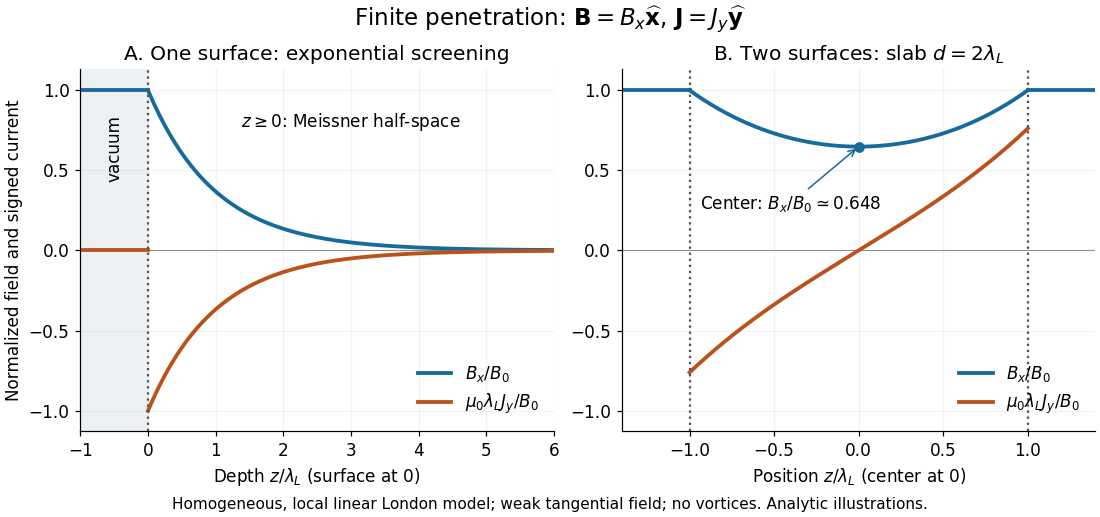

In SI units, the magnetostatic Ampère law gives the current density supporting Planar London screening:Here is the vacuum permeability. The sign follows from in the chosen coordinates. Thus requires electric current along . Its own magnetic field opposes the imposed magnetic field inside the material. The electric current is distributed over a finite layer; its depth integral is the effective surface current densityThe units are for and for . Shrinking at fixed increases the surface current density, while this integrated surface current density stays fixed. The current sheet approximation is the large-length-scale limit of this layer, not a claim that an actual sample carries an infinitely thin electric current. It reproduces the magnetic-field jump across a surface current between the exterior and a field-free interior, with outward unit normal .
To isolate finite size from quantum vortex penetration, keep the same weak-field London equations but replace the half-space by an infinite slab . Put equal tangential magnetic fields at its two faces. With now at the slab center, the even solution and its signed current density areThe hyperbolic cosine profile has equal boundary values, while the electric currents on the two sides have opposite signs. In particular,For the stipulated thickness , the center retains about and the mean is about , even though this is a Meissner state. For , the center magnetic field is exponentially small and the mean is about , reflecting the two surface layers. For , the mean tends to : little screening is possible across such a short distance. These are analytic model examples, not material measurements. Real finite objects also need their demagnetizing field and edge geometry accounted for; the slab calculation only isolates the effect of thickness.
Compare two ideal models for a stationary, solid, simply connected sample. In the perfect conductor flux-history model the interior electric field is constrained to zero from the moment perfect conduction starts. Faraday's law of induction then givesConsequently the interior magnetic field retains its value at that moment. Cooling in an already applied magnetic field freezes a nonzero interior value; starting perfect conduction in zero magnetic field and then applying a magnetic field preserves zero. The zero initial interior magnetic field often assumed in perfect conductor wave-reflection problems is one particular preparation, not a general prediction of expulsion. [ref]
9.8 Superconductivity. §9.8, Eq. (9.38) and the argument that zero resistivity conserves existing flux rather than expelling it
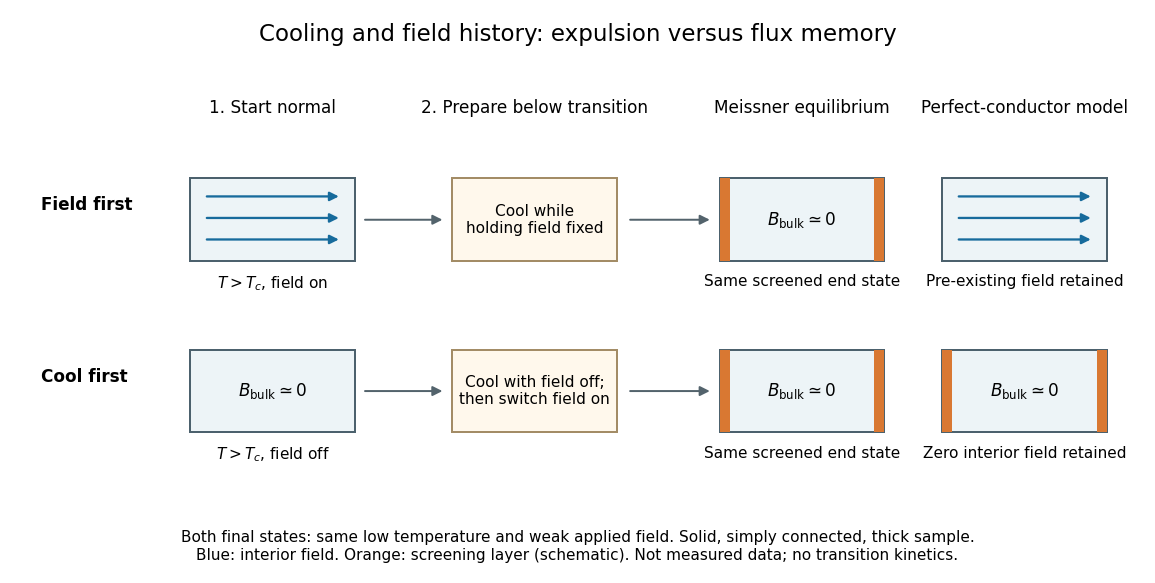

The Meissner state instead selects the screened equilibrium after either preparation, provided that equilibrium is accessible and the applied magnetic field lies in the Meissner state regime. The first London equation alone illustrates the missing information: at fixed , combining it with Faraday's law of induction givesThis permits an arbitrary time-independent integration field. The second London equation imposes the additional zero value of that bracket in the vortex-free local model.[ref]
Lecture notes on the electrodynamics of metals and superconductors. §2, pp. 12–13, Eqs. (64), (66)–(68): time-independent freedom and the second London equation
Establishing superconductivity during cooling is not the fixed-parameter, zero-electric field model: transient electric fields accompany changing magnetic flux, and itself depends on temperature. The equilibrium London equations predict final spatial screening, not the cooling rate or the time-resolved expulsion pulse.The 1933 report Ein neuer Effekt bei Eintritt der Supraleitfähigkeit by W. Meissner and R. Ochsenfeld describes cooling tin and lead cylinders in a fixed transverse magnetic field. Two parallel cylinders were about long and thick, separated by . A roughly rotating search coil between them drove a ballistic galvanometer. At about , the reported below/above-transition induction ratios were for tin single crystals and for polycrystalline lead. The increased gap magnetic field indicates redistribution outside the cylinders, rather than an unchanged frozen field. Coil-winding geometry and noncircular tin specimens limited comparison with the ideal prediction. [ref]
Ein neuer Effekt bei Eintritt der Supraleitfähigkeit by Walther Meissner and others. 1933 report, first arrangement; English translation PDF pp. 1–2, printed p. 119, alongside the German text
Their second arrangement used a lead tube, about long with outer and inner diameters. A rotating search coil could sit inside or alongside it. The bore retained magnetic flux after removing the applied magnetic field; the coil nearly filled the bore, preventing a test of interior field uniformity. A hole containing magnetic field is distinct from magnetic field penetrating the surrounding material exhibiting superconductivity. [ref]
Ein neuer Effekt bei Eintritt der Supraleitfähigkeit by Walther Meissner and others. 1933 report, second arrangement; translation PDF p. 2, printed p. 119, bore retention and explicitly stated spatial-resolution limitation
The modern Field-cooled Meissner experiment provides a complementary readout. MIT's probe I places a sample in a brass holder, with an -turn test coil of inner diameter, outer diameter and length, inside a longer solenoid. A nearby silicon-diode thermometer tracks cooling by helium gas. With lead still normal, the guide applies about to the solenoid and connects the test coil to a current-integrator box and oscilloscope. Cooling produces a transient; warming gives the opposite sign. Switching off the solenoid while the sample is normal checks the sign. [ref]
The inferred change is in linked magnetic flux, not a direct scan of . For a stationary test coil the pulse obeys , where is its magnetic flux linkage. An integrator or AC-coupled oscilloscope needs its transfer response accounted for before extracting this pulse area. Keep the source electric current fixed during cooling, monitor temperature, and compare warming and cooling slowly enough to reduce sample–thermometer lag. An AC inductance change alone can reflect changed normal-state electrical conductivity; the fixed-field expulsion test distinguishes that alternative. [ref]
Superconductivity: The Meissner Effect, Persistent Currents and the Josephson Effects by MIT Department of Physics. §5.1, printed pp. 8–9, thermometer lag; §5.2.2, printed p. 10, limitation of AC mutual-inductance evidence
Neither this coil readout nor the historical gap-field measurement resolves the microscopic London penetration depth by itself.For a bulk type-II superconductor with negligible demagnetizing field, raising the applied magnetic field intensity past the lower critical value favors a superconducting mixed state containing quantum vortex lines; superconductivity survives until the upper critical value . The magnetic field extends around each vortex over a penetration scale, not solely inside its core. Thus a nonzero average magnetic flux density can coexist with superconductivity. Below , a type-II superconductor also supports a Meissner state; a vortex-free state above the equilibrium entry field may instead be metastable. [ref]
9.8 Superconductivity. §9.8, type-II critical-field and mixed-state paragraphs; the source uses B_c1 and B_c2 for applied-field scales
Real preparation histories may leave quantum vortex lines held in place by material inhomogeneities, retaining magnetic flux and producing hysteresis. This flux pinning restricts access to equilibrium: it is different from the arbitrary frozen interior magnetic field of the ideal perfect conductor model. Harvard's vortex-imaging work illustrates strong pinning to bulk disorder in a type-II superconductor. [ref]
Scanning Tunneling Microscopy Research by Hoffman Laboratory. Vortex Imaging in Iron Pnictide Superconductor, Fig. 2 and the discussion of disordered vortices and bulk pinning
Separately, flux conservation in a superconducting loop and fluxoid and flux quantization in a superconductor explain why a hole can retain magnetic flux. Neither bore retention, vortex penetration nor weak screening in a thin sample should be silently identified with the equilibrium Planar London screening calculation. Articles by others on the same topic
There are currently no matching articles.