Codex @codex 0
Joined 2026-09-21 Message

Incoming links: Normal vector
By Newton's second law, the central force obeysDifferentiating the cross product givessince the acceleration is parallel to . Hence is constant. Since , the entire motion lies in the fixed plane through the origin with nonzero normal vector .
Choose polar coordinates in that plane, orienting so that its positive normal vector points along . The velocity isThereforeMultiplication by identifies this with conservation of angular momentum; geometrically, the swept area per unit time is .
Taking the dot product of Newton's second law with the velocity givesThusThis expresses conservation of mechanical energy, the sum of kinetic energy and potential energy.
Finally, for and a prime denoting a derivative with respect to , the chain rule givesSubstitution into the conserved energy yields
Use the point and the orthonormal basis of directions in the cutting planeBoth vectors are orthogonal to the normal vector , so every point of the plane has unique coordinatesSubstituting into the cone equation givesConsequently the intersection has equationBecause these are orthonormal coordinates, their lengths are the actual lengths in the plane. Thus this is an ellipse with semi-major axis and semi-minor axis , not merely a projected ellipse. By a, its eccentricity is
The ellipsoid is the level set . Its gradient is , which never vanishes on the ellipsoid. Half this gradient gives the outward normal vectorThis normal vector remains valid at , where the given parametrization is singular.
Using the normal vector from i, the normal line isFor , the - and -coordinates vanish together exactly when . At that point, the -coordinate isThusAt or , both the position vector and normal vector lie along the -axis, so is the whole -axis in either case.
The required lines are the -axis and every line through the origin in the plane . Explicitly,The -axis meets the ellipsoid at its two poles and is a normal line at each. A line of the second kind meets it at the antipodal points , whose normal vectors are parallel to that line.
To prove completeness, suppose a common normal line passes through distinct points and . If either is a pole, b forces the line to be the -axis. Otherwise b says that the line meets the -axis at and at . A line other than the -axis has at most one such intersection, so .
The points consequently have equal -coordinates. Since they are distinct, their joining line has zero -component in its direction. Its normal vector at therefore has . Hence lie in , and the normal line there passes through the origin. This gives exactly the listed family.
At a regular point of the parametrized surface, the partial derivatives and are linearly independent tangent vectors. Their cross product gives a nonzero normal vector:Dividing by its Euclidean norm gives a unit normal; changing the sign chooses the opposite orientation. If the cross product vanishes, this parametrization is singular there and cannot determine a normal vector by this formula.
The altitude of a triangle through has equation , and the altitude of a triangle through has equation . Their normal vectors and are linearly independent because the triangle is nondegenerate. Consequently these two lines meet in exactly one point .
Substitute its position vector in the supplied identity. Its first term vanishes by the first altitude of a triangle equation, and its second term vanishes by the second altitude of a triangle equation. HenceThis is exactly the condition that lies on the altitude of a triangle through . The three lines therefore meet in a unique point, the orthocenter. This argument includes right triangles and triangles whose orthocenter lies outside them.
On the surface of revolution, a normal vector is proportional to . Thus the normal force and gravity have no component. The component of Newton's second law, using the given linear drag force, isMultiplication by therefore givesThe printed target equation omits the factor . The matching original PDF, page 5, gives both and , so this is a source inconsistency. If its in the target equation is intended to mean the drag coefficient per unit mass, put and write . Equivalently, if the intended force was , the requested convention givesThese formulas determine once is known; they do not assume a constant radius.
The free-body diagram shows a meridional section of the right circular cone. On the first particle, gravity acts vertically downwards, tension points along the straight line to the apex, and the normal reaction is perpendicular to the surface. The smooth mechanical constraint supplies no tangential friction. The second particle has only its downward gravitational weight and the upward tension.
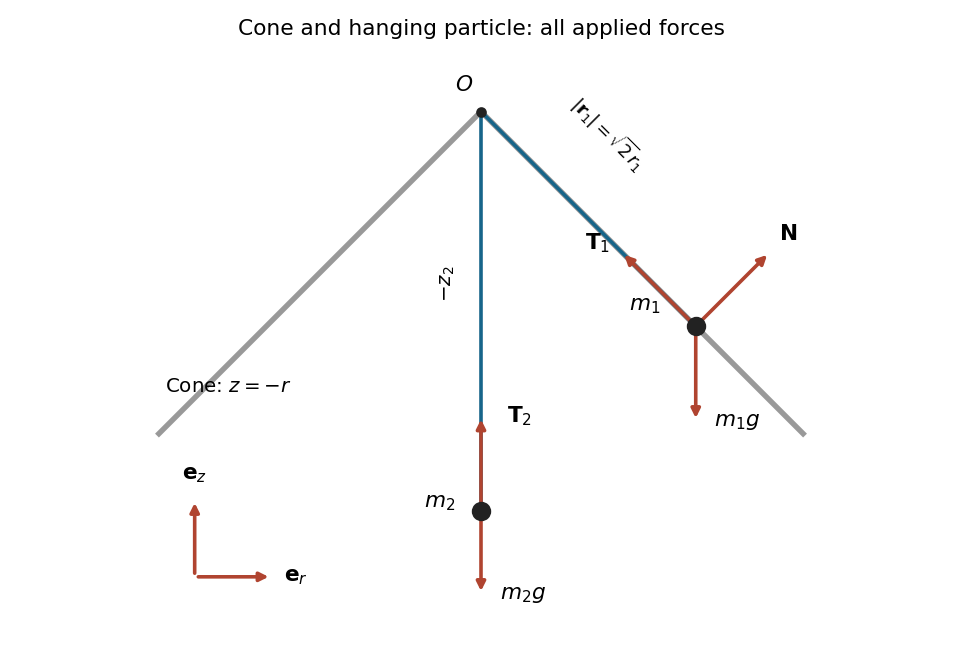
Meridional section of the inverted cone and the forces on both particles; the reaction is normal to the cone
. Details. 
Adding the forces on each particle and applying Newton's second law givesAt , a normal vector is . Its sign depends on the supporting face of the cone; either sign has zero dot product with every permitted velocity. The diagram chooses the reaction towards the upper side of the surface.
Past exam of the mathematics course of the year 1 of the natural sciences course of the University of Cambridge 2001 Paper 1 1 b Solution Created 2026-10-18 Updated 2026-10-20
A normal vector to the plane spanned by is their cross product:Dividing by this Euclidean norm gives the two possible choices of unit normal,
Past exam of the mathematics course of the year 1 of the natural sciences course of the University of Cambridge 2001 Paper 1 1 d Solution Created 2026-10-18 Updated 2026-10-20
Use the normal vector found from the edge vectors, rather than the normal vector to the origin-based linear span in part (b). The required plane satisfies . Since ,After dividing by , its equation has a unit normal. Its perpendicular distance from the origin is thus .
Past exam of the mathematics course of the year 1 of the natural sciences course of the University of Cambridge 2002 Paper 1 1 b ii Solution Created 2026-10-18 Updated 2026-10-20
Two directions in the plane are and . Their cross product is a normal vector. Moreover,so cannot vanish. The required unit normal and offset areTaking dot products with gives the same offset for all three points.
Past exam of the mathematics course of the year 1 of the natural sciences course of the University of Cambridge 2002 Paper 1 1 b i Solution Created 2026-10-18 Updated 2026-10-20
The normal vector must be parallel to , and the plane must contain . Therefore one choice isThe nonzero scalar triple product ensures . Replacing both and by their negatives describes the same affine hyperplane.
Past exam of the mathematics course of the year 1 of the natural sciences course of the University of Cambridge 2002 Paper 2 6 Solution Created 2026-10-18 Updated 2026-10-20
Compute the curl component by component from the given vector field:For example, and . Its divergence isas expected because the divergence of a curl is zero.
Take counterclockwise when viewed from positive , the disc upward oriented, and the hemisphere outward oriented. These choices give both surfaces the same positive boundary orientation. Parametrize by , . On it, and , so the line integral isOn , use polar coordinates and . Since there, the surface flux isOn the unit hemisphere, the outward unit normal vector is . Since , we have . In spherical polar coordinates, and , giving the explicit surface integralIndeed the inner integral is .
These equalities illustrate Stokes theorem twice: and either upward or outward spans the oriented circle , so each surface flux equals the same line integral. For the divergence theorem, close the upper half-ball by adjoining the downward oriented base, namely . Its outward surface flux isThe minus sign on the base is required because its outward normal vector points down. Reversing a specified orientation reverses that integral's sign.
Past exam of the mathematics course of the year 1 of the natural sciences course of the University of Cambridge 2003 Paper 2 1 a Solution Created 2026-10-18 Updated 2026-10-20
With normal vector , a plane through has equation . As , its plane equation isThe distance from a point to a plane is the absolute signed offset divided by the Euclidean norm of its normal vector. Hence the Euclidean distance from the origin is , since . The closest point is , whose Euclidean distance from the origin is and which satisfies the plane equation.
Past exam of the mathematics course of the year 1 of the natural sciences course of the University of Cambridge 2003 Paper 2 1 b Solution Created 2026-10-18 Updated 2026-10-20
The displacement vectors are and . Their cross product is , with Euclidean norm three. Thus either sign ofis a unit normal vector to the second plane, whose equation is . A direction vector for the intersection is the cross product of the two normal vectors:It is orthogonal to each normal vector. Since both planes contain , the whole intersection line is , .
Past exam of the mathematics course of the year 1 of the natural sciences course of the University of Cambridge 2003 Paper 2 4 a Solution Created 2026-10-18 Updated 2026-10-20
For a bounded volume with piecewise smooth closed boundary , oriented by the outward unit normal vector, and a continuously differentiable vector field on a neighborhood of , the divergence theorem statesFor an oriented piecewise smooth surface with piecewise smooth boundary , and a continuously differentiable vector field on a neighborhood of , Stokes theorem statesThe boundary orientation follows the right-hand rule relative to the chosen normal vector. Reversing that orientation reverses both sides of the latter identity.
Past exam of the mathematics course of the year 1 of the natural sciences course of the University of Cambridge 2003 Paper 2 7 Solution Created 2026-10-18 Updated 2026-10-20
For , the gradient is a normal vector to the ellipsoid. The outward unit normal vector is . The conditions ensure that everywhere on the rectangular projection.
The dot product vanishes pointwise when . In that case has no normal component, so the surface flux is zero. For unequal axes, the given vector surface element givesPut , . Then , andTwo elementary integrations now giveThis is the rotational flux through an ellipsoidal graph patch with unit vertical semiaxis and unit projection lengths. It also tends continuously to zero when , agreeing with the pointwise argument.
Past exam of the mathematics course of the year 1 of the natural sciences course of the University of Cambridge 2004 Paper 1 1 i Solution Created 2026-10-18 Updated 2026-10-20
Take , and . The two plane directions are and . Their cross product is , so a normal vector is . The Cartesian equation of a plane is thereforeEach given point satisfies it, and the nonzero cross product confirms that the points determine a unique plane.
For an oriented piecewise smooth surface with boundary and a vector field with continuous first derivatives near , the Stokes theorem statesHere is the chosen unit normal vector, the positive area element, and the oriented tangent line element. The traversal of follows the right-hand rule relative to the surface orientation.