A useful organizing principle is Gibbs free energy: at specified temperature and pressure a coupled process is favorable when its total is negative. For each chemical species,The relative amounts of chemical substances determine the available Gibbs free energy, beyond counting energy in individual bonds. Nutrient oxidation and light-driven chemistry can maintain nonequilibrium compositions. ATP hydrolysis can drive biosynthesis, transport and motion of molecular motors when reactions are coupled so that their total free-energy change is favorable. Breaking an inorganic phosphate bond itself costs energy; the favorable net hydrolysis includes formation and solvation of the products and depends on their thermodynamic activities.
Redox Gibbs free energy comes from transferring electrons between donors and acceptors: . Electron transfer in respiration or photosynthesis can help establish an electrochemical gradient. For a mole of ions moving from side 1 to side 2,The concentration and electrical terms together drive transport and can power ATP synthase. ATP-driven pumps can conversely build gradients. Chemiosmosis is the coupling between this gradient and chemical synthesis, not the creation of Gibbs free energy by an enzyme.
Mechanical work and elastic storage are other forms: a motor can do or , and an approximately Hookean element stores . ATP-driven motors convert Gibbs free energy into motion, while externally forced reverse motion can sometimes drive chemical synthesis. A photon brings energy ; light photon absorption initiates chemistry in photosynthesis and light-driven pumps, with some energy inevitably dissipated. Living cells use these conversions for structure, movement, homeostasis and synthesis, while releasing heat and exporting entropy. At a single uniform temperature, dissipated heat cannot be completely recycled into useful work.
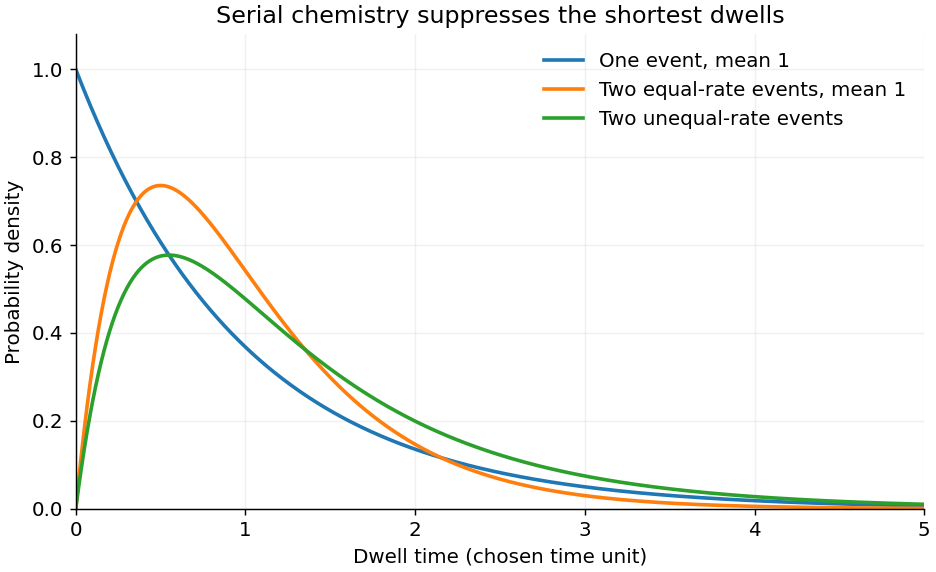
At saturating ATP, binding need no longer dominate the observed dwell, but saturation alone does not determine a dwell-time distribution. The standard interpretation of a distribution that rises from zero is that at least two sequential events remain rate limiting. Model a dwell as , where the independent waiting times are distributed according to exponential distributions with rates . Their convolution isThis hypoexponential distribution starts at zero, rises to a mode , then has an exponential tail. When the rates are equal, the continuous limit is the two-stage Erlang distribution,A single slow memoryless event instead gives , maximal at zero. Three 120-degree steps per revolution specify rotational stoichiometry, not three slow reactions within every dwell. The two-event interpretation is supported by the resolved catalytic-dwell chemical kinetics in the primary F1 experiment.[ref]
Resolution of distinct rotational substeps by submillisecond kinetic analysis of F1-ATPase by Ryohei Yasuda and others. 2001, abstract and Figure 8: two reactions occupy the catalytic dwell
The fit assumes sequential approximately irreversible events, constant rates during each dwell, negligible ATP-binding delay, negligible mechanical transit time, and detection of all relevant steps. Parallel pathways, backward transitions, inhibited states, probe drag and missed short dwells can change the histogram. The mathematical fit alone does not identify each event chemically or prove that two ATP molecules are hydrolyzed per step.

Let and use a one-molar standard state, so the inorganic phosphate activity is approximately . With the source's stated standard hydrolysis value,The downhill proton-transfer Gibbs free energy is for the signed driving force V. Ideal reversible balance of one complete turn requiresSolving yieldsAt 298.15 K the estimate is . Temperature is not specified in this paragraph; the first value explicitly adopts physiological temperature rather than pretending it is supplied. The unexpectedly large ADP/ATP ratio follows from using the printed standard value kJ/mol with the stated dilute inorganic phosphate. One must not silently replace that value by another convention or treat it as the already concentration-corrected cellular hydrolysis Gibbs free energy.
This estimate assumes ideal thermodynamic activities, consistent pH and magnesium conventions, tight coupling of ten protons to three ATP, no leak or transport overhead, and operation close to reversible balance. A working cell is not in global equilibrium. Net synthesis at this fixed driving force requires , hence above this reversible-balance threshold; finite chemical kinetics and dissipation prevent the stoichiometry alone from determining an exact physiological ratio.
Articles by others on the same topic
There are currently no matching articles.