The cover identifies Hilary Term 2021 but its date line says January 2020. The year here follows the term and the archived paper identity. Solutions cover all four questions.
Let on the tensor product . The linear map commutes with , so preserves its and eigenspaces, namely the symmetric square and the exterior square . Restricting the tensor product representation to these invariant subspaces defines and . The representation identity follows by restricting .
For a finite group, has finite order , so . Over the complex numbers, the polynomial has distinct roots; hence is diagonalizable. Choose an eigenbasis with eigenvalues . A basis of the symmetric square consists of and for . A basis of the exterior square consists of for . Their eigenvalues are respectively and . Taking traces,But and . Thus the characters areAt , these also give the dimensions and .
Write the two Pauli matrices asThey satisfy , and . Moving every to the left of every reduces each word to one of eight distinct matrices. ConsequentlyTaking , gives and , identifying the group with the dihedral group of a square.
The elements are central. Conjugating by changes its sign, and similarly for and . No conjugation mixes these pairs: modulo the central subgroup the quotient group is the Klein four-group and hence Abelian. Thus the conjugacy classes are preciselyThere are five complex irreducible representations, one for each conjugacy class. In a one-dimensional representation, the images of are signs . Since they commute, maps to , and all four choices of satisfy the relations. These are four inequivalent one-dimensional representations. The sum of squares of irreducible representation dimensions leaves for the fifth, so the dimensions are
Use the conjugacy class order of solution. The defining representation has characterIts character inner product with itself is , proving that it is an irreducible representation. There is also a direct invariant subspace argument: has two distinct coordinate eigenspaces, and exchanges them, so no line is invariant under both.
Let denote the one-dimensional representation with and . Then and . The complete character table isThe four scalar rows obey character orthogonality, and the dimensions exhaust the group order as established in solution.
The squares of are , whereas . Therefore . The symmetric square and exterior square formulas from solution giveComparison with the character table gives the Clebsch-Gordan decomposition of group representationsFor explicit bases, put . The symmetric tensors , , and transform as respectively. The antisymmetric tensor transforms as , also the determinant representation of . Adding these direct sums recovers .
Write a homogeneous quadratic polynomial as . Invariance under forces . Invariance under then forces . Since generate the group, this proves that all homogeneous quadratic polynomial invariants areThis agrees with the single trivial representation in the symmetric square in solution; more precisely, coordinate polynomials lie in the symmetric square of the dual representation, which here is equivalent to . If “quadratic” permits terms of smaller degree, arbitrary constants can be added. There are no invariant linear terms because negates every linear polynomial.
The symmetric group has three conjugacy classes, determined by cycle type: the identity, three transpositions, and two three-cycles. Hence it has three complex irreducible representations. Two are the trivial representation and the sign representation . Their dimensions are one, so the sum of squares of irreducible representation dimensions gives , whence for the remaining representation .
Write on these classes. Orthogonality to and gives and . Thus , and the character table isThe character of a tensor product representation is the product of the factor characters. Thus , , and . These determine all the Clebsch-Gordan decomposition of group representations:
For permutations , the prescribed linear maps satisfySince this holds on a basis, . Also and . Hence is a representation.
The trace of a permutation matrix counts its fixed coordinate basis vectors. There are respectively fixed vectors on the three conjugacy classes, so . ConsequentlyIn particular the sign representation is absent.
The two invariant subspaces areCoordinate permutations preserve both equal coordinates and the coordinate sum. Their dimensions add to three and their intersection is zero, so . On , the basis gives for every transposition.
On choose the basis , . Directly permuting their entries givesThus, taking images as columns, the matrices of the matrix representation areEach has trace zero and squares to . Their three-cycle products have trace , so this is exactly the two-dimensional irreducible representation of solution. These are all nonzero invariant subspaces affording individual irreducible representations, since each occurs once in solution.
First choose the same orthonormal basis for the left and right copies of the two-dimensional unitary representation . Then the family representation is . Because the barred fermion transforms with and the scalar field is a trivial representation, invariance of the Yukawa interaction requiresWrite in a block form. The off-diagonal blocks would be intertwiners between inequivalent irreducible representations and , so the Schur lemma makes them zero. The doublet block must be a scalar matrix, while the singlet block is arbitrary. ThereforeEquivalently, the allowed Yukawa interaction is , together with its Hermitian conjugate when constructing a real Lagrangian. The tensor product rules explain the two free parameters: both and contain one trivial representation, while the mixed products contain none.
There is a useful basis qualification. The basis used in solution is not orthonormal: its Gram matrix is , and . If the fields are expressed in exactly those coordinates, with the barred components defined by ordinary conjugate transpose, the invariant doublet coefficient is , rather than . Canonically normalizing the kinetic term returns the boxed form. Independently chosen left and right orthonormal bases replace by , where is their fixed unitary intertwiner; the physical degeneracy is unchanged.
After the scalar field obtains a vacuum expectation value , the fermion mass matrix in a canonically normalized basis is . Physical masses are its singular values, not arbitrary entries or signed eigenvalues. ThusThe independent Yukawa coupling can fit the tau lepton mass relative to the doublet scale, but the electron and muon are predicted to have equal masses. The values supplied by the paper instead give . Consequently exact unbroken with this representation assignment cannot reproduce all three masses. Complex phases of , or changes of basis, cannot split the two equal singular values. Additional breaking of the symmetry or a different field content would be needed; the discrepancy cannot be removed merely by choosing different invariant Yukawa couplings.
Use Dynkin labels , so the rows of the Cartan matrix are the simple roots expressed in fundamental weight coordinates. For the A2 root system,Starting at the highest weight and subtracting successive allowed simple roots gives . Negating these weights gives the dual representation. Hence the two fundamental weight systems areEach listed weight has weight multiplicity one. The highest weight is the highest root, so its representation is the Adjoint representation. Its nonzero weights are the six roots, while the Cartan subalgebra supplies the zero weight twice:The superscript indicates weight multiplicity. This also follows from : the nine tensor product weights comprise six differences of distinct fundamental weights and three zeros, one zero belonging to the trivial representation.
For an A2 root system weight , the specified electric charge and flavour hypercharge are the linear functionalsApply these to the meson octet weights in solution. The results, with electric charges measured in units of the positive elementary electric charge, areThe table illustrates the meson octet of pseudoscalar mesons; the same weight calculation applies to another meson species arranged in the same representation. Here flavour hypercharge is , with the baryon number and the strangeness, rather than weak hypercharge. If the full quark model tensor product is retained, its additional trivial representation is a ninth meson with . This singlet is separate from the octet and need not share its mass.
Order the simple roots of the G2 root system with long and short. This ordering is consistent with the supplied projection in solution; reversing the nodes would interchange the two fundamental Dynkin labels. Choose , , and . With the same row convention for the Cartan matrix as in solution,The positive roots, with their Dynkin labels, areFor the highest weight , a lowering chain isThe middle three terms form the length-three weight string for the short simple root. The Weyl dimension formula, with this long-first convention, isIt gives seven for , so the chain exhausts the weight system, with every weight multiplicity equal to one:For , observe that is the highest root. Thus this is the Adjoint representation; the twelve root spaces contribute the twelve nonzero weights once, and the rank-two Cartan subalgebra contributes two zero weights. ThereforeThe same Weyl dimension formula gives fourteen, confirming the count.
The highest root is . In the Extended Dynkin diagram, the extra node is long and is joined by a single bond to the long node ; it is orthogonal to the short node . Deleting the short node therefore leaves the A2 root system Dynkin diagram. Equivalently, the six long roots are a closed root subsystem, so their root spaces together with the Cartan subalgebra form an A2 root system Lie subalgebra. The corresponding compact subgroup is .
For the particular projection in the paper, choose the A2 root system simple roots as and . Since these are long, and . Consequently the Dynkin labels restrict asProjecting the six short roots gives . Group these into the three weights of and the three of listed in solution. The zero weight of is left over, soThe three positive long roots project as , and . Together with their negatives and the two zero weights, these are exactly the Adjoint representation . The remaining six short roots again give . Hence the branching of a representation is
A G2 multiplet containing the known meson octet must restrict to a representation containing . Among the two fundamental representations just computed, fails this test, while the Adjoint representation contains the required octet. Thus the minimal such choice isLarger representations containing an octet would be other model choices; the octet alone does not force a unique arbitrarily large representation.
A dual vector must be pulled back by , since . Applying this to the electric charge and flavour hypercharge vectors givesThus a G2 root system weight has . This pullback ensures that every known octet meson retains its values from solution. The extra gives six additional mesons, one at each ofFor instance the first three come from the G2 root system weights , and ; the other three come from their negatives. The weight diagram displays the preserved octet and the new states.
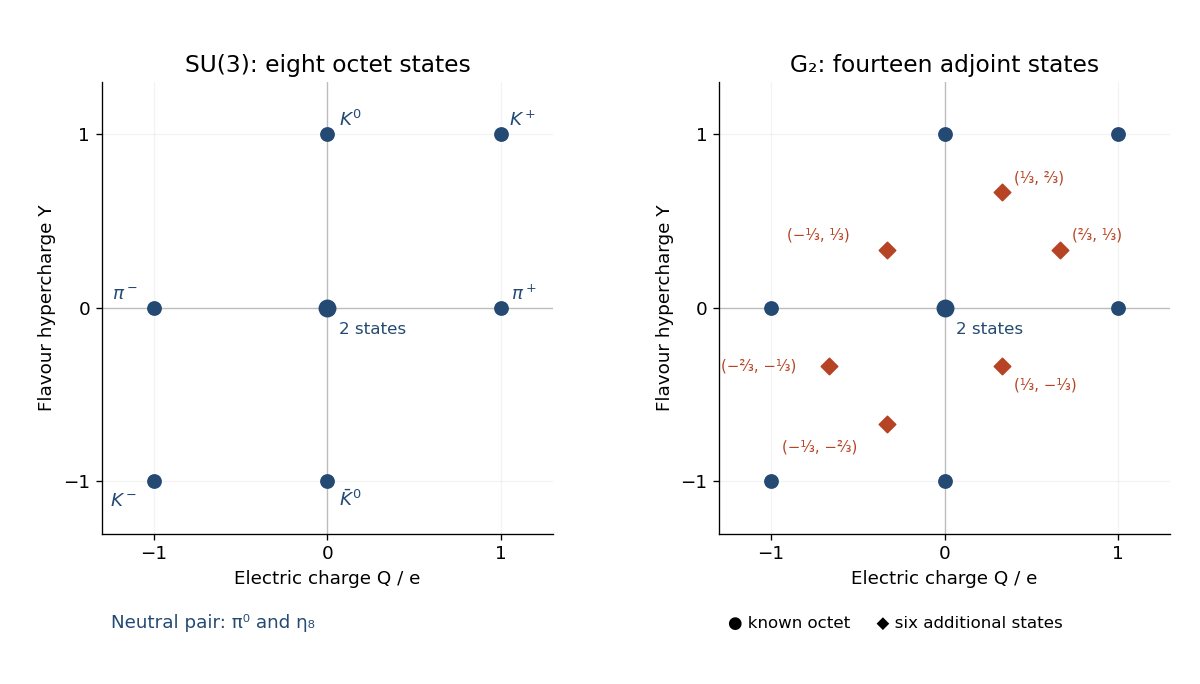

The fractional electric charges make these additional states qualitatively different from ordinary quark-antiquark mesons, whose electric charges are integers. This is a consequence of the proposed symmetry extension, not evidence for such particles. If “known mesons” also includes a flavour singlet from , that singlet can be accommodated by a separate G2 trivial representation: the minimal octet-plus-singlet construction is then , still with six new states. A demand for one irreducible G2 multiplet containing the entire nonet is a different extra assumption; alone does not contain that singlet.
For , Dynkin labels correspond to a Young diagram with row lengths . Numbered boxes below give representative Young tableaux; they specify the shapes, not additional component values:Here the dimensions are , , , and . The third is the dual representation : the invariant volume tensor identifies . The last is the Adjoint representation, equivalent to the shape Young symmetrizer construction after converting its three-box column to one lower index and removing the trace.
For , the tensor transformation laws areThese preserve antisymmetry and tracelessness. The Adjoint representation can be treated as complex traceless matrices; a real adjoint scalar field is conventionally represented by Hermitian traceless matrices with the same conjugation action.
Adding one box to the one-box Young diagram gives row shapes and . Thus the first tensor product splits into the symmetric square and exterior square:Their tensors are respectively and . Adding one box to the three-box column gives shapes and . The full four-box column is the determinant representation, trivial because . ConsequentlyFor a mixed tensor , the corresponding pieces are and .
Under the two-block subgroup , the defining vector space splits into its first and last two coordinates. ThereforeFor the exterior square, the exterior square of a direct sum identity gives two within-block determinant representations, each trivial for , and the cross-block tensor product . For the Adjoint representation, use : each diagonal two-by-two block contributes a scalar and a traceless triplet, while each off-diagonal block gives because the SU(2) doublet is self-dual. Removing the overall trace leaves one scalar. The dimension counts are , , and .
Under , the first three coordinates carry the defining SU(3) representation and the fourth is fixed. HenceIndeed . The upper three-by-three block of a traceless matrix supplies the Adjoint representation and one scalar, while the upper-right and lower-left blocks give and . This establishes the branching of a representation in each case without a dimension-only guess.
An unbroken subgroup must fix the vacuum expectation value itself. Thus a nonzero -invariant vacuum expectation value can exist only if the restriction of a representation to contains a trivial representation. Applying the singlet criterion for an unbroken subgroup to solution givesThe two “no” entries are forbidden for every nonzero vacuum expectation value. Each “yes” means that the indicated subgroup can remain unbroken, subject to the scalar potential choosing such a vacuum. It does not by itself prove that the indicated subgroup is the entire stabilizer.
For exact spontaneous symmetry breaking to the stated subgroup, the distinction matters. A complex admits an exact stabilizer; a complex admits an exact stabilizer. A single preserving or necessarily preserves an additional continuous , as computed in solution, so neither exact endpoint is possible with that single field. Also, if the scalar field is constrained to the real structure of the SU4 exterior square, its nonzero stabilizer is larger than . The paper does not specify whether this reality constraint is imposed, so both cases are distinguished below.
The fundamental case. Set , where . Fixing this vector forces the fourth column of a unitary matrix to be , and hence also fixes its fourth row. The remaining three-by-three block has determinant one. ThereforeEvery nonzero complex vector can be brought to this form by an SU(4) transformation: complete its normalized direction to a unitary basis and adjust the phase of a complementary basis vector to obtain determinant one. Thus a generic nonzero fundamental vacuum expectation value has a conjugate of as its exact unbroken subgroup. The particular embedded of the question is fixed only when the vacuum expectation value lies along .
The antisymmetric case. With , takeSince for , this antisymmetric tensor is fixed by for every . Its transformation is , so any stabilizing also preservesIf , its two eigenspaces force with unitary two-by-two blocks. For each nonzero block, forces the block determinant to be one. If one block is zero, the SU(4) determinant condition forces the other block determinant to be one as well. HenceThe unitary skew-diagonalization of an antisymmetric matrix shows that a generic complex has two distinct paired singular values; choosing an SU(4) rather than a basis merely leaves an allowed overall phase in . Thus its generic stabilizer is conjugate to .
If instead , the form is proportional, up to unitary coordinates and phases, to a nondegenerate standard symplectic form. Its stabilizer is the compact symplectic group , of dimension ten, containing properly. The explicit choice is a concrete counterexample to inferring an exact stabilizer from the existence of two singlets alone. For a real , the real structure of the SU4 exterior square imposes in this form, so these equal magnitudes are compulsory. Every nonzero real therefore has the larger compact symplectic group stabilizer. The zero vacuum expectation value preserves all of .
The adjoint cases. The -fixed and -fixed traceless matrices have respectively the formsFor a Hermitian adjoint scalar field, choose real. More generally a complex gives the same stabilizers. The repeated eigenvalues implyHere means that the product of the block determinants is one. These groups contain respectively and , together with an additional continuous . Explicit extra transformations are and . They commute with and for every , proving that neither exact endpoint or occurs for a single adjoint vacuum expectation value.
Nor do these larger subgroups survive for a generic Hermitian traceless matrix: four distinct eigenvalues leave only the maximal torus . For a generic complex adjoint matrix, there need not even be a continuous stabilizer; generically its unitary centralizer is just the centre of a group . Thus the displayed degenerate adjoint directions are special. All these statements concern the stabilizer of a possible vacuum expectation value; no unspecified scalar potential can be assumed to select a particular direction or a particular reality condition.
Articles by others on the same topic
There are currently no matching articles.