[ref]
https://www.whatdotheyknow.com/request/natural_science_tripos_physics_e_2/response/2340776/attach/2/FOI%202023%20399%20Zahid%20materials.pdf?cookie_passthrough=1. Original public PDF, physical pages 583–585; dated 26 April 2013
For an isolated approximately spherical mass distribution outside its luminous extent, retain the gravitational force and use the specified low-acceleration inertial law. circular motion then givesThe radius cancels when enclosed luminous mass is effectively constant. This is the asymptotic modified Newtonian dynamics result associated with the baryonic Tully-Fisher relation; an arbitrary extended disk cannot everywhere be replaced exactly by a point mass.
At the disk edge,Using givesThis is an order-of-magnitude isolated, low-acceleration estimate. The edge acceleration is below , but not extremely small compared with it; a full interpolation law, disk geometry and an external gravitational field can affect a more precise mass fit.
For the spherical mass profile for a flat rotation curve, assume spherical symmetry where the halo dominates. A flat rotation curve gives , and differentiating yieldsHere is the density of the spherical gravitating model; it is not an exact deprojection of a thin luminous disk or a proof that the central density must diverge. At the outermost stated measured radius,This gives the requested galaxy-plus-halo mass estimate if the model is truncated at the outermost observed radius . The observation itself constrains enclosed mass within ; any additional outer halo remains unconstrained. Extending to infinity would give divergent mass. Subtracting the MOND-inferred luminous mass to obtain a Newtonian halo mass would mix independent model-dependent estimates without an independently measured luminous mass.
In the Bullet Cluster collision, most observed baryonic mass is hot gas. ram pressure slows and shocks the gas, while the galaxies pass through much more freely. weak gravitational lensing maps the projected gravitational mass without requiring that the gas be in hydrostatic equilibrium. The dominant lensing peaks lie closer to the galaxies than to the displaced X-ray gas. This supports a dominant weakly collisional dark matter component under the usual gravity model. It is stronger evidence than a mass-to-light discrepancy alone because distinct components separate during the same encounter. The inference needs background-source shape/redshift calibration, projection control and uncertainty in the lensing reconstruction; it does not identify a WIMP species or by itself exclude every modified-gravity theory.[ref]
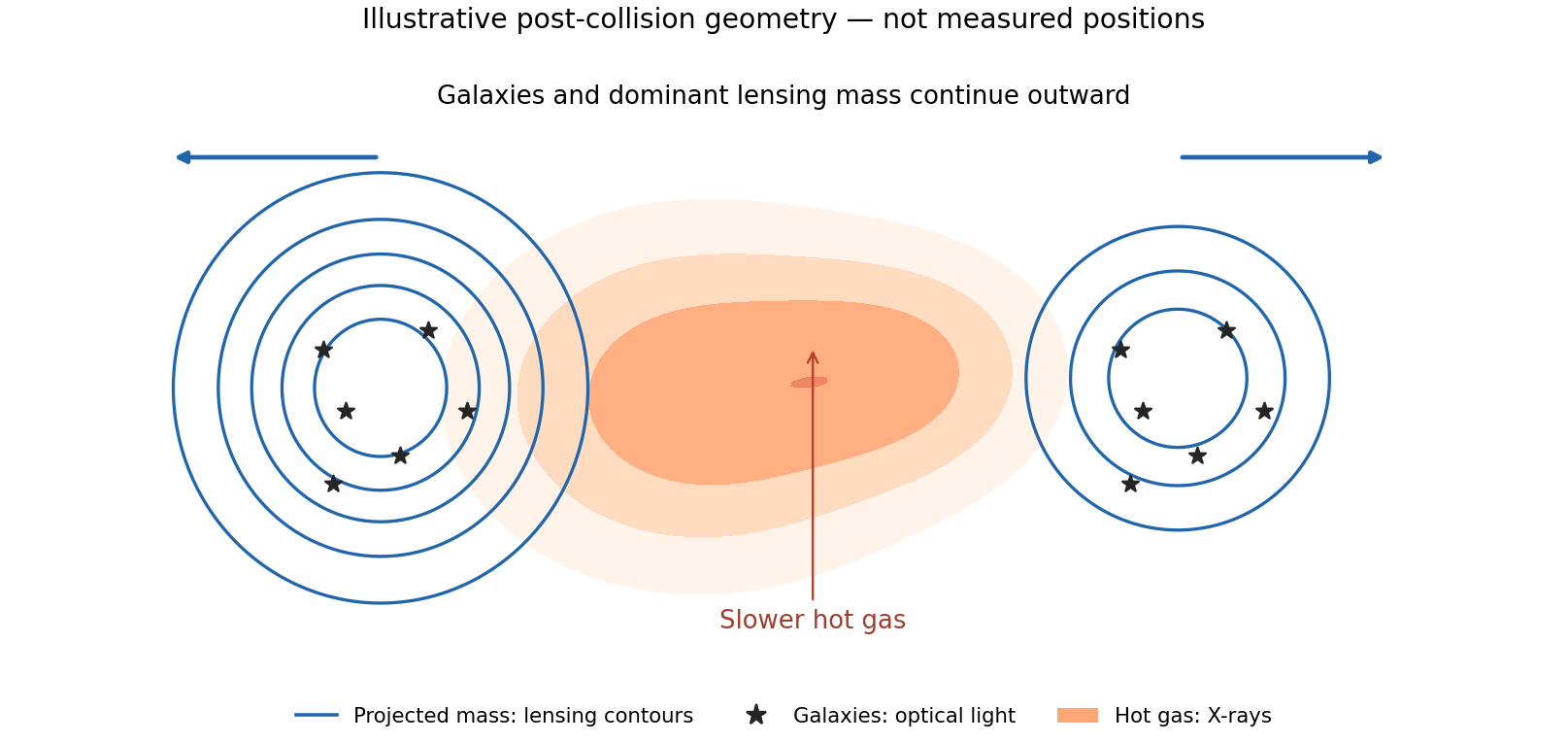
Original conceptual merger sketch showing galaxies and dominant lensing mass displaced from slowed X-ray gas; illustrative positions, not observational data
. Details. 
For dark-matter direct detection, consider XENON100 at Gran Sasso. A halo WIMP can undergo elastic scattering from a xenon atomic nucleus, leaving a recoil of only a few to tens of keV. The expected rate is very low, so a large target, low threshold and long exposure must be combined with background rejection. The nuclear-recoil kinematics of WIMP scattering gives in the nonrelativistic limit, where is the reduced mass and masses and velocities use consistent units. This explains why low-energy response calibration matters.
The dual-phase xenon detector measures prompt particle scintillation S1 and delayed electroluminescence S2 from ionization electrons extracted into gas. Their time separation gives interaction depth; the S2 light pattern supplies transverse position. An inner fiducial volume uses xenon's self-shielding to suppress external backgrounds. The S2/S1 distribution statistically separates nuclear recoils from electron recoils; it is not perfect event-by-event identification. Underground siting reduces cosmic-ray backgrounds, while passive shielding, low-radioactivity components, xenon purification and a surrounding active detector veto reduce other events.[ref]
The XENON100 Dark Matter Experiment by the XENON100 Collaboration. Sections 2–3, two-phase detection, detector design and background control
Neutrons can also make nuclear recoils, so charge-to-light discrimination alone cannot eliminate them. Multiple-scatter rejection, shielding and background modelling remain necessary. Gamma-source and neutron-source calibrations map electron- and nuclear-recoil distributions, energy scale and selection acceptance. Position-dependent light collection and charge losses need correction; photon-counting fluctuations and uncertain low-energy yields limit threshold sensitivity. Blind event selection and independent sidebands guard against tuning cuts to apparent candidates. The 224.6-live-day, 34 kg search found two benchmark candidates against about one expected background event, consistent with background. Its interaction limit therefore depends on the assumed halo distribution, WIMP mass and nuclear response; it is not a detection or an exclusion of all dark matter.[ref]
Dark Matter Results from 225 Live Days of XENON100 Data by the XENON100 Collaboration. Printed pp. 2–4, calibrations, blind selection and backgrounds; abstract for exposure and result
A grand unified theory embeds the strong and electroweak gauge groups in a larger group, for example . quarks and leptons can belong to common representations, while heavy extra gauge or scalar bosons connect them. The resulting interactions can violate baryon number, unlike ordinary perturbative Standard Model reactions. Running gauge couplings and proton-decay searches test such ideas; unification is a theoretical possibility, not an established observation.[ref]
Unified Gauge Theories and the Baryon Number of the Universe by Motohiko Yoshimura. Abstract, early-universe baryon-number-violating reactions in unified theories; later erratum noted in source record
baryogenesis must explain why a nearly matter-antimatter-symmetric early state evolves into a surviving baryon asymmetry. In the usual local CPT-invariant framework, the Sakharov conditions require baryon-number violation, C and CP violation, and departure from thermal equilibrium. baryon conservation would forbid creating a net excess; exact conjugation symmetries would pair baryon-producing processes with equal antibaryon production; equilibrium with no imposed asymmetry would erase a source term through detailed balance.
For heavy particles and , let decay channels carry different baryon numbers. CP-violating interference can make their branching fractions differ, even though CPT symmetry requires equal total widths. Defining the mean baryon number produced per decay as , an out-of-equilibrium abundance can generate of order times its initial number per entropy, reduced by inefficient production and washout. A rough condition is that decays become effective after inverse production has ceased, with the relevant reaction rate compared with the Hubble parameter. Complex couplings alone do not guarantee a nonzero rate asymmetry: a relative absorptive phase is also needed.
Survival matters as much as production. Electroweak sphalerons violate while conserving baryon-minus-lepton number , so a minimal GUT-generated asymmetry with can be washed out if sphalerons and the other relevant reactions equilibrate. Generating nonzero , as in suitable heavy-Majorana-neutrino leptogenesis, can avoid this problem. A viable GUT baryogenesis model must generate an asymmetry and demonstrate that subsequent reactions do not erase it. The Sakharov conditions are necessary ingredients under these assumptions, not a numerical prediction of the observed abundance.
supersymmetry pairs bosonic and fermionic degrees of freedom; broken supersymmetry permits partners heavier than known particles. At the Large Hadron Collider, strong production of squarks and gluinos is an important channel. If R-parity is conserved, partners are produced in pairs and their cascades end in a stable lightest supersymmetric particle. A neutral weakly interacting lightest supersymmetric particle escapes, giving missing transverse momentum together with jets and possibly leptons. Conservation is tested transversely because the initial parton longitudinal momenta are unknown.
The experimental observable isneutrinos produce genuine missing transverse momentum, and calorimeter mismeasurement or detector defects can imitate it. Searches use jet multiplicity, transverse momenta, missing momentum, angular separation cuts and a collider effective mass such as . Isolated-lepton selections explore complementary cascades. Trigger efficiency, jet energy scale, collision pileup and event cleaning affect acceptance.
A credible search estimates backgrounds from particle-physics control regions before inspecting the signal region. Invisible plus jets can be constrained using photon-plus-jets or visible samples with control-region transfer factors. Lepton-enriched samples constrain and top backgrounds with lost leptons; multijet samples constrain fake missing momentum. A joint likelihood includes these observations and nuisance parameters for systematic uncertainties. Agreement with background gives upper bounds on signal rate and conditional mass exclusions. The pre-examination ATLAS 7 TeV analysis is a concrete example of this strategy and reported no significant excess.[ref]
Search for squarks and gluinos with the ATLAS detector in final states with jets and missing transverse momentum using 4.7 fb^-1 of sqrt(s) = 7 TeV proton-proton collision data by ATLAS Collaboration. Sections III, IX and XI, control-region likelihood and background estimates; abstract for the null result
Electroweak production motivates multilepton searches; compressed spectra can give soft visible decay products and require special selections such as recoil against initial-state radiation. R-parity violation can instead remove the stable missing-particle signature, requiring other searches. An exclusion always depends on masses, branching fractions, production rates and decay assumptions; a null jets-plus-missing-momentum result does not exclude supersymmetry as a whole.
A gravitational wave produces a time-dependent tidal distortion. For a normally incident plus-polarized wave in the long-wavelength limit, two perpendicular freely suspended arms change by and . Their differential length is thereforefor a simple round-trip Michelson interferometer. LIGO uses kilometre-scale orthogonal arms with optical cavities that enhance the phase response, a stabilized laser and suspended mirrors in vacuum. As an illustrative scale, across a 4 km arm corresponds to differential length . The measured quantity is returning light phase, not mirror displacement against a rigid external ruler. Optical storage and control loops give a frequency-dependent calibrated response.
Seismic and terrestrial disturbances dominate low frequencies, thermal motion of suspensions and mirror coatings contributes at intermediate frequencies, and photon shot noise limits high-frequency readout. Isolation and suspension systems reduce ground coupling; low-loss materials reduce thermal noise; vacuum suppresses gas scattering and forces. Greater optical power reduces shot noise but increases radiation-pressure fluctuations and thermal demands. Stable optical alignment and feedback are essential, yet their own sensor and actuator noise must be controlled. These are engineering requirements because the desired strain is extraordinarily small.[ref]
LIGO: The Laser Interferometer Gravitational-Wave Observatory by B. P. Abbott and others. Instrument configuration and detector-noise discussion; primary initial-LIGO account
A candidate should appear coherently at separated observatories with consistent propagation delay and antenna response. Auxiliary environmental monitors, calibration injections and time-shifted coincidence backgrounds test instrumental explanations. Matched filtering is powerful for modelled compact-binary chirps; coherent burst searches allow less predictable signals. Binary-pulsar orbital energy loss already provided indirect evidence for gravitational radiation before 2013, but it is distinct from directly measuring passing waves.[ref]
Binary Pulsars and Relativistic Gravity by Joseph Hooton Taylor Jr.. Binary-pulsar orbital-decay test of relativistic gravity
At the examination date, direct detection remained a search objective. Reliable detection requires both sufficient strain sensitivity and a demonstrated astrophysical signal rather than correlated or accidental noise.The cosmic microwave background is relic thermal radiation from the hot early universe. Its temperature anisotropy is expanded in spherical harmonics, with angular power spectrum . Thomson scattering of a local radiation quadrupole generates linear polarization around last scattering and again during reionization. Polarization maps are decomposed into E-mode polarization and B-mode polarization, giving spectra such as , and in addition to temperature information.
Cosmic microwave background acoustic peak positions compare the sound horizon with the angular-diameter distance to last scattering, constraining geometry and expansion history. Relative peak heights constrain baryon loading and matter-radiation equality; the damping tail constrains diffusion and other early-universe physics. The scalar spectral index and primordial scalar amplitude constrain inflationary perturbations. Coherent acoustic structure and temperature-polarization correlations support predominantly adiabatic initial perturbations. Large-angle E-mode polarization measures the reionization optical depth, helping break its degeneracy with the scalar amplitude inferred from small-scale temperature anisotropy.
Under a specified cosmological model, these data constrain ordinary and cold dark matter densities, the Hubble constant, spatial curvature and cosmic age. Complementary distance information helps break the geometrical degeneracy: temperature peaks alone do not uniquely establish a cosmological constant. The Planck 2013 parameter analysis used Planck temperature data and, in important combinations, WMAP low-multipole polarization; it should not be described as a full Planck polarization release.[ref]
Linear scalar cosmological perturbations generate E-mode polarization but no primordial B-mode polarization in the simplest treatment. tensor cosmological perturbations can generate B-mode polarization, making them a possible probe of inflationary gravitational waves. gravitational lensing converts some E-mode power into B-mode polarization, however, and Galactic dust and synchrotron radiation also contribute polarized foregrounds. Multifrequency observations, foreground modelling, beam calibration and control of temperature-to-polarization leakage are therefore necessary. Polarization does not by itself establish a primordial tensor signal. temperature and polarization jointly test the expansion history and primordial perturbations, while complementary data and foreground control determine how uniquely parameters can be inferred.
For a homogeneous canonical scalar field, and . Potential-energy domination gives , accelerated expansion and a decreasing comoving Hubble radius. Hubble friction can permit slow roll down a sufficiently flat potential. Enough inflation stretches an initially small causally connected region to encompass our observable universe, suppresses the relative spatial-curvature term and dilutes unwanted massive relics. quantum fluctuations supply possible seeds for cosmological structure; a successful model must also end inflation and create the hot post-inflationary universe. These statements do not imply that arbitrary initial conditions inevitably inflate.
Use the stated reduced-Planck units throughout the field calculation. Differentiating the Friedmann constraint and substituting the field equation givesDivision assumes the nontrivial expanding branch ; the vacuum endpoint follows continuously.
During rapid oscillations, require and . To leading order, , while the Friedmann constraint gives . ThusAveraging over many oscillations on a timescale still short compared with givesThe quadratic-inflaton Hubble oscillations obey, to leading order in ,Differentiating this expression reproduces the cosine term, with smaller corrections from the slowly varying amplitude. Instantaneously remains nonincreasing because its exact derivative is ; an oscillatory correction does not mean oscillatory growth of the total Hubble parameter.
The mean equation integrates toThe shift is set by matching to the earlier evolution, not necessarily the Big Bang origin of the full solution. Averaged kinetic and potential energies are equal, so , and . The coherent quadratic oscillations behave as pressureless matter, not radiation, even though they are a scalar field rather than a gas of cold particles. radiation would instead give . The averaged approximation is controlled only after oscillations are fast compared with expansion.
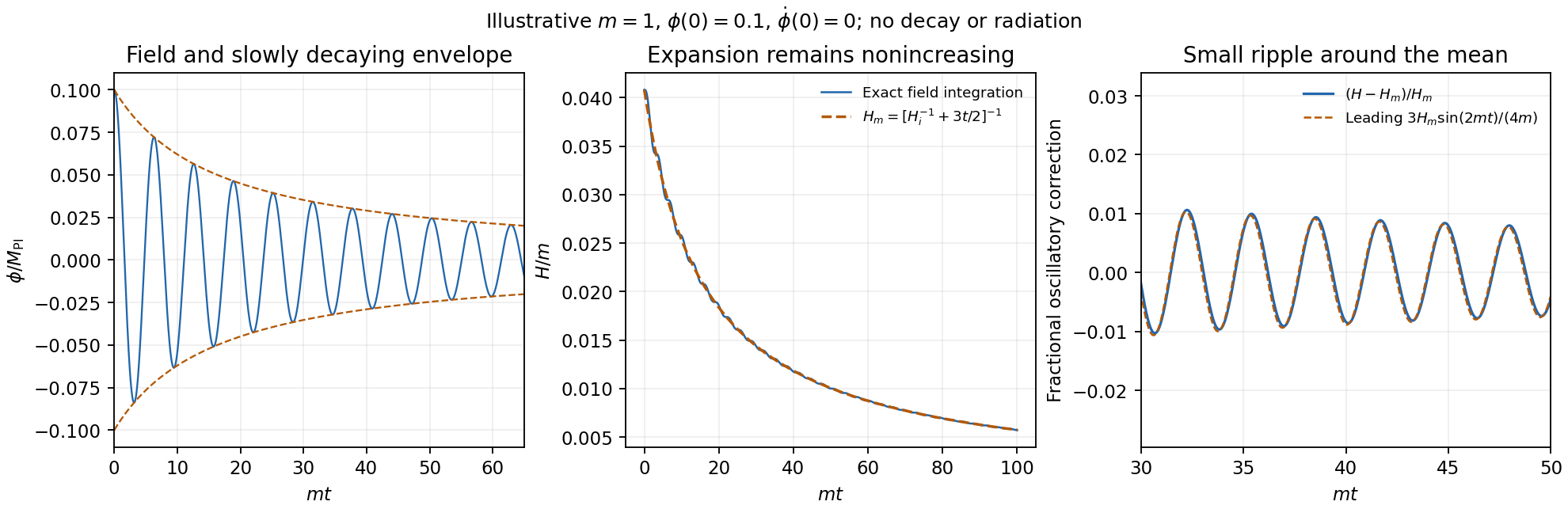
Original dimensionless scalar-field integration showing a decaying oscillation envelope and a nonincreasing Hubble parameter with a matter-like average
. Details. 
reheating requires interactions beyond the isolated field equations above. The oscillating inflaton can decay into other particles, whose scattering and further decays establish a thermal bath. The perturbative inflaton reheating equations areExpansion redshifts the components differently; transfer becomes efficient around , and radiation domination follows when the transferred relativistic energy dominates. For suitable couplings, nonperturbative preheating by parametric resonance can precede thermalization, with backreaction and rescattering affecting its completion. Neither the decay rate nor thermalization is specified by and alone. Instantaneous reheating idealizes all this as immediate conversion of the end-of-inflation energy to radiation.[ref]
Towards the Theory of Reheating After Inflation by Lev Kofman and others. Abstract and Introduction: perturbative decay, resonant preheating, backreaction and thermalization
For instantaneous-reheating horizon matching, specify the comparison: take the initial patch to be of order , compare the same-shaped inflationary history with approximately fixed , and assume instantaneous reheating followed by adiabatic expansion. Ignoring changes in relativistic degrees of freedom, , while energy conservation and the Friedmann equation give . The present size of this inflated patch therefore scales asAt fixed present Hubble radius, a higher instantaneous reheating scale requires more e-folds in this standard comparison, approximately , up to slow scale and entropy-degree corrections. Hotter reheating gives more subsequent expansion, but the associated initial Hubble patch is smaller by a stronger power of temperature. If instead one artificially holds the initial physical patch or fixed while varying the end energy independently, the post-inflationary geometric effect alone would give the opposite trend. temperature without an inflation-scale comparison convention does not fix that alternative problem; this is why the matching assumptions must be stated.[ref]
Articles by others on the same topic
There are currently no matching articles.