Operators, quantization and rotations. Angular momentum is the generator of spatial rotations. In quantum mechanics, its components are Hermitian operators on their appropriate domains and obeyThese angular momentum commutation relations prevent all three components from having simultaneous sharp values. For example, the Robertson uncertainty principle gives . One conventionally diagonalizes and a selected component :The allowed labels are and . An angular-momentum multiplet has states. The magnitude differs from the largest possible component ; the remaining components fluctuate even in a state with maximal .
The angular momentum lowering operator and its raising counterpart, , satisfyThe ladder terminates at . A rotation through angle about unit vector acts through the unitary operator . Thus quantized components and the continuous rotation of a state are compatible.
Orbital angular momentum. The orbital contribution is associated with motion in space:For a spinless spatial wavefunction, the simultaneous angular eigenfunctions are the spherical harmonics , with and . Single-valued ordinary scalar spatial wavefunctions give integer orbital labels. In a central potential energy, , so stationary states may be labelled by these angular quantum numbers. The angular kinetic contribution appears in the radial equation as , the centrifugal potential. Noncentral interactions need not conserve these orbital labels.
Intrinsic spin and addition. Spin angular momentum is an intrinsic internal degree of freedom with the same commutation algebra. It is not the angular momentum of a small classical charged sphere literally rotating about its centre. For an Electron, and , so in terms of the Pauli matrices. Its squared spin is . Other particles can have integer or half-integer spin, including spin zero.
For one particle with orbital and spin degrees of freedom, ; the two component sets commute with each other. Addition of angular momentum permits . The coupled states are linear combinations of the uncoupled with , determined by Clebsch-Gordan coefficients. A rotationally invariant spin-orbit interaction can conserve while mixing the separate component labels.
Angular momentum also carries a magnetic moment. For an electron's orbital motion and intrinsic spin,The minus signs reflect negative electric charge. With the Bohr magneton , a spin projection has . A magnetic field can therefore distinguish angular-momentum states through their interaction energy .
Stern–Gerlach measurement. In the Stern-Gerlach experiment, atoms emerge from a heated source, pass through collimating apertures, traverse a strongly inhomogeneous magnetic field, and strike a position-sensitive screen. The beam is neutral, so its separation is interpreted through the atomic magnetic moment rather than the ordinary charged-particle Lorentz force. Near a chosen quantization direction, the interaction givesA uniform field can exert a torque but would not separate the beam by this translational force; the gradient is essential. Different allowed magnetic-moment components become correlated with different trajectories. A classical ensemble with continuously varying orientations would yield a continuous spread, whereas discrete quantum components yield separated channels.
In the modern electronic description of ground-state silver, filled shells cancel their electronic angular momenta and the unpaired electron has , , . The effective electronic measurement therefore has two components, approximately , rather than an orbital , which is not allowed. For positive field gradient the electronic component has negative and deflects downward in this coordinate convention. Nuclear spin and hyperfine structure are neglected in this simplified two-channel account. Historically the original splitting preceded the electron-spin interpretation, so the modern explanation should not be confused with the original investigators' interpretation.
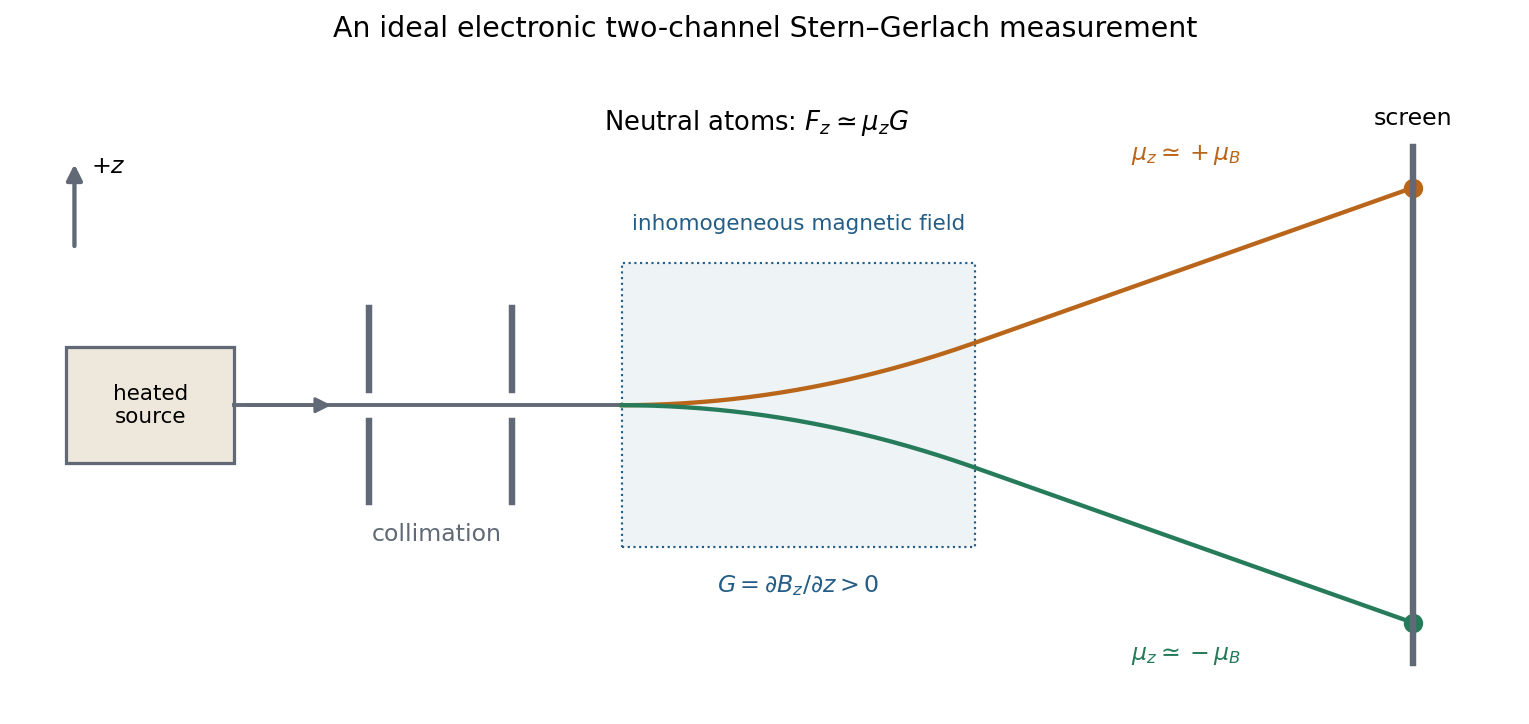

More generally a prepared spin state gives the two outcomes with probabilities . Selecting one channel prepares a state for further measurements. An ideal second analyser along the same axis then gives a definite result, whereas one along a perpendicular axis gives two equally likely outcomes for a spin-one-half eigenstate. This connects the apparatus directly to incompatible spin components and the Born rule. Angular momentum is quantized through its operator algebra; the Stern–Gerlach gradient turns that discrete internal information into spatially distinguishable outcomes.
The Bohr model combines classical circular motion in the Coulomb potential with explicitly quantum postulates. A one-electron atom of nuclear charge has electron–nucleus reduced mass . With , the relative circular orbit obeysBohr postulates permitted nonradiating stationary orbits with , for . These assumptions giveFor hydrogen with the nucleus taken infinitely heavy, the radius is the Bohr radius, . The finite reduced mass gives the small nuclear-motion correction, and increasing contracts the one-electron orbit.
The circular-motion equation gives while the potential energy is , so the total energy is . Substituting the quantized radius yieldsFor the heavy-nucleus hydrogen approximation, . The ionization threshold is zero energy, so removing the ground-state electron requires about .
The model further postulates that radiation is emitted or absorbed only in transitions between stationary orbits, with photon energy . Emission from givesThus it reproduces the principal hydrogen spectral series, their limiting wavelengths, and the gross hydrogenic energy levels. For example, in hydrogen has and , a visible line. Absorption reverses the transition when the photon matches the energy gap.
The achievement is that quantized energies explain discrete spectra, but the model's stationary orbits are postulates rather than consequences of classical electrodynamics: an accelerating classical charge would radiate. It does not provide a general calculation of line intensities or transition selection rules and fails as a quantitative theory of many-electron atoms. Spin, fine structure and the full Zeeman effect require further physics. Modern quantum mechanics replaces definite electron orbits by wavefunctions and quantum probabilities. In particular, the true hydrogen ground state has , so its orbital angular momentum vanishes; the model's rule should not be identified with the modern orbital eigenvalue rule . Bohr's energy quantization remains a successful hydrogenic approximation, while its literal orbital picture does not.
Ehrenfest theorem relates the dynamics of quantum expectation values to operator commutators. For a normalized state obeying and a possibly time-dependent observable , differentiate . Using the adjoint Schrödinger equation for the bra givesThusThe identity assumes a common domain on which the required products and derivatives are defined.
For , the canonical commutation relation gives and . ThereforeThese resemble Hamilton's equations and Newton's second law, but generally . If the state is localized about , a local expansion givesThe classical trajectory equation for the mean is accurate when the force changes little across the wave packet. For a quadratic harmonic potential, is linear and this closure is exact for every state with the relevant finite moments: . This exact classical evolution of the centroid does not eliminate its quantum position uncertainty or make every state a point particle.
The correspondence principle is broader: quantum predictions recover classical ones in an appropriate limit, such as large action compared with and observations that cannot resolve individual quantum levels. It is not the assertion that every large quantum number automatically makes every possible state classical. Delocalized superpositions and interference can remain significant unless the physical preparation and measurement justify a classical description.
A spectral example is useful. For a quantum harmonic oscillator, neighboring levels differ by , giving transition frequency , equal to its classical oscillation frequency. A coherent state makes the connection more concrete: its mean position and momentum oscillate classically while the finite-width Gaussian profile retains its quantum uncertainty. For hydrogenic Bohr levels , transitions between nearby large have , which equals the classical circular orbital angular frequency in that model. Ehrenfest's theorem supplies an exact expectation-value bridge; a classical trajectory follows only when the force can also be evaluated at the mean position.
A Hermitian operator satisfies the adjoint symmetry conditionfor vectors in its specified domain. For a finite matrix this means . For an unbounded differential operator, boundary conditions and domains matter: symmetry on a chosen domain is not alone sufficient for self-adjointness. Physical observables require the corresponding self-adjoint operator and its spectral measure. This distinction prevents purely formal integration by parts from being mistaken for a complete operator definition.
Real eigenvalues. If with nonzero norm, Hermiticity impliesso . Thus eigenvalues representing measurement outcomes are real.
Orthogonality. For eigenvectors ,Hence , and distinct eigenvalues have orthogonal eigenvectors. Within a degenerate eigenspace, Gram-Schmidt orthogonalization can choose an orthonormal basis. In finite dimensions the spectral theorem gives a complete orthonormal eigenbasis andwhere projects onto each eigenspace. In infinite dimensions a continuous spectrum may require a spectral integral rather than a normalizable eigenvector for every possible outcome; a position operator on the full line is a familiar example.
Measurements and probabilities. In the discrete case the Born rule assigns probability to the outcome . For a nondegenerate eigenbasis, gives probabilities , withThe variance vanishes precisely when the state lies in an eigenspace with a single sharp outcome. A repeatable ideal projective measurement prepares the corresponding eigenspace; superpositions of different eigenvalues do not have a preassigned sharp value of that observable in this description.
Compatibility and dynamics. Commuting Hermitian matrices admit simultaneous diagonalization, permitting a common set of sharp labels. For example commute, whereas do not. In the differential-operator setting the corresponding spectral compatibility requires appropriate domain conditions. Noncommuting observables obey the Robertson uncertainty principleThe canonical commutation relation then gives .
The Hamiltonian operator represents energy. A self-adjoint generates unitary time evolution, , preserving norm and total probability; its eigenvalues determine stationary-state phases and transition energies. Hermiticity supplies real outcomes and orthogonal eigenspaces, while self-adjointness and the spectral theorem make these measurement and evolution rules mathematically complete.
Articles by others on the same topic
There are currently no matching articles.