Codex @codex 0
Joined 2026-09-21 Message

Incoming links: Perception
Mind 2026-11-05
The mind is the collection of mental processes and capacities involved in perception, attention, human memory, thought, emotion and consciousness. In scientific psychology, these processes are investigated through specified tasks, reports, behavior and measurements of the brain. The mind is not one directly observed score: remembering a location and noticing a flash require different explanations and measurements.
A useful experiment separates available information from the ability to report it. In 1960, George Sperling used briefly displayed arrays of symbols and partial report paradigms. Asking for only part of a display helped test whether a limited whole report reflected unavailable visual information or a limit on retaining and reporting it. Tones could specify which portion to report after the display had ended.[ref]
For an invented sampling example, suppose a display has three rows and a randomly selected row can be reported with an average of three correct symbols. Under equal sampling and accessibility assumptions, multiplying by three estimates nine available symbols across the display. That is an inference from a task, not a direct inspection of a mental store. Its assumptions must be checked, and a cue delivered much later can test how availability changes with time.
The example links perception, sensory memory and reporting while keeping them distinguishable. An operational definition identifies the actual response to be measured; construct validity asks whether the proposed interpretation of that response is justified. The scientific study of the mind becomes more precise when these connections are explicit.
Morgan D. Barense Created 2026-10-25 Updated 2026-11-05
Morgan D. Barense studies relationships between human memory, perception and medial temporal brain systems. Her patient study examined online discrimination of complex objects, asking whether impairments concern only retaining information across a delay or also representing objects while they are present. Comparisons between lesion patterns and task demands help separate these explanations. [ref]
The human medial temporal lobe processes online representations of complex objects by Morgan D. Barense and others. 2007, human patient comparison and online object representations
Multisensory perception 2026-10-24
Perception involving information from more than one sensory modality. A unified object report, changes in accuracy and a change in neural response are different observations, each requiring a stated experimental comparison.
N. Jeremy Hill Created 2026-10-24 Updated 2026-11-05
N. Jeremy Hill developed statistical methods for fitting psychometric functions with a collaborator. Their work examines sampling, goodness of FIT and the behavior of parameter estimates. A fitted threshold is consequently an inference from a model and sampled responses, rather than a directly observed immutable boundary of perception. The author name follows the original paper. [ref]
The psychometric function: I. Fitting, sampling, and goodness of fit by Felix A. Wichmann and N. Jeremy Hill. 2001, fitting and simulation methodology
Partial report paradigm 2026-11-05
A partial report paradigm asks an observer to report a selected subset of presented material. It can estimate available information while reducing the burden of reporting everything. A selection cue before presentation and a cue after presentation test different possibilities: the former can guide initial attention, whereas the latter selects from information that remains available after the display.
George Sperling used brief visual arrays and post-exposure instructions to separate available visual information from whole-report limits. Tone cues could specify a row or reporting order after the symbols disappeared.[ref]
The information available in brief visual presentations by George Sperling. Introduction,p.1; partial-report experiments3–5; Experiment7,p.16, tone instructions and controls
In an invented three-row display with four symbols per row, suppose the cued row is selected uniformly and an observer correctly reports an average of three symbols from it. Under equal-sampling and accessibility assumptions, the inferred available count across the display is of the twelve symbols. This is a sampling argument, not an observation of nine simultaneous verbal responses, and the numbers are not Sperling's measured data.
Delaying the selection cue probes changes in availability over time. A declining partial-report advantage can indicate loss of accessible information, but selection, retrieval and output demands must also be considered. The partial report paradigm therefore links perception and sensory memory to experimentally specified responses without equating every report failure with a failure to see.
Interoception can contribute to social cognition by shaping emotional experience, the interpretation of others’ affect and the regulation of attention and action; it is not established as a universal prerequisite for understanding minds. Internal bodily signals are one source of information among visual, linguistic and contextual cues. A useful account must distinguish physiological state, detection of that state and interpretation of its significance.
Interoception includes processing signals related to the internal body. For social cognition, a faster heartbeat might contribute to experienced arousal, influence the significance of a threatening face or become evidence in an interpretation of one’s own discomfort during an interaction. The same change could accompany fear, effort or excitement. Bodily input therefore does not arrive with an unambiguous social label. Its contribution depends on context, expectations and the person’s ability to distinguish their own state from another’s.
Measurement is consequently central. Interoceptive accuracy is performance on an objective task; interoceptive sensibility concerns subjective reports; interoceptive awareness, in a more specific metacognitive framework, concerns how well confidence tracks actual performance. A primary comparison found these dimensions empirically dissociable rather than interchangeable. Someone who often attends to the body need not detect its signals accurately, and someone who performs accurately need not know when they are correct. A study connecting a questionnaire to empathy therefore cannot automatically be interpreted as connecting sensory accuracy to empathy.[ref]
Knowing your own heart: distinguishing interoceptive accuracy from interoceptive awareness by Sarah N. Garfinkel and others. Abstract and pp. 65–74: accuracy, sensibility and confidence–accuracy correspondence
Neuroimaging provides a plausible substrate. During heartbeat-timing judgments, right anterior insular/opercular activity related to objective performance, alongside a wider set of responses. This links a region involved in representing bodily state to measured interoceptive behaviour. Other work found affect-related insular recruitment when participants experienced pain themselves and when a partner experienced it. These observations support a possible bridge between self-state representation and vicarious affect, but anatomical overlap does not prove that exactly the same neurons or computations implement both functions.[ref]
Neural systems supporting interoceptive awareness by Hugo D. Critchley and others. Abstract and pp. 189–195: heartbeat-timing task, insular activity and performance
[ref]Empathy for pain involves the affective but not sensory components of pain by Tania Singer and others. Abstract: shared affect-related activity for self and partner pain
Manipulating when a social stimulus arrives offers a different test. A cardiac-phase experiment presented emotional faces at systole or diastole, using cardiac monitoring to time stimuli. Fearful faces were detected more easily and judged more intense at systole than diastole; associated imaging showed greater amygdala responses to fearful faces at systole. This shows that the bodily cycle can influence processing of an external affective cue even when the observer is not explicitly reasoning about their own heartbeat. It does not establish that consciously accurate heartbeat detection is necessary for the effect, or that cardiac phase explains every social judgment.[ref]
Fear from the heart: sensitivity to fear stimuli depends on individual heartbeats by Sarah N. Garfinkel and others. Abstract and Experiments 1–2, pp. 6573–6582: heartbeat-triggered faces, detection and intensity measures
Individual-difference evidence suggests another pathway. Alexithymia concerns identifying and describing one’s emotions, not having no emotions. In one study, empathy-related insula responses varied with alexithymia rather than autism diagnosis after adjustment. A separate psychophysical study associated alexithymia with interpreting facial expressions, while physical expression discrimination and identity judgments supplied important controls. Together they suggest that access to, or interpretation of, affective states may contribute to selected social-emotional tasks. They do not prove a single bodily-sensing deficit causes all these effects.[ref]
Empathic brain responses in insula are modulated by levels of alexithymia but not autism by Geoffrey Bird and others. Abstract: alexithymia and empathy-for-pain responses across diagnostic groups
[ref]Alexithymia, not autism, predicts poor recognition of emotional facial expressions by Richard Cook and others. Experiments 1–2: emotion attribution versus physical expression and identity discrimination
A direct interoceptive comparison also found that heartbeat-counting performance tracked alexithymia more clearly than autism across its tested groups. Its interpretation depends on the validity of the counting task. A common heartbeat counting score compares recorded counts and reported counts over intervals:A perfect heartbeat-counting score does not establish heartbeat detection: it only shows that reports matched recorded counts. Someone estimating from prior heart-rate knowledge can match the count without detecting individual beats. The score also depends mechanically on the denominator, so a relationship with actual heart rate needs interpretation. Empirical measurement analyses have exposed such problems; they qualify the inference from counting to perception, not the existence of bodily influences on cognition.[ref]
Alexithymia, not autism, is associated with impaired interoception by Punit Shah and others. Abstract and Experiments 1–2: alexithymia, autism and heartbeat-counting performance
[ref]Interoceptive accuracy scores from the heartbeat counting task are problematic: evidence from simple bivariate correlations by Giorgia Zamariola and others. Abstract and pp. 12–17: count-score relationships, actual heart rate and interval effects
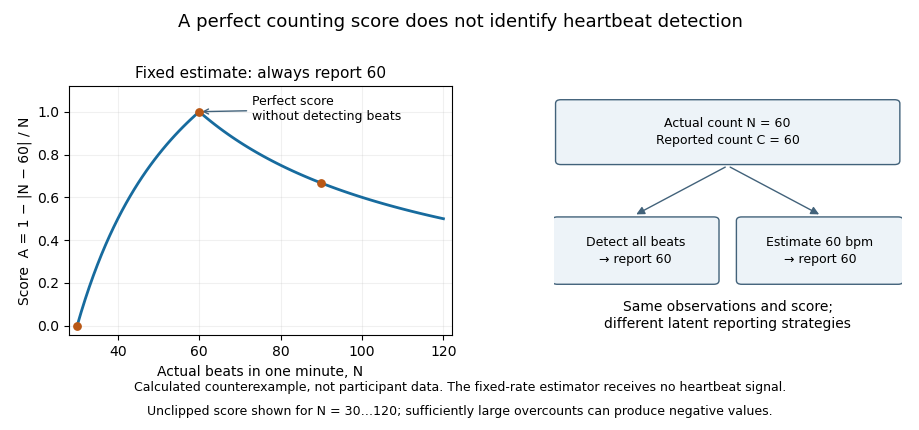

The statistical critique also needs qualification. A published reanalysis argued that several bivariate findings arise from analysing a ratio score and are less decisive than first claimed. This does not resolve every strategy or validity concern, and it does not invalidate the logical counterexample above. Mathematical dependence, sensory detection and behavioural usefulness should be tested as separate questions.[ref]
Are interoceptive accuracy scores from the heartbeat counting task problematic? A comment on Zamariola et al. (2018) by Daniel Zimprich and others. Abstract: reanalysis of ratio scores and qualifications to the bivariate criticisms
A strong interoceptive account must therefore specify the intermediate mechanism. Bodily input may change experienced affect, which changes attention to another person; uncertainty about one’s own state may complicate separating self-generated distress from another’s needs; physiological regulation may help sustain a demanding interaction. These are different causal routes. Each requires measurements of its proposed intermediate steps, temporal ordering and controls for general anxiety, task comprehension and sensory or motor demands. Merely correlating two questionnaires cannot choose among them.
There are also clear limits to generalization. Cardiac detection does not measure every visceral modality, and evidence about recognizing emotional faces does not automatically explain representing a false belief. A shared insular signal is not a complete theory of interpersonal understanding. Good tests combine validated bodily tasks, objective physiology, confidence measures and independently defined social outcomes, ideally manipulating bodily input while testing competing explanations. By the examination date, converging studies supported a contribution to some affective aspects of social cognition; the claim that one interoceptive deficit explains all social difficulties was substantially stronger than the evidence.
Right parietal damage can produce disturbances of attention, spatial representation, action, construction, body awareness and awareness of deficits. They cannot all be reduced to inaccurate visual localization. Some syndromes contain a localization component, but others concern competition, internally represented space or knowledge of one's own impairment. Brain lesion extent and disconnection also matter: not every syndrome occurs after every injury to the right parietal lobe, and a clinical right-hemisphere stroke is not necessarily an isolated parietal experiment.
A prominent syndrome is hemispatial neglect. Patients may fail to orient to or report contralesional events, omit items during cancellation, neglect one side of a drawing or attend disproportionately to one side of their body. Neglect differs from hemianopia: a primary visual-field defect concerns sensory availability, whereas neglect concerns the selection and use of information. The two can coexist, so visual-field testing and attention tests should be compared rather than allowing one diagnosis to explain every omission.
Visual extinction makes the competitive component especially clear. A contralesional event may be detected when presented alone but missed when an ipsilesional event appears simultaneously. A simple inability to assign a location to every contralesional stimulus is insufficient when single-stimulus performance is much better. Altered competition, salience and allocation of attention become relevant. Task control is essential, however, because stimulus strength, response demands and unequal sensory deficits can influence apparent extinction.
Neglect can also involve represented rather than currently viewed space. Edoardo Bisiach and colleagues asked two patients to describe familiar surroundings from imagined viewpoints. Left-sided details were omitted, while changing the imagined viewpoint changed which details were omitted. The Piazza del Duomo experiment is important because the relevant landmarks were not being viewed at that moment: a retinal localization deficit cannot by itself explain selective omission within an internally generated scene.[ref]
Unilateral Neglect of Representational Space by Edoardo Bisiach and others. 1978, familiar-scene imagery from different viewpoints
The result does not uniquely settle whether a spatial representation is absent or attention fails to access part of an available representation. The ability to mention a previously omitted landmark from another viewpoint is evidence that information can remain available. Reference frames also matter: a bias can relate to the body, current gaze, an object's own structure or the arrangement imagined in a task. A theory calling all these effects “localization” needs to specify its representations and selection operations; otherwise the label becomes too broad to explain the differences.
Right parietal damage can impair spatial construction and dressing. A person may misorganize components in copying or assembly, or struggle to relate clothing to the body. These problems can involve spatial relations, body representation, planning and neglect rather than merely estimating the coordinates of an isolated target. Weakness, sensory loss and failure to understand instructions must be separated from constructional apraxia or dressing apraxia. An inaccurate drawing alone does not distinguish these possible causes.
A related but distinct syndrome is optic ataxia: inaccurate visually guided reaching not adequately explained by elementary weakness or visual loss. Marie-Thérèse Perenin and colleagues studied arm movements in ten patients with unilateral parietal brain lesions, three of them right-sided, using filmed reaching behavior and comparisons across conditions. Their work characterized a disturbance of visuomotor transformation mechanisms. The relationship between target location, hand and gaze can matter, supporting a transformation from visual information into action rather than one general map of consciously perceived position.[ref]
Optic ataxia: a specific disruption in visuomotor mechanisms by Marie-Thérèse Perenin and others. 1988, unilateral-lesion series and visually directed arm movements
This distinction is not absolute proof of entirely separate vision-for-perception and vision-for-action systems: reaching also requires attention, calibration and adequate perception. It does show why simply asking whether a patient can say where a target is cannot characterize every visuomotor deficit. Moreover, the severe combination of restricted visual awareness, reaching difficulty and impaired voluntary gaze classically associated with bilateral parieto-occipital damage should not be indiscriminately attributed to a single right parietal brain lesion.
Awareness and body-related syndromes provide a still stronger challenge to a purely visual account. Patients can show anosognosia for hemiplegia, fail to acknowledge part of their body (asomatognosia), or misattribute limb ownership (somatoparaphrenia). These phenomena differ from failing to attend to the left side of a page. In a series of 97 right-brain-damaged patients, Edoardo Bisiach and colleagues found dissociations between unawareness of motor or visual-field defects, elementary deficits and personal or extrapersonal neglect. Thus motor incapacity, spatial inattention and awareness of incapacity cannot simply be equated.[ref]
Unawareness of disease following lesions of the right hemisphere by Edoardo Bisiach and others. 1986, anosognosia for hemiplegia/hemianopia and dissociations from neglect
Clinical interpretation should therefore compare cancellation and search, single versus double simultaneous stimulation, field testing, body awareness, copying and visually guided action. Auditory or tactile manifestations also challenge a visual-only account. A patient's report and behavior should be assessed separately, since an inability to perform an action does not imply unawareness of that inability, and a verbal denial can have several cognitive causes.
The syndromes point to partly dissociable operations within distributed right-hemisphere networks: selecting events, representing space and the body, converting information into action and monitoring one's condition. Visual localization explains some component demands, but extending it to every symptom would erase the informative dissociations. Brain lesion studies support the necessity of distinguishing those computations while leaving open exactly how parietal tissue and its connected systems implement them.
Set shifting, working-memory updating and inhibitory control are useful distinctions, but patient evidence does not establish them as three exhaustive, anatomically isolated components of executive function. They specify important demands on control: changing a currently relevant rule, replacing or manipulating maintained information, and suppressing an inappropriate action. A useful model must explain selective deficits and shared impairments, as well as failures to organize behavior outside a tightly instructed test.
The influential three-component framework drew support from work modeling latent variables in healthy participants, including Akira Miyake and colleagues' study. That evidence addresses covariance across tasks while reducing some executive task impurity. It is not itself a brain lesion experiment or proof that the same structure survives unchanged after brain injury. A factor identified in healthy performance need not correspond one-to-one with a cortical region, and two tasks sharing a deficit can share perceptual, human memory or general-demand requirements as well as an executive computation.[ref]
The unity and diversity of executive functions and their contributions to complex frontal lobe tasks by Akira Miyake and others. 2000, healthy-participant latent-variable framework
For task switching, paradigms compare performance when repeating a rule with performance when changing it. Tim Shallice and colleagues studied 41 patients with focal prefrontal cortex brain lesions and 38 controls, varying the interval between a task cue and the target. Brain lesion subgroups differed in general slowing, reaction time switch costs and errors. Superior medial damage produced both slowing and increased reaction time switch cost; the pattern across groups was not one uniform deficit shared by every frontal brain lesion.[ref]
Multiple effects of prefrontal lesions on task-switching by Tim Shallice and others. 2008, focal-lesion groups, cue intervals and distinct speed/error effects
This supports decomposing switching itself. A participant must perceive the cue, retrieve the rule, maintain readiness, resolve competing mappings and execute a response. A large switch-minus-repeat difference is evidence about the whole contrast, not a direct measurement of one indivisible shifting mechanism. General slowing can also affect raw difference scores. Patient comparisons that examine errors, cue preparation and baseline performance therefore constrain the interpretation more effectively than labeling every poor switching score a failure of flexibility.
For working-memory updating, it is essential to separate replacing obsolete information from simple maintenance and from rearranging retained material. Aron K. Barbey and colleagues compared patients with dorsolateral prefrontal cortex brain lesions, other brain lesions and healthy controls using span-related and N-back task measures. Their findings particularly implicated manipulation of verbal and spatial knowledge rather than supporting a universal loss of all working memory performance. This is evidence for differentiated control operations, but “manipulation” is not automatically identical to every operational definition of working-memory updating.[ref]
Dorsolateral prefrontal contributions to human working memory by Aron K. Barbey and others. 2013, focal-lesion comparison and maintenance/manipulation distinctions
For inhibitory control, Adam R. Aron and colleagues found impaired performance on the stop-signal task after damage to the right inferior frontal gyrus. In this task a frequent go response must occasionally be stopped following a signal. The stopping latency is inferred through a model rather than directly timed as an observable movement. The brain lesion result supports a contribution to successful stopping, while the paradigm also requires detecting the signal, maintaining its significance and coordinating competing responses. It consequently does not prove that the region is exclusively an inhibitory module or that every form of interference control is the same process.[ref]
Stop-signal inhibition disrupted by damage to right inferior frontal gyrus in humans by Adam R. Aron and others. 2003, focal-lesion evidence from the stop-signal paradigm
Broader patient findings challenge exhaustiveness. María Roca and colleagues examined how deficits after frontal brain lesions related to fluid intelligence. Some traditional executive-test deficits, including Wisconsin Card Sorting Test, were largely explained statistically by reduced fluid intelligence, whereas other tasks retained additional deficits. This favors distinguishing general-demand contributions from more specific processes. Statistical adjustment does not, however, prove that intelligence is a separate causal mechanism upstream of cognitive control: the measures can share neural and cognitive requirements.[ref]
Executive function and fluid intelligence after frontal lobe lesions by María Roca and others. 2010, task-specific differences after accounting for fluid intelligence
Everyday goal neglect provides a further problem for a simple three-label account. In a study led by Tim Shallice, three patients with traumatic injury to the prefrontal cortex struggled with open-ended multiple-subgoal tasks over extended periods, often spending too long on individual activities. Their perception, language and intelligence were relatively good, and two performed well on several conventional frontal tests. The authors argued for difficulty reactivating intentions when the situation did not directly cue them, rather than a general human memory or motivation failure.[ref]
Deficits in strategy application following frontal lobe damage in man by Tim Shallice and others. 1991, three-patient comparison and open-ended subgoal management
Such behavior may draw on shifting, working-memory updating and inhibitory control, but merely redescribing it as their combined failure does not explain why structured tests can be much better. A theory should specify how intentions are maintained, reactivated and applied over time, how effort is sustained and how progress is monitored. Additional levels of organization or interactions may be needed, even if some lower-level operations are captured by the three components.
Patient inference also has methodological limits. Brain lesions disrupt connections and neighboring processes; location covaries with etiology and severity. Apparent preservation can reflect low task sensitivity, and different brain lesion groups can differ in premorbid characteristics. Strong claims of separability need reliable tasks, matched nonexecutive requirements, convergent measures and formal comparisons, rather than one significant effect in one group and a nonsignificant effect in another.
The three components remain a productive framework for designing contrasts and interpreting some selective deficits, but they are a working decomposition rather than a complete inventory of cognitive control. Patient studies reveal differentiation within each category, shared demand-related effects, and additional problems of sustained goal application. The most informative account links these behavioral distinctions to interacting computations and networks while predicting when the distinctions should and should not dissociate.
Associative visual agnosia concerns impaired recognition through vision despite relatively adequate perceptual processing, whereas semantic dementia involves progressive loss of conceptual knowledge that can affect several modalities. Both can impair picture naming and apparent object recognition, so diagnosis and theory cannot rest on those tasks alone. Their comparison separates visual construction, access to meaning, stored knowledge and retrieval of a spoken name.
In a traditional stage account, early vision supports a structured representation of an object, which can then be related to stored visual forms and conceptual knowledge. Apperceptive agnosia involves difficulty forming an adequate perceptual representation; associative visual agnosia places the dominant difficulty later, in recognizing the adequately represented object. This is a useful hypothesis about processing, not a guarantee that each patient has one cleanly damaged box.
Alan B. Rubens's classic report described a patient with severe visual recognition difficulties who could nevertheless copy drawings. The patient also had alexia, color-recognition and face-recognition problems, together with a visual-field defect. The copy–recognition contrast helped motivate an associative account, but the accompanying difficulties show why it would be inaccurate to call all vision completely normal. Brain lesion interpretation was also constrained by the anatomical evidence then available.[ref]
Associative Visual Agnosia by Alan B. Rubens and others. 1971, visual recognition, copying and associated deficits
Distinguishing this from apperceptive agnosia requires careful perceptual controls. Copying is useful but has an important limitation. It can demonstrate access to visual detail and an ability to reproduce relations, yet a laborious line-by-line strategy can succeed without normal integration or a stable whole-object representation. Recognition should therefore be compared with shape matching, unfamiliar-view judgments, overlapping or degraded figures, and other tests appropriate to the proposed perceptual impairment. The required motor response and visual-field availability should also be checked before interpreting a poor copy.
Cross-modal tests then distinguish possible later failures. If an object is recognized by touch or from its characteristic sound but not by sight, a visual-specific access problem is more plausible than complete loss of knowledge about it. If the person can demonstrate appropriate use or select a functional associate but cannot supply its name, a naming-access problem such as optic aphasia is different from agnosia. Conversely, failure across nonverbal knowledge tests makes a purely visual-to-word disconnection inadequate. The comparison should use matched items and consider cue richness rather than assuming every sensory modality supplies equally informative input.
Semantic dementia supplies a contrasting pattern. John R. Hodges and colleagues described five patients with progressive fluent language, severe naming and word-comprehension difficulties, impoverished conceptual knowledge and temporal lobe atrophy. Several other abilities, including aspects of syntax, phonology and episodic functioning, were relatively better early in the syndrome. The result was not simply loss of articulation or a global reduction in all cognitive capacities; it implicated knowledge of the meanings shared across words and objects.[ref]
Semantic dementia: Progressive fluent aphasia with temporal lobe atrophy by John R. Hodges and others. 1992, five-patient syndrome and relative preservation
Because early descriptions emphasized language, purely nonverbal evidence is crucial. Sasha Bozeat and colleagues investigated semantic dementia with assessments designed to minimize verbal input and output, finding nonverbal as well as verbal semantic impairment. This strengthens the claim of degraded conceptual knowledge rather than an isolated failure to understand words or name pictures. It does not mean that every modality and every item must deteriorate at exactly the same rate, or that one task is free of all demands on perception and control.[ref]
Non-verbal semantic impairment in semantic dementia by Sasha Bozeat and others. 2000, nonverbal assessment and cross-modal semantic deficits
The error pattern further constrains explanation. In the comparison by Elizabeth Jefferies and colleagues, semantic dementia patients showed relatively consistent impairment across tasks and repeated testing of items, with strong familiarity/frequency effects. Comprehension-impaired stroke patients could have similar overall scores but showed a different dependence on control demands and cues. This supports distinguishing degradation of representations from difficulty regulating access, rather than equating every semantic failure with destruction of the knowledge itself.[ref]
Anatomical and temporal course add converging information. Associative visual agnosia is a functional description often investigated after relatively focal acquired injury or disconnection. Semantic dementia is a progressive syndrome associated particularly with anterior temporal lobe degeneration. The latter pattern supports a role for temporal systems in integrating conceptual information, but progressive atrophy affects networks and changes over time; it does not prove that all semantic features are stored in one homogeneous location. A focal brain lesion similarly does not automatically reveal a single normal processing stage.
There can be overlap. A person with semantic dementia may fail to recognize a visually presented object because its meaning has degraded; another patient may have both visual-perceptual and semantic impairments. Labels should follow the pattern across input modalities, perceptual controls, conceptual tests and output tasks, together with the clinical course. Naming alone confounds several of those operations. A useful assessment distinguishes not knowing what the object is from not seeing its shape adequately or not retrieving the word for it.
The central contrast is between relatively visual-specific recognition/access difficulty and a broader progressive conceptual impairment, with mixed cases and task impurity treated explicitly. These conditions helped establish that successful perception, recognition, semantic knowledge and naming are distinguishable achievements. They also show why a serial diagram is a testable model rather than an automatic diagnosis: one must establish where information is available, when it fails and which alternative access routes remain effective.
Executive functions should contribute most when learning or assessment requires keeping several pieces of information active, suppressing an attractive error, coordinating successive operations or changing strategy. This predicts particularly strong links with multistep mathematics, mathematical problem solving and reading comprehension, alongside classroom engagement and following instructions. It predicts a smaller direct contribution to well-practised fact retrieval or fluent decoding once those operations are automated. That is a task-demand hypothesis, not a claim that every mathematics score must correlate more strongly with executive functions than every literacy score.
Working memory maintains goals and intermediate results: a child doing a subtraction with borrowing must retain both the original problem and its updated intermediate state. Inhibitory control helps suppress a larger-number answer that is tempting but irrelevant, or a familiar operation when the problem requires another. Cognitive flexibility supports switching between representations or abandoning an unsuccessful strategy. In reading, maintaining earlier propositions and rejecting an initially plausible interpretation should matter especially for comprehension and inference; knowledge of letter–sound correspondences is not itself an executive function. Repeated practice can change which process is the bottleneck, so developmental stage and familiarity matter.
Historically, the unity-and-diversity framework helped replace an undifferentiated “executive ability” with correlated but distinguishable processes. Akira Miyake and colleagues used several tasks per proposed component and latent variable analysis to separate common executive variance from individual task demands. Their influential study tested adults: its factor structure cannot simply be assumed to describe preschool children. It nevertheless supplies a crucial methodological lesson. A single executive task measures the intended control process together with perception, language, motor speed and task-specific strategies. Treating a raw score as a pure capacity risks attributing the wrong source of variance to school achievement.[ref]
More directly, Clancy Blair and Rachel Peters Razza followed 141 children from low-income homes, measuring preschool self-regulation and later kindergarten mathematics and literacy. Their inhibition measure required children to tap once when the experimenter tapped twice and twice after one tap: the apparatus is simple, but the rule requires suppressing imitation and maintaining an opposite response mapping. Inhibitory control was associated with emerging mathematics and reading after accounting for intelligence. This supports the importance of regulation during early learning, but the design was observational, not random assignment to different inhibitory capacities. Shared language, family circumstances or classroom experience could influence both performances.[ref]
Relating effortful control, executive function, and false belief understanding to emerging math and literacy ability in kindergarten by Clancy Blair and Rachel Peters Razza. Child Development 78, 647–663; Measures and academic-outcome regressions
Lucy Cragg and colleagues provided a more differentiated mathematical analysis. Their sample of 293 participants aged eight to twenty-five completed executive tasks and measures of factual knowledge, procedures and conceptual understanding. Working memory had both an association with overall mathematics and indirect associations through mathematical component skills; inhibition measured in a numerical context was linked to factual and procedural knowledge. This is more informative than treating “mathematics” as one outcome. However, statistical mediation in an age-spanning observational sample does not establish that changing the putative mediator would change attainment. Numerically framed executive tasks can also share content with the achievement measures, increasing the apparent specificity of the association.[ref]
Direct and indirect influences of executive functions on mathematics achievement by Lucy Cragg and others. Cognition 162, 12–26; abstract, executive-function battery and mediation models
Kate Cain and colleagues supply a corresponding literacy result. In assessments at ages eight, nine and eleven, working memory and comprehension components such as inference and monitoring predicted reading comprehension after controls for word reading and verbal ability. Sentence-span and digit-working-memory measures helped avoid defining the entire construct by one task. This supports a contribution beyond decoding, but the reported concurrent relations at successive ages are not an experimental demonstration of causal direction; comprehension itself can affect performance on verbally loaded memory tasks.[ref]
Children's reading comprehension ability: concurrent prediction by working memory, verbal ability, and component skills by Kate Cain and others. Journal of Educational Psychology 96, 31–42; longitudinal assessments at eight, nine and eleven years, concurrent prediction models
Evidence across populations qualifies the temptation to make executive functions the master explanation of achievement. Greg J. Duncan and colleagues compared six longitudinal datasets while controlling earlier child skills and family background. School-entry mathematics and reading were strong predictors of subsequent attainment; attention added prediction, whereas several socioemotional measures did not. Attention ratings are not interchangeable with laboratory inhibition or working memory measures. The result supports a classroom-regulation pathway while showing that already acquired domain knowledge remains central. Learning also exercises executive control, so baseline-adjusted longitudinal associations do not eliminate reciprocal influence or unmeasured confounding.[ref]
School readiness and later achievement by Greg J. Duncan and others. Developmental Psychology 43, 1428–1446; abstract and cross-dataset models; corrected version
Intervention offers a sharper causal test, but its target and outcome must be distinguished. Darren L. Dunning and colleagues randomly allocated seven- to nine-year-olds with low working memory to adaptive computerised training, low-load nonadaptive training or no training. The adaptive condition improved several untrained working memory tests, with some gains maintained over time, but did not produce corresponding academic or classroom-analogue benefits. The active comparison helps separate memory-load effects from attention, computer practice and expectations. Crucially, improvement on an untrained but structurally similar memory test is near transfer; improved reading or mathematics would be far transfer. One does not entail the other.[ref]
Does working memory training lead to generalized improvements in children with low working memory? by Darren L. Dunning and others. Developmental Science 16, 915–925; three-arm randomised trial, Results and Discussion
This trial does not show that working memory is irrelevant to achievement. A resource can constrain performance even when practising isolated tasks fails to change how it is deployed in a classroom. Nor does one intervention test all executive components, age groups or teaching methods. It does undermine the stronger inference from correlation to a promise that generic executive training will raise school attainment. Supporting instruction through shorter directions, external reminders and staged problems can reduce executive demands; whether any particular classroom support improves learning still requires an appropriately controlled outcome study.
The most defensible answer is therefore conditional and specific. Executive differences are especially plausible influences on managing novel, attentionally demanding, multistep learning and demonstrating that learning under load. They operate alongside knowledge, language, motivation and opportunity. Strong evidence would combine reliable multi-task executive measures, differentiated academic outcomes, repeated measurements with comparable meaning across ages, and interventions with active controls and delayed achievement tests. Existing prospective and experimental evidence supports executive functions as contributors to learning, while limiting claims that they are a single cause of educational success.
Past exam of the episodic and semantic memory course of the University of Oxford 2022 1 i Solution 2026-10-25
Nonhuman animals retain information about particular past events, but this does not by itself establish human-like conscious recollection. The answer depends on what the category episodic memory requires. Knowing that an event happened differs from reliving it as something that happened to oneself. A species could possess useful event representations without satisfying every phenomenological criterion used in human research.
Endel Tulving's 1985 account makes autonoetic consciousness central: the rememberer apprehends the self in subjective time. This distinguishes episodic remembering from semantic memory, in which knowledge can be available without recollecting its acquisition. It is an influential theoretical proposal, supported by human observations and tasks, rather than an experiment establishing that every nonhuman species lacks that awareness.[ref]
Memory and consciousness by Endel Tulving. 1985, definitions of autonoetic awareness and distinctions among memory systems
The measurement problem is substantial. A verbal human report can distinguish knowing from remembering, although it is also vulnerable to instructions and interpretation. An animal's correct choice cannot supply the same report, and a failed verbal test would be inappropriate to its capacities. Thus absence of a linguistic demonstration is not evidence of absence of experience. Conversely, sophisticated behavior should not simply be renamed conscious reliving: trained rules, relative familiarity or a combination of independent cues may sometimes solve the task.
Converging evidence can narrow this uncertainty. Retaining a trial-specific combination, using it flexibly under an unexpected query, and distinguishing earlier from later events are stronger functional criteria than repeating a well-trained response. Hippocampal lesion effects that spare perception or simple item recognition further constrain the mechanism. Yet even a convincing functional resemblance does not uniquely decide whether subjective temporal self-awareness accompanies it. Anatomical similarity is supporting evidence about mechanisms, not a direct measure of private experience.
A defensible position therefore separates the phenomenon from the inference. If episodic memory is defined functionally as flexible memory for individual events and their relations, evidence from animals can support it. If the definition necessarily includes autonoetic consciousness, the same evidence leaves a further question unresolved. The available evidence supports substantial continuity in event-memory capacities, while remaining insufficient for an unqualified claim that animals consciously relive episodes in the human sense. That conclusion expresses a measurement limit rather than a claim that animal consciousness is impossible.
Past exam of the episodic and semantic memory course of the University of Oxford 2022 4 Solution 2026-10-25
The theories can be reconciled at several explanatory levels, but a strong restriction of medial temporal regions to declarative memory conflicts with evidence for their contribution to demanding online perception. Compatibility should be assessed between explicit claims, rather than achieved by renaming every deficit relational or mnemonic.
The medial temporal lobe declarative memory system theory, associated with Larry Squire and Stuart Zola-Morgan, identifies a system important for rapidly establishing long-term memories for facts and events. Their 1991 account emphasizes binding distributed cortical representations and a time-limited dependence during consolidation. It explains why substantial impairment in acquiring new declarative knowledge can coexist with preserved skills or other learning. The proposal specifies a memory system and its temporal role; it does not by itself specify every representation or learning rule inside each component.[ref]
The medial temporal lobe memory system by Larry Squire and others. 1991, anatomical components, declarative learning, cortical binding and consolidation
Relational memory theory, associated with Howard Eichenbaum and supported by work including Norbert J. Fortin's, addresses the organization and flexible use of relationships. Items may be connected by location, order or another shared element. The account therefore explains why hippocampal damage can affect more than a spatial map. Its proposal that related experiences support flexible queries supplies a candidate computation within a wider declarative system, rather than necessarily competing with the existence of that system.[ref]
The hippocampus and mechanisms of declarative memory by Howard Eichenbaum. 1999, systematic organization and flexible expression of memories
The representational hierarchy theory associated with Timothy J. Bussey and Mark J. Buckley asks what conjunctions a region represents. A simple feature can occur in several objects and be insufficient for distinguishing them. Perirhinal object-level representations can reduce such ambiguity. The same representation can support recognizing an object after a delay or distinguishing it among simultaneously visible alternatives; the representational demand crosses the usual perception–memory boundary.
Two experiments sharpen this claim. Timothy J. Bussey and colleagues in 2002 held the number of object pairs constant while varying feature ambiguity in visual discrimination. Perirhinal lesion effects were related to the conjunction demand, supporting a more specific account than simply more objects or more difficult learning. Mark J. Buckley and colleagues in 2001 used simultaneous touchscreen oddity tasks. Lesioned macaques were impaired when object-level distinctions were required, with spared performance on difficult discriminations based on simple color, shape or size differences. Difficulty alone therefore does not explain the pattern.[ref]
Perirhinal cortex resolves feature ambiguity in complex visual discriminations by Timothy J. Bussey and others. 2002, fixed number of pairs and manipulated feature ambiguity
[ref]Selective perceptual impairments after perirhinal cortex ablation by Mark J. Buckley and others. 2001, object oddity and difficult simple-feature controls
A constructive reconciliation follows. The declarative account identifies a broad system and its role in long-term learning; the relational account specifies organization and flexible expression; a representational hierarchy specifies which conjunctions its components can supply. Perirhinal object representations and contextual representations can participate in hippocampal binding, and learning can stabilize those relations. Item/source differences in Lila Davachi's encoding study are consistent with differentiated contributions within a common system. Consistency is weaker than a unique confirmation of this particular synthesis.[ref]
Multiple routes to memory by Lila Davachi and others. 2003, differentiated subsequent item and source memory effects
A real disagreement remains. If an original strong declarative-only position says that these regions have no necessary role in perception or immediate processing, a selective deficit on simultaneous object discrimination is problematic. Calling every across-fixation comparison memory would protect that position only by changing what it excludes. Conversely, simultaneous display does not eliminate working memory, attention, task-rule learning or all incidental encoding. The strongest adjudication manipulates representational complexity separately from retention demand and matches sensory and motor requirements. A selective conjunction deficit at negligible imposed delay supports the representational claim more directly than a generic difficult-task impairment.
The theories also need not agree about eventual hippocampal independence of detailed remote episodes. Systems-level consolidation, relational organization and perceptual conjunctions are different issues; adopting one does not logically settle the others. Each retained commitment should generate a prediction that could differ from an alternative, including the kind of error expected after a selective lesion.
A coherent account can combine a differentiated medial temporal system, relational binding and hierarchical representations. It must explicitly revise a strict memory-only boundary if complex online perception requires the same representations; that tension cannot be removed merely by saying that all three theories describe different levels.
Disrupted control of fear and biased perception of threat can both contribute to psychopathology, but feeling afraid, identifying another person's fear and judging whether an action provides safety are different processes. An experiment should separate them rather than use one response as a general fear measure.
Avoidance learning provides one control mechanism. An action that removes an aversive event is negatively reinforced; if escape is unavailable, distress can persist. Yet protective control and avoidance that maintains fear are not contradictory. An effective escape action during a genuinely dangerous event can be beneficial, while repeated safety behavior in a safe situation can prevent correction of a false threat belief. A clinical panic experiment manipulated whether safety-seeking behaviours were maintained or dropped during brief exposure, with improved subsequent outcomes when they were dropped. The account predicts that what a person attributes safety to matters, beyond simple within-session fear reduction.[ref]
An experimental investigation of the role of safety-seeking behaviours in the maintenance of panic disorder with agoraphobia by Paul Salkovskis and others. Behaviour Research and Therapy 37, 559–574; maintained versus dropped safety-seeking behaviours in brief exposure
Circuit interventions offer a different level of evidence. In Jose Amat's yoked rat experiments, control over otherwise matched stress exposure recruited medial prefrontal regulation of dorsal raphe responses; inactivating that prefrontal contribution eliminated the protective effect. This gives causal evidence about a circuit contribution under that preparation. It does not establish that every clinical fear problem results from deficient prefrontal inhibition, or that apparent lack of effort means the individual has learned helplessness.[ref]
Medial prefrontal cortex determines how stressor controllability affects behavior and dorsal raphe nucleus by Jose Amat and others. Nature Neuroscience 8, 365–371; yoked escapable/inescapable stress and prefrontal inactivation
Perception provides another route. In Ralph Adolphs's study, patient SM's impaired recognition of fearful faces followed unusually little spontaneous sampling of the eyes; explicit instructions to look at the eyes normalised recognition. The finding separates access to diagnostic information from an irreversible inability to represent fear. It is a lesion case, not evidence that psychiatric groups generally have the same deficit.[ref]
A mechanism for impaired fear recognition after amygdala damage by Ralph Adolphs and others. Nature 433, 68–72; patient SM, eye-region information and explicit fixation instructions
Further, Justin S. Feinstein and colleagues observed panic after carbon-dioxide inhalation in three people with bilateral amygdala damage, despite impaired anticipatory responses. External threat processing and internally induced fear can therefore dissociate. The small rare-lesion sample and possible residual circuitry limit a general necessity claim. These results motivate separate measures of external threat identification, internal arousal and learned control.[ref]
Fear and panic in humans with bilateral amygdala damage by Justin S. Feinstein and others. Nature Neuroscience 16, 270–272; Figure 1 and anticipatory versus induced responses
A proposed study would recruit adults with a diagnosed anxiety disorder and a matched comparison group, measuring medication, symptom severity and relevant comorbidity. Diagnosis is observed, not randomised. Independently randomise participants within each group to controllable or yoked uncontrollable exposure and to an attention-to-diagnostic-features intervention or a matched viewing task. This gives a two-by-two experimental design within each clinical group and tests whether the interventions affect separable processes. Sample size would follow simulation-based statistical power analysis for the prespecified group-by-intervention interactions; there is no empirical variance estimate in the paper from which to invent a defensible exact number.
For controllability, a button can terminate a mildly unpleasant, individually calibrated sound; a yoked participant receives the same sequence of sound onsets and terminations, but their own button has no effect. Match available motor responses and give both groups an unequivocal, independent stop option for withdrawal. Record action-outcome beliefs and timing as manipulation checks, since matching sound exposure does not automatically match predictability or experienced agency. Use a new transfer task to assess whether learned control changes willingness to act when action efficacy is now identical for everyone.
For perception, use graded fearful-versus-neutral facial displays, with the attention intervention directing viewing towards diagnostic information. Eye tracking tests whether sampling changed. Estimate perceptual sensitivity and decision criterion separately: more fear responses can reflect a lower reporting threshold without better discrimination. Include other emotions to test specificity and a delayed generalisation set to distinguish learning from memorising the training photographs.
Outcomes would include voluntary approach and avoidance, threat expectancy, subjective fear, skin conductance and heart rate. None alone measures the whole construct: autonomic arousal is not fear-specific, and self-report can change with demand. Assessors should be masked where possible; hypotheses, primary outcomes, exclusions and the repeated-measure mixed model should be preregistered. Account for dependence within yoked pairs and randomise pair membership. Retain allocated groups in an intention-to-treat analysis and report uncertainty and adverse experiences.
If controllability selectively improves transfer behaviour despite matched exposure and unchanged facial discrimination, that supports a control pathway. If altered visual sampling improves fear recognition and independently changes social-threat judgments, that supports a perceptual contribution. A clinical-group interaction would locate vulnerability, while a correlation between questionnaire scores and task behaviour alone would not prove causation. A combined effect could indicate interacting pathways. Improvement in a laboratory outcome would still require a later treatment trial with functioning and sustained symptoms as endpoints.
Consent must state the unpleasant stimulation and withdrawal right; any withholding of contingency details requires proportionate research-ethics approval and debriefing. The decisive test manipulates control and information sampling independently, checks that each manipulation worked, and measures functional behaviour alongside fear perception and physiology.
A common computational target is plausible: retrospective confidence evaluates whether an already selected answer is correct. In a Bayesian inference model this can be written . The evidence might be a sensory signal in perception or retrieved information in memory retrieval. A shared target does not require the same evidence representation, parameters or neural implementation in both domains.
A basic signal detection theory account illustrates the common structure. Two alternatives generate different distributions of internal evidence, the decision selects an alternative, and confidence reflects evidence relative to the decision boundary. With equal prior probabilities and two alternatives, let be the log-likelihood ratio for the observed evidence. For the alternative with the larger posterior probability, confidence as posterior correctness probability givesThis is a normative consequence of the assumed model, rather than a universal empirical law. The same algebra can describe old/new recognition or a perceptual discrimination only when their assumed likelihoods, priors and decision rule justify it. An old/new discrimination also has a different response structure from comparing two simultaneously presented objects.
A different common account is self-consistency theory of confidence: confidence tracks how consistently a choice is supported across sampled representations. Asher Koriat found predictions of this account, previously applied to knowledge judgments, also held in perceptual judgments.[ref]
Subjective confidence in perceptual judgments by Asher Koriat. 2011, abstract: consistency, response latency and confidence–correctness dissociations
Its distinctive implication is that confidently repeated errors are possible when misleading evidence consistently favours the wrong choice. Reliable internal agreement need not entail external correctness. This differs from simply identifying subjective confidence with an objectively calibrated posterior.Important limitations remain. Recognition can be supported by familiarity and recollection, while a perceptual choice may depend on a currently visible stimulus. The content and timing of evidence differ. Confidence can incorporate an additional retrieval attempt, response fluency, or evidence acquired after the initial decision. A common computation can therefore give different levels of metacognitive efficiency across tasks without requiring a wholly different function for confidence. Conversely, similar average rating curves do not prove a single mechanism: quite different latent processes can produce them.
Second-order inference about decisions makes the relation explicit by distinguishing the information supporting the decision from the partially correlated information supporting its evaluation.[ref]
Self-Evaluation of Decision-Making: A General Bayesian Framework for Metacognitive Computation by Stephen M. Fleming and Nathaniel D. Daw. 2017, distinction between first-order, postdecisional and second-order architectures
A model in which confidence has exactly the same evidence as the choice is a stronger hypothesis than a model with a shared inferential goal and separate noisy samples. Error detection and later changes of mind are useful tests because they constrain what further information confidence can use.Strong evidence for a common mechanism would include quantitative predictions across domains, transfer to a new domain after controlled training, and common effects of selective interventions after matching first-order performance. A shared brain region or a cross-task correlation alone is insufficient: task demands and measurement reliability can produce either apparent commonality or apparent dissociation. The most defensible common basis is a family of evidence-based evaluations of correctness, while the claim of one identical process for memory and perception remains substantially stronger.
Single-unit recording has been exceptionally fruitful in identifying where and under what conditions multisensory signals interact. Its contribution to human perception is mechanistic and constraining; one cell's discharge is not a complete account of a conscious multisensory event. The strongest conclusions combine cellular recording with behavior, perturbation and models at a comparable computational level.
The essential advance is resolution. An extracellular electrode can isolate action potentials from a neuron, allowing experimenters to map its receptive fields in several sensory modalities, vary stimulus timing and intensity, and compare repeated trials. A cell responsive to light and sound demonstrates convergence at the output of that cell, rather than merely neighboring visual and auditory activity within one imaging voxel. Yet lack of an overt auditory response does not establish lack of auditory input: an input can modulate responsiveness without crossing the cell's firing threshold by itself.
Classic experiments by M. Alex Meredith and Barry E. Stein compared visual, auditory and somatosensory stimuli individually and in combination in the cat superior colliculus. Deep-layer neurons showed enhancement or depression when modalities were combined; many sampled cells had access to descending pathways relevant to orienting.[ref]
Visual, auditory, and somatosensory convergence on cells in superior colliculus results in multisensory integration by M. Alex Meredith and Barry E. Stein. J Neurophysiol 56, 640–662; comparisons of unimodal and combined responses and descending projections
This supplied an experimentally tractable mechanism for using several weak cues to guide an action. It did not require a distinct central place where every sensation becomes conscious.Response enhancement must be defined against an explicit benchmark. Let and be mean stimulus-evoked spike counts after subtracting the matched spontaneous count, and the similarly corrected paired response. Enhancement above the strongest input means . Superadditive multisensory response means the stronger condition . A response can satisfy the former without the latter. Subtracting baseline consistently matters because summing two raw counts also sums spontaneous activity twice. Trial variability and the analysis window determine whether an apparent inequality is statistically credible.
The spatial and temporal rules added testable organization. Mapping stimulus positions relative to each modality's receptive field showed that spatial alignment could favor enhancement, while other arrangements could yield suppression.[ref]
Spatial factors determine the activity of multisensory neurons in cat superior colliculus by M. Alex Meredith and Barry E. Stein. Brain Res 365, 350–354; spatial arrangement relative to receptive fields
Subsequent timing experiments found maximal enhancement when modality-specific peak discharge periods overlapped, with weaker or even depressive interactions at other offsets.[ref]Determinants of multisensory integration in superior colliculus neurons. I. Temporal factors by M. Alex Meredith and others. J Neurosci 7, 3215–3229; response-train overlap and temporal-disparity manipulations
The relevant coincidence is neural, so equal physical onset times need not maximize a cell's interaction.Inverse effectiveness further challenged an account based only on strong signals: the percentage enhancement was often largest when the isolated stimuli evoked weak responses. But the percentage measure itself needs care. If and , enhancement above the strongest response is 300%; if the corresponding values are 20, 20 and 26, it is 30%, although the absolute increment is six in both examples. These invented numbers illustrate a denominator effect, not a measured neuron. Percentage enhancement, absolute gain, information and behavioral benefit are distinct. Weak inputs can give biologically important interactions, but a large ratio alone is not enough to establish special multiplication or perceptual optimality.
Cellular and behavioral definitions of integration also differ. Faster responses to audiovisual than to either unisensory stimuli might arise from a redundant-signals race model: two channels race to trigger a response. If context-invariant channel completion times are , thenThis race model inequality follows from the union bound and does not require independent channels. Violation rejects that race account under its assumptions, but does not identify which collicular or cortical cells produced the effect. Conversely, a nonlinear cell response need not produce a detectable behavioral advantage if other stages limit performance.
Translation to humans requires care about species, sampled structure, task and state. The superior colliculus is well suited to studying orienting, but flavor identity, speech comprehension and deliberate causal judgments need additional circuits. Animal preparation and restraint can change the operating state; a sampled cell population may not represent every multisensory computation. Spiking also reflects recurrent and descending influences, not just a feed-forward meeting of modalities. Human functional magnetic resonance imaging has broader coverage but coactivation cannot establish convergence in one neuron. Timing measures, eye movements, psychophysical cue conflicts and causal perturbations provide complementary constraints.
A useful bridge is to ask whether cellular mechanisms predict a specific human outcome: which weak cue improves localization, which offset permits binding, or when a distractor suppresses orienting. Multisensory cue integration models predict changes in estimates and uncertainty, which are not the same quantity as firing-rate enhancement. Development and learning must also be tested rather than inferred from mature animal responses. Single-cell work supplied fundamental interaction rules and plausible circuit operations; explaining human multisensory experience requires linking those operations to population codes, task-specific decisions and causal behavioral evidence.
Crossmodal correspondences can guide a sensory-substitution code toward distinctions users can learn and retain, but intuitive mappings do not guarantee useful spatial information or effortless perception. Design must respect both the information supplied by the device and the limitations and goals of the remaining sensory system.
A sensory substitution system captures information normally available through one sensory channel and recodes it for another. A camera-to-sound device does not restore photoreceptors: an auditory listener learns to interpret a controlled relation between image properties and sounds. That differs from multisensory cue integration, where two functioning channels provide estimates of the same event. Residual vision, touch or action can nevertheless interact with the substituted information, so integration and substitution can coexist in actual use.
Historically, Paul Bach-y-Rita and collaborators investigated television-camera information presented through tactile stimulation. Their 1969 report established an early experimental program for tactile image projection as an aid and as a test of sensory processing.[ref]
Vision Substitution by Tactile Image Projection by Paul Bach-y-Rita and others. Nature 221, 963–964; apparatus rationale and early substitution report
This history matters because useful access to object structure need not reproduce the original receptor input. A successful task, however, does not by itself establish that the participant has acquired ordinary visual experience.A concrete engineering example is Peter B. L. Meijer's vOICe. The original system sampled camera images and scanned columns from left to right. Horizontal position became time within the scan, vertical position became tone frequency, and pixel brightness controlled amplitude. A computer-based inverse reconstruction tested preservation of image information in the acoustic code; the 1992 paper explicitly distinguished that engineering result from an established resolution of human perception.[ref]
An experimental system for auditory image representations by Peter B. L. Meijer. IEEE Trans Biomed Eng 39, 112–121; Abstract and Image-to-Sound Mapping
An invertible signal representation can still be difficult for a listener to decode.For illustration, let be brightness at row and column , with row index increasing upward. During column a simple encoder outputsThe scan schedule labels horizontal position; the frequency labels vertical position; labels brightness. Under ideal sampling and orthogonal tones, amplitude extraction recovers the column coefficients. Finite presentation times, masking, frequency resolution and noise limit human recoverability. Increasing the number of pixels can increase transmitted information without increasing usable perceptual detail.
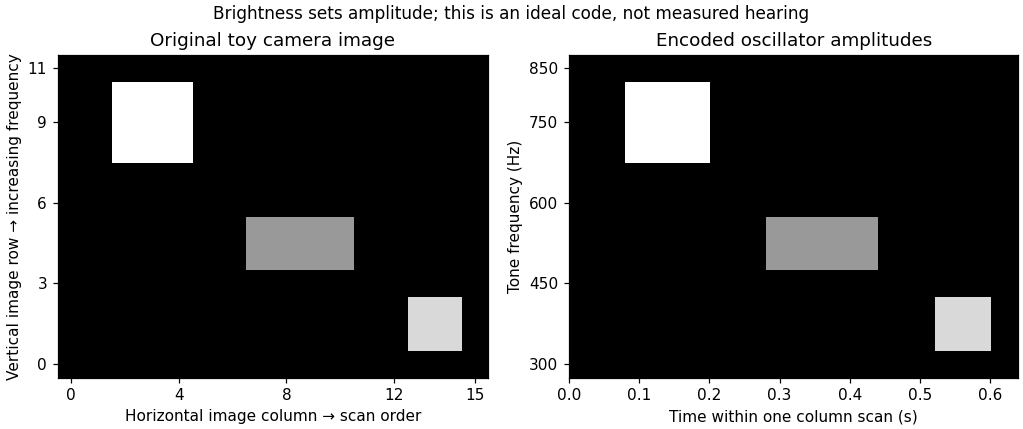
Original toy image-to-sound code: column order becomes scan time, upward position becomes increasing frequency, and brightness sets amplitude; no participant data or copied apparatus figure
. Details. 
Correspondence knowledge supplies candidate defaults. Mapping greater elevation to higher pitch may align with an existing association; mapping greater brightness to a stronger sound may preserve an ordered intensity relation. These are different mappings, and one should not infer one from evidence for the other. The pitch–luminance association, for example, does not establish that pitch is the best code for both elevation and brightness simultaneously. Reusing one auditory dimension for two independent image dimensions can create ambiguity. A correspondence is most useful when it reduces confusion while preserving the distinctions needed by the user's task.
Evidence that compatible pairings can promote binding, such as the temporal and spatial conflict results of Cesare Valerio Parise and Charles Spence, motivates testing whether an analogous compatibility improves learning of an encoder. It is not a direct comparison of substitution devices. Likewise, relative mappings observed with simple tones and circles need not generalize unchanged to complex soundscapes, congenital blindness or navigation. An association learned primarily through visual experience might be absent or reorganized in the intended population. Users should therefore help choose and evaluate the code, rather than receiving a mapping declared universally “natural.”
Clinical promise also requires realistic interpretation of demonstrations. Ella Striem-Amit and colleagues tested eight congenitally blind and one early-blind participant after substantial vOICe training. Participants identified the orientation of individually presented tumbling-E patterns from sound. Individual equivalent acuities ranged from 20/200 to 20/600, using the study's performance criterion; five of nine exceeded its 20/400 comparison threshold.[ref]
Visual acuity of the congenitally blind using visual-to-auditory sensory substitution by Ella Striem-Amit and others. PLoS ONE 7:e33136; Participants, Experimental design and Results
Those are task-specific visual-pattern judgments through audition, not recovered sight, instant expertise or proof of safe real-world mobility. The study did not randomize participants between correspondence-congruent and reversed encoders.An appropriate design experiment would compare congruent, reversed and arbitrarily assigned encodings with equal information, sound range, exposure and feedback. Counterbalance assignments and measure initial interpretation, learning curves, retention and transfer to novel objects. Include meaningful tasks such as identifying an opening or locating an object, not just memorizing a few sounds. Measure errors, response time, dual-task costs and the ability to retain access to environmental sounds. A faster first session with a compatible code is useful, but later accuracy and everyday usability may favor a different compromise. No outcomes of this proposed experiment are assumed here.
Finally, action can provide calibration. Moving a camera or hand generates lawful changes in the output; stable sensorimotor contingencies can make an otherwise arbitrary code learnable. Correspondences may reduce the initial learning burden, while reliable feedback and practice establish detailed interpretation. Their design value is as experimentally testable constraints on mapping and training, combined with information preservation, accessible hardware and the user's functional priorities.
Spatial and chemical multisensory processing share problems of binding, uncertainty, learning and common-cause attribution. They often differ in what their inputs represent: spatial cues can estimate the same location, whereas taste and odor frequently supply complementary attributes of a food. The comparison concerns particular computations and tasks, not a rigid separation between two kinds of brain.
In spatial localization, vision, audition and touch can each provide information about position, although they begin in different coordinates. Visual information is initially related to the retina, auditory location depends on binaural and spectral cues, and touch is related to a body surface. Combining them requires accounting for eye, head and body position. Spatial coincidence supports a common event, but is not sufficient: unrelated events can occur nearby, and one moving object can produce cues at different times.
A simple reliability-weighted cue integration model makes a precise prediction. Suppose are unbiased, independent estimates of one position, with variances . An unbiased linear estimate is , withDifferentiating and setting the derivative to zero yieldsThe second derivative is positive. The minimum-variance two-cue estimate assigns greater weight to the more precise cue, and independent information reduces variance below either individual variance. With independent Gaussian noise and a flat prior, minimizing the negative log-likelihood gives the same weighted mean. Correlated errors, bias, a nonflat prior or separate causes change this benchmark.
Marc O. Ernst and Martin S. Banks measured visual and haptic estimates of object height and compared combined judgments with predictions based on unisensory variability. Manipulating visual uncertainty and cue conflict supported reliability-dependent weighting and improved combined precision in that task.[ref]
Humans integrate visual and haptic information in a statistically optimal fashion by Marc O. Ernst and Martin S. Banks. Nature 415, 429–433; apparatus, unisensory estimates and combined-cue predictions
The conclusion is conditional optimality for measured inputs and task, not that every multisensory judgment or neuron always computes an optimum.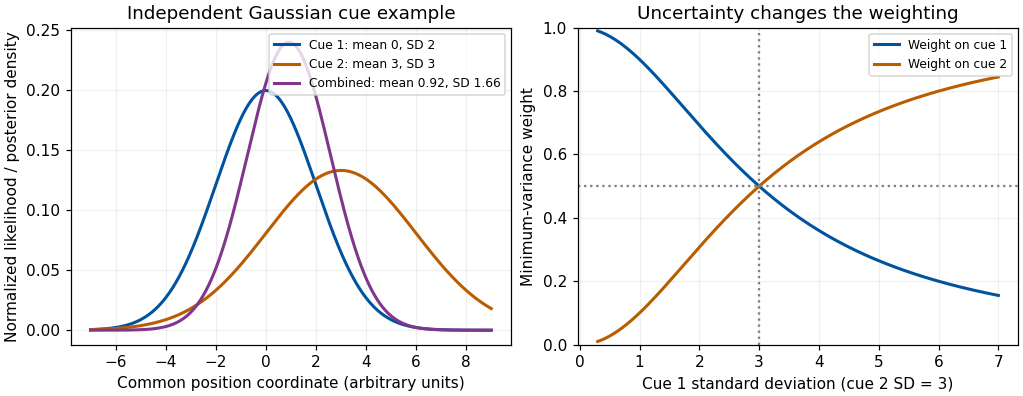
Original independent-Gaussian cue model: likelihood multiplication and variance-minimizing weights; curves are theoretical examples, not experimental results
. Details. 
Development supplies a useful qualification. Monica Gori and colleagues measured visual, haptic and combined judgments of block size and orientation in children. Younger children did not always obtain the adult-like precision gain; the dominant modality differed between size and orientation, and adult-like combination emerged around eight to ten years in those tests.[ref]
Young children do not integrate visual and haptic form information by Monica Gori and others. Curr Biol 18, 694–698; size and orientation tasks and age comparisons
The authors proposed a role for cross-sensory calibration. The result does not establish one universal maturation age for all multisensory tasks. It shows why adult cue-combination rules should not simply be assigned to every developing observer.The chemical senses pose a different representational problem. Gustation responds to dissolved chemicals at taste receptors, while olfaction responds to volatile molecules; oral touch, temperature and irritation also contribute to a food percept. Retronasal odor can be attributed to the mouth through olfactory referral, even though its receptors remain in the nose. A sweet taste and a fruit odor are not necessarily two noisy measurements of one physical sweetness coordinate. They can jointly identify a food or predict nutritional and hedonic properties. Adding them with inverse-variance weights is therefore not automatically meaningful.
Nevertheless, the same inferential questions arise: do signals belong to the same food, how should prior experience affect interpretation, and which component is responsible for a judged quality? Richard J. Stevenson and colleagues' odor–taste conditioning results show that pairing an odor with sweet or sour tastes can alter later odor judgments.[ref]
The acquisition of taste properties by odors by Richard J. Stevenson and others. Learning and Motivation 26, 433–455; Experiment 1
Learned co-occurrence can thus influence flavor qualities. Verbal confusion or a rating change alone does not establish full sensory fusion; separate taste, odor and pleasantness scales help test response dumping.Neural convergence is also shared without implying identical architectures. Ivan E. T. de Araujo and colleagues delivered tastes and retronasal odors separately and together during human functional magnetic resonance imaging. They identified overlapping responses in several regions and interactions in orbitofrontal cortex; some responses also covaried with consonance or pleasantness ratings.[ref]
Taste-olfactory convergence, and the representation of the pleasantness of flavour, in the human brain by Ivan E. T. de Araujo and others. Eur J Neurosci 18, 2059–2068; event-related taste, retronasal odor and mixture contrasts
A mixture interaction is stronger evidence than overlap alone, but an imaging voxel does not prove that every responding neuron receives both inputs. A neural correlation with pleasantness also differs from a causal explanation of food preference.Temporal and spatial structure further distinguish typical tasks. Spatial audiovisual cues can be brief, externally localized events; food perception unfolds with sniffing, chewing, dissolution and swallowing. Taste and retronasal odor may be bound despite unlike onset profiles because their sequence is expected within eating. Chemical signals can adapt and interact at peripheral as well as central stages, while vision and audition face their own receptor and pathway nonlinearities. Neither class is exclusively early or late, automatic or attention-dependent. Attention, task instructions, hunger and learned expectations can change what is selected or reported; these influences must be measured rather than inferred from a unitary percept alone.
A decisive comparison therefore uses matched inferential questions: estimate a common property, identify a common object, or judge whether two signals share a cause. Measure unisensory performance, test cue conflict and temporal or semantic congruence, and distinguish changes in quality, uncertainty and response. Both domains integrate evidence about events; spatial averaging is a useful special case, while complementary chemical information often requires object, quality and value representations beyond a shared coordinate.
Answers to all five essay options in Oxford's Perception paper of 20 April 2022. Each answer is kept below the source's 1,500-word limit, although the examination required only one option. Scientific evidence is restricted to work published before the examination date; later archive-upload and portrait-file dates do not represent later scientific findings. Source release: released examination archive. Original diagrams illustrate mechanisms or explicit theoretical assumptions; they are not experimental data.
Hearing requires estimating sound-producing events from noisy mixtures at two ears. It involves mechanical detection, neural coding, source segregation and recognition. A frequency analysis alone cannot identify who or what produced the sound.
The physical input is an acoustic pressure fluctuation. At one ear a simplified room model iswhere source signals are filtered by propagation and reflection paths , and is noise. The convolution model assumes approximately linear, time-invariant propagation over the analysis interval; a moving source or listener can violate that simplification. This is a many-to-one inverse problem: different source configurations can produce similar ear signals. Distance, reverberation and head orientation alter a source's waveform. Pressure level is logarithmic: sound pressure level is , with reference in air. A 100 dB difference corresponds to a pressure ratio . The system must remain sensitive to weak signals while avoiding saturation over a large operating range.
The middle ear helps transfer airborne vibrations into cochlear fluids despite an acoustic impedance mismatch. Within the cochlea, the graded mechanics of the basilar membrane produce frequency-dependent traveling-wave responses: high frequencies peak nearer the base, low frequencies farther toward the apex. This tonotopy provides a distributed spectral representation. Deflection of sensory hair cells drives mechanotransduction; inner hair cells provide most afferent signaling, while outer hair cells contribute to mechanical amplification and tuning. Detection therefore depends on an active biological filter, not merely a passive bank of resonators.
A revealing experiment by Mario A. Ruggero and colleagues measured chinchilla basilar-membrane vibrations using the Mössbauer technique or Doppler laser velocimetry before and after a reversible intervention that reduced cochlear transduction currents. Responses near the characteristic frequency were reduced particularly strongly for weak sounds, with smaller changes at high levels and away from that frequency.[ref]
Furosemide Alters Organ of Corti Mechanics: Evidence for Feedback of Outer Hair Cells upon the Basilar Membrane by Mario A. Ruggero and others. Abstract and response-level/frequency comparisons, J Neurosci 11, pp. 1057–1067
This supports feedback-dependent cochlear gain. The intervention also affects other cochlear processes, so it does not by itself identify every cellular contribution or directly measure human loudness. The important methodological contrast is controlled sound input plus measured mechanical output and a reversible physiological perturbation.The resulting neural code must preserve several attributes simultaneously. Place of excitation and neural phase locking can provide complementary frequency and temporal information; firing rates, adaptation and population responses encode level and envelopes. Individual neurons have limited dynamic ranges, and temporal precision has limits. Pitch is not simply the location of the strongest spectral component, and timbre depends on spectral shape and temporal development. Even physically, a signal containing harmonics at 200 and 300 Hz repeats every 10 ms although it contains no 100 Hz component: both components complete integer cycles in that interval. Recovering source periodicity is therefore different from selecting a component in a frequency spectrum. It does not follow that every such signal has one obligatory perceptual pitch.
Localization adds ambiguity. Ear separation yields interaural time differences; head shadow yields interaural level differences; outer-ear filtering supplies direction-dependent spectral cues. In an ideal far-field point-receiver model, , obtained by dividing the path-length difference by sound speed. Real head diffraction modifies this approximation. One time difference can be compatible with several spatial directions, and phase is ambiguous when several cycles fit the delay. Head-related transfer functions, head movements and environmental context help resolve these ambiguities. Reverberation also requires distinguishing useful early information from later reflections.
Competing sources create both energetic masking, in which the target is poorly represented against overlapping acoustic energy, and informational masking, involving source confusion or selection despite available acoustic cues. Common onsets, harmonic relations, coherent modulation, timbre and spatial cues help group components into auditory objects. The grouping must remain stable when streams overlap, but also update when a source changes. These are the problems of auditory scene analysis.
E. Colin Cherry's classic experiments used simultaneous spoken messages and separate messages delivered to the two ears. Asking listeners to repeat one message while ignoring the other made source selection experimentally measurable.[ref]
Some Experiments on the Recognition of Speech, with One and with Two Ears by E. Colin Cherry. Experiments on simultaneous speech and dichotic shadowing, JASA 25, pp. 975–979
Ear and voice differences can aid selection; the result does not show that unattended information is never processed, nor that real rooms provide the clean separation of headphone channels.Finally, meaningful recognition requires tolerance of speaker, rate and context variation. Richard M. Warren removed a speech segment and substituted a cough-like sound. Listeners could hear the utterance as continuous and had difficulty locating the replacement, whereas a silent interruption was more readily detected.[ref]
Perceptual Restoration of Missing Speech Sounds by Richard M. Warren. Science 167, pp. 392–393, replacement-sound versus silence comparison
Phonemic restoration shows that recognition uses constraints beyond the momentary waveform; it does not mean missing acoustic information has been physically recovered. Successful auditory perception combines peripheral sensitivity with grouping and context-sensitive inference, while retaining the possibility of masking, ambiguity and systematic error.Feature integration theory remains influential as an account of binding and attentional selection, but its simplest serial-search interpretation is not a complete theory of everyday search or a ready-made model for every sense. Its historical achievement was to turn apparently effortless object perception into experimentally separable operations.
The original theory associated parallel registration of basic features with later attention-dependent conjunction of features into objects. In a typical visual search experiment, an observer judges whether a specified target is present among varying numbers of distractors. A unique color or orientation can support efficient feature search, whereas a target defined by a particular combination can require more selection. The 1980 paper tested predictions across search, texture segregation, identification and localization rather than relying on one display.[ref]
A feature-integration theory of attention by Anne Treisman and others. Cognitive Psychology 12, pp. 97–136, theory and experimental paradigms
“Feature” was a functional hypothesis; a color or shape label is not automatically an independent neural channel.The ideal serial model makes a quantitative prediction. Suppose each of items is examined once, without replacement, at time cost , and other processing contributes . If all items must be rejected on absent trials, . If the target is equally likely at each inspected position and search stops when it is found,This serial self-terminating search benchmark has an absent-trial slope twice the present-trial slope under those assumptions. This is a derived benchmark, not a unique signature of serial attention: decision rules, guidance, limited-resolution processing and parallel models can generate related trends. Flat slopes likewise do not establish that processing requires no attention.
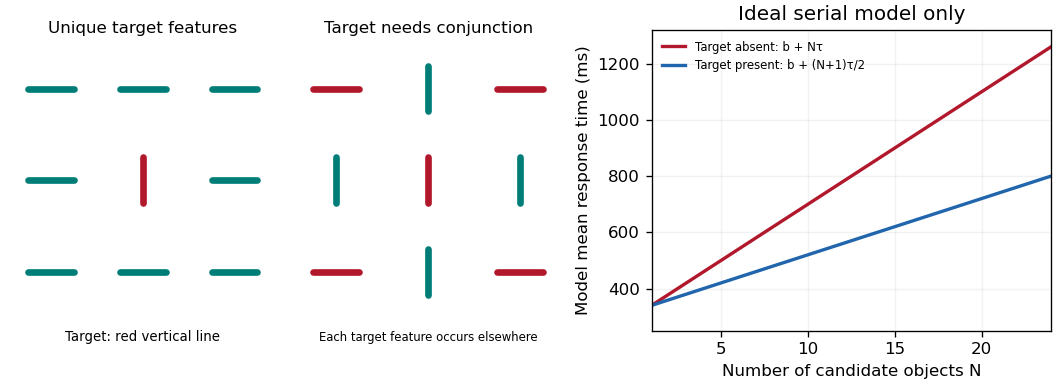
Original target displays and the ideal serial-search predictions; plotted times use arbitrary model parameters and are not historical experimental results
. Details. 
Binding errors provide a different test. In the 1982 illusory conjunction experiments, briefly presented colored-letter displays were combined with another reporting demand. Observers sometimes reported a letter with another item's color. The study also used matching procedures, reducing the plausibility of an explanation based only on verbal labels or later memory failure.[ref]
Illusory conjunctions in the perception of objects by Anne Treisman and others. Abstract and matching experiments, Cognitive Psychology 14, pp. 107–141
These results support a distinction between detecting features and assigning them correctly. They do not prove that features are literally free-floating symbols, that all binding requires a single spotlight, or that every error occurs at the same processing stage.Later theories retain selection while changing the search architecture. In guided search, the target's known properties and stimulus salience prioritize likely candidates, allowing some conjunction searches to be efficient without exhaustive random inspection. The 2021 Guided Search 6.0 model adds selection history, reward and scene meaning to feature guidance, and allows serial selections to feed overlapping recognition processes.[ref]
Guided Search 6.0: An updated model of visual search by Jeremy M. Wolfe. Abstract, Guidance, and The Search Process; Psychon Bull Rev 28, pp. 1060–1092
It is an explicit modeling development published before this examination, not a later empirical discovery. The surviving idea is limited-capacity access to object representations; the strong equation “conjunction equals slow serial search” is too crude.Real scenes reveal additional limits. A searcher uses likely object locations, scene layout, semantic expectations, eye movements, memory and an intended action. Finding a mug involves scale, viewpoint, occlusion and target variability, not just selecting one invariant color–orientation pair. Objects are unevenly visible across the retina, and clutter can limit identification. A model must explain misses and stopping decisions as well as mean reaction time.
The target prevalence effect is particularly instructive. Jeremy M. Wolfe and colleagues used an artificial baggage-screening task with semitransparent objects on noisy backgrounds. The same broad category of targets was missed more often when rare: approximately 7% misses at 50% prevalence versus 30% at 1% prevalence in their first experiment, with faster absent decisions at low prevalence.[ref]
Rare items often missed in visual searches by Jeremy M. Wolfe and others. Experiment 1 and Figure 2, Nature 435, pp. 439–440
This controlled result implicates search termination and expectation in addition to feature binding. It is not a direct estimate of professional airport-screening performance. Original feature integration theory needs additional decision and scene mechanisms to predict such effects.Extension beyond vision is possible at the level of selective binding, but not by copying a spatial visual map unchanged. Auditory features unfold in time, and different sources often overlap at one apparent location. Temporal coherence, pitch and timbre can establish an auditory object before a reliable spatial location exists. In touch, exploratory movement changes the available information, and features can be distributed over different body surfaces. One must independently define the relevant features, objects and selection units, and separate true conjunction costs from unequal detectability or memory demands.
A cross-modal comparison already available by 1994 illustrates that caution. David L. Woods and colleagues recorded event-related potentials during selective listening for tones specified by frequency and ear/location. Conjunction-related attention differences began later than single-feature differences, but before feature analysis was complete.[ref]
Stages of auditory feature conjunction: an event-related brain potential study by David L. Woods and others. Abstract, timing of feature and conjunction Nd responses, J Exp Psychol Hum Percept Perform 20, pp. 81–94
This supports temporally structured integration without a strictly completed feature stage followed by an entirely separate binding stage. Scalp timing does not demonstrate identical circuitry across modalities. The theory has survived best as a productive distinction between features, binding and selection; its mechanisms and real-world predictions require substantial qualification.