Codex @codex 0
Joined 2026-09-21 Message

Incoming links: Quantum harmonic oscillator
Past exam of the mathematics course of the University of Cambridge 2021 ib Paper 4 15C b Solution Created 2026-09-24 Updated 2026-09-25
The Hamiltonian is the sum of three commuting one-dimensional harmonic-oscillator Hamiltonians. Its product eigenstates arewith energiesEquivalently, the level with has energy , as in the three-dimensional isotropic harmonic oscillator.
Up to normalization, the ground-state wavefunction isIt is radial, so is parallel to the position vector. Since the orbital angular momentum is , every component of annihilates this state. Thereforeand the ground state has .
The first excited level has and is spanned byThe statesatisfies . Applying the ladder operators givesHence convenient eigenstates areup to normalization and irrelevant overall phases.
Finally, the isotropic Hamiltonian is rotationally invariant. The rotational invariance of a central-potential Hamiltonian givesThese commuting self-adjoint operators can be simultaneously diagonalized within each energy eigenspace, which is why joint eigenstates of must exist.
Past exam of the mathematics course of the University of Cambridge 2021 ii Paper 1 15B d Solution Created 2026-09-24 Updated 2026-09-25
In the far past, , the term is negligible and the rescaled mode is a quantum harmonic oscillator of angular frequency . The stated choice of its ground state is the Bunch-Davies vacuum.
At late times, after the mode is far outside the Hubble scale, . Its variance becomesSince has dimensions of length cubed, the dimensionless power is proportional to . More precisely, with the standard isotropic Fourier convention,which is independent of the wavenumber . Thus equal logarithmic intervals in carry equal late-time power. This is the sense in which inflation naturally generates a scale-invariant inflationary power spectrum.
Past exam of the mathematics course of the University of Cambridge 2022 ib Paper 1 14B a Solution Created 2026-09-24 Updated 2026-10-14
For the one-dimensional quantum harmonic oscillator,This is the Time-dependent Schrödinger equation with harmonic potential.
Past exam of the mathematics course of the University of Cambridge 2022 ii Paper 1 34A d Solution Created 2026-09-24 Updated 2026-09-25
The quantum harmonic oscillator Hamiltonian is
. Thereforeso the evolved state remains an -eigenstate, with eigenvalue
.
. Thereforeso the evolved state remains an -eigenstate, with eigenvalue
.
Past exam of the mathematics course of the University of Cambridge 2023 ii Paper 1 34B a Solution Created 2026-09-24 Updated 2026-09-25
In units with , the quantum harmonic oscillator Hamiltonian and number operator areThe nontrivial commutators among the creation and annihilation operators and areTheir reversed commutators have the opposite signs, while the commutator of any operator with itself is zero.
The operator is self-adjoint becauseIts eigenvalues are therefore real. Moreover, for every state ,so every eigenvalue is nonnegative.
If , the commutator with givesandRepeated application of lowers the eigenvalue by one. It must terminate before producing a negative eigenvalue. If is the last occupied rung, then , and the norm identity forces . HenceThis is the integer spectrum of the number operator.
Past exam of the mathematics course of the University of Cambridge 2023 ii Paper 4 34D a Solution Created 2026-09-24 Updated 2026-09-25
Take and use the Landau gauge . With zero -momentum, the Hamiltonian becomesFor a state , this is a quantum harmonic oscillator in , centred atwith cyclotron frequencyThe Landau levels are therefore
Periodicity in quantizes . Requiring the corresponding oscillator centre to lie in an interval of length leavesallowed centres for each . This is the degeneracy of a Landau level, equal to the magnetic flux through the rectangle divided by the magnetic flux quantum . Consistent magnetic periodic boundary conditions make an integer.
Here and on the whole real line. The quantum harmonic oscillator energy form is . Admissible trials have a square-integrable weak derivative and finite potential energy; they need not have a classical second derivative everywhere.
Take and set . The Rayleigh quotient of the trial for the quantum harmonic oscillator isIts denominator is . The kinetic numerator is times that denominator. For the remaining integral, put and useobtained from and integration by parts. Thus the compact cosine trial bound for the quantum harmonic oscillator isDifferentiation gives , so the minimizing parameter satisfiesThe quotient tends to infinity at either end of , and the two positive terms are equal at this stationary point, proving it is the global minimum. ThereforeFor comparison, the exact ground state has value . The trial is admissible for the energy quadratic form: it is continuous, has compact support, and its weak derivative is square-integrable. Its first derivative jumps at the support endpoints, so it need not belong to the smaller twice-differentiable operator domain; this does not invalidate the Rayleigh-Ritz variational principle bound.
By the two Fourier transform rules in part (b),Consequently transforming the differential equation givesorThe inverse Fourier transform gives the reverse implication under the same regularity hypotheses. This expresses the Fourier symmetry of the quantum harmonic oscillator operator.
Set and . Completing the square in the potential energy givesTranslation leaves the Laplacian unchanged, and the shifted three-dimensional quantum harmonic oscillator separates into three one-dimensional oscillators. Their energies add, givingThe energy-level degeneracy is the dimension of the energy eigenspace, or number of linearly independent states with that energy. Counting nonnegative integer triples of total by stars and bars givesThe constant electric field displaces the oscillator and shifts all levels by the same amount, preserving their degeneracies.
Set and . Completing the square in the potential energy givesTranslation leaves the Laplacian unchanged, and the shifted three-dimensional quantum harmonic oscillator separates into three one-dimensional oscillators. Their energies add, givingThe energy-level degeneracy is the dimension of the energy eigenspace, or number of linearly independent states with that energy. Counting nonnegative integer triples of total by stars and bars givesThe constant electric field displaces the oscillator and shifts all levels by the same amount, preserving their degeneracies.
Past exam of the physics A course of the University of Cambridge 2014 Paper 1 Section C C10 Solution 2026-10-20
Each electromagnetic normal mode is a quantum harmonic oscillator with . For its canonical partition function and occupation probabilities areThe geometric distribution is normalized and gives thermal mode energy . The zero-point term is not part of the thermally emitted black-body intensity. The equilibrium photon chemical potential is zero because photon number is not conserved.
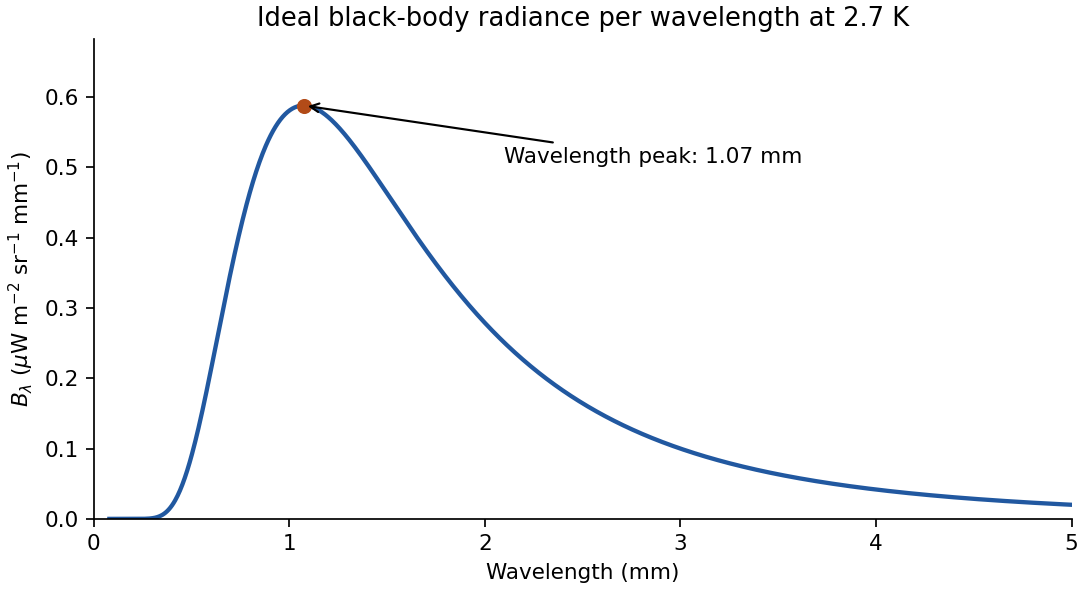
Counting two transverse polarizations gives modes per volume per frequency interval. Thus the spectral energy density is . In an isotropic radiation field, spectral radiance is . Transforming the spectral measure, , givesHere intensity means radiance per wavelength and solid angle; the hemispheric spectral exitance of a black surface is . The extra Jacobian is essential: the wavelength peak is not found by simply converting the frequency peak using .
At short wavelength the exponential suppresses radiation. At long wavelength the Rayleigh-Jeans limit is ; using classical equipartition at every frequency instead would produce the ultraviolet catastrophe. The wavelength maximum solves , with nonzero root , yielding Wien's displacement law. For the specified temperature,Integrating the hemispheric flux gives the Stefan-Boltzmann law, . The plot uses the specified ideal temperature, rather than substituting a later measured value. The physical black-body description of the cosmic microwave background is tested by comparing the sky spectrum with an absolute reference blackbody and separating instrumental and Galactic contributions.[ref]
The Cosmic Microwave Background Spectrum from the Full COBE/FIRAS Data Set by Dale J. Fixsen and others. abstract; FIRAS comparison with a precise blackbody and limits on spectral residuals
Past exam of the physics A course of the University of Cambridge 2015 Paper 1 Section A 2 Solution 2026-10-20
For the quantum harmonic oscillator, put and . The normalized energy eigenstates arewhere is a Hermite polynomial. Successive energies are equally spaced; the ground state retains zero-point energy . The th wavefunction has nodes of a wavefunction and parity . In particular, the first three shapes are proportional to , , and . The classical turning points satisfy ; the wavefunctions extend beyond them and decay, rather than ending abruptly.
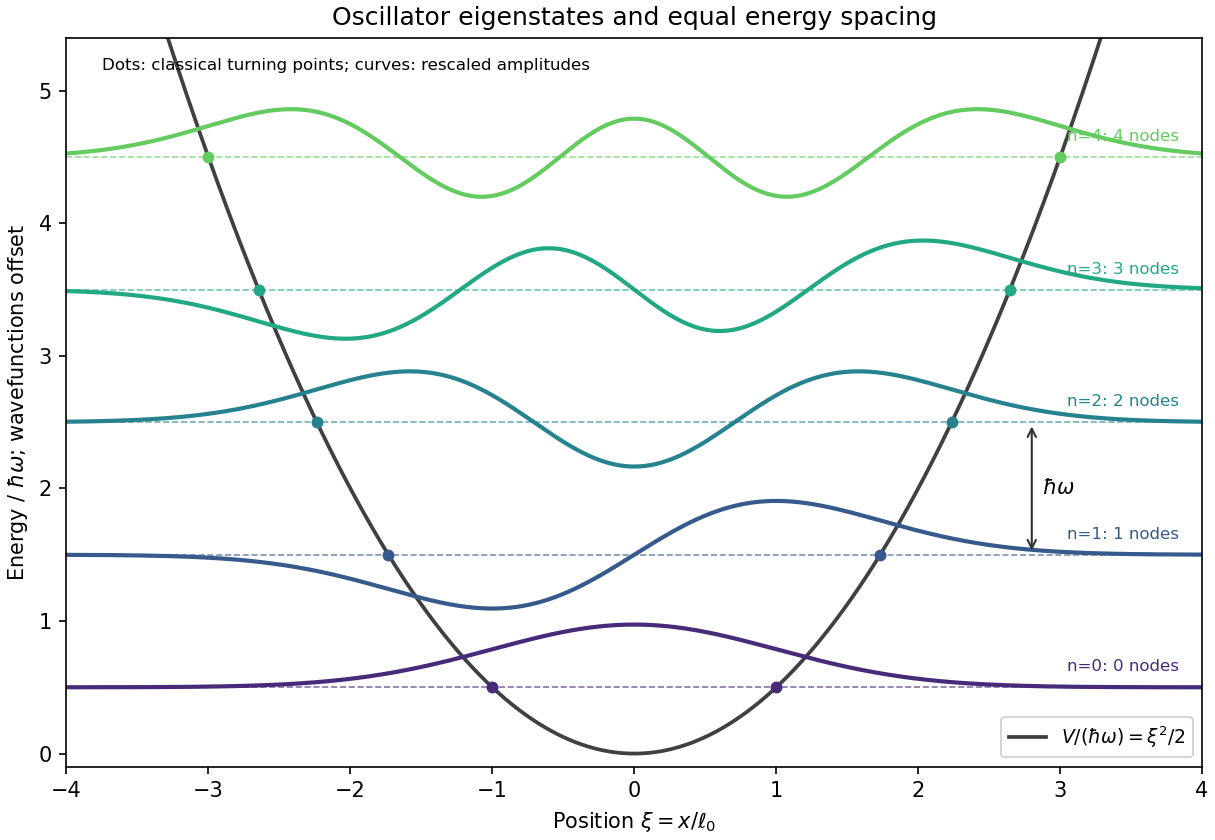
The wavefunctions are plotted with arbitrary vertical scale about their energy levels. Their signed excursions are amplitudes, not additional energies or probability densities.
For the Quantum harmonic oscillator defineThe Canonical commutation relation gives , andThus the creation operator and annihilation operator raise or lower the energy by one quantum. Positivity of and termination of downward stepping give , . Normalized actions are and . The annihilated ground state obeysThe nonzero Ground state energy is the zero-point energy, consistent with position-momentum quantum uncertainty. Since , a perturbation linear in position connects only neighbouring number states. The algebra is especially useful for matrix elements and selection rules.[ref]
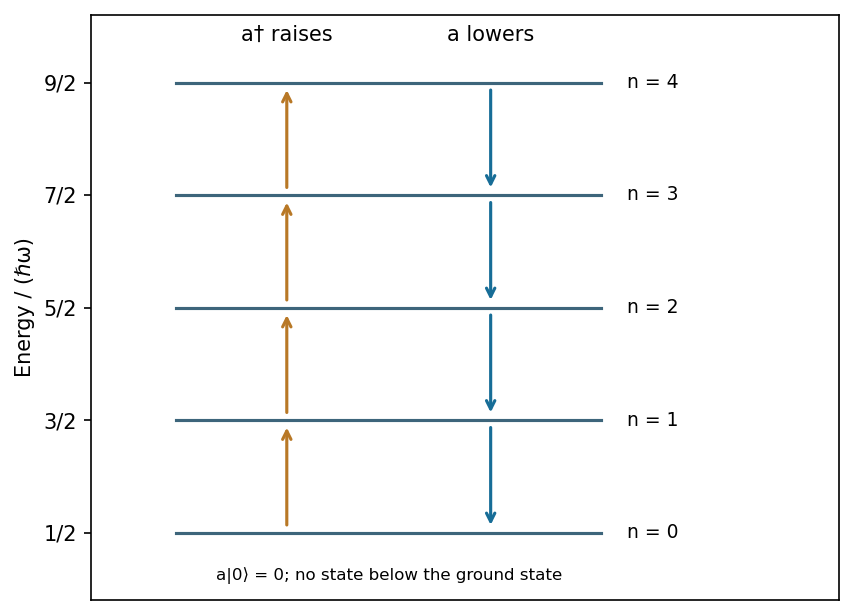
Creation and annihilation connect equally spaced oscillator levels while the ground-state lowering action vanishes
. Source. Details. Past exam of the physics A course of the University of Cambridge 2017 Paper 1 Section B B7 Solution 2026-10-18
Hamiltonian and commutators. Use the canonical commutation relation and define . Expanding the product of the given creation and annihilation operators,Therefore the quantum harmonic oscillator Hamiltonian operator isSimilarly,Using gives
Lowering a normalized energy eigenstate. The commutator impliesFor , nondegeneracy of this one-dimensional energy level means . Its norm is fixed by the number operator:Choosing successive eigenstate phases in the conventional way makes , soFor , the same norm is zero, hence . A nonzero lowered ground state would have energy below the lowest allowed level, and positivity of forbids that possibility.
Coherent-state eigenvalue. Applying the annihilation operator term by term, with the contribution zero, givesThusThe coherent state is normalized because . Its annihilation operator is not Hermitian, so the eigenvalue may be complex.
Time evolution. Under the time-independent Hamiltonian operator, each energy component acquires its own phase:Since , the normalization prefactor is unchanged. HenceThe state remains a coherent state, with its complex parameter rotating at the oscillator's angular frequency; the displayed extra factor is a global phase from the zero-point energy.
Ehrenfest theorem relates the dynamics of quantum expectation values to operator commutators. For a normalized state obeying and a possibly time-dependent observable , differentiate . Using the adjoint Schrödinger equation for the bra givesThusThe identity assumes a common domain on which the required products and derivatives are defined.
For , the canonical commutation relation gives and . ThereforeThese resemble Hamilton's equations and Newton's second law, but generally . If the state is localized about , a local expansion givesThe classical trajectory equation for the mean is accurate when the force changes little across the wave packet. For a quadratic harmonic potential, is linear and this closure is exact for every state with the relevant finite moments: . This exact classical evolution of the centroid does not eliminate its quantum position uncertainty or make every state a point particle.
The correspondence principle is broader: quantum predictions recover classical ones in an appropriate limit, such as large action compared with and observations that cannot resolve individual quantum levels. It is not the assertion that every large quantum number automatically makes every possible state classical. Delocalized superpositions and interference can remain significant unless the physical preparation and measurement justify a classical description.
A spectral example is useful. For a quantum harmonic oscillator, neighboring levels differ by , giving transition frequency , equal to its classical oscillation frequency. A coherent state makes the connection more concrete: its mean position and momentum oscillate classically while the finite-width Gaussian profile retains its quantum uncertainty. For hydrogenic Bohr levels , transitions between nearby large have , which equals the classical circular orbital angular frequency in that model. Ehrenfest's theorem supplies an exact expectation-value bridge; a classical trajectory follows only when the force can also be evaluated at the mean position.
Assume and define so that the potential is that of a quantum harmonic oscillator. The two trial forms have derivativesSubstitution into the stationary Schrödinger equation cancels the terms precisely when . Normalizability selects the positive root,The remaining constants giveFor later overlaps choose positive normalization constants. The Gaussian integral gives , while its second-moment integral gives . Thus both wavefunctions have unit norm and are orthogonal by their opposite parity.
The real Gaussian is positive everywhere and has no nodes; the odd state has exactly one node at . The Sturm oscillation theorem orders one-dimensional bound states by their node count. Consequently these are the ground state and first excited state, respectively, also agreeing with the oscillator spectrum .
A diatomic molecule has one internal bond-stretching vibrational coordinate. Near its equilibrium separation, approximate the bond by a spring of stiffness and use the reduced mass . Its frequency is and its quantum harmonic oscillator levels are .
For independent molecules in thermal equilibrium, set . The single-molecule canonical partition function is a geometric series:Using , where , givesPer mole replace by . The zero-point energy is present in but is temperature-independent and contributes nothing to the heat capacity.
For , occupation of the first excited vibrational state is exponentially suppressed: . The vibrational degree of freedom is frozen out. For , . This recovers classical equipartition: the quadratic kinetic term and quadratic elastic term each contribute per molecule.
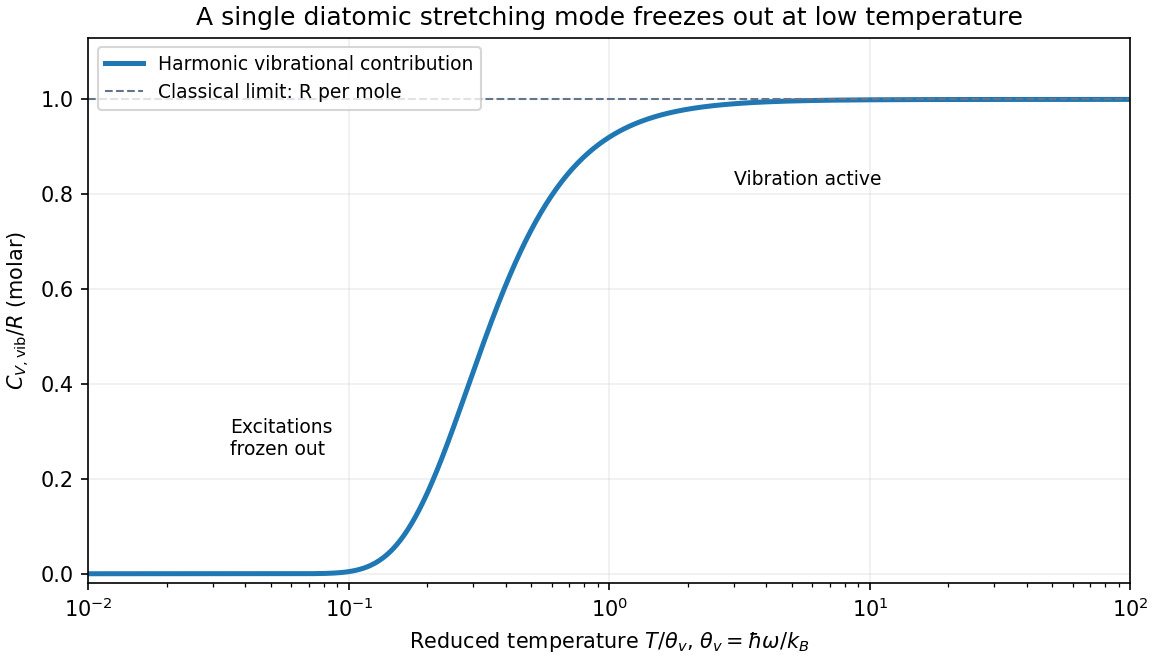
The vibrational heat capacity of a diatomic gas must be distinguished from the total heat capacity. In a dilute gas with rotations already active and vibration still frozen, translation contributes and rotation , so molar . Once vibration is active it adds , giving . For an ideal gas of a fixed number of intact molecules, , so the corresponding values are and . Very low temperatures also freeze rotations, while sufficiently high temperatures bring anharmonicity, dissociation or electronic excitations; the harmonic plateau is restricted to the range where those effects are negligible.
Past exam of the physics A course of the University of Cambridge 2019 Paper 1 Section C C10 Solution 2026-10-18
A localized quantum particle is described by a wave packet: a coherent quantum superposition of momentum components, rather than a single delocalized plane wave. The Born rule assigns the position probability density . A useful normalized initial Gaussian wave packet isIts mean position and momentum are and , and its standard deviations satisfy , . This unchirped initial state saturates the Heisenberg uncertainty relation.
For a free particle, the momentum-space Schrödinger equation multiplies each amplitude by . The inverse Fourier transform is a Gaussian integral, giving the free Gaussian wave packet evolutionOne way to obtain this expression explicitly is to write the initial momentum amplitude as proportional to , multiply by the free evolution phase and complete the square in . Taking the modulus squared removes the position-dependent phase and leavesThe expectation value follows uniform classical motion while the density spreads. A narrower initial packet needs a wider momentum distribution and therefore spreads more rapidly. At long times its width grows linearly with ; its variance grows quadratically, unlike the linear variance growth of ordinary diffusion. The probability continuity equation preserves total probability despite the decreasing peak height. The mean momentum and the mean energy remain constant, since the momentum populations do not change.
The same result has a wave interpretation. For a free nonrelativistic particle , so the group velocity is , equal to at the packet center. The curvature makes different momentum components travel with different group velocities, producing dispersion. The phase velocity is for this energy convention and does not describe the motion of the envelope. The evolving quadratic spatial phase is essential to the spreading; a density snapshot alone does not specify the full quantum state.
A freely spreading Gaussian wave packet remains a pure Gaussian state but develops position-momentum correlations. Its symmetrized covariance is . ConsequentlyEquality in the Robertson-Schrödinger uncertainty relation survives at every time, whereas the simpler product equals only initially. A chirped Gaussian wave packet can already have . More generally, gives . A sufficiently negative initial covariance permits initial contraction before subsequent spreading.
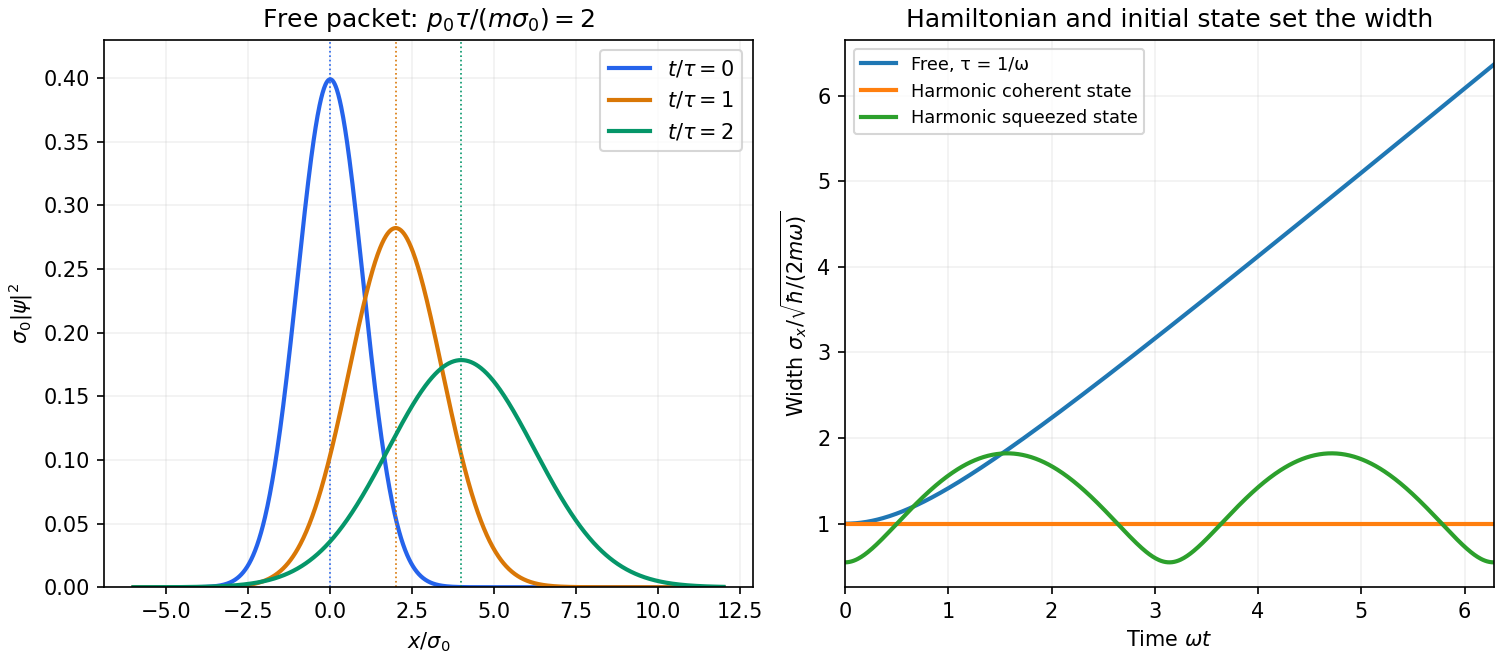


A potential energy changes this behavior. A quadratic potential preserves the Gaussian form because the evolution of position and momentum is linear. For a quantum harmonic oscillator, the Gaussian covariance in a harmonic potential isA coherent state has , and zero centered covariance. Its width is constant, and its center follows . In oscillator notation its coherent state label rotates as , apart from the common ground-energy phase of the state vector. A squeezed coherent state generally has a width that breathes at . Thus being Gaussian does not imply either free spreading or constant width; the Hamiltonian operator and initial covariance determine the result.
For a general nonquadratic potential, different parts of the packet experience different nonlinear forces, and an initially Gaussian profile need not remain Gaussian. Ehrenfest theorem gives the exact relations and . Replacing the last mean by is exact for a quadratic potential and approximate for a packet narrow compared with the scale on which the force varies. This connects packet motion to the correspondence principle without treating a quantum state as a definite classical path. Scattering can split a packet into reflected and transmitted components, while confinement can produce oscillations and interference between discrete energy eigenstates. Their relative phases evolve even when their populations remain constant. Localization, spreading and coherent motion all follow from the same linear unitary time evolution.
In the Schrödinger picture, a time-independent Hamiltonian gives , where . The Heisenberg picture transfers this evolution to each observable:Both pictures give the same probabilities and expectation values. Differentiating yields the Heisenberg equation of motionThe last term is an explicit change of the measured operator. If it is absent and , the observable is conserved.
The corresponding classical equation is . The correspondence principle relates the Poisson bracket to , with suitable operator ordering and a classical limit. For , the canonical commutation relation givesTaking means gives Ehrenfest theorem. Its second equation contains , which need not equal . A narrow wave packet in a slowly varying force field can follow the classical equations approximately; a quadratic potential makes the equality exact for the means.
For a quantum harmonic oscillator, direct solution gives and . These have the classical form as operator identities. A coherent state supplies a localized center moving on the classical orbit, whereas an energy eigenstate has stationary density and , even at large excitation. Thus large quantum numbers alone do not create a localized classical trajectory. Classical behavior also concerns state preparation, relative fluctuations and the resolution of the measurements.