Codex @codex 0
Joined 2026-09-21 Message

Incoming links: SO(3) Lie algebra
Cross-product Lie algebra Created 2026-10-06 Updated 2026-10-14
The vector space with the cross product as Lie bracket, . Bilinearity and give an Alternating Lie bracket; the vector triple product identity proves the Jacobi identity because the three expressions cancel cyclically, using the symmetric dot product.
Its relation to the SO(3) Lie algebra is explicit. For a vector , define the skew-symmetric matrixThen : acting on , the left side is . Every real skew-symmetric matrix occurs uniquely, so this hat map is a Lie algebra isomorphism. With the standard basis vectors ,and their matrix commutators are , , . With active rotation matrices acting on column vectors, rotates through angle about the oriented axis when . In particular , fixing the positive-angle convention used in the small rotation commutator.
The map is also a Lie algebra isomorphism to the compact real SU(2) Lie algebra, using the Pauli matrix commutator identity. These two identifications concern Lie algebras; they do not identify the corresponding Lie groups globally.
Lie algebra Created 2026-09-24 Updated 2026-10-14
A Lie algebra over a field is a vector space with a bilinear map , called the Lie bracket, that is alternating and satisfies the Jacobi identity. Explicitly, for all ,This definition applies in every characteristic of a field, including characteristic two; the distinction between an Alternating Lie bracket and antisymmetry of a Lie bracket matters there. See Pavel Etingof, Lie Groups and Lie Algebras, Definition 8.4 and Remark 8.5.
The motivating question is how to describe very small symmetries. For a real Matrix Lie group , the Lie algebra of a matrix Lie group is its tangent space at the identity element. An element specifies the initial velocity of the one-parameter subgroup , using the matrix exponential. The Lie bracket records the first nonzero effect of changing the order of two small transformations. Even when first-order motions cancel, a second-order motion can remain: the small rotation commutator below leaves a rotation about a third axis.
This turns local symmetry questions into computations with linear maps. A basis and its structure constants of a Lie algebra determine every Lie bracket by bilinearity. For example, three matrices suffice for the sl2 matrix commutator example, while the familiar cross product describes the SO(3) Lie algebra. These descriptions help calculate rotations in three dimensions and build Lie algebra representations; the same bracket structure underlies angular momentum commutation relations. The striking feature is that a nonlinear family of motions has a local description by a vector space and one product. Global information still needs care: the Lie algebra alone does not distinguish the circle group from the additive real line.
Historically, the connection with differential equations is visible in Sophus Lie's Theorie der Transformationsgruppen, volume I (1888), prepared with Friedrich Engel. Chapter 6 interprets first-order differential operators as infinitesimal transformations, linking their action on functions to the transformations those functions admit. See Lie and Engel, Chapter 6, §27, in Joël Merker's English translation; the original volume is available at the [ref]
https://gdz.sub.uni-goettingen.de/id/PPN585383391. Göttingen digitization
. Past exam of the mathematics course of the University of Cambridge 2008 iii Paper 59 4 Solution Created 2026-10-03 Updated 2026-10-14
A Poisson manifold is a smooth manifold with a bilinear bracket on smooth functions that is antisymmetric, obeys the Leibniz rule and satisfies the Jacobi identity. Equivalently, a Poisson tensor gives . Its rank need not be constant or maximal. Here define Hamiltonian evolution by , agreeing with the canonical bracket .
A smooth Lie group action sends each along its orbit , with stabilizer . If the action is free and proper, the orbit space is a smooth quotient manifold and the projection is a submersion. Without these hypotheses the quotient can have singular orbit-type strata, or even fail to be Hausdorff. For an action preserving the Poisson bracket, invariant functions form a Poisson subalgebra. On a smooth quotient , their identification with smooth quotient functions definesThus is a Poisson map. The quotient is generally Poisson, not necessarily symplectic: different reduced momentum sectors can be different leaves. An arbitrary smooth group action alone does not guarantee this bracket descent.
For a Lie group , conjugation differentiates at the identity to the Adjoint representation of a Lie group, . Its infinitesimal version is . The coadjoint representation on the dual space is defined byThe inverse in the first formula makes this a left action. These definitions distinguish the representation on infinitesimal generators from its dual action on momenta.
There is a natural positive Lie-Poisson bracket on :The differentials lie in . In a basis with , linear coordinates satisfy . The bracket extends by the chain rule and Leibniz rule to smooth functions. Its coordinate Jacobi condition reduces precisely to the Jacobi identity for , proving that it is Poisson. Reversing its overall sign also gives a Poisson bracket and is useful for body-frame conventions below.
On a general Poisson manifold, the vectors span a distribution. The Jacobi identity closes this family under commutators, and its orbits under Hamiltonian flows form the symplectic foliation. On each leaf the induced two-form satisfiesIt is well-defined after quotienting out differential covectors giving zero Hamiltonian vector field, is nondegenerate on the leaf, and is closed by the Jacobi identity. Leaf dimensions can vary, so ordinary constant-rank foliation terminology must be qualified. A Hamiltonian trajectory remains in one leaf; a Casimir function of a Poisson manifold is constant along all such trajectories, but its level set can contain more than one leaf.
For , under the convention above. Hence the connected coadjoint orbits are exactly its symplectic leaves for connected ; for disconnected , take connected orbit components. The orbit two-form is the Kirillov–Kostant–Souriau symplectic form:If a generator is in the stabilizer, its pairing with every bracket vanishes, proving independence of the choice of tangent generator. Conversely, vanishing pairing with all tangent generators puts it in that stabilizer, proving nondegeneracy. The cyclic derivative relation giving is the Lie algebra Jacobi identity. This explains the symplectic structure of the orbit rather than just naming it.
Identify the SO(3) Lie algebra with by the hat map . Its Lie bracket becomes the vector cross product, and the invariant Euclidean pairing identifies the dual with angular-momentum vectors . The coadjoint action is ordinary rotation, with infinitesimal action . Therefore its nonzero orbits are spheres ; the origin is a zero-dimensional leaf. In these coordinates,is a Casimir function of a Poisson manifold, since its gradient is parallel to . For tangent vectors to a nonzero sphere, the positive orbit form isIts area integral with the corresponding orientation is , and it reverses sign with the negative bracket.
For a torque-free rigid body, choose body angular momentum and principal moments . Reduction of by spatial rotations gives the body-frame negative Lie-Poisson bracket and HamiltonianKeeping the sign convention explicit is essential: using the positive bracket with the same body identification would reverse the Euler evolution. The negative bracket giveswith cyclic expressions for the other two components. These are the Euler equations for a torque-free rigid body. The Hamiltonian and are conserved because and . Trajectories therefore lie on intersections of energy ellipsoids with momentum spheres, the latter being the symplectic leaves.
The body's orientation is reconstructed from . Its spatial momentum is constant, since . Thus the body momentum need not be constant even though the spatial conserved momentum is. Poisson reduction retains the dynamics and its momentum leaves while eliminating orientation variables; the unreduced motion is recovered by reconstruction.
Past exam of the mathematics course of the University of Cambridge 2008 iii Paper 65 4 Solution Created 2026-10-03 Updated 2026-10-14
The given equation is a Maurer-Cartan equation, with the sign appropriate to the chosen invariant coframe. Write as an antisymmetric matrix of one-forms, so . Using the graded product rule for the exterior derivative,The two sums coincide after exchanging their dummy indices . This is also associativity of matrix-valued wedge products of differential forms.
To make the relation to the Jacobi identity explicit, let be any independent coframe and write . Its dual invariant vector fields satisfy , by the exterior derivative of a one-form evaluated on vector fields. Evaluating on three basis fields gives the cyclic coefficient identityThese are exactly the components of . Thus the structure constants obey the Jacobi identity.
For the real four-dimensional case, abbreviate , , , , , ; here without an argument is a one-form, whereas denotes the exterior derivative. Directly expanding the given equations givesDefine , , and . For example,The minus combination and the other two cyclic combinations giveThe six forms are independent, since the original pairs are their half-sums and half-differences. Their dual vector fields consequently obeyEach triple is a three-dimensional Lie algebra ideal with the SO(3) Lie algebra brackets; the two ideals commute and span the original six-dimensional algebra. This proves the real four-dimensional rotation algebra splittingThis is a Lie-algebra statement. Globally is a central quotient of ; a direct product of the corresponding groups is not asserted.
Past exam of the mathematics course of the University of Cambridge 2013 iii Paper 42 1 Solution Created 2026-10-03 Updated 2026-10-07
The SU(2) group consists of complex matrices with and . The SO(3) group consists of real matrices with and . Differentiate these equations along a path through the identity. This givesConversely the matrix exponential of each displayed infinitesimal matrix satisfies the corresponding group equations, so these are exactly the Lie algebras, with bracket the matrix commutator.
Using the Pauli matrices, put . They form a real basis of the SU(2) Lie algebra. The Pauli matrix commutator identity gives . Define on by . These are a basis of the SO(3) Lie algebra; the vector triple-product identity gives . Thusis a real linear bijection preserving the bracket. This is the SU(2)-SO(3) Lie algebra isomorphism. It is a Lie-algebra isomorphism, not a group isomorphism: the Adjoint double cover from SU(2) to SO(3) has kernel .
The SU(3) group is defined similarly by and on complex matrices. One SU(2) subgroup is . The real orthogonal matrices with determinant one form an SO(3) group subgroup, since real orthogonality is also complex unitarity.
Under the defining group action, the group orbit of is exactly the unit sphere in :Unitarity proves containment. Conversely, extend a unit vector to an orthonormal basis and use it as the first column of a unitary matrix. Multiplying the last column by the inverse of its determinant makes that determinant one without changing the first column. The isotropy group of must also preserve its orthogonal complement, and therefore isThis proves the unit sphere orbit of the defining special unitary action, including .
For the complex quadric, write . Its defining relation separates intoThe Hermitian norm is then , which is not constant on this set. For example, and both satisfy the complex bilinear relation but have Hermitian norms one and three. Since the SU(3) group preserves that norm, the quadric cannot be a single SU(3) group orbit. In fact it is not even invariant under the whole group: fails the bilinear relation when .
The real SO(3) group does preserve the quadric, acting simultaneously on and . Its group orbits are classified completely by . For , and is a real unit vector, giving the group orbit and stabilizer subgroup . For , the vectors and are orthonormal. Adjoining their cross product gives an oriented orthonormal frame. There is a unique rotation taking the standard frame to this one; hence the action is transitive at fixed and the stabilizer subgroup is trivial. Thus the real rotation orbits on a complex unit quadric areIn particular the real subgroup does not act transitively on the whole quadric. The parametrization with and also identifies the quadric, as a real manifold, with the tangent bundle of .
Past exam of the mathematics course of the University of Cambridge 2015 iii Paper 44 2 Solution Created 2026-10-03 Updated 2026-10-06
For a differentiable curve in the SO(3) group with , differentiating gives , where . Conversely, if is a real skew-symmetric matrix, is an orthogonal matrix and has determinant . HenceThe displayed generators of the SO(3) Lie algebra areThey are linearly independent and span the three independent entries of a real skew-symmetric matrix. Equivalently, . The vector triple-product identity then givesThus the structure constants of a Lie algebra in this basis are
Use a real, antisymmetric convention throughout the SO(3) vector Higgs model. With gauge coupling , the gauge covariant derivative and gauge field strength areThere is no factor of in these formulas because are real antisymmetric generators. For a local non-Abelian gauge transformation , with in the SO(3) group, the compatible transformation of the gauge potential isIt gives and . These covariance laws fix the relative signs in the gauge covariant derivative and gauge field strength.
An SO(3) invariant quartic scalar potential isSince , this scalar potential is gauge-invariant. Its minimum is the sphere , rather than a preferred direction in the internal vector space.
Writing , the cross product form of the gauge covariant derivative is . In components this isCorrespondingly, the gauge field strength has components
A covariantly constant vector Higgs field has constant norm, becauseThe last equality uses antisymmetry of the gauge potential. On a connected region write this norm as . If , the vector Higgs field is identically zero. If , the SO(3) group acts transitively on unit vectors, so choose a smooth local non-Abelian gauge transformation rotating to . In this unitary gauge, with constant. This is a local construction, and is global on a trivial contractible region; a nontrivial bundle can require more than one gauge patch.
For nonzero , substituting the constant aligned vector Higgs field into gives . For nonzero gauge coupling, the most general compatible gauge potential and gauge field strength arewhere is an arbitrary real one-form. Thus the surviving gauge group is the stabilizer subgroup of . A covariantly constant vector Higgs field does not force the gauge field strength to vanish: it only requires the curvature to annihilate that field.
For the Higgs mechanism, choose a vacuum of the SO(3) invariant quartic scalar potential, so the constant norm is . The canonically normalized kinetic term then containsThe two broken-direction gauge bosons have mass (or if the sign of is unrestricted), while the gauge boson remains massless. The two angular Goldstone bosons supply the massive vectors' longitudinal gauge-boson polarizations. The radial fluctuation remains a physical scalar field, with for this normalization. The condition selects backgrounds without broken-direction gauge potentials; fluctuations about such a vacuum exhibit the two massive modes. Constancy of the norm alone does not require it to minimize the scalar potential.
Past exam of the mathematics course of the University of Cambridge 2017 iii Paper 302 1 Solution Created 2026-10-03 Updated 2026-10-05
The two Lie groups have the same local infinitesimal structure, but different global topology. This difference determines which Lie algebra representations integrate to representations of each group.
An element of the SU(2) group is a unitary matrix of determinant one. Orthogonality of its columns and its determinant give the unique formThus its group manifold is the unit three-sphere in : this is SU(2) as the three-sphere. In particular it is compact, connected and simply connected. In terms of the Pauli matrices one may also write with real coefficients satisfying .
Differentiate and at . The tangent space consists of traceless skew-Hermitian matrices:The Lie bracket of a Matrix Lie group is the matrix commutator. With , the Pauli matrix multiplication law givesThis derives the SU(2) Lie algebra as a three-dimensional real Lie algebra. The Hermitian physics generators instead obey ; they are times the skew-Hermitian tangent generators, so these are consistent conventions.
The SO(3) group consists of real orthogonal matrices with determinant one. Differentiating at the identity givesThe determinant condition gives no additional infinitesimal constraint because a skew-symmetric matrix already has trace zero. Define . The cross product identity impliesTherefore the SO(3) Lie algebra has the same structure constants and is a Lie algebra isomorphism.
The global relation is the Adjoint double cover from SU(2) to SO(3). For , define byConjugation preserves the real space of traceless Hermitian matrices and its inner product . Hence is orthogonal. Continuity and connectedness, together with , put it in . Composition of conjugations makes a group homomorphism. If , then commutes with every Pauli matrix, hence is scalar; unitarity and determinant one leave precisely . The differential sends to , so it is an isomorphism. More concretely,induces rotation through angle about , by the Rodrigues rotation formula. Every three-dimensional rotation has such an axis and angle, proving surjectivity. ConsequentlyThe matrices and are antipodal points on the three-sphere, so the SO(3) group manifold is Real projective space . Equivalently, the closed axis-angle ball has opposite boundary points identified. The fundamental group is , whereas . A rotation lifts from to ; a rotation returns to . Thus the covering is the universal cover and the groups are not globally isomorphic.
For representation theory, specify finite-dimensional complex continuous representations. Compactness permits an invariant Hermitian inner product, obtained by averaging against Haar measure, and therefore complete reducibility. Complexifying either real Lie algebra gives the sl2 Lie algebra. Its finite-dimensional irreducibles are indexed by , have highest weight , and have dimension . By integration of a Lie-algebra representation, since is simply connected, every such Lie algebra representation integrates uniquely. The resulting homogeneous polynomial representation of SU2 isIn the spin angular momentum notation , its Hermitian eigenvalues are . The central matrix acts on the symmetric power by , so descent of an SU(2) representation to SO(3) occurs exactly when is even. HenceFor a reducible representation, every summand must satisfy the descent condition. The spin-one-half doublet is a genuine representation of the covering group but does not define a single-valued representation of ; the spin-one triplet does and is its vector representation. The distinction is topological, rather than a difference in their isomorphic Lie algebras.
For antisymmetric Maurer–Cartan forms with , let . Direct expansion gives and cyclic analogues, with no mixed terms. The dual triples form two commuting ideals, each with the SO(3) Lie algebra brackets. This is a real compact splitting, distinct from the splitting of the complexified algebra into two copies of .
Small rotation commutator 2026-10-14
Use the cross-product Lie algebra convention , , , so . Put and , using the matrix exponential. The finite group commutator isHere and big O notation refers to any fixed matrix norm. Active rotation matrices act on column vectors from right to left: first rotate about by , then about by , then about by , and finally about by . Swapping and replaces the product by its inverse and changes the leading Lie bracket to .
Writing and , direct matrix multiplication givesFor radians, , whereas . Thus the residual is a positive rotation about to leading order; at finite it also has smaller components. The Lie bracket captures the leading effect of the four moves rather than their entire finite motion. See Etingof, Section 7.2, Proposition 7.11.
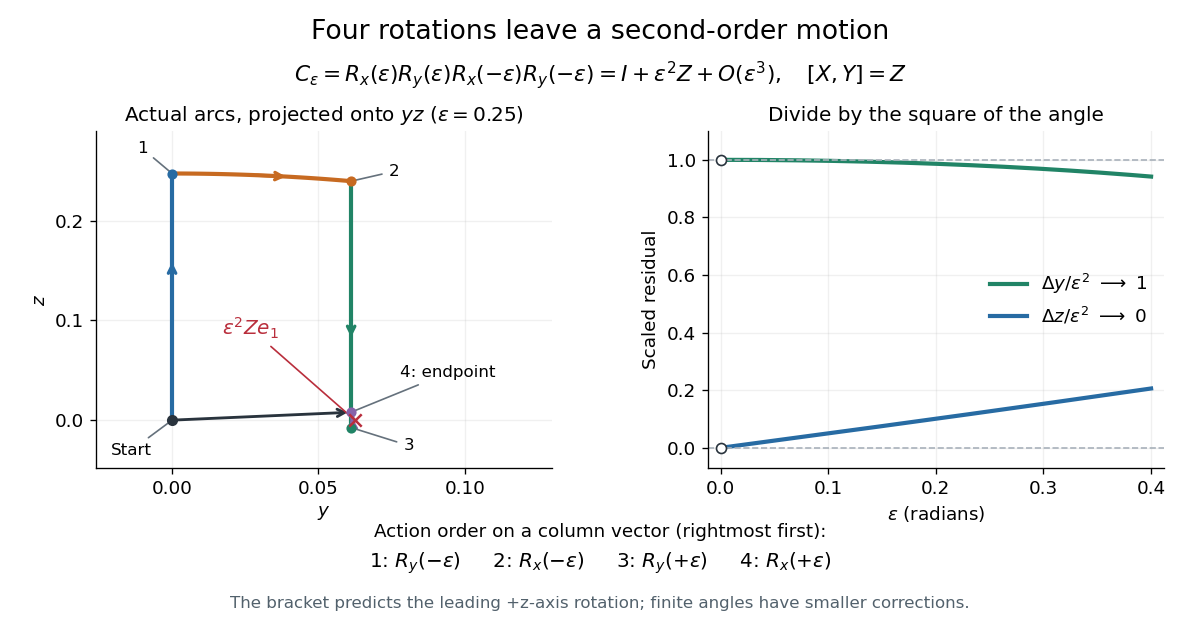

The left panel projects the actual four arcs onto the -plane for ; the start and endpoint are close but distinct. The right panel divides the residual coordinates by , making the limit visible. This is a numerical picture of in the SO(3) Lie algebra.