Room temperature corresponds to about 0.026 eV, or keV. Read the left-hand branch there and draw a horizontal line to the rising hot branch. The original graph gives a return temperature of order , with graph-reading uncertainty, not the temperature of minimum conductivity.
At full ionization m. Inserting the inferred temperature into gives a Debye-sphere occupancy of order –. This is much greater than one and supports a collective weak-coupling description more than the conductivity-minimum region does. The approximate collision-time formula and omitted Coulomb logarithm do not warrant forcing the entire plotted conductivity curve to have its exact prefactor.
After foreground and dipole removal, primordial CMB anisotropies are small hot and cold patches across the sky, with characteristic correlated angular scales and amplitudes of order of the mean temperature. They trace perturbations at photon decoupling and subsequent propagation, not simply the current distribution of Milky Way dust.
Degenerate electrons conduct heat efficiently, making most of the interior nearly isothermal while an outer nondegenerate insulating envelope sustains a large temperature gradient. Nuclei have much larger masses and much smaller thermal de Broglie wavelengths than electrons, so their quantum degeneracy is weak at these temperatures/densities, although Coulomb coupling and crystallization can matter. Under the stipulated classical ideal-carbon-ion approximation,
This excludes crystallization, latent heat and low-temperature heat-capacity changes; nondegenerate does not automatically mean weakly interacting.
The given cooling law yields K. Combine it with the ion thermal energy to obtain
For this is about years; the exact value is retained in the independent numerical check. At approximately fixed radius, , giving . The required cooling time is comparable to the cosmic age and leaves little time for progenitor evolution. Such objects would also be very faint. This explains scarcity in the toy model, rather than a universal prohibition on observing ultracool white dwarfs. The source's categorical absence claim is too strong; detailed cooling histories can differ. The ideal-ion heat capacity and luminosity law are being extrapolated into regimes where crystallization, atmosphere physics and other corrections matter, so this is not a precision cooling age.
A concrete observational counterexample to a categorical absence in this temperature regime is the observed ultracool population including LHS 1402, LHS 3250 and SDSS J1337+00, with published atmosphere fits spanning about 3240–3480 K. [ref]
The formula assumes spherical geometry, an effective uniform emission temperature, steady balance, specified bolometric emissivity, no important internal heating and appropriate redistribution or averaging. An atmosphere is not mathematically required: for any surface-temperature pattern the same global balance holds with if emissivity is uniform. Without redistribution on an ideal airless surface, local dayside equilibrium instead gives and the instantaneous night side would approach zero in the no-storage limit. Atmospheric absence alone does not justify replacing the factor four by one for a global temperature.
The Moon's mean equatorial temperature near 206 K is well below the approximately 270 K global effective radiative temperature. The surface has a large day-night range and finite thermal inertia; exceeds , so comparing those two differently averaged quantities as though they were equal is invalid. The discrepancy need not imply a missing atmospheric greenhouse effect on an airless Moon.
Jupiter emits at about 130 K rather than the solar-only estimate around 111 K. Intrinsic heat contributes additional outgoing flux, so . The difference of fourth powers is the relevant energy excess, not their direct temperature difference. Cooling and contraction of the interior provide the main physical motivation for including this extra term.
Io's volcanic structures and young resurfaced regions indicate strong ongoing geological activity, despite a low sunlight-set equilibrium temperature. Tidal dissipation forced by its orbital interactions supplies interior energy. Europa's fractured relatively lightly cratered ice indicates resurfacing and a mechanically active ice shell on geological timescales, with tidal heating a plausible contributor; surface appearance alone does not prove every fracture is currently opening. Ganymede has both older cratered regions and grooved younger terrain, indicating a more varied resurfacing history; primordial/radiogenic heat and past tides can matter. Callisto's heavily cratered surface suggests much less extensive recent resurfacing, without proving that all interior activity or subsurface liquid is absent.
The comparison is between surface ages and possible energy sources, not simply “warmer means active.” Surface irradiation is too cold to explain silicate volcanism, while internal heat, tidal work and material-dependent melting temperatures can sustain processes below a cold surface. The NASA images in the source are evidence to interpret; no exam illustration is reproduced.
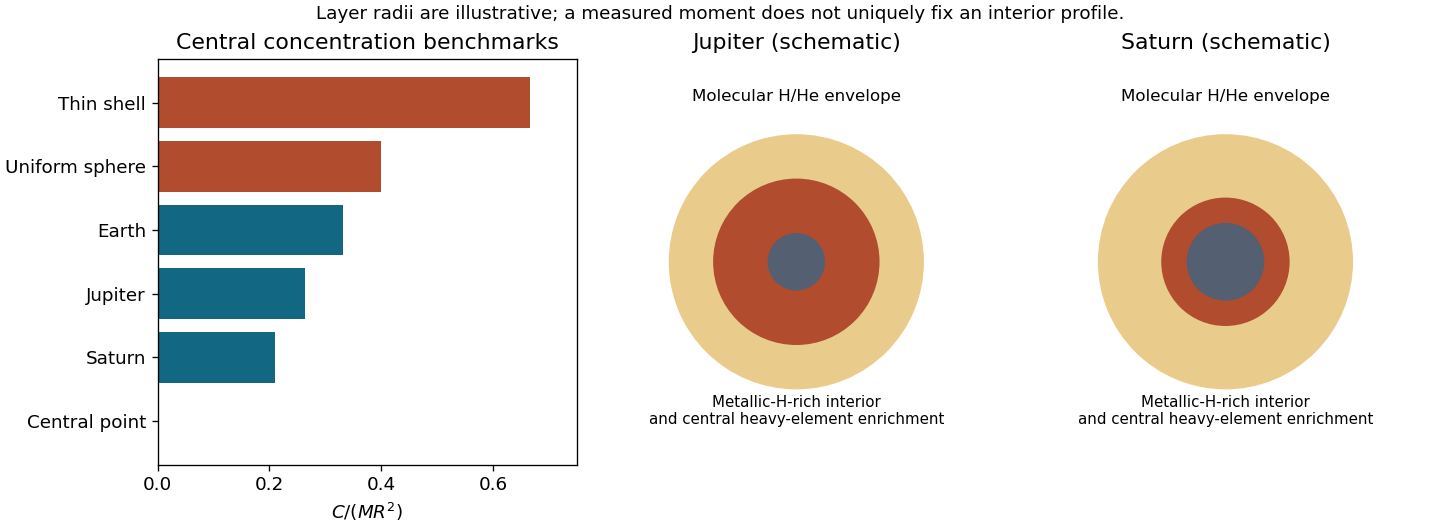
A qualitative sketch has molecular hydrogen/helium outside, increasing pressure into a conducting metallic-hydrogen-rich interior, and centrally enhanced heavy elements, possibly distributed rather than confined to a sharp solid core. Saturn's lower mass produces different pressure/temperature transitions and a larger relative role for central concentration. Both can have compositional gradients and helium separation; the moment alone does not decide whether any boundary is sharp.
Figure 1.
Moment-of-inertia benchmarks and qualitative giant-planet interior structures
. Details.
A tokamak confines a hot, approximately toroidal plasma using a strong toroidal magnetic field and a poloidal field associated with plasma current and external coils. Helical field lines and suitable magnetic surfaces reduce rapid transverse escape. D-T fusion releases 17.6 MeV, mostly in an uncharged neutron that escapes magnetic confinement and transfers energy to a surrounding blanket. A heat exchanger and thermal power cycle convert some of that energy into electricity.
Essential systems include the vacuum vessel, toroidal and poloidal magnets, current-drive/transformer and auxiliary heating equipment, fueling and exhaust systems, divertor for concentrated heat and particle removal, neutron-absorbing/breeding blanket and shielding. Alpha particles retained in the plasma contribute self-heating. Confinement and controlled exhaust are as important as reaching a high temperature; a magnetic field does not confine the neutrons or make material heat loads vanish.
Mean kinetic energy keV means keV, not 12.9 keV. For fully ionized D-T with equal electron and ion temperatures, gives m. Thus
only about one third of the stated requirement. The specified operating point therefore does not meet that criterion and requires improved confinement/pressure or continuing external heating. If the criterion's counts all thermal particles instead of ions, the product doubles but remains below its given threshold. A precise fusion gain or duty cycle cannot be inferred from the triple product alone.
In a sufficiently uniform flow the Stokes force is toward trap 2. Its work over separation lowers the second effective well by . Equal effective free energies require . Hence
at 298 K. The temperature was not specified, so the numerical result scales as . This approximation treats a weak uniform drag as a constant tilt and neglects changes in barrier shape and hydrodynamic interactions with boundaries.
Sadi Carnot's ideal engine was motivated by the practical problem of obtaining mechanical work economically from heat. Existing engines made temperature differences, boilers, condensers and the waste associated with cooling impossible to ignore. His use of a cyclic working substance and two thermal reservoirs therefore retained decisive features of real engine operation. An engine that has to be reset after each stroke cannot be assessed by considering expansion alone.
His crucial step was to strip away friction and uncontrolled heat transfer and ask for a limiting cycle that could be reversed. Combining a putatively better engine with a reversed ideal engine would produce an unacceptable result without a compensating thermal change; the comparison makes the maximum performance depend on reservoir temperatures rather than the identity of the working substance. This is a theoretical limit against which imperfect machines can be judged, not a blueprint that an actual engine can execute at finite power without losses.
There is a historically important separation between this reasoning and its modern reformulation. Carnot worked substantially within a caloric framework in which heat was treated as conserved in transfer. Modern thermodynamics instead distinguishes heat input, work output and heat rejected, with and reversible efficiency . It would be anachronistic to attribute the complete modern energy-and-entropy analysis to his 1824 text.
Practical experience thus supplied the problem, relevant constraints and examples of irreversibility, while idealization supplied a result that experience alone could not establish by testing finitely many engines. The ideal engine's importance lies precisely in exceeding any particular machine without pretending that its limiting operation is practically attainable at useful power.[ref]
William Thomson had to reconcile a successful constraint on engine performance with evidence that mechanical work could be converted into heat. Count Rumford's cannon-boring observations challenged a finite store of caloric by showing sustained production of heat through mechanical action. James Prescott Joule made the connection quantitative through controlled comparisons of mechanical or electrical input and thermal output. Neither result alone supplied the general limit on converting heat back into useful work.
Carnot's reversible-engine reasoning supplied that second ingredient, but its conservation-of-caloric interpretation could not simply coexist unchanged with the mechanical equivalent of heat. The synthesis retains energy conservation while replacing caloric conservation: in a cycle, the heat received equals work produced plus heat rejected. A second principle restricts what transformations of that conserved energy are possible. In the Thomson formulation, a cyclic device cannot have as its sole result the extraction of heat from one reservoir and its complete conversion into work. A reversible engine between two temperatures sets the upper bound; an irreversible one performs worse.
This separation explains why the first law does not imply the second. An imagined perfect converter of heat from a single reservoir could conserve total energy and still violate the required directionality. Conversely, observing heat from friction does not prove that every reverse conversion can occur without additional change. Absolute thermodynamic temperature gives the reversible comparison an operational scale independent of any particular thermometer substance.
Thomson's contribution was a developing reconciliation, not the immediate acceptance of a finished package. Experimental work, revised theoretical commitments and collaboration and disagreement with contemporaries all mattered. The resulting laws harmonized work-heat equivalence with limits on cyclic conversion while preserving the useful core, rather than every premise, of Carnot's argument.[ref][ref]
The ion density is and double ionization gives m. Therefore eV. The photon energy loss gives eV, while momentum conservation gives
Inverting the stipulated dispersion law gives
An angular frequency expressed “in eV” means , not the frequency itself. The temperature is a formal inference conditional on the dispersion model, whose validity is tested next.
The inferred parameters give m and , or without the spherical factor. Neither is much larger than one. Thus a good classical weakly coupled plasma approximation is not justified. Correlations, collisions and potentially degeneracy matter at this density; treating the preceding 18.7 eV as a reliable temperature measurement would overstate what this simple model establishes.
The measured ratio is ten, so . Taking eV gives eV or K. Substitute into Saha's equation:
Higher density favors recombination and reduces the entropy advantage of free electrons at a fixed ionized fraction, so a higher temperature is required. The ratio 8.5 means half ionization does not require to equal the ionization energy: translational phase space and the exponential tail are important.
Hydrogen's excitation energy is eV. With electronic degeneracy ratio , its relative population is . Thus the first excited manifold contributes below one percent of the ground population at the inferred temperature, explaining the leading ground-state approximation.
There is a qualification to extending this argument to infinitely many Rydberg states: the isolated-atom partition sum with degeneracy formally diverges. Plasma screening and level dissolution impose a physical cutoff. The small low-lying populations justify the simple approximation in its intended regime, not an unrestricted infinite partition sum.
A continuum peak gives a color temperature through Wien's law, provided the continuum is approximately Planckian and extinction is corrected. Broad-band colors or a fitted spectral energy distribution compare flux ratios with model atmospheres; they require a reddening estimate, abundance and gravity assumptions, and calibrated passbands. Spectroscopic line ratios or excitation/ionization balances provide another thermometer, requiring atomic data and a suitable atmosphere model, often local thermodynamic equilibrium.
For this cool giant, line blanketing and molecular absorption substantially distort a simple continuum peak, so Wien's law is the least reliable of these approximations. A detailed spectroscopic analysis, checked against a multi-band atmosphere fit, would generally be the strongest of the three if good data and model parameters are available. There is no unconditional accuracy ranking without measurement errors and model systematics; an accurately measured angular diameter plus bolometric flux would offer a more direct effective-temperature determination, if obtainable.