Topics (384k) Articles (398k) Users (410) Discussions (242) Comments (383) Files (13k) New article

Christopher A. Sullivan coauthored the 1988 study of neuronal polarity in cultured hippocampal neurons. The work combined repeated observations with molecular identification of developing dendrites. [ref]
The establishment of polarity by hippocampal neurons in culture by Carlos G. Dotti and others. 1988, byline and abstract: sequential photography and MAP2 confirmation
It supplied a way to test when an apparently similar neuronal process acquires a distinct identity, rather than inferring its history solely from mature shape.Gary A. Banker coauthored work following the emergence of neuronal polarity in cultured hippocampal neurons. Sequential observations linked initially similar processes to distinct axon and dendrite outcomes. [ref]
The establishment of polarity by hippocampal neurons in culture by Carlos G. Dotti and others. 1988, byline and abstract: developmental observations and process identification
The culture model made cellular differentiation observable in the same cells through time, separating a developmental sequence from comparisons of unrelated endpoint images.Ainhoa Etxeberria led experiments connecting visual experience to myelin geometry and neural conduction in mice. Long-term deprivation of input to one eye shortened myelinated segments along the visual pathway while increasing formation of oligodendrocytes. Electrophysiological measurements found altered optic nerve conduction.[ref]
The experiment connects cellular structure with signal timing: counting axons or identifying myelin as merely present would miss differences in sheath spacing. It also shows why experience-dependent change need not be confined to changes at synapses.
Dmitry Usoskin led a study using single-cell RNA sequencing to classify mouse sensory neurons. Analysis of 622 individual neurons distinguished eleven principal groups with different molecular and functional properties. Measuring each cell separately preserved differences that a pooled RNA sample would average together.[ref]
Unbiased classification of sensory neuron types by large-scale single-cell RNA sequencing by Dmitry Usoskin and others. Abstract; figures 1–3: transcriptomes, clustering and functional interrogation
The groups included neurons associated with mechanical sensation, body-position information, temperature, itch and damaging stimuli. Molecular clusters provide candidates for distinct cell types; their interpretation becomes stronger when combined with localization and functional experiments. The paper appeared online in 2014 and in the 2015 journal volume.
William A. Truitt coauthored an experimental identification of spinal neurons important for ejaculation in male rats. With Lique M. Coolen, he used a toxin targeted to a receptor-bearing lumbar neuron population. Removing these cells disrupted ejaculation while sparing other observed sexual behaviors.[ref]
The design goes beyond observing neurons active during a behavior: altering the population and measuring a selective behavioral loss tests its causal importance. The result supports a role in a spinal coordinating circuit, while leaving the circuit's other necessary components to be identified.

Portrait of William A. Truitt
. Identified Indiana University School of Medicine faculty portrait. Source.Lique M. Coolen investigates neural control of reproductive behavior. With William A. Truitt, she tested the role of a lumbar spinal cord neuron population in male rats. Selective destruction using SSP-saporin disrupted ejaculation while leaving other components of sexual behavior intact.[ref]
Identification of a potential ejaculation generator in the spinal cord by William A. Truitt and Lique M. Coolen. 2002, abstract: selective ablation and behavioral dissociation
The dissociation supported a specific contribution to coordinating ejaculation, rather than merely a general inability to move or mate. It did not establish that the targeted neurons act alone, or that the same manipulation has been demonstrated in humans.

Portrait of Lique M. Coolen
. Identified New Mexico Tech portrait; the page also verifies the neuroscience research connection. Source.Sandrine De Seranno investigated signalling between vascular endothelial cells and glial cells in the neuroendocrine brain. A 2004 study combined purified rat median eminence endothelial cells with cultured tanycytes, identifying nitric oxide-dependent changes in the actin cytoskeleton.[ref]
Vascular endothelial cells promote acute plasticity in ependymoglial cells of the neuroendocrine brain by Sandrine De Seranno and others. Journal of Neuroscience 24, pp. 10353–10363; primary byline and culture experiments
Electron microscopy complemented the culture manipulation: stimulating endogenous nitric oxide release changed how glial endings and GnRH-containing axons approached the vascular surface. The work connected a diffusible signal with altered cellular geometry at a neurovascular interface.[ref]
Vascular endothelial cells promote acute plasticity in ependymoglial cells of the neuroendocrine brain by Sandrine De Seranno and others. Abstract; nitric oxide signalling and ultrastructural changes
Regina Faubel investigated how cilia organize cerebrospinal fluid transport in the brain. A 2016 study of the mouse third ventricle found coordinated cilia modules generating a complex network of local flows.[ref]
Cilia-based flow network in the brain ventricles by Regina Faubel and others. Science353, pp.176–178; Abstract and primary byline
The observed flow pattern included a periodically switching component, and related complex patterns occurred in rat and pig third ventricles. These results motivated a transport question beyond total flow through a cavity: which paths carry signaling molecules to particular parts of its lining? A compartment can exchange fluid overall while still having an organized internal distribution.[ref]
Cilia-based flow network in the brain ventricles by Regina Faubel and others. Abstract; switching flow and comparisons across species
S. H. DeVries investigated how parallel pathways in the retina extract different temporal components from a shared cone cell signal. In a 2000 study, simultaneous recordings from synaptically connected cone cells and OFF retinal bipolar cells linked distinct bipolar-cell types to different AMPA receptors or kainate receptors.[ref]
Bipolar cells use kainate and AMPA receptors to filter visual information into separate channels by S. H. DeVries. Abstract; paired recordings and postsynaptic receptor differences
The glutamate signal released by one cone cell can therefore enter several postsynaptic channels with different response dynamics. The study combined paired measurements with receptor-selective pharmacology in ground-squirrel retina, making it possible to compare the input and output at an identified connection.[ref]
Bipolar cells use kainate and AMPA receptors to filter visual information into separate channels by S. H. DeVries. Original Results; cone/OFF-bipolar recordings and AMPA/kainate pharmacology
The motivating question is how the same changing light signal can support both a response to a rapid transition and a response to a more sustained change. Different receptor kinetics supply one experimentally testable part of that explanation. A common transmitter does not require identical temporal filtering in every receiving neuron; neither does a result in these cell types establish a universal receptor assignment across every species and retina.
Masayuki Matsumoto studies neural signals associated with reward, learning and decision making. His 2007 study with Okihide Hikosaka compared responses in the lateral habenula and dopaminergic neurons during a rewarded saccade task. Reward-predicting and no-reward-predicting targets produced opposing response patterns in the two populations.[ref]
Lateral habenula as a source of negative reward signals in dopamine neurons by Masayuki Matsumoto and Okihide Hikosaka. Abstract; target predictions and opposing neural responses
A conceptual example explains the reversal control. Initially, suppose a left target predicts reward and a right target predicts no reward. Swap those outcomes while leaving the screen positions unchanged. A response that follows the newly unrewarded side cannot be explained solely by a permanent preference for rightward stimuli. The study observed response reversals when rewarded and unrewarded positions changed.[ref]
Lateral habenula as a source of negative reward signals in dopamine neurons by Masayuki Matsumoto and Okihide Hikosaka. Abstract; reversal of rewarded positions, neural responses and saccade-latency bias
Okihide Hikosaka investigates how neural circuits connect sensory information, expected reward and saccades. With Masayuki Matsumoto, he studied the lateral habenula and dopaminergic neurons while monkeys performed visually guided saccades. A 2007 experiment reversed which target position predicted reward; neural responses changed along with the reward contingency.[ref]
Lateral habenula as a source of negative reward signals in dopamine neurons by Masayuki Matsumoto and Okihide Hikosaka. Abstract; rhesus-monkey saccade task and reward-location reversal
The reversal distinguishes a response to a fixed location from a response associated with its learned outcome. Habenular excitation on unrewarded trials preceded inhibition of dopaminergic neurons, and weak electrical stimulation of the lateral habenula inhibited those neurons.[ref]
Lateral habenula as a source of negative reward signals in dopamine neurons by Masayuki Matsumoto and Okihide Hikosaka. Abstract; response timing and stimulation
Recording and intervention address complementary questions: when does activity occur, and can changing the candidate circuit influence another population? The stimulation result alone does not identify every intervening synapse or establish a direct monosynaptic connection.J. R. Haag investigated whether plant RNA polymerase IV and RNA polymerase V require conserved catalytic metal-binding motifs for their gene-silencing functions. The 2009 study mutated the Metal A and Metal B motifs and tested small-RNA production, DNA methylation and silencing in vivo.[ref]
Metal A and metal B sites of nuclear RNA polymerases Pol IV and Pol V are required for siRNA-dependent DNA methylation and gene silencing by J. R. Haag and others. Abstract and author contributions: active-site mutations, functional assays and experimental roles
Loss of these functions after active-site alteration supported a catalytic role for the polymerases rather than merely a structural association with silencing machinery. The distinction mattered because direct in-vitro activity had not yet been demonstrated in that study. The primary byline identifies the researcher as Jeremy R. Haag and credits him with experimental design, experiments, analysis and writing alongside the coauthors.
Teemu Kivioja led work on counting original nucleic-acid molecules using unique molecular identifiers. A sequence label attached before amplification lets descendants of one starting molecule be recognized, so repeated reads from that molecule need not be mistaken for many independent originals.[ref]
For example, a hundred reads with one valid molecular identifier can represent one amplified starting molecule, whereas a hundred different valid identifiers can represent many originals. Identifier collisions and sequencing errors complicate that idealization. The contribution links molecular population measurement to an explicit observation model, separating amplification yield from original molecular abundance.
M. Frommer led the 1992 paper establishing a sequence-based display of 5-Methylcytosine in individual DNA strands. The method exploits the different responses of ordinary cytosine and methylated cytosine to bisulfite treatment: ordinary cytosine is preferentially converted to uracil, which is read as thymine after amplification, while methylated cytosine is relatively resistant.[ref]
This connects chemical modification to an ordinary sequence readout, making bisulfite sequencing a way to map DNA methylation. The untreated reference and conversion controls matter because an observed cytosine/thymine difference could otherwise be mistaken for a sequence variant or incomplete chemical conversion.
T. P. Hopp led the 1988 paper introducing the short peptide marker now called the FLAG tag. The engineered eight-residue sequence DYKDDDDK supplied an antibody-recognized handle for detecting and purifying recombinant proteins. Because the handle was shared, the same recognition reagent could be used with otherwise different target proteins.[ref]
A Short Polypeptide Marker Sequence Useful for Recombinant Protein Identification and Purification by T. P. Hopp and others. Abstract: eight-residue N-terminal tag, antibody detection and immunoaffinity purification
The experiment connects sequence design to a practical measurement problem: an arbitrary target need not already have its own suitable antibody. Tag accessibility and its effect on the target still matter in a new application; success for the proteins tested does not establish that every fusion is functionally unchanged.
Andrei Kuzmichev led a 2002 study identifying histone methyltransferase activity in a human protein complex containing Enhancer of Zeste. Biochemical isolation linked the complex to methylation of histone H3, with activity depending on an intact SET domain.[ref]
Histone methyltransferase activity associated with a human multiprotein complex containing the Enhancer of Zeste protein by Andrei Kuzmichev and others. Abstract: isolated complex, histone substrates and SET-domain requirement
The contribution connected a regulator of gene expression to a specific chemical activity on chromatin. Measuring a histone methylation reaction and disrupting a required domain supplied more mechanistic information than observing that two proteins occur in the same cell.
R. Timpl coauthored the 1979 isolation and characterization of laminin, a large glycoprotein associated with basement membranes. The researchers isolated it from a mouse tumour producing abundant basement-membrane material and used antibodies to investigate its distribution.[ref]
Laminin--a glycoprotein from basement membranes by R. Timpl and others. Abstract and pp. 9933–9937: isolation, biochemical characterization and immunological localization
Purification and localization answer complementary questions. Purification establishes a distinguishable molecular component; localization connects that component with a tissue structure. Finding both laminin and type IV collagen in the material helped show that a basement membrane is an organized extracellular assembly, rather than a layer made of one interchangeable protein.
Roberto Weinmann coauthored a 1974 study assigning transcription of transfer RNA and 5S ribosomal RNA genes to RNA polymerase III. With Robert G. Roeder, he compared the effects of alpha-amanitin on RNA synthesis in isolated cell nuclei and on chromatographically separated polymerase activities.[ref]
Role of DNA-Dependent RNA Polymerase III in the Transcription of the tRNA and 5S RNA Genes by Roberto Weinmann and Robert G. Roeder. Abstract: isolated-nucleus transcription and polymerase inhibitor sensitivities
Robert G. Roeder investigates transcription and its regulation. His 1974 study with Roberto Weinmann helped identify which RNA polymerase produces transfer RNA and 5S ribosomal RNA. The researchers compared sensitivity to alpha-amanitin in transcription by isolated cell nuclei with the sensitivities of separated polymerase activities.[ref]
Role of DNA-Dependent RNA Polymerase III in the Transcription of the tRNA and 5S RNA Genes by Roberto Weinmann and Robert G. Roeder. Abstract: inhibitor-response comparisons in nuclei and separated polymerases
Matching these responses supported the role of RNA polymerase III. The experiment connected production of particular RNA products to a biochemical activity, instead of assuming that every gene in a cell nucleus is transcribed by the same enzyme.
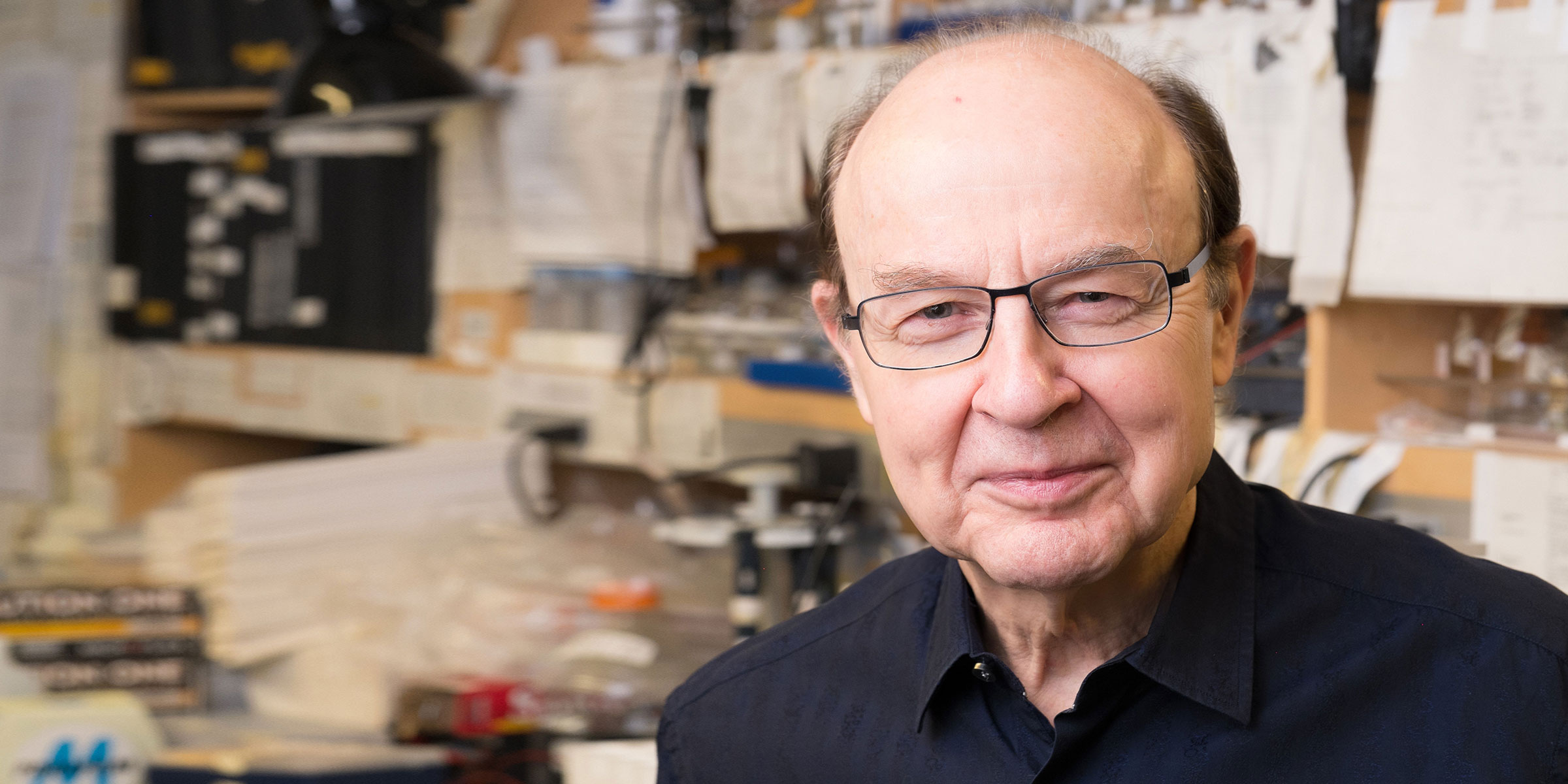
Portrait of Robert G. Roeder
. Portrait linked from the identified Rockefeller University laboratory profile. Source.Harold B. Brooks coauthored practical guidance for designing enzyme assays used to test many candidate compounds. His 2012 chapter explains how enzyme kinetics, the choice of reaction substrate and controls determine whether an assay can identify reversible enzyme inhibition. Its emphasis on initial rates connects an instrument's signal to a defined biochemical reaction rather than treating an endpoint measurement as self-explanatory.[ref]
Basics of Enzymatic Assays for HTS by Harold B. Brooks and others. Abstract, Introduction and Concept
For example, imagine an enzyme assay that starts with micromolar reaction substrate. Measuring after only micromolar has been consumed leaves its concentration approximately unchanged; measuring after micromolar has been consumed does not. The chapter recommends establishing an early linear interval with little substrate depletion, checking several enzyme concentrations and measuring background signals with appropriate missing-component controls. A later plateau can reflect exhausted reaction substrate rather than loss of enzyme activity. This is why an enzyme inhibition initial-rate assay needs a time course before it can turn a smaller signal into evidence about inhibition.[ref]
Basics of Enzymatic Assays for HTS by Harold B. Brooks and others. What is initial velocity?; Measuring initial velocity of an enzyme reaction; reaction progress curves
Pinned article: Introduction to the OurBigBook Project
Welcome to the OurBigBook Project! Our goal is to create the perfect publishing platform for STEM subjects, and get university-level students to write the best free STEM tutorials ever.
Everyone is welcome to create an account and play with the site: ourbigbook.com/go/register. We belive that students themselves can write amazing tutorials, but teachers are welcome too. You can write about anything you want, it doesn't have to be STEM or even educational. Silly test content is very welcome and you won't be penalized in any way. Just keep it legal!
Intro to OurBigBook
. Source. We have two killer features:
- topics: topics group articles by different users with the same title, e.g. here is the topic for the "Fundamental Theorem of Calculus" ourbigbook.com/go/topic/fundamental-theorem-of-calculusArticles of different users are sorted by upvote within each article page. This feature is a bit like:
- a Wikipedia where each user can have their own version of each article
- a Q&A website like Stack Overflow, where multiple people can give their views on a given topic, and the best ones are sorted by upvote. Except you don't need to wait for someone to ask first, and any topic goes, no matter how narrow or broad
This feature makes it possible for readers to find better explanations of any topic created by other writers. And it allows writers to create an explanation in a place that readers might actually find it.
Figure 1. Screenshot of the "Derivative" topic page. View it live at: ourbigbook.com/go/topic/derivativeVideo 2. OurBigBook Web topics demo. Source. - local editing: you can store all your personal knowledge base content locally in a plaintext markup format that can be edited locally and published either:This way you can be sure that even if OurBigBook.com were to go down one day (which we have no plans to do as it is quite cheap to host!), your content will still be perfectly readable as a static site.
- to OurBigBook.com to get awesome multi-user features like topics and likes
- as HTML files to a static website, which you can host yourself for free on many external providers like GitHub Pages, and remain in full control

Figure 2. You can publish local OurBigBook lightweight markup files to either OurBigBook.com or as a static website.
Figure 3. Visual Studio Code extension installation.
Figure 5. . You can also edit articles on the Web editor without installing anything locally. Video 3. Edit locally and publish demo. Source. This shows editing OurBigBook Markup and publishing it using the Visual Studio Code extension. 
- Infinitely deep tables of contents:


All our software is open source and hosted at: github.com/ourbigbook/ourbigbook
Further documentation can be found at: docs.ourbigbook.com
Feel free to reach our to us for any help or suggestions: docs.ourbigbook.com/#contact